Translate

Showing posts with label 18th Century. Show all posts

Thursday, 29 October 2026

Catch results of the Dutch Greenland commandeur A. Ravesteyn according to the Dutch newspaper Opregte Leydse courant dated 24 July 1702

An item dated Amsterdam, Netherlands 23 July reported the arrival at Hamburg, Germany on 16 July of the German Greenland whaler Neptunis commandeur Jan Voz 11 whales 400 quardelen who left the ice on the 16th June and the 23rd Greenland on 77.45 degrees. He brought with him a list with catch results of the Dutch Greenland commandeur A. Ravesteyn 7-8 whales.(1)

Note

1. Abraham Ravestyn, Greenland commandeur between 1700-1733, 1702 for Bartholomeus van Halen, Amsterdam, 15 whales 520 barrels blubber.

Alphabetische naam-lyst van alle de Groenlandsche en Straat-Davidsche Commandeurs die sedert het jaar 1700 op Groenland en sedert het jaar 1719 op de Straat Davis etc.Gerret van Sant. Published by Johannes Enschede, Amsterdam 1770, with hand written note until 1794.

People in the 17th and 18th centuries held a different geographical view than people today. This means that when we speak of “Greenland whaling”, “the term “Greenland” actually refers to Svalbard, whereas “Davis Strait” refers to whaling off the coast of present-day Greenland. The Davis Strait is a southern arm of the Arctic Ocean that lies north of the Labrador Sea.

Dutch Greenland whaler de Ryp returned home according to the Dutch newspaper Amsterdamse courant dated 7 September 1700

An item dated Amsterdam, Netherlands 6 September reporting the arrival off Texel, Netherlands of the Dutch Greenland whaler de Ryp 8 whales

People in the 17th and 18th centuries held a different geographical view than people today. This means that when we speak of “Greenland whaling”, “the term “Greenland” actually refers to Svalbard, whereas “Davis Strait” refers to whaling off the coast of present-day Greenland. The Davis Strait is a southern arm of the Arctic Ocean that lies north of the Labrador Sea.
Dutch Greenland whaler Gekroonde Zaegmolen returned home according to the Dutch newspaper Amsterdamse courant dated 7 September 1700

An item dated Amsterdam, Netherlands 6 September reporting the arrival off Texel, Netherlands of the Dutch Greenland whaler Gekroonde Zaegmolen 8 whales

People in the 17th and 18th centuries held a different geographical view than people today. This means that when we speak of “Greenland whaling”, “the term “Greenland” actually refers to Svalbard, whereas “Davis Strait” refers to whaling off the coast of present-day Greenland. The Davis Strait is a southern arm of the Arctic Ocean that lies north of the Labrador Sea.
Dutch Greenland commandeur H. Jacobsz bound for whaling grounds according to the Dutch newspaper Oprechte Haerlemsche courant dated 24 April 1749

An item dated Amsterdam, Netherlands 23 April reported the departure to Greenland of the Dutch Greenland commandeur H. Jacobsz.(1)

Note

1. Identical to Harmen Jacobsz, Greenland commandeur between 1744-1756, total catch 46 whales-1,490 barrels blubber-2,159 quardelen whale oil, in 1749 director Fredrik de Harde, Amsterdam, results 2.5-70-114. Alphabetische naam-lyst van alle de Groenlandsche en Straat-Davidsche Commandeurs die sedert het jaar 1700 op Groenland en sedert het jaar 1719 op de Straat Davis etc.Gerret van Sant. Published by Johannes Enschede, Amsterdam 1770, with hand written note until 1794.

People in the 17th and 18th centuries held a different geographical view than people today. This means that when we speak of “Greenland whaling”, “the term “Greenland” actually refers to Svalbard, whereas “Davis Strait” refers to whaling off the coast of present-day Greenland. The Davis Strait is a southern arm of the Arctic Ocean that lies north of the Labrador Sea.

Wednesday, 28 October 2026

Confusion of names: Greenland whaling = Spitsbergen/Svalbard whaling and Davis Strait whaling= Greenland whaling

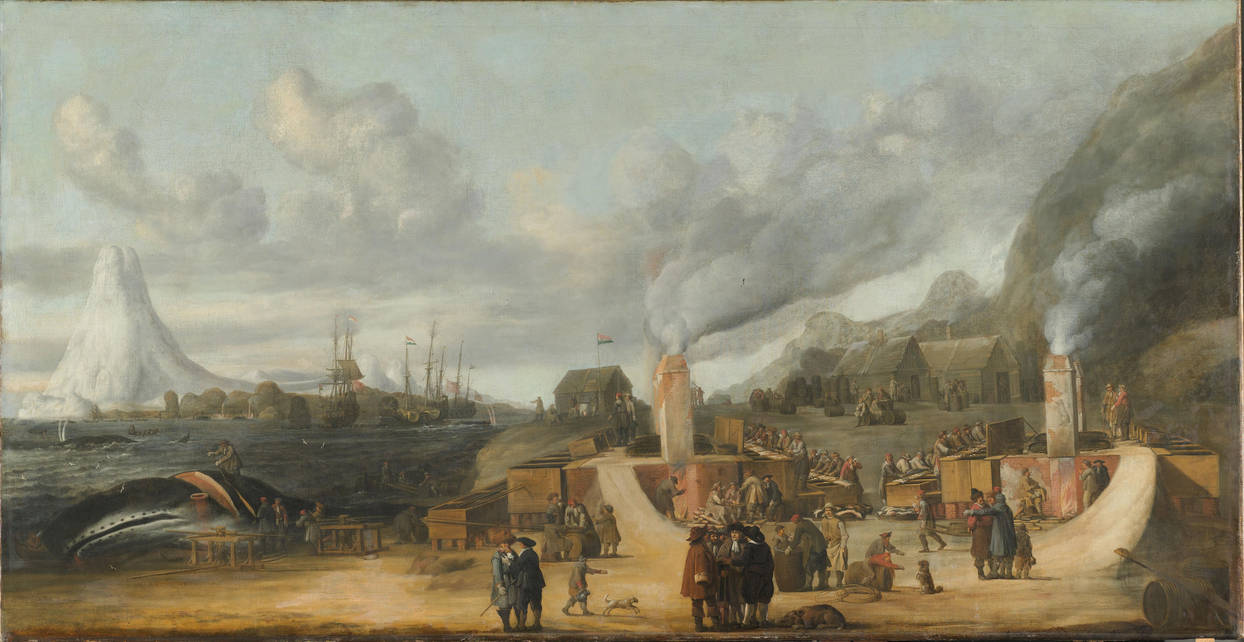
Boiling whale oil, probably Amsterdam Eiland, Spitsbergen. 

Mountain left probably Jan Mayen-eiland (Beerenberg).

Rijksmuseum Amsterdam. Cornelis de Man

People in the 17th and 18th centuries held a different geographical view than people today. This means that when we speak of “Greenland whaling”, “the term “Greenland” actually refers to Svalbard, whereas “Davis Strait” refers to whaling off the coast of present-day Greenland. The Davis Strait is a southern arm of the Arctic Ocean that lies north of the Labrador Sea. It lies between mid-western Greenland and Baffin Island in Nunavut, Canada. 

Catch results of the Dutch Greenland whaler Ojevaer according to the Dutch newspaper Amsterdamse courant dated 21 August 1700

An item dated Amsterdam, Netherlands 20 August referred to a list of commandeur Engel Isaakse reporting the catch results of the Dutch Greenland whaler Ojevaer commandeur Jacob Ommekommen 12 whales.(1)

Note

1. Jacob Jansz Ommecomme, Greenland commandeur between 1700-1716, in 1701 for Simon Goosen, Zaandam, 12 wgales, 400 barrels blubber. Alphabetische naam-lyst van alle de Groenlandsche en Straat-Davidsche Commandeurs die sedert het jaar 1700 op Groenland en sedert het jaar 1719 op de Straat Davis etc.Gerret van Sant. Published by Johannes Enschede, Amsterdam 1770, with hand written note until 1794.

People in the 17th and 18th centuries held a different geographical view than people today. This means that when we speak of “Greenland whaling”, “the term “Greenland” actually refers to Svalbard, whereas “Davis Strait” refers to whaling off the coast of present-day Greenland. The Davis Strait is a southern arm of the Arctic Ocean that lies north of the Labrador Sea.

Dutch Greenland whaler Roggeblom returned home according to the Dutch newspaper Amsterdamse courant dated 7 September 1700

An item dated Amsterdam, Netherlands 6 September reporting the arrival off Texel, Netherlands of the Dutch Greenland whaler Roggeblom catch results unknown

People in the 17th and 18th centuries held a different geographical view than people today. This means that when we speak of “Greenland whaling”, “the term “Greenland” actually refers to Svalbard, whereas “Davis Strait” refers to whaling off the coast of present-day Greenland. The Davis Strait is a southern arm of the Arctic Ocean that lies north of the Labrador Sea.

Dutch Greenland whaler Den Arent returned home according to the Dutch newspaper Amsterdamse courant dated 7 September 1700

An item dated Amsterdam, Netherlands 6 September reporting the arrival off Texel, Netherlands of the Dutch Greenland whaler Den Arent 9 whales

People in the 17th and 18th centuries held a different geographical view than people today. This means that when we speak of “Greenland whaling”, “the term “Greenland” actually refers to Svalbard, whereas “Davis Strait” refers to whaling off the coast of present-day Greenland. The Davis Strait is a southern arm of the Arctic Ocean that lies north of the Labrador Sea.

Dutch Greenland commandeur H. Jacobsz bound for whaling grounds according to the Dutch newspaper Oprechte Haerlemsche courant dated 24 April 1749

An item dated Amsterdam, Netherlands 23 April reported the departure to Greenland of the Dutch Greenland commandeur H. Jacobsz.(1)

Note

1. Identical to Harmen Hacobsz, Greenland commandeur between 1744-1756, total catch 46 whales-1,490 barrels blubber-2,159 quardelen whale oil, in 1749 director Fredrik de Harde, Amsterdam, results 2.5-70-114. Alphabetische naam-lyst van alle de Groenlandsche en Straat-Davidsche Commandeurs die sedert het jaar 1700 op Groenland en sedert het jaar 1719 op de Straat Davis etc.Gerret van Sant. Published by Johannes Enschede, Amsterdam 1770, with hand written note until 1794.

People in the 17th and 18th centuries held a different geographical view than people today. This means that when we speak of “Greenland whaling”, “the term “Greenland” actually refers to Svalbard, whereas “Davis Strait” refers to whaling off the coast of present-day Greenland. The Davis Strait is a southern arm of the Arctic Ocean that lies north of the Labrador Sea.

Dutch Greenland commandeur Cornelis Butter bound for whaling grounds according to the Dutch newspaper Oprechte Haerlemsche courant dated 24 April 1749

An item dated Amsterdam, Netherlands 23 April reported the departure to Greenland of the Dutch Greenland commandeur C. Butter.(1)

Note

1. Greenland commandeur between 1745-1760, total catch results 95 2/3 whale-2,174 barrels blubber-3,216 quardelen whale oil, director in 1749 Philippe d’ Orville, Amsterdam results 2-40-59. Alphabetische naam-lyst van alle de Groenlandsche en Straat-Davidsche Commandeurs die sedert het jaar 1700 op Groenland en sedert het jaar 1719 op de Straat Davis etc.Gerret van Sant. Published by Johannes Enschede, Amsterdam 1770, with hand written note until 1794.

People in the 17th and 18th centuries held a different geographical view than people today. This means that when we speak of “Greenland whaling”, “the term “Greenland” actually refers to Svalbard, whereas “Davis Strait” refers to whaling off the coast of present-day Greenland. The Davis Strait is a southern arm of the Arctic Ocean that lies north of the Labrador Sea.

Catch results of the Dutch Davis Strait whalers in 1764

An item reported that in 1764 40 whalers were bound for Davis Strait, namely 23 of Amsterdam, 8 of Zaandam, 2 of De Koog, 2 of Zaandijk, 2 of Krommenie, 1 of Oost Zaandam and 2 of Hamburg. Last two ships were already with five Dutch ships at sea. A second item reported that all whalers returned home with as results Amsterdam 14 1.2 whale, 747 quardelen, Zaandam 9 1/2 whale, 533 quardelen, De Koog 2 whales 92 quardelen, Oostzaan 2 1/2 whale 128 quardelen and Krommenie 2 1.2 whale 130 quardelen blubber.

People in the 17th and 18th centuries held a different geographical view than people today. This means that when we speak of “Greenland whaling”, “the term “Greenland” actually refers to Svalbard, whereas “Davis Strait” refers to whaling off the coast of present-day Greenland. The Davis Strait is a southern arm of the Arctic Ocean that lies north of the Labrador Sea. It lies between mid-western Greenland and Baffin Island in Nunavut, Canada.

Source

De Maandelyksche Nederlandsche Mercurius, January-June, Amsterdam, 1764. 

Catch results of the Dutch Greenland whalers in 1764

An item reported that in 1764 Dutch 125-126 whalers were bound for Greenland: 67-68 of Amsterdam, 1 of Dordrecht, 6 of Rotterdam, 1 of Krimpen, 4 of Alkmaar, 3 of Hoorn, 1 of Monnikendam, 2 of Wieringerwaard, 20 of Zaandam, 2 of Oost Zaandam, 4 of West Zaandam,3 of Zaandijk, 1 of Wormerveer, 2 of De Koog, 2 of Jisp, 5 of De Rijp and 1 of Middelburg. A second itemm reported that all whalers returned home except for Roelof Teunis who caught 2 whales. Totally were 192 whales caught resulting in 7,546 quardelen blubber and further more 377 quardelrn seal blubber.

People in the 17th and 18th centuries held a different geographical view than people today. This means that when we speak of “Greenland whaling”, “the term “Greenland” actually refers to Svalbard, whereas “Davis Strait” refers to whaling off the coast of present-day Greenland. The Davis Strait is a southern arm of the Arctic Ocean that lies north of the Labrador Sea. It lies between mid-western Greenland and Baffin Island in Nunavut, Canada.

Source

De Maandelyksche Nederlandsche Mercurius, January-June, Amsterdam, 1764. 

Monday, 26 October 2026

Sale of 1/32 share in the Dutch whaler de Vrouw Helena at Amsterdam, Netherlands in 1767

An item mentioned that ship brokers A. Kramp, C. van der Glas and M. Kly sold at Nieuwezyds Heeren Logement at Amsterdam, Netherlands on Monday 12 October 1767 1/32 share in Dutch fluytship de Vrouw Helena, commandeur Daniel Claasz Meyser, built in 1733, length 113 1.2 feet, 125 guilders, stroke 6 guilders, J.H. Jansz (1)

Note

1. Greenland commandeur between 1750-1759, 1765-1770 and 1774-1775, in 1767 for Robbert Macreel, Amsterdam: 2 whales-75 barrels blubber-101 quardelen whale oil. Alphabetische naam-lyst van alle de Groenlandsche en Straat-Davidsche Commandeurs die sedert het jaar 1700 op Groenland en sedert het jaar 1719 op de Straat Davis etc. Gerret van Sant. Published by Johannes Enschede, Amsterdam 1770, with hand written notes until 1794.

Source

De Maandelyksche Nederlandsche Mercurius, Volume 22, October part 1, Amsterdam, 1767. 

Saturday, 24 October 2026

Portuguese caique Corvo 1797-1798

Former privateer, mentioned between 1797-1798. 

Source

A. Marques Esparteira. Catalogo dos navios brigantinos (1640-1901). Lisboa, 1976.

Portugese cutter Uniao 1787-1790

Mentioned between 1787-1790, armament of 22 guns.

Source

A. Marques Esparteira. Catalogo dos navios brigantinos (1640-1901). Lisboa, 1976.

Thursday, 22 October 2026

Sale of 1/32 share in the Dutch whaler de Vrouw Helena at Amsterdam, Netherlands in 1767

An item mentioned that ship brokers A. Kramp, C. van der Glas and M. Kly sold at Nieuwezyds Heeren Logement at Amsterdam, Netherlands on Monday 12 October 1767 1/32 share in Dutch fluytship de Vrouw Helena, commandeur Daniel Claasz Meyser, built in 1733, length 113 1.2 feet, 125 guilders, J. Boelema.(1)

Note

1. Greenland commandeur between 1750-1759, 1765-1770 and 1774-1775, in 1767 for Robbert Macreel, Amsterdam: 2 whales-75 barrels blubber-101 quardelen whale oil. Alphabetische naam-lyst van alle de Groenlandsche en Straat-Davidsche Commandeurs die sedert het jaar 1700 op Groenland en sedert het jaar 1719 op de Straat Davis etc. Gerret van Sant. Published by Johannes Enschede, Amsterdam 1770, with hand written notes until 1794.

Source

De Maandelyksche Nederlandsche Mercurius, Volume 22, October part 1, Amsterdam, 1767.

People in the 17th and 18th centuries held a different geographical view than people today. This means that when we speak of “Greenland whaling”, “the term “Greenland” actually refers to Svalbard, whereas “Davis Strait” refers to whaling off the coast of present-day Greenland. The Davis Strait is a southern arm of the Arctic Ocean that lies north of the Labrador Sea. It lies between mid-western Greenland and Baffin Island in Nunavut, Canada.

Sale of 1/32 part in the Dutch whaler de Vrouw Cornelia at Amsterdam, Netherlands in 1767

An item mentioned that ship brokers A. Kramp, C. van der Glas and M. Kly sold at Nieuwezyds Heeren Logement at Amsterdam, Netherlands on Monday 12 October 1767 1/32 part in Dutch fluytship de Vrouw Cornelia and whaling tools of commandeur Barent Pietersz, built in 1755, length 112 feeet, 350 guilders, H. van der Meulen(1)

Note

1. Greenland commandeur between 1756-1771, in 1767 for Leendert van der Meulen 1.5 whale-60 barrels blubber-96 quardelen whale oil. Alphabetische naam-lyst van alle de Groenlandsche en Straat-Davidsche Commandeurs die sedert het jaar 1700 op Groenland en sedert het jaar 1719 op de Straat Davis etc. Gerret van Sant. Published by Johannes Enschede, Amsterdam 1770, with hand written notes until 1794.

Source

De Maandelyksche Nederlandsche Mercurius, Volume 22, October part 1, Amsterdam, 1767.

People in the 17th and 18th centuries held a different geographical view than people today. This means that when we speak of “Greenland whaling”, “the term “Greenland” actually refers to Svalbard, whereas “Davis Strait” refers to whaling off the coast of present-day Greenland. The Davis Strait is a southern arm of the Arctic Ocean that lies north of the Labrador Sea. It lies between mid-western Greenland and Baffin Island in Nunavut, Canada.

Portuguese cutter Coroa 1786-1791

Required in 1786, last mentioned in 1791, armament of 20 guns.

Source

A. Marques Esparteira. Catalogo dos navios brigantinos (1640-1901). Lisboa, 1976.

Portuguese chaloupe Nossa Senhora do Monte do Carmo 1787-1794

Mentioned between 1787-1794, armament of 11-12 guns.

Source

A. Marques Esparteira. Catalogo dos navios brigantinos (1640-1901). Lisboa, 1976.

Wednesday, 21 October 2026

American whaler Waverly visited Honolulu, Hawaii according to the newspaper The Polynesian dated 13 November 1852

An item reported the arrival at Honolulu, Hawaii on 10 November of the American whaler Waverly master Kempton 25 barrels sperm oil 1,200 barrels whale oil 15,000 lbs bone