Translate

Showing posts with label Aland Islands. Show all posts

Tuesday, 19 May 2026

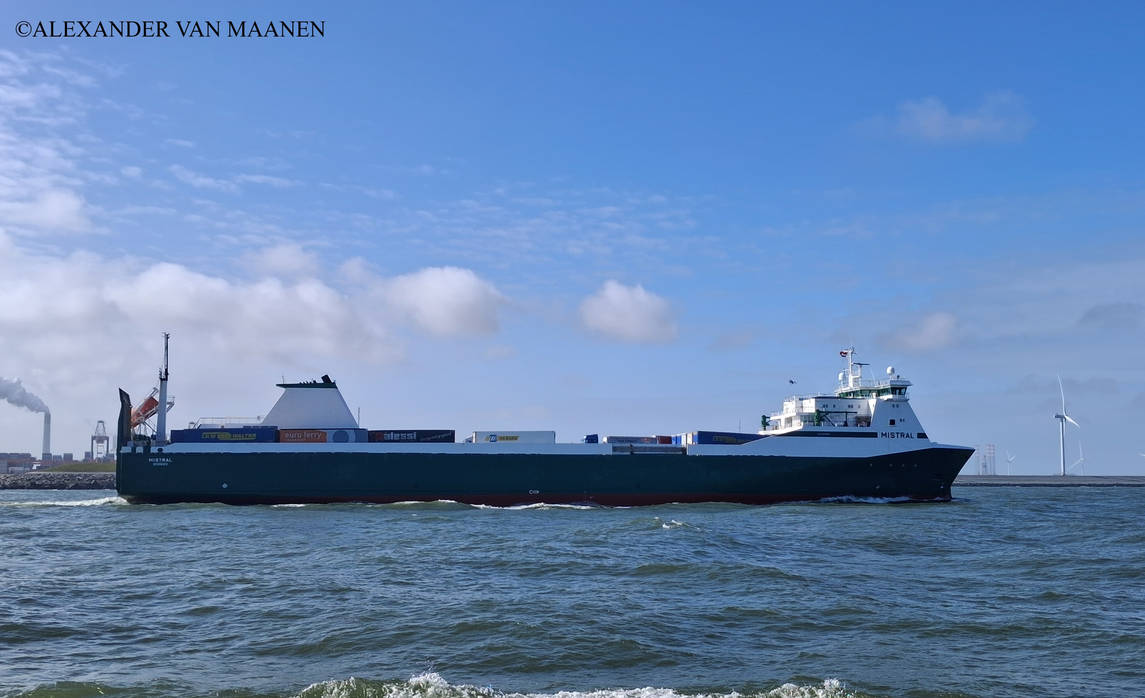
Finnish ro-ro cargo ship Mistral 1999-

Entrance Nieuwe Waterweg, Netherlands 31 March 2026

Finland-flagged, homeport Braendoe, IMO 9183788, MMSI 230925000 and call sign OJIX. Owner Trailer Link AB, manager Godby Shipping AB, both Mariehamn, Aland Islands, Finland. Built by JJ Sietas Schiffswerft, Hamburg, Germany in 1999. 

Saturday, 15 November 2025

Finnish and Russian navies battling for control the Gulf of Bothnia and Aaland Archipelago in December 1939

An item reported that the Finnish naval forces seemed to gather at the south west of the Aaland Islands to control the mined entrance to the Gulf of Bothnia. The entrance to the eastward of the Aaland Archipelago was full of skerries making it impossible to navigate excluded the local coastal vessels. Russian minelayers seemed to lay mines in the waters west of the Aaland Islands and four Russian submarines were sighted north of the Islands past the recently laid mines.(1)

Note

1.  Winter War between Finland and the Soviet Union between 30 November 1939-13 March 1940.

Source

The National Archives, Kew Gardens, England CAB-66-4-13 Weekly Résumé (No. 15) of the naval, military and air situation from 0700 7 December to 0700 14 December 1939. 

Thursday, 16 October 2025

Lot of work done in Finnish harbours in the Gulf of Bothnia in August 1945

An item reported the considerable work done in the Finnish harbours east of the Aland Islands in the Gulf of Bothnia.  

Source

The National Archives, Kew Gardens, England CAB-129-1-20. Weekly Résumé (No. 311) of the naval, military and air situation from 0700 9th August to 0700 16th August 1945. 

Thursday, 26 May 2022

Nordic sails - History & development of working sail in North & Northwest-Europe


The intention behind creation of this book was to present the reader with a broad outline of the history and development of working sail in Northern and North-western Europe. The vessels depicted represent hundreds of years of evolution in merchant and fishing ship design and construction. Although many tend to believe that the "age of sail" is long gone and destined never to return, it has in fact never faded completely away, merely decreased in presence and, remarkably enough, some of the technologies and inventions of the past are now revealing their potential to become more important in the future.


Throughout human history, ship propulsion has become more and more advanced. In the earliest days it was provided mostly by paddles/oars, followed by sails. Only after the Industrial Revolution did things start to change more and ship propulsion became increasingly diverse over the years that followed, first with the introduction of steam engines, followed by steam turbines, gasoline and diesel engines, electrical motors, nuclear power and even hydrogen-fueled systems, but the development of wind-based methods never stopped. Sailing merchant ships are making a quite unexpected comeback, and their numbers are increasing. These days the family of commercially active sailing ships is becoming more diverse once again, as the vessels carrying 'classic' canvas sails are being joined by ones carrying the so-called mechanical sails, such as rotor sails, dyna sails, wing sails, wind turbines and various other wind powered mechanisms.


The 1973 oil crisis gave birth to many initiatives towards sailing cargo ship revival, but few of them actually came to fruition. Some examples from this "forgotten decade" of ship design are included here, to an extent permitted by the size constraints of this publication and an unfortunate limitation stemming from a limited source base for these often extremely imaginative projects. Yet, many engineers dared to take the challenge of pushing the bounds of sail technology to wholly new levels and they will all be honoured in this publication as a result

The focus is on ships built (or intended to be built) in countries located in Northern & North-western Europe, as well as those vessels built elsewhere but for clients from the aforementioned areas. As mentioned, obvious practical considerations allowed us to present only a limited selection from an immense multitude of ships that potentially could be included, and some tough choices had to be made in order to find a proper balance between the various categories of vessels while keeping this publishing project manageable. The categories of all kinds of sailing merchant and fishing ships were eligible to be included in this book, on the condition that they were originally built for these purposes, even if not necessarily "sailing" ships from the start, merely converted from motor vessels at some point in their service lives:

Each ship has been presented in a number of detailed technical drawings depicting them during key moments of their history, and supported by detailed write-ups of the ship's service record, technical specifications and sail plans. Starting with their original appearance, followed by the modifications made, changes of ownership, changes in purpose and in some cases their change back to a nearly original state.

Countries that will be represented: Åland, Belgium, Denmark, Estonia, Faroe Islands, France , Germany, Ireland, Iceland, Latvia, Lithuania, Netherlands, Norway, Poland, Russia/Soviet Union, Sweden, United Kingdom.

Tuesday, 21 December 2021

Finland temporarily stopped minesweeping in the Baltic according to the Secret Admiralty Weekly Intelligence Summary Nr. 31 for the week ending 6 August 1921

An item referred to the Finnish press reporting that the Finnish minesweeping operations in the Baltic starting in May 1921 were stopped for the time being. Waters in the Aland Islands area were still to be swept what was later in 1921 to be executed.

Source

The National Archives CAB-24-127-7. No.31. Weekly appreciation of matters of naval interest for the week ended 6 August 1921

Monday, 8 November 2021

Nordic sails - History & development of working sail in North & Northwest-Europe

The intention behind creation of this book was to present the reader with a broad outline of the history and development of working sail in Northern and North-western Europe. The vessels depicted represent hundreds of years of evolution in merchant and fishing ship design and construction. Although many tend to believe that the "age of sail" is long gone and destined never to return, it has in fact never faded completely away, merely decreased in presence and, remarkably enough, some of the technologies and inventions of the past are now revealing their potential to become more important in the future.


Throughout human history, ship propulsion has become more and more advanced. In the earliest days it was provided mostly by paddles/oars, followed by sails. Only after the Industrial Revolution did things start to change more and ship propulsion became increasingly diverse over the years that followed, first with the introduction of steam engines, followed by steam turbines, gasoline and diesel engines, electrical motors, nuclear power and even hydrogen-fueled systems, but the development of wind-based methods never stopped. Sailing merchant ships are making a quite unexpected comeback, and their numbers are increasing. These days the family of commercially active sailing ships is becoming more diverse once again, as the vessels carrying 'classic' canvas sails are being joined by ones carrying the so-called mechanical sails, such as rotor sails, dyna sails, wing sails, wind turbines and various other wind powered mechanisms.

The 1973 oil crisis gave birth to many initiatives towards sailing cargo ship revival, but few of them actually came to fruition. Some examples from this "forgotten decade" of ship design are included here, to an extent permitted by the size constraints of this publication and an unfortunate limitation stemming from a limited source base for these often extremely imaginative projects. Yet, many engineers dared to take the challenge of pushing the bounds of sail technology to wholly new levels and they will all be honoured in this publication as a result

The focus is on ships built (or intended to be built) in countries located in Northern & North-western Europe, as well as those vessels built elsewhere but for clients from the aforementioned areas. As mentioned, obvious practical considerations allowed us to present only a limited selection from an immense multitude of ships that potentially could be included, and some tough choices had to be made in order to find a proper balance between the various categories of vessels while keeping this publishing project manageable. The categories of all kinds of sailing merchant and fishing ships were eligible to be included in this book, on the condition that they were originally built for these purposes, even if not necessarily "sailing" ships from the start, merely converted from motor vessels at some point in their service lives:

Each ship has been presented in a number of detailed technical drawings depicting them during key moments of their history, and supported by detailed write-ups of the ship's service record, technical specifications and sail plans. Starting with their original appearance, followed by the modifications made, changes of ownership, changes in purpose and in some cases their change back to a nearly original state.

Countries that will be represented: Åland, Belgium, Denmark, Estonia, Faroe Islands, France , Germany, Ireland, Iceland, Latvia, Lithuania, Netherlands, Norway, Poland, Russia/Soviet Union, Sweden, United Kingdom.

Sunday, 3 October 2021

Finnish steamship Charterhague arrived at Zaandam, Netherlands according to the Dutch newspaper Zaans volksblad dated 12 August 1939

An item reported the arrival at Zaandam, Netherlands on 10 August of the steamship Charterhague from Borga [Porvoo, Finland?] with a cargo of sawn wood.(1)

Note

1. Call sign OHDI.. Ex-Silverway and WarFig. Gross tonnage 2.522 ton, under deck 2.248 ton, net tonnage 1.348 ton, dimensions 312.9 x 43.0 x 20.7 feet, buil in November 1920 by Monmouth Shipbuilding Co. Ltd, Chepstow, England, in 1939 owned by Angfartyg Akitebolaget “Alfa”, manager A. Karlsson, homeport Mariehamn, Åland (Islands), Finland-flagged.

Wednesday, 29 September 2021

Finnish steam timber carrier Ferrum arrived at Zaandam, Netherlands according to the Dutch newspaper Zaans Volksblad dated Tuesday 10 May 1938

An item reported the expected arrival at Zaandam, Netherlands next Wednesday of the Finnish steam timber carrier Ferrum loaded with about 1.100 standaards sawn timber. She was the second timber carrier that season. The edition dated 14 May reported her arrival on the 12th and that she came from Koivista.(1)

Note

1. Ex-Stadt Zaltbommel renamed 1936, call sign OHYO, gross tonnage 2.089 ton, net tonnage 1.174 ton, dimensions 293.7 x 41.3 x 19.1 feet, built by J. Meyer’s Scheepsbouwmaatschappij, Zaltbommel, Netherlands in 1939 owned by Lemlands Rederi A/B, manager Anders Öström, homeport Mariehamn, Åland (Islands), Finland-flagged.

Monday, 14 October 2019

Finnish ro-ro cargo ship (ex-Ahlers Baltica 1990-1995, Ahlers Baltic 1995, Transbaltica 1995-2003) Baltica 2003-

Schelde off Vlissingen, Netherlands 22 July 2015

Malta-flagged, homeport Valletta, IMO 8813154, MMSI 215013000 and call sign 9HA2607. Ex-Ahlers Baltica 1990-January 1995, Ahlers Baltic January-February 1995 and Transbaltica February 1995-December 2003. Built by Hyundai Heavy Industries, Ulsan, South Korea in 1990. Owned by Lillbacka Powerco, Harma, Finland and managed by ASP Shipmanagement Scandinavia, Mariehamn, Aland Islands.

Wednesday, 7 August 2019

Aland Islands crude oil tanker Thornbury 2011-

Schelde off Vlissingen, Netherlands 29 March 2014

Bahamas-flagged, homeport Nassau, IMO 9226970, MMSI 311168000 and call sign C6RS7. Gross tonnage 56.115 tons, net tonnage 31.451 tons, summer deadweight 98.893 tons and as dimensions 248 (overall) x 43 x 14,3 metres. Cargo capacity at 98% 112.100 cubic metres. Built in 2011 by Daewoo Shipbuilding&Marine Engineering, Goeje, South Korea. Owned and managed by Lundqvist Rederierna, Mariehamn, Aland Islands

Saturday, 1 June 2019

Alands Islands owned crude oil tanker Hildegaard 1999-


Schelde off Vlissingen, Netherlands 9 February 2014

Bahamas-flagged, homeport Nassau, IMO 9194139, MMSI 308574000 and callsign C6QU3. Gross tonnage 56.115 tons, net tonnage 28.647 tons, summer deadweight 99.123 tons and as dimensions 248,00 (over all) x 43 x 13,5 metres. Built in 1999 by Daewoo Shipbuilding&Marine Engineering, Geoje, South Korea. Owned and managed by Lundqvist rederierna, Mariehamn, Aland Islands.

Wednesday, 11 April 2018

American 4-mast barque (ex-Kurt 1903-1917, Moshulu 1917-1952, Oplag 1952-1953) Moshulu 1953-

At Philadelphia, USA
With our thanks for allowing us to publish

Laid down by Alex. Wm. Hamilton&Co., Port Glasgow, Scotland for account of G.H.J. Siemens&Co., Hamburg, Germany on 1903, launched on 18 April 1904, completed in June 1904, maiden voyage via Santa Rosalia, California, USA towards Valparaiso, Chile in June 1904, used for shipping coal, nitrate and coke between England, Australia, Chile, Germany and Mexico, seized by the USA in 1917, renamed Moshulu with as homeport San Francisco, USA and used by the US Shipping Board on the timber and chrome shipping line USA-Philippines-Australia, owned by the Moshule Navigation Company (Charles Nelson&Co.,) 1920-1922, James Tyson 1922-1928 in the timber trade USA-Australia-South Africa, laid up in 1928, sold towards Gustaf Erikson, Finland on 1935, now cargo ship with as homeport Mariehamn, Aland Islands on the Australia-Europe grain line, seized by Germany in 1940 returning from Buenos Aires, Argentina, capsized and loosing her masts in 1947, floating grain storage since 1948 first by Trygve Sommerfedlt, Oslo, Norway, than at Sweden berthed at Stockholm 1948-1952, sold Heinz Schliewen, Germany and renamed Oplag as cargo annex training ship, sold to the Swedish Farmers State Union and since 16 November 1953 floating warehouse, sold to the Finnish government and became grain warehouse at Naantali, sold to the USA in 1970, rerigged in the Netherlands and since 1975 restaurant annex museum ship.

With a displacement of 7.000 tons, holds capacity 5.300 tons and as dimensions 102,2 (between perpendiculars)-102, (waterline)-121 (over all) x 14,3 x 7,4full loaded)) x 8,5 (moulded depth) x 8,11 (depth of hold) x 65 (height keel-masthead truck) metres or 335.3-359-396 x 46.9 x 24.3 x 28 x 26.6 x 212 feet. Fitted out with a donkey engine for the sail winches and steam rudder. Sail area 4.180 square metres. Crew numbered 35 men. 

Monday, 4 December 2017

German minelayer SMS Albatross launched according to the Dutch magazine Marineblad dated 1907-1908 No. 8

Swedish Marinmuseum Original

An item reported that the Albatrosz, the second modern minelayer of the German Imperial Navy was launched on 23 October 1907 by Aktien Gesellschaft Weser [Bremen, Germany. She was a sister ships of the in August 1906 by the same shipyard launched Nautilus.(2) Building costs 3.340.000 Mark.(1)

Notes
1. Part of the Nautilus-class consisting of the Nautilus and Albatross, preceded by the SMS Pelikan and succeeded by the Brummer-class. Laid down o 24 May 1907, launched on 23 October 1907, commissioned on 19 May 1908, stricken on 21 March 1921 and sold to be broken up.
2. Laid down on 19 December 1905, launched on 28 August 1906, commissioned on 19 March 1907, stricken on 21 March 1919 and sold to be broken up at Copenhagen, Denmark in 1928. 

Thursday, 6 July 2017

Russian bark Ruby sunk by submarine according to the Dutch newspaper De Telegraaf dated 29 January 1917

An item dated Cape Town, South Africa 28th reported the arrival of captain Jansen with the 10 crewmembers of the Russian bark Ruby [949 tons, owned by Lindström&Co.(1), Mariehamn, nowadays Aland] where they were interviewed. The Ruby was by a [German] submarine of the newest type sunk on 4th January on a distance of 90 miles from England. The submarine warned first with a gunshot and her master ordered the crew to abandon the ship and go into the open boats despite the very rough seas. The boat was not even two ship’s length the submarine sunk the bark with 15 shots. The submarine left the scene without offering any support but the crew managed to hoist a sail and got away. Four hours were the ice-cold and soaking wet men picked up by Japanese steamboat.

Note
1. Gustav Arvid Lindström, 2 May 1863 Sund, Finland, 5 January 1949 West Hartlepool, England). Ship owner 1913-1917. 

Sunday, 12 March 2017

Aland Islands of strategically importance for Finland according to the Dutch magazine Marineblad dated 1938 no. 5

An item referred to the Proceedings dated June 1938 reported that the Aland Isles were again a political issue. After the Crimean war was at the treaty of Paris, France in 1856 decided that the islands were neutral. In the First World War however Russia fortified the islands and which fortress were destroyed after 1921. In 1918 became the islands part of Finland despite the fact that the major part of the population choose for Sweden. After the 1921 convention the island were declared neutral again. Since then was Finland building a new naval base at Abö with as result hat the islands became of strategically importance for Finland, It was common known that in the past years military agents of several countries visited the islands. (1)

Note
1. Although the archipelago at the entrance to the Gulf of Bothnia is still part of Finland it is autonomous and demilitarised and still a Swedish speaking region. 

Thursday, 27 October 2016

Finnish ro-ro cargo ship Miranda 1999-

Schelde off Vlissingen, Netherlands 26 September 2016

Finland-flagged, homeport Finstrom, IMO 9183790, MMSI 230926000 and call sign OJIY. Built by JJ Sietas Schiffswerft, Hamburg, Germany in 1999. Owned by Trailer Link, Godby, Finland and managed by Godby Shipping, Mariehamn, Aland Islands.

Sunday, 2 October 2016

German mine cruiser SMS (ex-“mine steamer B”) Albatross 1907-1921


Minelayer cruiser of the Nautilus-class Consisting of the Nautilus and the Albatross. As the ‘mine steamer B” laid down at AG Weser, Bremen, Germany on 24 May 1907, launched on 23 October 1907, commissioned on 19 May 1908, sea trials 19 May-25 July 1908, deliberately stranded on the island of Gotland, Sweden, heavily damaged after a fight with Russian cruisers after lying a minefield of the Aland Islands on  2 July 1915, salvaged and interned the same month by the Swedish, returned to Germany in January 1919, stricken on 21 March 1921, sold for a sum of 900.000 Mark and broken up at Hamburg, Germany.

Displacement 2.506 tons and as dimensions 100,9 (over all) x 11,5 x 4,4 metres or 331.0 x 37.9 x 14.5  feet. The machinery consisted of 2x3 cylinder triple expansion steam engines and 4 water tube boilers supplying 6.600 hp allowing a speed of 20 knots. With a speed of 9 knots was the range 3.530 nautical miles. Crew numbered 208 men (included 11 officers). The armament consisted of 8x1-8,8cm/3.5” L/45 quick firing guns and 288 mines.

Friday, 1 July 2016

Aland Islands crude oil tanker Thornbury 2001-

Schelde off Vlissingen, Netherlands 21 June 2016

Bahamas-flagged, homeport Nassau, IMO 9226970, MMSI 311168000 and call sign C^RS7. Built by Daewoo Shipbuilding&Marine Engineering, Geoje, South Korea in 2001. Owned and managed by Lundqvist Rederierna, Mariehamn, Aland Islands.

Friday, 24 June 2016

German forces captured Russian warships at Abo, Finland according to the Dutch newspaper Het nieuws van den dag dated 18 March 1918

An item dated Petrograd, Russia 14th reported that German forces coming from the Aland Islands captured Abo [=Turku], Finland after bombarding the town during 30 minutes. Three Russian torpedo boats and a large number of minesweepers were captured by the German forces.

Saturday, 13 June 2015

Finnish ro-ro cargo ship (ex-Ahlers Baltica 1990-1995, Ahlers Baltic 1995, Transbaltica 1995-2003) Baltica 2003-

Schelde off Vlissingen, Netherlands 9 June 2015

Malta-flagged, homeport valletta, IMO 8813154, MMSI 215013000 and callsign 9HA2607. Ex-Ahlers Baltica renamed January 1995, ex-Ahlers Baltic renamed February 1995 and Transbaltica renamed December 2003. Built by Hyundai Heavy Industries, Ulsan, South Korea in 1990. Owned by Lillbacka Powerco, Harma, Finland and managed by ASP Shipmanagement Scandinavia, Mariehamn, Aland Islands.