Translate

Showing posts with label German East Africa. Show all posts

Tuesday, 4 November 2025

German steamship Graf Götzen 1913-1916 and British/Tanzanian Liemba 1924-

Maritiem Museum Hamburg, Germany

Built by Meyer-Werft, Papenburg, Germany in 1913, disassembled in 5,000 crates, transported with ship and train to the Lake Tanganyika in the German colony Deutsch-Ostafrika. Three shipbuilders travelled along and supervised her again assembled. Launched on 5 February 1915 and served as gunboat, troop transport and passenger-cargo ship, commissioned on 9 June 1915, scuttled in the Katabe Bay on 26 July 1916, salvaged by Belgians in 1918, again salvaged by British Royal Navy in 1924, recommissioned as the mv Liemba in service of the British Tanganyika Territory on 16 May 1927 and taken over by Tanzania. Still existing, renovation at the Croatian Brodosplit shipyard started in 2024. Technical characteristics according to Museum: tonnage 1,200 tons and as dimensions 76 x 10 x 2,2 metres. Speed 8 knots. Crew numbered around 60 men. Armament consisted of 3-3,7cm guns, 2-8,8cm guns and 1-10,5cm gun. Wikipedia supplies other characteristics.

Note

1. Nowadays Burundi, Rwanda and parts of Tanzania and Mozambique.

Tuesday, 8 October 2024

German survey vessel SMS Möwe 1906-1914 (1922)

model by Günther Seherr Maritime Museum Hamburg, Germany

Part of Planet-class. Launched by Imperial Shipyard, Wilhelmshaven in 1906 for service in the German colonies. In 1911 she begun first with her tasking going in the end of 1912 towards German East Africa, the outbreak of the First World War in 1914prevented her going to the Indian Ocean. She was then stationed at Dar es Salaam [Tanziana], by her own crew disarmed and scuttled with the use of explosives on 20 September 1914 with the wreck salvaged and broken up in 1922. As the division Möwe was her crew added to the German colonial troops. Crew numbered 102-104 men, armament consisted of 3-3.7cm Hotchkiss Canon revolvers. Speed 9.5 knots. Displacement 650 tons and as dimensions 49 x 9.8 x 2.8 metres.

Tuesday, 12 April 2022

French protected cruiser Infernet visited the Dutch East Indies in February 1904


French protected cruiser Infernet


Dutch protected cruiser Hr.Ms. Friesland

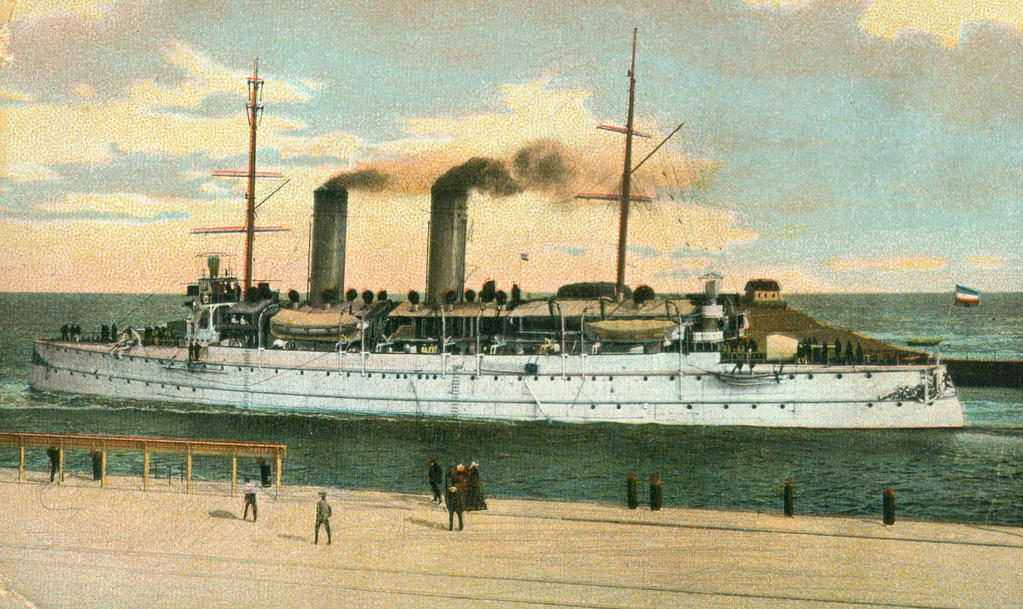
The Jaarboek van de Koninklijke Nederlandsche Zeemacht 1903-1904 reported that the French cruiser Infernet visited Sabang, Dutch East Indies between 1-4 February 1904. The Bataviaasch nieuwsblad dated Tuesday 2 February referred to the Straits papers reporting her arrival at Colombo, Ceylon and on Thursday departed bound for Sabang. The edition dated 8 February 1904 reported her arrival on 1 February 1904 for loading fresh water, victuals and coal. Gun salutes were exchanged with the Dutch protected cruiser Zr.Ms. Friesland.

Notes

1. Of the Destrées-class protected cruisers, laid down by Forget et Chantiers de la Gironde, France in December 1896, launched on 7 September 1899, completed in 1900 and wrecked in 1910. Displacement 2.467 tons, armament 2x1-13,8cm/5.4” guns, 4x1-10cm/3.9” guns, 8-4,7cm/1.9” guns and 2-3,7cm/1.5” guns and Speed 20-20,5 knots.The newspaper Het nieuws van den dag voor Nederlandsch-Indië dated 22 April 1902 reported that sailors of her helped the Germans at Dar-es-Salaam, German East Africa extinguishing a forest fire which became a threat for the local gun powder magazine.  The edition dated 30 November 1910 reported that she for 196.144 francs was sold to a shipyard at Stettin, Germany.

2. Of the Holland-class protected cruiser, laid down by Nederlandsche Stoomboot Maatschappij, Rotterdam, Netherlands in 1895, launched on 4 November 1896, commissioned on 16 January 1898, decommissioned on 1 February 1911 to undergo important heavy repairs but not executed and sold to be broken up for ƒ 152.055,- on 28 May 1913. Displacement 3.900 tons, armament 2x1-15cm/5.9” guns, 6x1-12cm/4.7” guns, 4x1-7,5cm/3” guns, 4x1-1pd guns and 2-45cm/18” torpedo tubes, and speed 20 knots.

Wednesday, 3 February 2021

German government mail steamship (ex-Mark 1893-1902) Markgraf 1902-1915

 
Roads of Vlissingen, Netherlands

The German government mail steamship Markgraf captain Gauhe arrived on 6 March 1905 at Vlissingen, Netherlands and departed after disembarking of around 50 passengers via Bremerhaven, Germany towards Hamburg, Germany. On Sunday1 October of the same year she left Lisbon, Portugal for Vlissingen and collided with the Portuguese steam yacht Olivia of which 4 of the 5 people on board drowned. The Markgraf was coming from South Africa. Launched by Armstrong Mitchell, Newcastle-upon-time with yard number 610 as the Mark for the Norddeutschen Lloyd on 28 September 1893, bought by the Deutschen Ost-Afrika Linie in 1902, in 1908 used to transport pelgrims between India and Arabia, served on the shipping line Durban-Bombay in 1908, seek refugee in 1914 towards Tanga, Tanzania (German East Africa) and sunk there by the British HMS cruisers Hyacint hand gunboats Mersey and Severn on 19 August 1915.

Wednesday, 15 January 2020

The German steamship Valdivia visited the Dutch East Indies according to the Dutch newspaper De Locomotief dated Monday 6 February 1899

An item referred to the Sum. Courant dated 30th January reporting the departure in the morning of the German steamship Valdivia from Emmahaven towards the Mentawai Islands, Dutch East Indies and from there via Ceylon, Zanzibar [Tanzania] and German East Africa towards Hamburg, Germany where se was expected to arrive in May. On board was a collection of animals from the Indian Ocean and the Antarctic area.(1)

Note
1. The German Deep-Sea expedition with the steamship Valdivia organized and financed by the German Empire in 1898-1899 to explore the depths of the oceans below a depth of 500 fathoms yet not earlier explored. The ss Valdivia belonged to the Hamburg America Line launched by Armstrong&Mitchell&Co., Newcastle upon Tyne England on 28 August 1886 as the Tijuca, renamed Valdivia in 1896, renamed Tom G. Corpi in 1907, Flandres in 1909 and broken up at La Seyne, France in 1927.

Wednesday, 17 April 2019

British protected cruiser HMS Pioneer visited the Dutch East Indies in 1905


An item reported that the British cruiser HMS Pioneer (1) visited Tandjong Priok, Dutch East Indies on 18-23 November 1905.(2)

Notes
1. Part of the Pelorus 3rd class cruisers designed by chief constructor of the British Royal Navy Sir William White (2  February 1845 Plymouth, England-27 February 1913 London, England) consisting of the Pactolus, Pandora, Pegasus, Pelorus, Perseus, Pioneer, Pomone, Prometheus, Proserpine, Psyche and Pyramus, preceded by the Arrogant-class and succeeded by the Highflyer-class. Laid down at the Chatham Dockyard, England on 16 December 1897, launched by Miss Andoe on 28 June 1899, completed on 23 January 1900, laid up in reserve, commissioned on 10 July 1900, decommissioned on 29 November 192, handed over to Australia on 29 November 1912, commissioned as a tender to Graden Island naval base on 1 March 1913, refitted in second part of 1913, training ship for reservists since 1 January 1914, served in German East Africa [Zanzibar] 1915-1916, decommissioned on 7 November 1916, became an accommodation vessel in 1922, transferred to the Cockatoo Island Dockyard to be scrapped in May 1923, handed over to the Commonwealth Shipping Board in 1924, being hulked sold to H.P. Stacey, Sydney, Australia in 1926 and finally scuttled off Sydney Heads, Australia on 18 February 1931. Wreck still exists.
2. The Dutch newspaper Bredasche courant dated 18 October 1908 reported that a steamship sighted off Djebel-Zoukoub, Algeria the HMS Pioneer towing the HMS Pyramus.The Dutch newspaper Soerabaijasch handelsblad dated 27 November 1905 reported that the HMS Pioneer departed in Thursday afternoon towards Sydney, Australia leaving the Pyramas behind which was still under repairs. The Pyramus would stay for another two weeks at Batavia waiting for the British cruisers 1st class Powerful and Terrible. The commanding officer of the squadron was to decided if she was to be docked at Batavia or to be towed towards Sydney. The Dutch newspaper Soerabaijasch handelsblad dated Tuesday 21 November 1905 reported the arrival on Friday of the HMS Pioneer at Tandjong Priok for bunkering coals. She was underway from Colombo, Ceylon towards Sydney, Australia. Armed with 8 guns and a crew numbering 215 men (including 10 officers).

Source
Jaarboek van de Koninklijke Nederlandsche Zeemacht 1905-1906

Wednesday, 21 March 2018

Germany wanted to found wireless station in the Dutch East Indies according to the magazine Mitteilungen aus dem Gebiete des Seewesens dated 1914 No. 5

An item reported that the German cabinet was negotiating with the Netherlands for founding a wireless telegraph station on Sumatra, Dutch East Indies to secure communication with German East Africa and the Caroline Islands. If the communication with Togoland and Nauen stayed possible had all German colonies wireless contact with Berlin, Germany.(1)

Note
1. The Nauen Transmitter Station was founded on 1 April 1906 and in 1911 was foe the first time a radio link with Togoland achieved. 

Tuesday, 15 August 2017

German customs cruiser Wami 1893-1916

Model Deutsches Schiffahrtsmuseum Bremerhaven

Built by Jos L. Meyer-Werft, Papenburg an Ems, Germany in 1893 to be used on the Tanganika Lake in German East Africa.(1) Displacement 25,3 cubic metres and as dimensions 16,00 (between perpendiculars) x 3,65 (maximum over thrushes) x 1,30 (design draught) x 2,00 (hold at side) metres. Horsepower 85,5ihp. Speed 10 knots.(2)

Notes
1. German East Africa to be located in the African Great Lakes region including what nowadays is known as Burundi, Rwanda and partly Tanzania [earlier called Tanganyika]. After the First World War divided between Belgium, Portugal and the United Kingdom.
2. In February 1916 deliberately ran ashore to escape the Allied forces and burned. Apparently later refloated by the British forces and commissioned. 

Friday, 24 March 2017

British protected cruiser 3rd class HMS Pegasus 1896-1914

Pelorus-class

HMS Hyacinth of the Highflyer-class

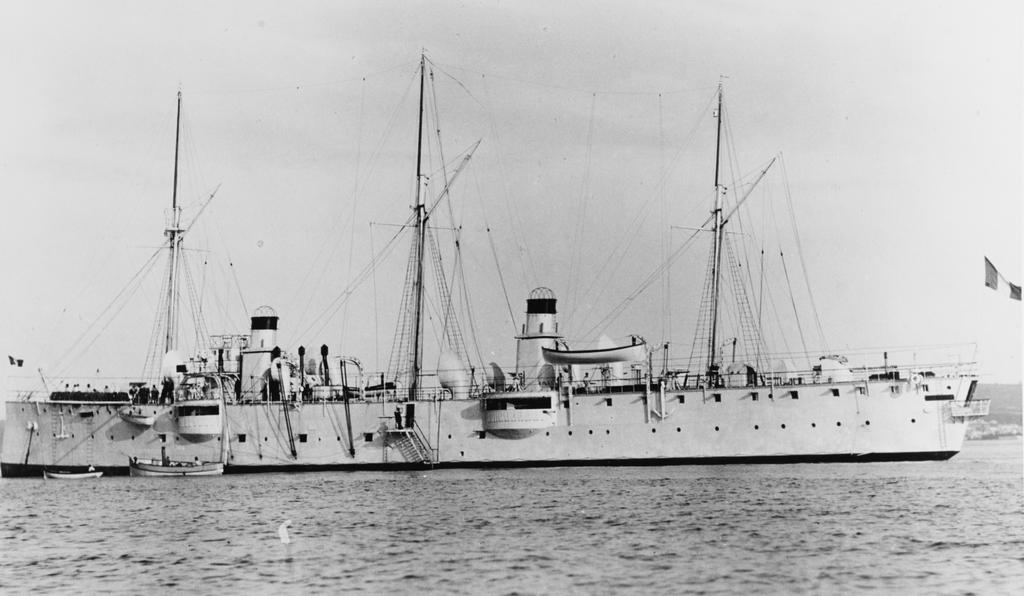
Building ordered in 1893, laid down at Palmers Shipbuilding and Iron Company, Jarrow, England in May 1896, launched on 4 March 1897, commissioned on 17 January 1899, sunk by the German light cruiser SMS Königsberg when lying with boiler and engine in the Zanzibar harbour on 20 September 1914, wreck sold for 500 pond sterling to be broken up in 1955 but parts are left behind on the sea bottom.

Of the Pelorus-class designed by chief constructor of the British Royal Navy Sir William White (2 February 1985 Plymouth, England-27 February 1913 London, England)consisting of the Pactolus, Pandora, Pegasus, Pelorus, Perseus, Pioneer, Pomone, Prometheus, Proserpine, Psyche and Pyramus, preceded by the Arrogant-class and succeeded by the Highflyer-class.

Displacement of 2.169 (normal)-2.780 (full load) tons and as dimensions 91,4 (between perpendiculars)-95,6 (over all) x 11,1 x 4,9 metres or 300’-313’6” x 36’6” x 16’. Machinery consisted of 2 shafts reciprocating vertical triple expansion steam engines and 8 Reed water-tube boilers delivering 7.000 ihp allowing a speed of 20 knots. Crew numbered 224 men. Armour consisted of a 3,8/1.5”05,1cm/2” thick deck while the conning tower was protected by 7,6cm/3” thick armour. The armament consisted of 8x1-10,2cm/4” quick firing guns, 8x1-4,7cm/3pd quick firing guns, 3 machineguns and 2x1-45cm/18” torpedo tubes. 

British protected cruiser 3rd class HMS Pioneer 1897-1912 and Australian HMAS Pioneer 1912-1931

Pelorus-class

HMS Hyacinth of the Highflyer-class

Laid down at the Chatham Dockyard, England on 16 December 1897, launched by Miss Andoe on 28 June 1899, completed on 23 January 1900, laid up in reserve, commissioned on 10 July 1900, decommissioned on 29 November 192, handed over to Australia on 29 November 1912, commissioned as a tender to Graden Island naval base on 1 March 1913, refitted in second part of 1913, training ship for reservists since 1 January 1914, served in German East Africa [Zanzibar] 1915-1916, decommissioned on 7 November 1916, became an accommodation vessel in 1922, transferred to the Cockatoo Island Dockyard to be scrapped in May 1923, handed over to the Commonwealth Shipping Board in 1924, being hulked sold to H.P. Stacey, Sydney, Australia in 1926 and finally scuttled off Sydney Heads, Australia on 18 February 1931. Wreck still exists.

Of the Pelorus-class designed by chief constructor of the British Royal Navy Sir William White (2  February 1845 Plymouth, England-27 February 1913 London, England)consisting of the Pactolus, Pandora, Pegasus, Pelorus, Perseus, Pioneer, Pomone, Prometheus, Proserpine, Psyche and Pyramus, preceded by the Arrogant-class and succeeded by the Highflyer-class.

Displacement of 2.169 tons and as dimensions 91,4 (between perpendiculars)-95,6 (over all) x 11,1 x 4,9 metres or 300’-313’6” x 36’6” x 16’. Machinery consisted of 2 shafts inverted 3-cylinder  triple expansion steam engines and 16 water-tube boilers delivering 7.000 ihp allowing a speed of 19,15-20 (design)  knots. Crew numbered 188-224 (originally) men. Armour consisted of a 3,8/1.5”05,1cm/2” thick deck while the conning tower was protected by 7,6cm/3” thick armour. The armament consisted of 8x1-10,2cm/4” quick firing guns, 8x1-4,7cm/3pd quick firing guns, 2 field guns, 3 Maxim machineguns and 2x1-45cm/18” torpedo tubes. 

Friday, 22 July 2016

Large floating dry dock being built for German East Africa according to the magazine Mitteilungen aus dem Gebiete des Seewesens 1900 no. 2

An item reported the building at the Howaldts-Werke, Kiel, Germany of a floating dock for German East Africa. There ware several German government ships active along the 500 nautical miles coast line of German East Africa with also regular voyages towards Zanzibar. For repairs and maintenance was a small shipyard at Dar es Salaam. The larger government ships and the cruiser were for repairs forced to go towards Bombay, British Indies and Cape Town, South Africa. The German parliament decided in spring to station a floating dock at Dar es Salaam to end this depending on foreign shipyards. Building costs of the complete steel built dock with a lifting capacity of 1.800 ton was 800.000 mark. If needed could it be considerable be increased. It was able to dock the largest government ships included the cruiser. German and foreign merchant ships could also be docked and repaired if needed. The dock was in this manner well used and could encourage the merchant shipping around Dar es Salaam.

Wednesday, 10 December 2014

Royal Netherlands Navy not interested in German portable boats in 1910


In her letter dated The Hague, Netherlands 7 February 1910 asked the firm Kaumanns&Co. (representing the firm Weedermann at Flensburg) if the Royal Netherlands Navy was interested in aluminium made portable boats. This kind of boat was used in the German colonies in East- and West Africa and proved well when used by the Schutztruppen. The dimensions were 6,85 x 1,50 x 6/8 (unloaded)-0,30 (loaded with 2.500 kilo) x 0,45 (height). The boat consisted of nine parts included both ends. Apparently the boat could be lengthened of shortened by using more or less parts and could be assembled on water or at land using bolts and nuts. Assemblage on water was preferred to prevent pollution by sand or other dirt. If the men were well experienced could the boat be assembled within 30 minutes. Each part had a weight of 55-60 kilo designed to be portable by just two men. The Schutztruppen used the boats for transporting 30 men in war dress, one machinegun, 10 ammunition casks and other stores. Each part of the boat was watertight making it possible to use the boat even if 1-3 parts were damaged. However the Dutch naval staff answered not to be interested in such portable boats and also believed that experiences with the use of metal object in tropics had not been encouraging. What left is an advertising folder containing some photographs of these boats when used in German East Africa. .

The Royal Netherlands Navy was off course active in the Dutch West Indies (included Surinam) and Dutch East Indies (nowadays) and may be considered as experienced and competent. However you could imagine that these boats would have been useful by marines when operating on land.

Source
Archive Dutch Naval Staff 1886-1942 inventory no. 146 (National Archive, The Hague, Netherlands).

Saturday, 17 November 2012

The German Harmonie rebuilt at Flushing, Netherlands as German government colonial steamship according to the Dutch newspaper Vlissingse Courant dated 27 February 1889

An item reported that some days before the German twin screw steamship Harmonie was docked. She was one of the six steamships bought by the German government to be used on the line towards the German African East Coast colonies. She was to be considerable repaired and made suitable to serve under tropical conditions. When she was completed she was bound for Hamburg to load war stores. The Dutch shipyard Kon. Mij. De Schelde was ordered to repair her. She was built at the same yard and in the past used on the line Köln-London.(1)

Note
1. The edition dated 27 January reported her arrival in the evening of the 25th coming from Rotterdam via de inland waterways. Her captain was H. Krützveldt. She belonged to the Badische Dampfschiffahrts-Gesellschaft and served nearly three years on the line Köln-London. She was in 1886 built by the Kon.Mij. De Schelde as de Industrie II. The order administration of the shipyard Kon.Mij. De Schelde (Municipality Archive Flushing) said that her building was ordered on 23 November 1885, keel laid down by shipbuilder engineer J. Janszen jr. on 5 December 1885 with yard number 44, the needed steel arrived on 1 January 1886, in thrushes on 26 January, plating fitted on 2 March, launched on 27 March, tested while anchored 20 April, official trial at Rotterdam on 28 April and on 2 May started her maiden voyage. Built in 5,25 months. Contracted price ƒ 85.200, cost price without expenses ship ƒ 52.500 and for engine and boilers ƒ 35.365, totally 87,865,- resulting in a loss of ƒ 2.865, for the shipyard. The 3-clyinder triple compound steam engines and two boilers supplied 300 hp while driving two screws allowing a speed of 9 knots. According to the administration was her building started for own account of the yard as a general trader lacking orders. Displacement 180 (at launching)-678 tons with as dimensions 150’0” (prow) x 24’6” x 2’3” (fore at launching)-3’10” (aft at launching)-9’6” and a hold of 10’6”-11’1”. Deadweight 400 tons. Gross register tonnage 334,88 and net register tonnage 200,29 tons and a capacity of 0.425 cubic feet.