Translate

Showing posts with label Slave trade. Show all posts

Wednesday, 13 May 2026

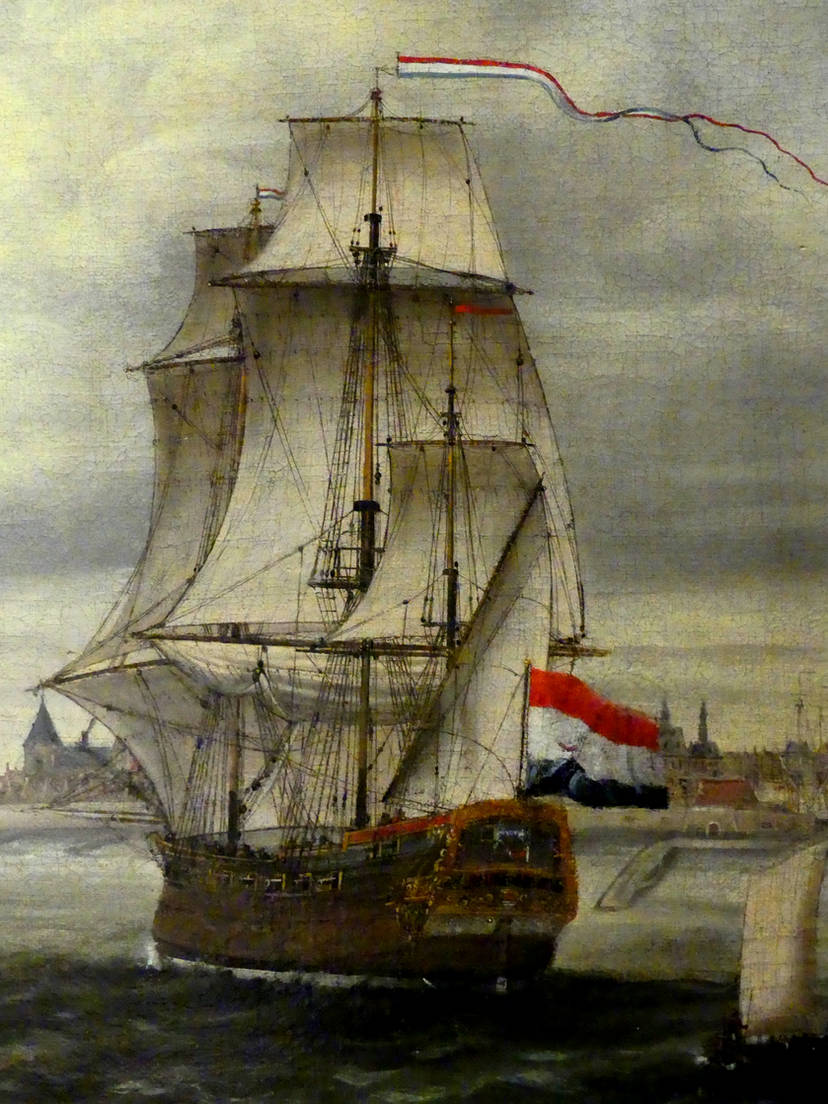
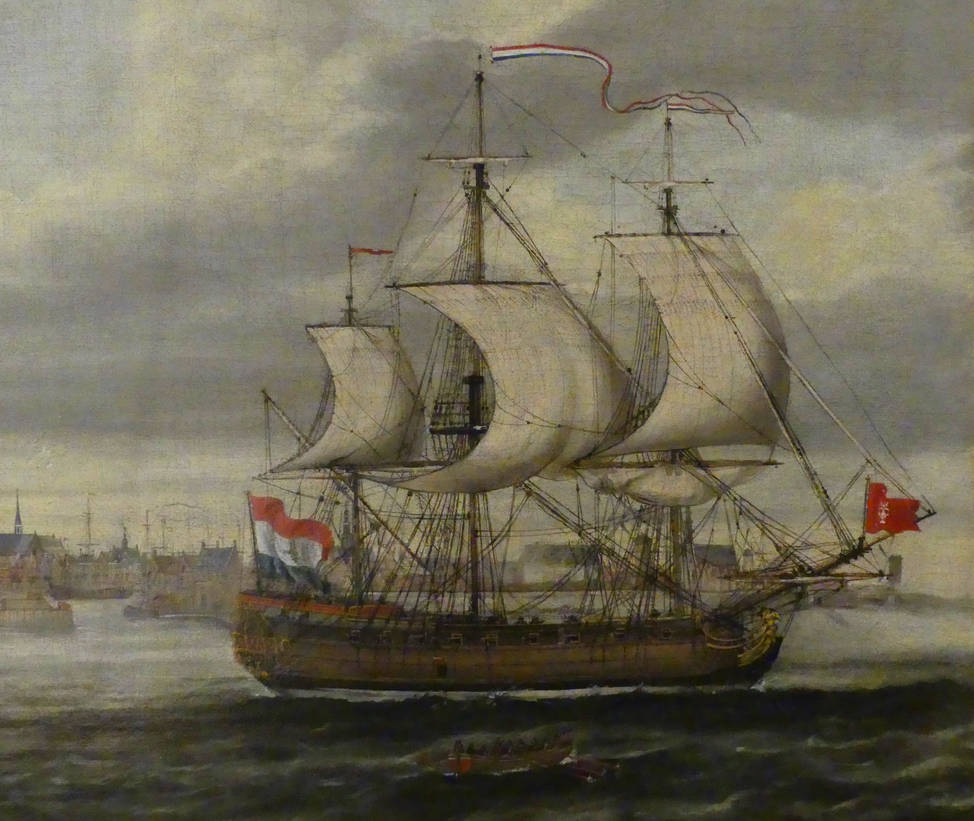
Dutch 3-mast hooker Brandenburg in 1780

Schelde off Vlissingen, Netherlands. Engel Hoogerheyden, 1780

muZEEum, Vlissingen, Netherlands

Certificate dated 9 November 170: dimensions 112’7”x 31’8”x 13’3½”, height deck 5’6½”, 127 6/10 lasten, destination America, master Jan de Vos of Middelburg. Certificate dated 12 April 1791: dimensions 112’7”x 31’8”x 13’3½”, height deck 5’6½”, 170 93/400 lasten, destination Africa, master Ottexander Gerritsen of Middelburg. The foundation of the Middelburgsche Commercie Compagnie was 13 July 1270 stated and since 5 August was a board active. The municipality of Middelburg was responsible for the supervision. The company was 28 September allowed to found a yard and elsewhere where ships bought. January of the next year departed her first ships since 1723 with destination Africa (Guinea). Since 1730 played the company an important roll in the slave trade between Africa and the West Indies and from there back to Europe. Because due to the fact that the (second) Dutch West India Company already was active in this area were this latter company paid compensation. The last slave voyage was in 1807. The ships were measured by experts on behalf of the chamber Zealand of the Dutch West Indies Company and which supplied a certificate. Dimensions in Amsterdam foot.

Source

Archive Middelburgsche Commercie Compagnie no. 148 (Zeeuws Archief, Middelburg).

Saturday, 9 May 2026

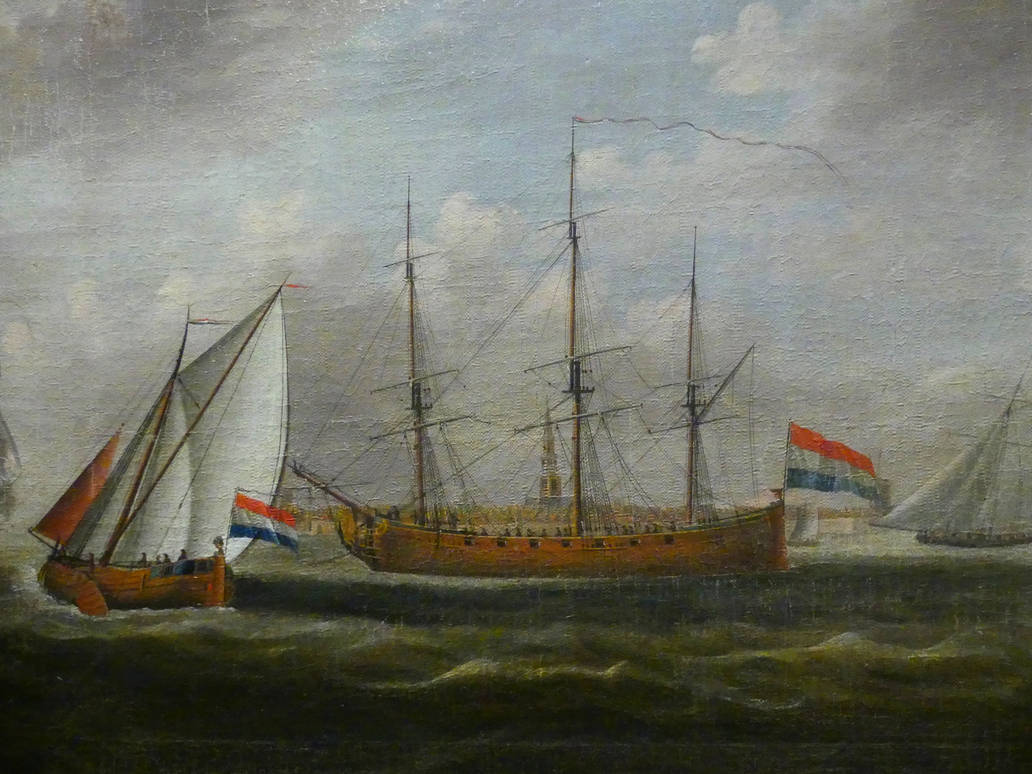
Dutch slaver or so-called lorredraaier De Witte Bijle 1715


Roadstead Vlissingen. Cornelis Low, 1715. muZEEum, Vlissingen, Netherlands

Smuggler. 

Sunday, 6 December 2020

Spanish slaver La Fortune arrived at Cadiz, Spain according to the Dutch newspaper Rotterdamse courant dated 14 December 1769

An item dated Cadiz, Spain 10 November reported the arrival on 24 October of the Spanish ship La Fortune belonging to the negro slavery commerce company returning from Puerto Rico and Havana, Cuba loaded with sugar and other products of the colonies.

Saturday, 6 June 2020

Colombian privateers versus Spanish navy according to the Nederlandsche Staatscourant dated 14 January 1822

London, 8 January. Letters from Havana dated 26 November reported that a large number privateers of the Independents were crossing off the Cuban coasts and that all efforts of the Spanish navy to drive them off were probably useless. According to the rumours did these privateers capture two merchant ships with refugees from Vera Cruz with all their properties on board. Among their prizes were two American ships of Boston, which were totally plundered of everything of value but finally were released. There were also 6 African slavers captured, the slaves set on land and the ships fitted out as privateers.

Wednesday, 18 March 2020

British screw steam sloop HMS Wasp captured Arabian slaver according to the Dutch newspaper De Tijd dated 11 October 1865

An item reported that the armed boats of the British brig HMS Wasp captured off the Seychelles after a fierce fight an Arabian vessel with on board 287 slaves.(1)

Note
1. Wood-built screw steam sloop launched at the Deptford dockyard, England on 28 May 1850, sold on 2 December 1869 with a 973 tons builders measurement and an armament of 12 guns.

Sunday, 2 February 2020

French squadron off African coasts to prevent slavery according to the Nederlandsche Staatscourant dated 1 July 1818

Paris. 25 June. According to a royal decision dated 24 June was a permanently squadron to be fitted out stationed off the African coasts to visit all French vessels which appeared in these waters to prevent slavery.

Monday, 23 December 2019

Dutch East Indiaman serving at Timor according to the Generale Missive dated 6 October 1734

The Valk transported 78 realen gold, 11730 lb wax, 56 last green katjangs and 32 male and female slaves, total value ƒ 15144.

Source
J. van Goor, Generale Missiven van Gouverneurs-Generaal en Raden aan Heren XVII der Verenigde Oostindische Compagnie. Deel IX: 1729-1737. The Hague, 1988, Generale Missive from Dirk van Cloon, p. 588-596.

Monday, 26 August 2019

British squadron captured French slaver l’Orphée of the African coast according to the Nederlandsche Staatscourant dated 2 December 1825

London, 26 November. The British squadron active off the African coast captured the French slaver l’Orphée destined towards Martinique with 700 negro-slaves on board all heavily chained and in a worse condition.

Tuesday, 20 August 2019

French brig le Lancier departed with Portuguese prize Poche towards France according to the Dutch newspaper Zierikzeesche Courant dated 9 April 1841

An item referred to a letter dated St. Denis, Bourbon [Réunion] 17th December 1840 reporting the intended departure on short notice of the French brig le Lancier towards France together with the Portuguese brig Poche. The latter was seized in the Street of Mozambique by a French warship while she was active as a pirate. On board were 200 slaves discovered which were to be sold at Havana, Cuba. When St. Juan de Ulloa was captured she became French but was later sold at Havana. Her captain was quilt of fraud in the slavery and also plundered a North American whaler. When she was captured had she a crew of 65 well armed sailors on board. She was thought to be an excellent sailing vessel.

Monday, 19 August 2019

Spanish privateer el Romany captured a slaver according to the Nederlandsche Staatscourant dated 5 October 1824

London, 28 September. In an American newspaper was the next tiding published dated Havana 26 June. Some days ago arrived there a brig with 401 Negro's on board which was captured off the Brazilian coast by the Spanish privateer of Havana named el Romany which had hoisted the Brazilian flag. She was send to Havana to be sold there. According to rumours died in the first night of her arrival 200 Negro's caused by yellow fever.

Thursday, 1 August 2019

British warship HMS Snake versus Portuguese slavers off Jamaica according to the Nederlandsche Staatscourant dated 15 September 1838

The Jamaican newspaper the Watchman dated end of July reported that earlier the British warship Snake captured two Portuguese slavers, one of them with 250 slaves on board who were able to find work on a plantation. According too two female slaver they were first treated well but as soon as enough victuals were lacking the slaves were feed with the flesh of other slaves who died on board.

Tuesday, 2 July 2019

British transport Freenesbury returning from Cape Coast, Ghana according to the Nederlandsche Staatscourant dated 27 November 1824

London, 23 November. According to the newspaper the Hampshire Telegraph dated 20 November, arrived the transport Freenesbury that afternoon coming from Cape Coast from where it departed 29 August. It transported several sick army and navy officers. Recently died officers there due to fevers caused by the climate. Since the Ashanti were defeated and shattered all was calm at Cape Coast [=Ghana]. The Victor captured a Spanish goelette with 270 slaves on board.

Sunday, 30 June 2019

American brig Dolphin captured slaver according to the Dutch newspaper Dagblad van Zuidholland en ‘s-Gravenhage dated 15 September 1858

An item dated London 11 September reported that the American brig Dolphin captured in the waters of Cuba a brig coming from the African with 318 negro slaves on board.

Friday, 28 June 2019

Brazilian corvette (ex-Maria Isabel 1827-1831) Regeneracão 1831-1846


Dimensions 46,86 x 9,8 metres. Her armament consisted of 4-18pd guns and 22-32pd guns. Built in the USA and commissioned in the Brazilian navy as Maria Isabel in 1827 but when was renamed Regeneracão in 1831 when emperor D. Pedro I abdicated. In her active career used in actions against local rebellions and privateer on 1842 before she was laid up.Under captain Frederico Mariath arriving at Rio de Janeiro on 8th August 1837 coming from Para she captured off the island Tamaraci the Portuguese schooner Eugenia coming from Angola fitted out as slaver. It was clear that she just disembarked slaves. Making water she was deliberately stranded on the Itabagipe Beach, Salvador, Bahia, Brazil on 31 July 1846.

Tuesday, 28 May 2019

The Brazilian navy according to the The United service magazine of June-July 1856

Thanks to the fact that nowadays more and more books are digitized we are able to read books that are some times for decades no longer available for the public for several reasons. That’s quite a pity while these books contains useful information while the archives are destroyed, incomplete or nor accessible.

P. 233: “ What is the use of a small navy ? What advantage can accrue to a state that possesses one old corvette, two brigs, and a steamer, to float in strange harbours with a strange flag at their peaks, and to imitate, on a small scale, the habits of the French and English men-of-war? Take the example of Greece, which possesses one steamer, whose adventures were detailed in the United Service Magazine for November, 1854. Or take the example of Brazil, whose navy is somewhat more extensive, but not, as a whole, much more important. If we may trust a list of the Brazilian navy given us by a French author, M. Charles Beybaud, that state possesses two frigates, seven corvettes, eight brigs and brigantines, seventeen schooners and yachts, one steamer of 300-horse power, two of 220, two of 150, four of 130, one of 90, two of 70, one of 40, and two of 25.

Brazil is a commercial country, but we do not suppose that its navy is to be considered at all in the light of a protector of commerce. If any protection was needed, there are always English men-of-war at hand, ready to perform any service that may be required. Certainly since the Brazilian Government took an anti-slavery line, their navy was of some use in cruising off the coast, and boarding vessels suspected of engaging in the African traffic. Once or twice slavers were seized by Brazilian men-of-war, and, we believe, some which might have escaped the vigilance of our own cruisers, fell a prey to the insignificant steamers and brigantines on which the English looked with such unaffected contempt. But the success of Brazilian cruisers was small, and their effect on the slave-trade by no means to be compared to that produced by governors of places where slaves were landed. We have shown on a previous occasion how the Brazilians effected the almost total suppression of the importation of negroes, and very little credit belongs to their navy for its exertions in that service. During the Monte-Videan disturbances, although no naval actions took place, the Brazilian men-of-war were of some use in conveying troops from Rio Janeiro to the scene of action. But this duty might have been discharged by merchant vessels with equal or greater celerity. We are still unable to perceive the exact need of a Brazilian navy.

p. 234: We perceive by the list given us by M. Reybaud, that the two-decker which once belonged to the Brazilians is no longer in existence. This two-decker was named the Dom Pedro Segundo. She was built at Bahia by Brazilian artificers, and sailed from thence to Rio Janeiro. On her passage she rolled so dreadfully that her masts went by the board, and this accident induced the Brazilian government to abstain from sending her on another cruise. She was sold for the purpose of being broken up two years ago. After the said two-decker, the finest vessel belonging to Brazil is the frigate Constituciao, which will be recognised by the English (under the name of the Constitution) as an American frigate, which distinguished itself during the American War by capturing with great difficulty the Java, an English jackass frigate of about half the size of the Constitution. The Brazilians purchased this frigate of the Americans, and were taken in, as one reasonably might have expected.(1) They paid a large sum, supposing her to be copper-bottomed; but when she was drydocked in England, the Brazilians not possessing a drydock of sufficient dimensions, it was discovered that a slip of copper was nailed round her just about the water-line, so as to convey the impression that she was completely coppered. Such is the origin of the finest vessel in the Brazilian service. Few of the corvettes or brigantines have any pedigree to boast of. One or two of the most beautiful schooners have been captured with slaves on board, and converted into men-of-war. Yonder graceful yacht, with the pendant at her mast-head, and the green ensign at her peak, was a notorious slaver, after whom cruisers of every kind toiled in vain. She was captured during a calm by a contemptible little steamer of 25-horse power. Having given a list of the Brazilian navy, and noticed the most prominent vessels, it remains for us to chronicle its achievements. What has the Brazilian navy done ? Has it gained any victories, or have any remarkable actions between single ships graced its records ? With difficulty we have discovered one encounter, whose importance entitles it to a prominent place in the future annals of the state. An English brigantine was once cruising in search of slaves, when a suspicious-looking schooner hove in sight. The brigantine gave chase, and, as the schooner paid no attention to her presence, fired a gun, unshotted of course. On this the schooner hoisted the Brazilian ensign and a pendant at her mast-head, and the brigantine, satisfied, hove to. Immediately the schooner hauled up and fired a shot at the brigantine, and then bore up and made all sail to escape any punishment for this insult. Of course the brigantine declined to end the matter thus and went in chase again, firing at the schooner with shot and shell, ten of which brought her to a state of submission. Two officers were sent from the brigantine on board the schooner to demand some apology or explanation. The captain of the Brazilian schooner apologized humbly, and offered the two officers a glass of ale as a compensation!
A history of the Brazilian navy would not be complete without a sketch of one of its vessels. We will therefore select a corvette for

P. 235: this honour. A recent traveller has given this description of a corvette, named the Bertioga: “I had the pleasure of paying her a visit, and found a strong resemblance between her and a Newcastle collier. She was very 'slummy' (naval term for slovenly) and dirty. Aloft she seemed excessively untidy : ropes' ends flying about, sails badly furled, yards not squared, and ropes not taut. Some men were aloft, looking very uncomfortable, hanging to the slack ropes, that waved and swung about at each roll, with more than landsman-like tenacity. I entered into a conversation with an officer on board, who spoke a little French, and found that the Bertioga had that morning taken some slaves, who were visible on the main deck, men and women together in a state of nudity. The crew of the Bertioga consisted chiefly of Brazilians and negroes. I saw also one or two Englishmen on board, who seemed heartily ashamed of their ship, and sneaked about in a pitiful manner, as if the fact of belonging to a Brazilian man-of-war had robbed them of all their courage. The boatswain, a fierce man out of uniform, dressed in a sort of linsey-woolsey frock, roamed about the decks with a rope's end in his hand, applying it freely and indiscriminately. The officer with whom I was talking, informed me that the corvette had on each side eight 24-pounder guns, and one of 32-pounds; eighteen in all.” Such is the history of the Brazilian navy.”

One of the readers of this magazine reacted and his letter was published in July, p. 457. “[The gallant author of the subjoined letter is mistaken in supposing the article he complains of emanated from the Editor: it was from the pen of an officer who, having served on the coast of Brazil, might be supposed to know something of the subject referred to.]

To the Editor of the United Service Magazine.

SIR, My attention has been drawn to an article in your magazine of this month, entitled “The Brazilian Navy,” upon which I beg to make the following observations, not doubting that you will find them a place in your ensuing number. You ask. “What is the use of a small navy ? and what has the Brazilian navy done?” Large and small are merely relative terms, and convey no sort of meaning as to the value or merits of the things they describe. If you mean that the Brazilian navy is small, as compared with that of other nations, the idle comparison will hardly be disputed; but no one at all acquainted with the subject can call the navy of Brazil small, relatively to the present resources or population of that empire. Small or large, however, it has effectually fulfilled the purposes for which it was created. At the period when Brazil first declared the independence, it drove the superior naval forces of Portugal from the South Atlantic. It preserved, during a long and turbulent minority, the authority of the Imperial government in all the ports of the continent, extending from the equator to 33° south latitude, and finally it prominently co-operated towards the overthrow of the despotic power which closed to the commerce of the world the navigation of the tributaries of the river Plate. These are facts not to he disputed, unless by one who can credit the absurdity that the North Americans sold their frigate Constitution (“old Ironsides”) to the Brazilians; and they are a fair set off for the occasional shortcomings of individuals, of which it would not be difficult to find examples in more distinguished services - facts which certainly claim for the Brazilian navy more respectful consideration than would be implied from the article referred to. I enclose my card, and remain, Sir, your obedient servant, Liverpool, June 20, 1856. A SAILOR. “

Source
The United service magazine, part, 2, June and July 1856.

Note
1. According to the www.naval.com.br the frigate Constituição laid down July 1825 and launched May 1826. Ex-Isabel and ex-Amazonas. Displacement 1.768 tone Ladas with as dimensions 53.94 x 7.92 x 4.57m and draught 6.09m. Armed with 30-32pdrs, 30-42pdr carronades and 2-4pdrs (‘colubrinas‘). Built at New York and required by order dated 13 September 1824? In 1880 serving at the Escola de Marinha.

Saturday, 11 November 2017

Chinese navy to stop coolies trafficking off Macau according to the Dutch newspaper Tilburgsche courant dated 20 November 1873

An item referred to tidings received from China dated 8th October reporting that the Chinese government forbade all ships involved in the coolies trade to enter the Chinese waters. Chinese war junks were cruising off Macau which was considered to be the centre of the trafficking in coolies and ordered to stop involved Chinese vessels. It was known of also European vessels were to be stopped. 

Sunday, 3 April 2016

British admiralty ordered anti slave trade gunboats for Lake Nyassa according to the Dutch magazine Marineblad no. 4 dated 1892-1893

An item referred to the magazine Le Yacht reported that the British Admiralty ordered the building of 2 gunboats to prevent slave trade on the Lake Nyassa. They were to be assembled at location.(1)

Note
1. Yarrow built for instance the Illa for this purpose. Later ordered the Admiralty the Pioneer, Adventure and Dove.

Monday, 25 May 2015

British privateer Sukey and Polly of St. Kits captured French merchant ships according to the Dutch newspaper Amsterdamsche courant dated 6 July 1793

An item reported that the British privateer Sukey and Polly of St. Kits captured a merchant brig loaded with sugar, coffee and so underway from Martinique towards France and a brig loaded with slaves coming from Africa.

Wednesday, 21 January 2015

Dutch slaver Princes Royal captured by British privateer Amazon according to the Dutch newspaper Leeuwarder courant dated 8 September 1781

An item dated Amsterdam, Netherlands 2nd referred to a received tiding reporting that the British privateer Amazon captured the Dutch slaver Prinses Royal captain Walk of Vlissingen, Netherlands rich loaded with wax (?), ivory and gold dust and further more 400 slaves.

Tuesday, 18 March 2014

Dutch marines returning from the Dutch West Indies according to the Dutch newspaper Heldersche en Nieuwedieper Courant dated 10 December 1863

An item dated Den Helder the 9th reported that the marines send earlier to the Dutch West Indies to support the obtain calmness during the emancipation of the slaves would return to the Netherlands on 1 January 1864. (1)

Note
1. On 1 July 1863 was the slavery abolished in the Dutch West Indies.