
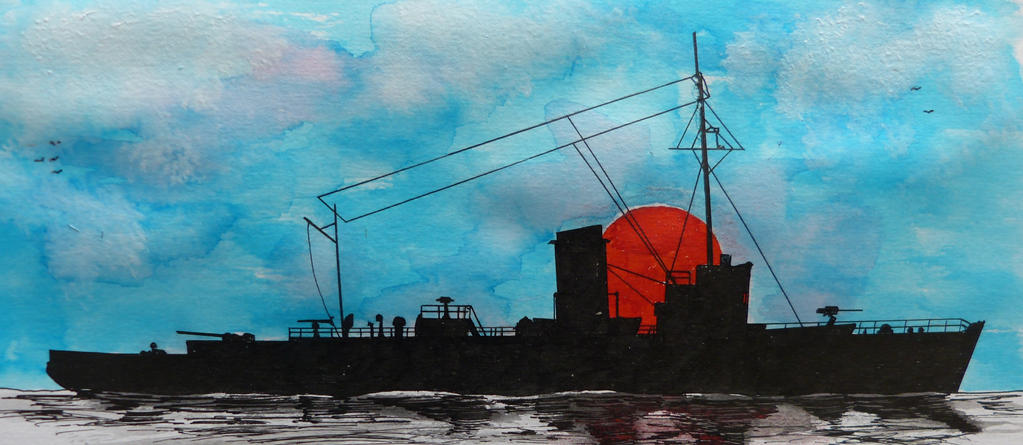
The archive of the shipyard De Schelde supplies some details dealing with these minesweepers. The major part of the preserved documents are dealing with financial aspects, just a few available with other data.
The yard numbers are 218-223 and the minesweepers were ordered to be built for the German Kriegsmarine on 3, 23 and 28 September 1946. The shipyard Wilton-Fijenoord at Schiedam was responsible for the supervision of the building of sixty minesweepers at several Dutch shipyards. These yards were Wilton Fijenoord (8), NSM at Amsterdam (8), RDM (8), Kon. Schelde (6), P. Smit (6), Gusto (6), NDM (5), v/d Giessen (5), J.&K. Smit (2), Boele (2), Gebr. Pot (2), L. Smit (1) and Verschure at Amsterdam. The figures between the brackets are the number of boats each yard had to built. On 28 October 1942 wrote the board of the Dutch firm Werkspoor N.V. at Amsterdam to the De Schelde that during her visit at Berlin the so-called Preisprüfstelle on 9 September the costs for the engines for the six minesweepers built at Flushing was estimated to be maximum ƒ 2.958.000,00. Later were these costs increased.
Standard technical specifications:
The dimensions were 57,60 (between perpendiculars)-62,185 (over all) x 8,50 x 3,65 (hold below upper deck) metres and with a displacement of 550 tons. Elsewhere are the dimensions described as 57,60 (between perpendiculars)-62,30 (over all) x 8,50 x 2,50 (draught) metres and a displacement of 543 (standard)-757 (loaded) tons. The armament was to consist of 1-3,7cm forward, 1-10,5cm, 1-8,8cm gun and 1-2cm machine guns, elsewhere is said 1-10,5 cm anti aircraft gun, 1-3,7cm anti aircraft gun and 6-2cm anti aircraft guns. The machinery consisted of two triple expansion engines fitted out with Bauer-Wach turbines and further more two Schulz water pipe boilers supplying 2x1.200 ihp allowing with the two screws a speed of 17 knots and with a speed of 10 knots and a coal bunker capacity of 142 tons a range of 4,000 nautical miles. Their crew was to number 76 men.
Specifications for the separate vessels
M 411
Keel laid down on 8 May 1941 on slipway no. I of the Island (lower part of the yard). Launched on 22 August 1942 by Chief engineer Schmidt who loosened her and she was baptized by captain Mollmann of the Kriegsmarine. The launching was not as easy as standard because the grease used for lubricating the slipway was of a worse quality. Displacement during the launching 450 ton included 80 ton water ballast. Docked between 11 and 14 October 1942. On 19 October 1942 was the technical trial, on the 28th the official trial and on the 29th handed over to the Kriegsmarine after 25 months building time with weeks of 48 working hours. Supervising during the building were engineer Venzelau (or Fenzelau) and further more the Oberwerft.stab at Flushing baurat Schöttle between 7 June 1940 and 23 December 1941 and marine ober rat engineer Schmidt between 23 December 1941 and 3 September 1942. Horsepower projected 2,00 ihp or 1,800 ahp. Maximum hourly wages: on 15 September 1940 60 cents, on 15 June 1941 62 cents, on 1 February 1952 64 cents and on 5 July 1954 65 cents.
M 412
Keel laid down on 8 May 1941 on slipway no. I of the Island (upper part of the yard). Launched on 22 August 1942 by captain Möllmann of the Kriegsmarine. Displacement during the launching 390 ton. Docked between 22 and 24 November 1942. On 2 December 1942 was the technical trial, on the 8th the official trial and on the 9th handed over to the Kriegsmarine after 26 months building time with weeks of 48 working hours. Supervising during the building were engineer Venzelau and further more the Oberwerft.stab at Flushing baurat Schöttle between 7 June 1940 and 23 December 1941, marine ober rat engineer Schmidt between 23 December 1941 and 3 September 1942 and since 31 Augustus 1942 ober baurat Rocher (or Röcher).
M 413
Keel laid down on 24 May 1941 on slipway no. II of the Island (lower part of the yard). Launched on 26 October 1942 by Chief engineer Rocher who loosened her and she was baptized by captain Mollmann of the Kriegsmarine.(1) Displacement during the launching 365 ton. Docked between 27 and 29 December 1942. On 5 January 1943 was the technical trial, on the 10th the official trial and on the 13th handed over to the Kriegsmarine after 27½ months building time with weeks of 48 working hours. Supervising during the building were engineer Venzelau and further more the Oberwerft.stab at Flushing baurat Schöttle between 7 June 1940 and 23 December 1941, marine ober rat engineer Schmidt between 23 December 1941 and 3 September 1942 and since 31 Augustus 1942 ober baurat Rocher.
M 414
Keel laid down on 28 May 1941 on slipway no. II of the Island (upper part of the yard). Launched on 9 November 1942 by Werkmeister Eidam who loosened her and she was baptized by captain Mollmann of the Kriegsmarine. Docked between 31 January and 1 February 1943. On 25 January 1943 was the technical trial, on 6 February the official trial and on the 7th handed over to the Kriegsmarine after 28 months building time with weeks of 48 working hours. Supervising during the building were engineer Venzelau and further more the Oberwerft.stab at Flushing baurat Schöttle between 7 June 1940 and 23 December 1941, marine ober rat engineer Schmidt between 23 December 1941 and 3 September 1942 and since 31 Augustus 1942 ober baurat Rocher.
M 415
Keel laid down on 12 July 1941 on slipway no. III outside the Island storehouse (lower part of the yard). Launched on 16 January 1943 by Oberwerkmeister Rudolph who loosened her and she was baptized by captain Mollmann of the Kriegsmarine. Displacement during the launching 368 ton. Docked between 28 February and 1 March 1943. On 8 March 1943 was the technical trial, on the 14th the official trial and on the 15th handed over to the Kriegsmarine after 29,5 months building time with weeks of 48 working hours. Supervising during the building were engineer Venzelau and further more the Oberwerft.stab at Flushing baurat Schöttle between 7 June 1940 and 23 December 1941, marine ober rat engineer Schmidt between 23 December 1941 and 3 September 1942 and since 31 Augustus 1942 ober baurat Rocher. According to Jane’s Fighting Ships for the year 1949-1950 was she as the minesweeper T 931 commissioned in the Soviet navy.
M 416
Keel laid down on 23 July 1941 on slipway no. III outside the Island storehouse (upper part of the yard). Launched on 13 February 1943 and baptized by Korvettenkapitän Parduhn of the Kriegsmarine. Displacement during the launching 390 ton. Docked on 17 March 1943. On 27 March 1943 was the technical trial, on 5 April the official trial and on the 7th handed over to the Kriegsmarine after 2,5 years building time with weeks of 48 working hours. Supervising during the building were engineer Venzelau and further more the Oberwerft.stab at Flushing baurat Schöttle between 7 June 1940 and 23 December 1941, marine ober rat engineer Schmidt between 23 December 1941 and 3 September 1942, ober baurat Rocher between 31 Augustus 1942 and 29 July 1944 and baurat Grötte since 29 July 1944.
In hand written notes are the fates of the above mentioned minesweepers reported.
M 411 1945 seized by the Soviet Union and became probably the minesweeper T 717 (not T 930!)
M 412 wrecked on 9 March 1945 off Granville
M 413 sunk by Soviet aircraft in the Finnish Gulf (Narwa) on 21 July 1944
M 414 torpedoed off the Dutch island Texel on 17 May 1943
M 415 1945 seized by the Soviet Union and became probably the minesweeper T 718 (not T 931!)
M 416 sunk by British destroyer off South Norway on 12 November 1944
According to the same notes had also the minesweepers M 417-420 to be built by the shipyard De Schelde, but the building of these vessels was never executed.
Archive De Schelde 1875-1970 (Municipality Archive Flushing block no. 214) nos. 557 and 651.
Siegrfied Breyer paid in his book Die Deutsche Kriegsmarine 1939-1945, vol. 2 Zerstörer etc.(1994) of course attention to these minesweepers although he called them mine hunters. The MBoot40 design was in fact an improved Imperial German Navy mine hunter used during the First World War and were really sea-worthy going vessels. The coal-fired boilers in combination with 3-cylinder expansion engines supplied 2,400 hip allowing a speed of 17 knots. With a displacement of more as 700 tons were their dimensions 62m3 x 9 metres and an armament of 2-10,5cm guns,1-2-cm quadruple anti aircraft gun or 1-3,7cm anti aircraft and 2-2cm anti aircraft guns.
Note
1. Kapitän zur See Gottfried Mollmann, chief commander of the Seeverteidigung für Süd-Holland. Between June 1940 and March 1943 called the Seekommandant. I have some doubts about the correct spelling of the names of the other persons mentioned in my note.

