
©Warshipsresearch.blogspot.com
There was just two forms of defence agansit a submarine attacking a target with her torpedoes. One was to destroy the submarine herself or improve the protection of the target, especially the bottom of the surface ship. In his article described Biles (1) some designs of battleships which should be able to keep fighting even after being torpedoed by a 21” torpedo. One of the solutions was to armor the bottom resulting in reducing her speed with 2 knots. The newest battleships had a form with a low resitance to forward motion. His idea was to develop a form better adapted to fitting and carrying armor despiter creating greater resistance or a reducing speed.
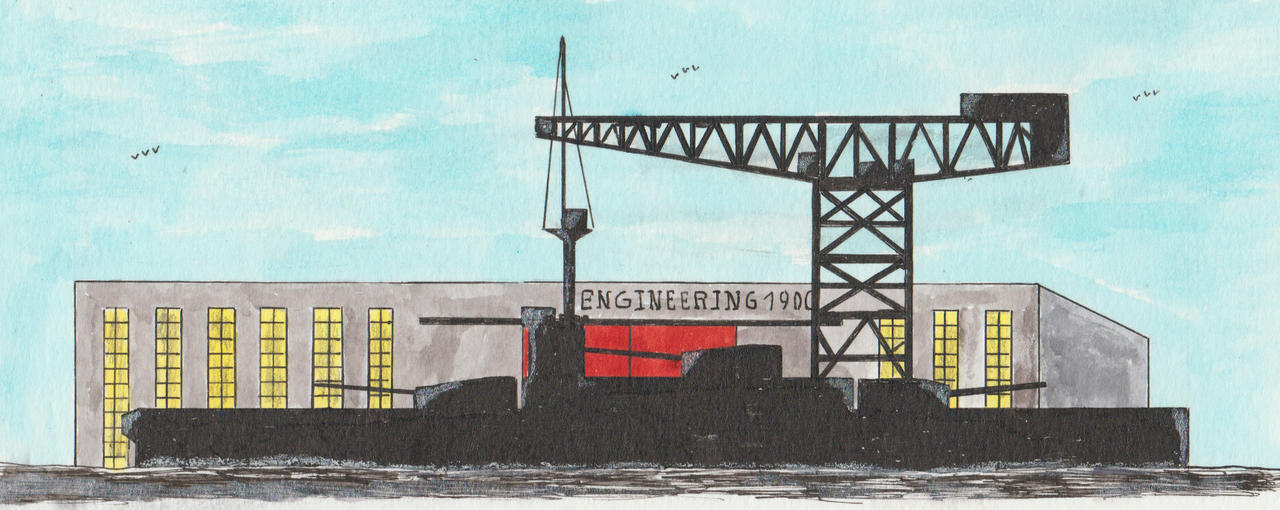
One design he suggested was a battleship with a displacement of 13,000 tons and as dimensions 336 (between perpendiculars)-358 (over all) x 80 (extreme) x 20 feet. Speed 10 knots. Armament 3x2-14” guns and 6-5” guns. The armor consisted of on side at waterline 10”, above waterline 3”, below waterline4’, on casemate 2”, on barbettes 12” and with 2” thick protective deck plating.
Note
1. Sir John Harvard Biles (1854-1933) was Professor of Naval Architecture at the University of Glasgow, Scotland between 1891-1921.
Sources
Biles, sir John. “Battleship protection against submarine. Proposed increase of armor at the expense of decrease in speed” in Journal of the United States Artillery, volume 42, 1914.
Idem. “On the Protection of Battleships against Submarine Attack” in: Shipbuilding and Shipping Record, 9 July 1914.
T.G. Owens. “Some questions to battleship design” in: Shipbuilding and Shipping Record, 9 April 1914.


No comments:
Post a Comment