
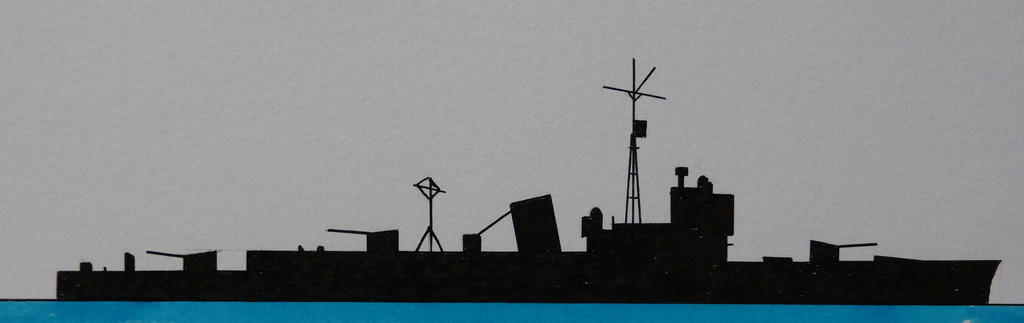
Laid down by Mitsui-Tamano Shipyards on 29 November 1938, launched on 14 December 1938, completed on 30 June 1940 and handed over to the Soviet Union on 5 July 1947, added to the Soviet Pacific Fleet as patrol vessel EK-31, dispatch vessel PS-25 and repair ship PM-74 and finally decommissioned on 16 May 1959. Part of the Shimushu-class escort ships, succeeded by Etorofu-class.The kaibokan is comparable with the Amerian destroyer escorts and British frigates. Her design was limited by the limitations under the 1930 London Naval Treaty and to be financed under the 1937 3rd Naval Armaments Supplement Program. The intention of the Japanese Imperial Navy was a simple design suitable for prefabrication or mass production. After the outbreak of the war in the Pacific this was a necessity. The ships were to be used as patrol and fishery protection vessels in the Kurilen Islands, furthermore as minesweepers and just on the third place as convoy escorts. Instead of those demands developed Mitsubishi a vessel with double-curved bow and forecastle deck, well suited for rough northern waters and cold weather conditions but to complex for prefabricaton or mass production building. General technical specifications are a standard displacement of 874 tons and as dimensions 77.7 x 9.1 x 3.05 metres or 255 x 29.10 x 10 feet. A speed of 19.7 knots and with oil fuel bunker capacity of 150 tons and 16 knots speed a range of 6.017 nautical miles. Their crew numbered 150 men. Armament consisted of 3x1-12cm/4.7” /45 cal dual purpose guns, maximum 15-2.5cm/0.98” Type 96 anti aircraft guns, 6 depth charge throwers (with maximum 60 depth charges) and 1-8.1cm/3.2”Type 87 trench mortar.


No comments:
Post a Comment