
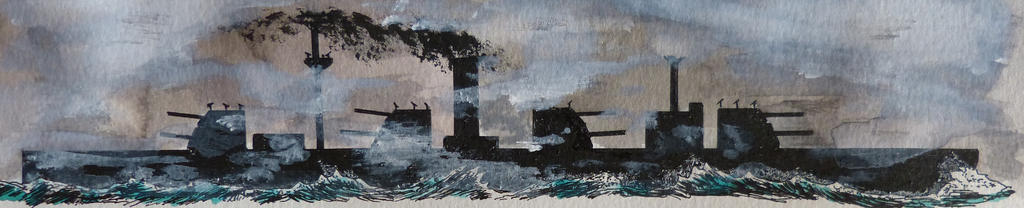
Proposed by Major-General of the Royal Marine Artillery Sir John Frederick Crease (1837 Saltash, England-21 June 1907 Hambeldon, England for coastal defence. Suitable to operate in shallow waters, to be torpedo proof and under ordinary conditions unsunkable when rammed by a battle ship. The Admiralty had some objections. There were none dockyards capable of building such forts, especially caused by the beam of 100 feet. The projected speed of just 8 knots was far too slow and enemy battleships could easilyoutrun a fort. Soldiers were not suitable to man a ship of this size as experiences of the past prooved. The building costs of the 18 projected forts could beter be spent to 18 battleships to be used worldwide. Dimensions 400 x 100 x 11.6 feet, weight of the 4-bottomed hull around 6,500 tons, an armament of 8x2-30.48cm/12” guns in barbettes and turrets, weight around 3,500 tons, coal bunker capacity 1,500, machinery weight around 8,50 tons and amour weight around 5,000 tons totally 18,150 tons in stead of the 11,500 tons suggested in the proposal. For a speed of 8 knots was at least 5,000 shp needed. Secondary armament 20 quickfiring guns. Suggested armour main belt 30.48cm/12” tapering to7.62cm/ 3”, ends 30.48cm/12-38.1cm/15”, turrets 15.24cm/6-30.48cm/12” and a 8.89cm/3.5-12.7cm/5”thick deck. Costs of the whole project of 18 forts to which so-called battle ship exterminators (high speed, ram, torpedo-armament) were 20 million pound.
Sources
Undated article titled Battleship Forts and battleship exterminators, published on the website secretprojects,co.uk.
The Dutch newspaper De avondpost dated 21 July 1898, called the forts floating batteries.


No comments:
Post a Comment