

HMS Revenge. ©Warshipsresearch.blogspot.com

HMS Resolution. ©Warshipsresearch.blogspot.com


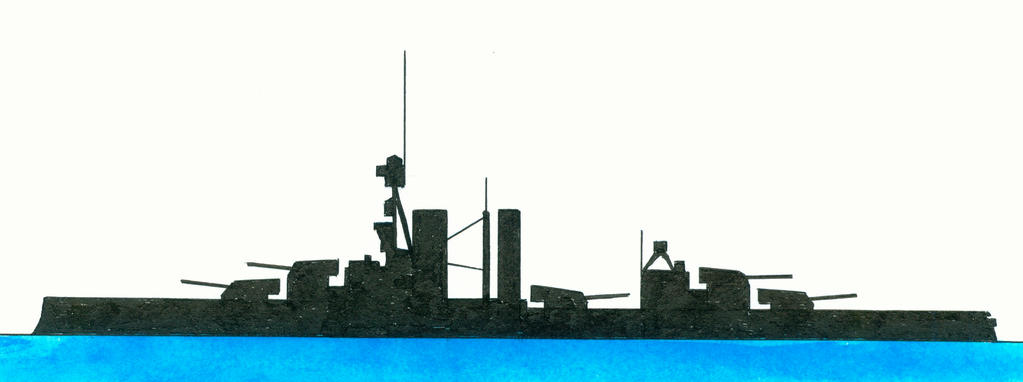
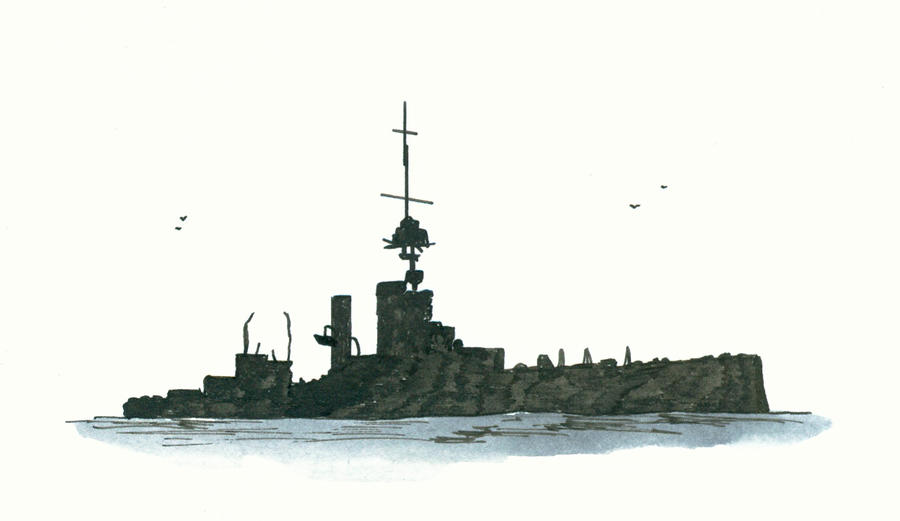
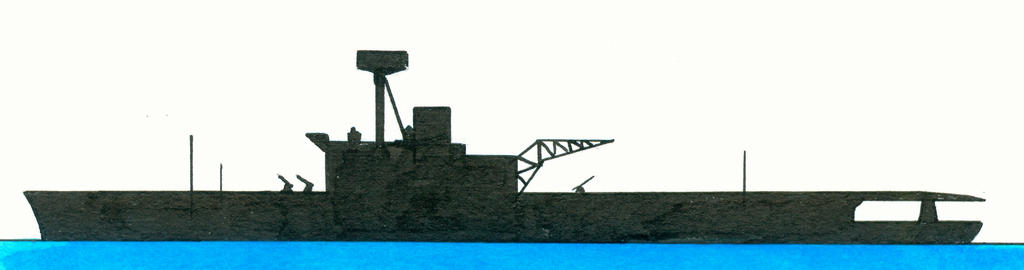
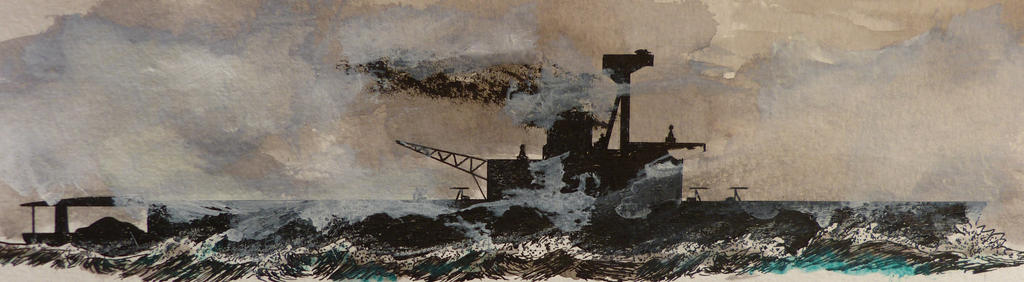

The Military Review February 1946 No. 11, p. 57, published the following item titled “The Royal Navy’s “Phantom Fleet”, originally published in The Sphere. The British Royal Navy disguished some merchant ships as warships to pretend the warships were lying in the harbour. The same was done in the First World War.
“For nearly two years of the war the Royal Navy used a phantom fleet of wooden warships fitted with dummy guns to hoax enemy reconnaissance aircraft and bombers. They were merchant ships with elaborate superstructure of plywood and canvas, painted to transform them into replicas of R-class battleships and an aircraft-carrier. They were used as bait for U-boats, and as aerial decoys to draw air attack from the base ships at Scapa Flow and in the Firth of Forth when the fleet was away, to dilute the scale of air attack on the fleet when present, and to keep the enemy guessing as to the strategic disposition of our capital ships. At the outbreak of this war a new force of dummy ships, known as “Fleet Tenders” for purposes of security, was quickly constructed. Three 7,900-ton merchant ships were used- the S. S. Pakeha and S. S. Waimana being turned into the 33,500-ton battleships Revenge (1) and Resolution (2), and the S. S. Mamari becoming the 12,000-ton aircraft-carrier Hermes (3). They were manned by naval “runner” crews and their holds were filled with thousands of empty barrels to give them greater bouyancy in the event of their being hit by bombs or torpedoes. Many rumors, which are known to have reached the enemy, were started by the appearance of one of these mystery ships in ports in Scotland and on the Tyne. By 1941 the dummy warships had served their purpose. S. S. Mamari (alias Hermes) had been wrecked off the Wash; the other two were handed back to their owners and are still sailing as merchant ships today.”
Fleet tender “A” and Fleet tender “B” became the Revenge and Resolution and Fleet tender “C” (ss Mamari) the Hermes and were based at Scapa Flow. The latter underway to Chatham for a reconversion into a merchant ship, strike a wreck off the Wash and hit by three torpedoes fire by German E-boats. The aged British battleship HMS Centurion was disguished as the King George V-class battleship HMS Anson (4) and was in active service including a voyage to Bombay, India.
Notes
1. Pennant 06. Of the Revenge-class/Royal Sovereign-class/R-class, preceded by Queen Elizabeth-class, succeeded by planned N3-class and realized Nelson-class. Laid down by Vickers Limited, Barrow-in-Furness, England on 22 December 1913, launched on 29 May 1915, commissioned on 1 February 1916 and broken up in 1948.
Pakeha, call sign GBMK, homeport Southampton, launched by Harland&Wolff Ld., Belfast, Northern Ireland on the South Yard with yard number 409 on 26 May 1910, delivered on 20 August 1910, purchased by Admiralty from Shaw Savill&Allbion Co. Ltd., in September 1939, converted into the refrigrated cargo ship Empire Pakeha in 1941, sold to Shaw Savill&Albion in 1946, renamed Pakeha and sold to be broken up in 1959. Gross tonnage 7,909 tons, under deck 7,390 tons, net tonnage 5,029 tons and as dimensions 477.5 x 63.1 x 31.3 feet.
2. Pennant 09. Of the Revenge-class/Royal Sovereign-class/R-class, preceded by Queen Elizabeth-class, succeeded by planned N3-class and realized Nelson-class. Laid down by Palmers Shipbuilding and Iron Company, Jarrow on 29 November 1913, launched on 14 January 1915, commissioned on30 December 1916 and sold to be broken up on 5 May 1948.
Ss Waimana, call sign GMRX, homeport Southampton, purchased by Admiralty from American Steam Shipping Co.Ltd., managers Shaw Savill&Albion Co.Ltd. In September 1939, gross tonnage 7,870 tons, inder deck 7,318 tons, net tonnage 4,948 tons and as dimensions 477.6 x 63.1 x 31.3 feet. Built by Workman, Clarks&Co., Belfast, Northern Ireland in November 1911, served as transport in the First World War, renamed Empire Waimana in Feburary 1942, sold to Shaw Savill again and broken pu in 1952..
3. Building of HMS Hermes ordered in April 1917, laid down by Armstrong Whitworth, Elswick, England on 15 January 1918, launched on 11 September 1919, completed at January since January 1920, modified in March 1920 and again in May 1921, sea trials in August 1923, commissioned on 18 February 1924, training ship since 16 July 1938, aircraft carrier again since 24 August 1939 and sunk by during a Japanese air attack near Batticaloa underway towards the Maldives coming from Trincomalee, Sri Lanka on 9 April 1942. Pennant number 95 and motto Altiora Peto. Hull shaped like a cruiser was she designed by Sir Eustace d’Eyncourt, Director of Naval Construction in April 1917 but who on his turn used as base the seaplane carrier design of Gerard Holmes and Sir John Biles dated 1916. In 1918 made d’Eyncourt an improved design. Originally she was to be carried out with seaplanes and wheeled aircraft at the same time.
Ss Mamari III, call sign GMTL, gross tonnage 7,925 tons, under deck 7,345 tons, net tonnage 5,058 tons, dimensions 477.5 x 63.1 x 31.5 feet, launched by Harland&Wolff Ld, Belfast, Northern Ireland as Zeelandic on 29 June 1911, troop transport 1917-June 1919, sold in 1926, renamed Mamilius, sold and renamed Mamari in 1932, renamed Mamari III in 1934, sold to the Admiralty from White StarLine (operated by Shaw Savill&Albion Co.) in September 1939, became Fleet Tender C, attacked by German aircraft on off Cromer 4 June 1941, striked the submerged wreck of the Ahamo and run aground en torpedoed by British E-boats.
4. HMS Anson. Part of the King George V-class preceded by Nelson-class succeeded by planned Lion-class and realized HMS Vanguard. Pennant 79. Laid down by Swan Hunter, Tyne and Wear on 20 July 1937, launched on 24 February 1940, commissioned on 14 April 1942, decommissioned in November 1941, stricken on 18 May 1957 and sold to be broken up on 17 December 1957.
HMS Centurion. Part of the King George V-class consisting of the King George V (ex-Royal George), Audacious, Centurion and Ajax, preceded by the Orion-class and succeeded by the Iron Duke-class. Laid down at the navy yard Portsmouth, England on 16 January 1911, launched in 18 November 1911, completed in May 1913, converted into a target ship in 1924, reclassified as target ship in 1927, ideas to use her as block ship in the harbour of Tripoli, Libya declined in April 1941, converted with a false superstructure into a decoy for the HMS Anson in April 1941-1942 and finally sunk as a breakwater off Normandy in June 1944.
Sources
Lloyds Register 1939
Ahoy-Mac’s Web Log. Naval, Maritime, Australian History and more


No comments:
Post a Comment