

Leander-class

Norfolk and Dorsetshire
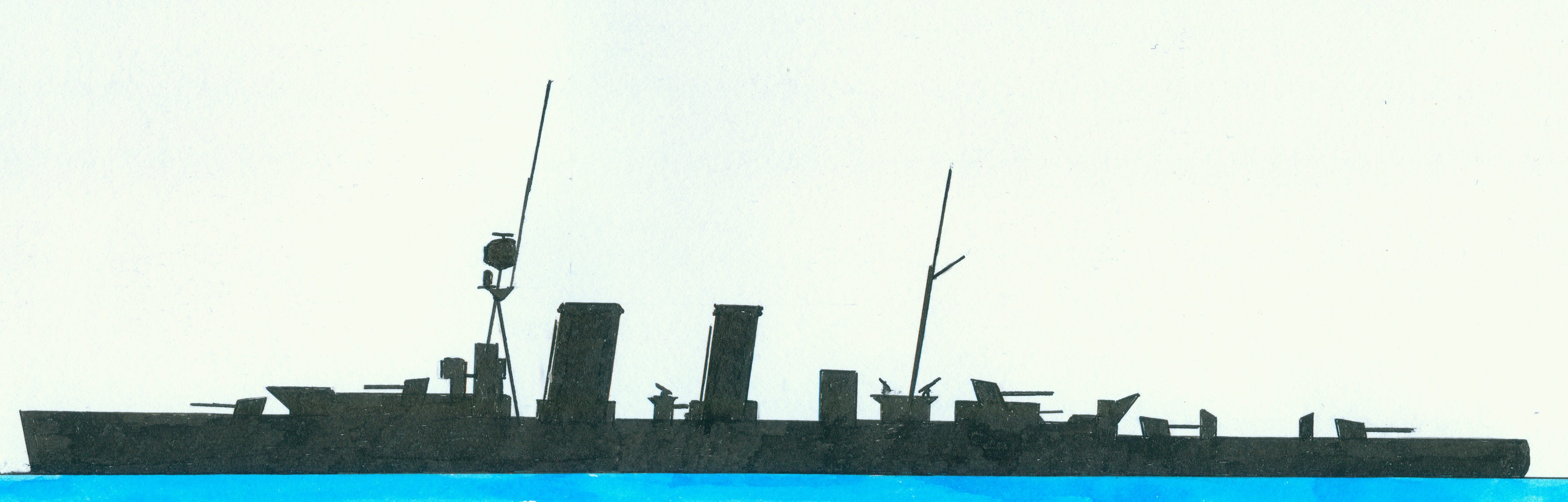
Hawkins-class
An item reported that the British cruiser Amphion (1) after completing her trials was to serve as flagship of the South-African squadron. The Dorsetshire (2) returned to England. The Norfolk (3) was to replace the Hawkins (4) as flagship of the East Indies squadron. It became clear that the London Naval Treaty was a failure as proved by breaking up the Hawkins, Effingham (5) and Frobisher (6) while the last two ships were to have served until 1941.
Notes
1. Building ordered on 1 December 1932, laid down on the Navy Dockyard at Portsmouth, England on 22 June 1933, launched on 27 July 1934, commissioned on 15 June 1936, sold to Australia in 1939, renamed HMAS Perth on 10 July 1939, commissioned on 29 June 1939 and finally sunk in the Second Battle of the Java Sea as part of the Striking Force commanded by the Dutch rear admiral Karel Doorman against Japanese forces on 1 March 1942.Pennant 29 in British service and D29 in Australian service. Motto Floreat, Of the Leander-class light cruisers consisting of the Leander, Orion, Neptune, Ajax, Achilles, Amphion, Apollo and Sydney With the Leander and the Hobart-Perth-Sydney forming sub classes. Preceded by the Emerald class and succeeded by the Arethusa-class.
2. Of the County-class heavy cruisers, laid down by Portsmouth Dockyard, England on 21 September 1927, launched on 29 January 1929, commissioned on 30 September 1930 and sunk during a Japanese aircraft attack while underway towards Colombo, Ceylon on 5 April 1942.
3. Of the Norfolk sub-class of the County-class consisting of the Norfolk and Dorsetshire, preceded by the Hawkins-class and succeeded by the York-class. It was a slightly improved London-design with the positions of her anti aircraft armament and a lower bridge due to the removed topmost deck. Designed by Sir William Berry and built under the 1926-1927 Estimates. Laid down by Fairfield Shipping&Engineering Co. Ltd., Govan, Scotland on 8 July 1927, launched on 12 December 1928, commissioned on 30 April 1930, sold to BISCO be broken up on 3 January 1950 and arrived at Newport on 19 February 1950 to undergo her final fate.
4. Laid down at the Chatham Dockyard, England on 3 June 1916, launched on 1 October 1917, commissioned on 25 July 1919, decommissioned for refit and recommissioned in December 1929, decommissioned in May 1930, recommissioned in 1932, laid up in reserve in April 1935, main guns and torpedo tubes removed in 1937, rearmed and recommissioned in 1939, used after January 1947 for aircraft bomb tests, sold to be broken up on 21 August 1947 and broken up at Arnott Young, Dalmuir, Scotland in December 1947. Part of the Hawkins-class heavy cruisers consisting of the Effingham, Frobisher, Raleigh, Vindictive and Hawkins, succeeded by the County-class. Although it were heavy cruisers was the Hawkins-class in fact an modernized and enlarged Town-class subclass Birmingham light cruiser, In 1915 it became clear that light cruisers were not capable for a sufficient protected of the merchant shipping in distant areas. The heavy cruiser was a combination of a high speed, long range and heavy guns.
5. Building ordered in December 1915, laid down by Portsmouth Dockyard, England on 6 April 1917, launched on 8 June 1921, commissioned on 2 July 1925, modernized between 1937-1938 including rearmament, replacing the 2 funnels by one and rebuilding the bridge, wrecked off Bodø, Norway 18 May 1940 and destroyed by a torpedo by the HMS Matabele. Part of the Hawkins-class heavy cruisers consisting of the Effingham, Frobisher, Raleigh, Vindictive and Hawkins, succeeded by the County-class.
6. Laid down by Devonport Dockyard, England on 2 August 1916, launched on 20 March 1920, commissioned on 20 September 1924 and sold to be broken up on 26 March 1949. Part of the Hawkins-class heavy cruisers consisting of the Effingham, Frobisher, Raleigh, Vindictive and Hawkins, succeeded by the County-class.

