Translate

Showing posts with label Bismarch Archipelago. Show all posts

Tuesday, 20 August 2024

Japanese fleet not reinforced after the Battle of the Coral Sea according to the U.S. Joint Intelligence Committee Daily summary dated 13 May 1942

An item reported that according to aircraft flying over the Bismarck Archipelago and the Solomon Islands up to 10 May Japanese naval units were especially busy with refuelling. It became clear that some went to the east for offensive purposes. There arrived no reinforcements to replace the losses suffered last week in the Coral Sea. (1) Except for lacking enough surface units were due to the loss of aircraft carriers also not enough ship-born aircraft avalaible. The reason for not sending reinforcements was that probably the fitting out of forces in Japanese home waters for offensive operations.

Note

1. Battle of the Coral Sea between USA and Australia against Japan between 4-8 May 1942, the Japanese light carrier Shoho was destroyed and the fleet carrier Shokaku damaged. The fleet carrier Zuikaku was forced to return to Japan for replacing the large loss of aircraft and aircrew.

Source

Map Room Papers (Roosevelt Administration), 1942 - 1945. U.S. Joint Intelligence Committee. Daily summary No. 154 dated 13 May 1942. 

Saturday, 24 September 2022

Japanese warships sighted in the Bismarck Archipelago and Solomon Islands according to the U.S. Joint Intelligence Committee. Daily summary dated 19 August 1942

An item reported that 3 cruisers and 1 destroyer were seen in the harbour of Kavieng, New Ireland [Papua New Guinea] and in Gizo harbour, Solomon Islands 2 destroyers and a freighter.

Source

Map Room Papers (Roosevelt Administration), 1942 - 1945. U.S. Joint Intelligence Committee. Daily summary No. 252 dated 19 August 1942

Saturday, 18 June 2022

Japanese merchant and warships sighted near Rabaul according to the U.S. Joint Intelligence Committee. Daily summary dated 25 August 1942

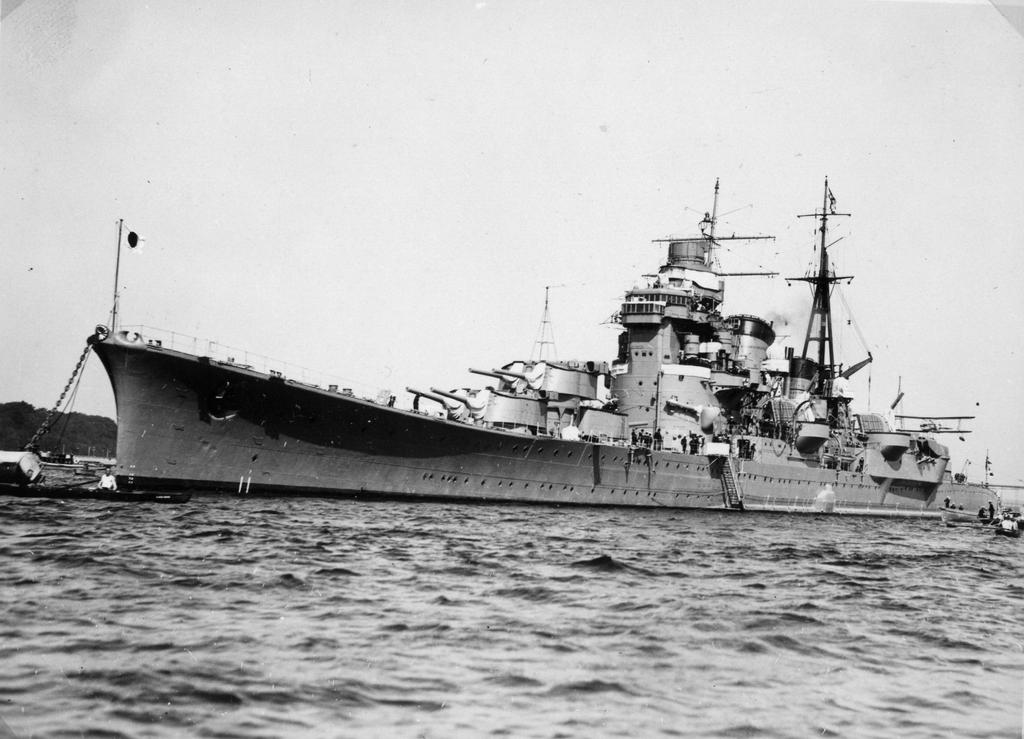
An item reported that on 23 August near Rabaul, Bismarck Archipelago a heavy cruiser of the Japanese Nachi-class(1), 2 large merchant ships and 2 gunboat were sighted.(1)

Note

1. The Myoko-class consisting of the Myoko, Nachi Haguro and Ashigara, with a displacement of 11,633 (standard)-14,980 (full load) tons and a main armament of 5x2-20,3cm/8” guns.

Source

Map Room Papers (Roosevelt Administration), 1942 - 1945. U.S. Joint Intelligence Committee. Daily summary No. 258 dated 25 August 1942.

Saturday, 4 June 2022

Large number of ships sighted in Rabaul Harbour according to the U.S. Joint Intelligence Committee. Daily summary dated 26 August 1942

An item reported that around 25 ships included 8 large ships were sighted on 24 August lying in Rabaul Harbour, Bismarck Archipelago.

Source

Map Room Papers (Roosevelt Administration), 1942 - 1945. U.S. Joint Intelligence Committee. Daily summary No. 259 dated 26 August 1942.

Wednesday, 25 May 2022

Allied aircraft sighted Japanese warships at Rabaul according to the U.S. Joint Intelligence Committee. Daily summary dated 27 August 1942

An item reported that in the night of 24-25 August Allied bombers attacked the Japanese airdromes at Vunakanau, Lukanua and Gasmata (Bismarck Archipelago). In the harbour of Rabaul were three possible cruisers, 4 destroyers, 9 merchant ships, 1 whaling factory ship and 1 tanker sighted.

Source

Map Room Papers (Roosevelt Administration), 1942 - 1945. U.S. Joint Intelligence Committee. Daily summary No. 260 dated 27 August 1942.

Sunday, 8 May 2022

Large number of Japanese merchant and warships sighted in Bismarck Archipelago according to the U.S. Joint Intelligence Committee. Daily summary dated 31 August 1942

An item reported that n 29 August Allied aircraft sighted in the harbour of Rabaul, Bismarck Archipelago [island New Britain, Papua New Guinea] 32 ships with a tonnage varying between 2,000-10,00 tons and at St. George [between New Britain and New Ireland) 2 destroyers and 2 merchant ships.

Source

Map Room Papers (Roosevelt Administration), 1942 - 1945. U.S. Joint Intelligence Committee. Daily summary No. 264 dated 31 August 1942.

Tuesday, 28 September 2021

Algerian general cargo ship (ex-Nordana 2008-2012, Aggersborg 2012-2014) Kherrata 2014-

Schelde off Vlissingen, Netherlands 29 December 2019

Algeria-flagged, homeport Alger, IMO 9646455, MMSI 605086012 and call sign 7THD. Ex-Nordana renamed August 2012 Aggersborg renamed December 2014. Panama-flagged, homeport Panama City 2012-2014. Built with yard number SF100102 between 3 November 2008-29 June 2012 by Taizhou Sanfu Ship Engineering Co. Ltd., Jiangsu, China. Owned by CNAN Nord Spa., and managed by CNAN Group, Algiers, Algeria. 

Wednesday, 25 August 2021

Japanese cargo ship Columbia Maru 1926-1943

Call sign JPZB. Gross tonnage 5.618 tons, under deck 5.210 tons, net tonnage 3.524 tons and as dimensions 405.0 x 55.0 x 32.0 x 8 (light)-25.6 (loaded) feet. Built by Mitsubishi Zosen Kaisen Ltd., Nagasaki, Japan for Mitsubishi Shoji Kaisha Ltd., Tokyo, Japan. Laid down on 24 November 1926, launched on 30 June 1927, completed on 29 July 1927, requisitioned by the Imperial Japanese Navy as No. 890 on 23 July 1941 and sunk by the American submarine USS Gato on 30 November 1943 north of the Admiraly Islands, Bismarch Archipelago, Papua New Guinea. Oil fuelled diesel machinery supplying via a single screw 582 nhp/2.350 bhp allowing a speed of 10.5 (normal)-13 (maximum) knots. With a oil bunker capacity including deep tanks of 1.788 tons and 10.5 knots speed a range of 40.000 nautical miles. Designed as lumber carrier.

Saturday, 1 May 2021

Several Japanese warships except aircraft carriers sighted in the Solomon Islands-Bismarck Archipelago according to the U.S. Joint Intelligence Committee Daily summary dated 17 May 1942

An item reported that allied aircraft flying over the Solomon Islands-Bismarck Archipelago area sighted numerous transports, 1-2 tankers and some cruisers and destroyers although since several days were none aircraft carriers seen. Probably was all available air power drawn back by the Japanese probably for an offensive to the north east areas.

Source

Map Room Papers (Roosevelt Administration), 1942 - 1945. U.S. Joint Intelligence Committee. Daily summary No. 158 dated 17 May 1942

Saturday, 20 February 2021

Japanese cargo passenger ship Kokai Maru 1938-1944

Laid down by Hakodate Dock Company, Hakodate, Hokkaido, Japan for account of Simatani Kisen Kabishiki Kaisha, Kobe, Japan in May 1938, launched in January 1939, requisitioned by the Japanese Imperial Navy on 3 October 1941, registered as auxiliary transport om 10 November 1941 and sunk in an American air attack on 21 February 1944 added to a convoy off New Hanover Island, Bismarck Archipelago, New Ireland Province, Papua New Guinea. With a cruiser stern. Gross register tonnage 3.871 tons, net tonnage 2.288 tons and as dimensions 103,8 x 14,7 x 8 metres or 340.4 x 48.2 x 26.2 feet. Coal fuelled reciprocating steam machinery with exhaust turbine supplying via one show 232 nhp. With a speed of 12 knots and 566 tons coal bunker capacity a range of 5.800 nautical miles. 

Monday, 18 January 2021

Japanese merchant ship attacked east of Rabaul according to the U.S. Joint Intelligence Committee. Daily summary dated 27 May 1942

An item reported that on 12 May east of Rabaul [New Britain, Bismarck Archipelago, Papua New Guinea] a Japanese merchant ship was attacked and probably hit with 2-3 torpedoes.

Source

Map Room Papers (Roosevelt Administration), 1942 - 1945. U.S. Joint Intelligence Committee. Daily summary No. 168 dated 27 May 1942

Sunday, 20 January 2019

Survivors of British sailing ship Aigburth saved by German ships according to the Dutch newspaper Het nieuws van den dag: kleine courant dated 24 August 1904

An item dated Hamburg, Germany 20th August referred to a telegram of the governor of German New Guinea that 16 survivor of the British ship Aigburth (1) were rescued by the German warship Möwe (2) and the German government steamship Seestern (3). Her captain and 7 other crewmember arrived safe at Brisbane, Australia.

Notes
1. British sailing ship underway from Newcastle, New South Wales towards Samarang, Dutch East Indies wrecked off New-Britain [Bismarck Archipelago, Papua New Guinea]. Captain John Henry Reid. Fully rigged vessel lost on 10 July 1904 at Rook Island. Built by Williamson R.&Son, Workington, United Kingdom in 1882. Owned by Welsford J.H.&Co. Ltd. Gulf Transport Line, R.W. Leyland Shipping Co. Ltd., Liverpool, England/
2. Gunboat. Launched with yard number 143 by F. Schichau, Elbing, Germany on 13 May 1879, commissioned on 31 May 1880 and stricken on 9 December 1905. Sister ship HMS Habicht.
3. Small government steel built twin screw steamship of 589 ton, stationed in German New Guinea and which disappeared after she left on 3 June 1909 Brisbane via Samarai towards Adolfshaven, normally a voyage of around 2 weeks. Chartered from the Norddeutschen Lloyd. In Germany assured for 20.000 pound sterling. 

Sunday, 7 October 2012

Japanese seaplane carrier/tender Kamikawau Maru (1936) 1937-1943


Laid down at the Kawasaki Kobe Shipyard on 5 August 1936 for the Kawasaki Kisen K.K. Line as a merchant ship, launched on 13 December and a year later purchased by the Japanese navy on 15 March, commissioned on 18 September and on 29 May 1943 torpedoed by the American submarine USS Scamp and she sunk around 250 miles northwest of Kavieng, New Ireland. With a displacement of 6.863 tons(gross tonnage 6.807 tons) and as dimensions 479 x 62 x 30 feet. Former merchant ship. The armament consisted of 2-5.9” guns, 2x2.5cm anti aircraft guns, 2x1,3cm machine guns and she could carry with her 12 planes (although maximum 24 stored) and for which she was fitted out with two catapults and cranes.. The diesel engine supplied via one shaft 7.600 shp allowing a speed of 28 knots.