Translate

Showing posts with label Nova Zembla. Show all posts

Saturday, 16 November 2024

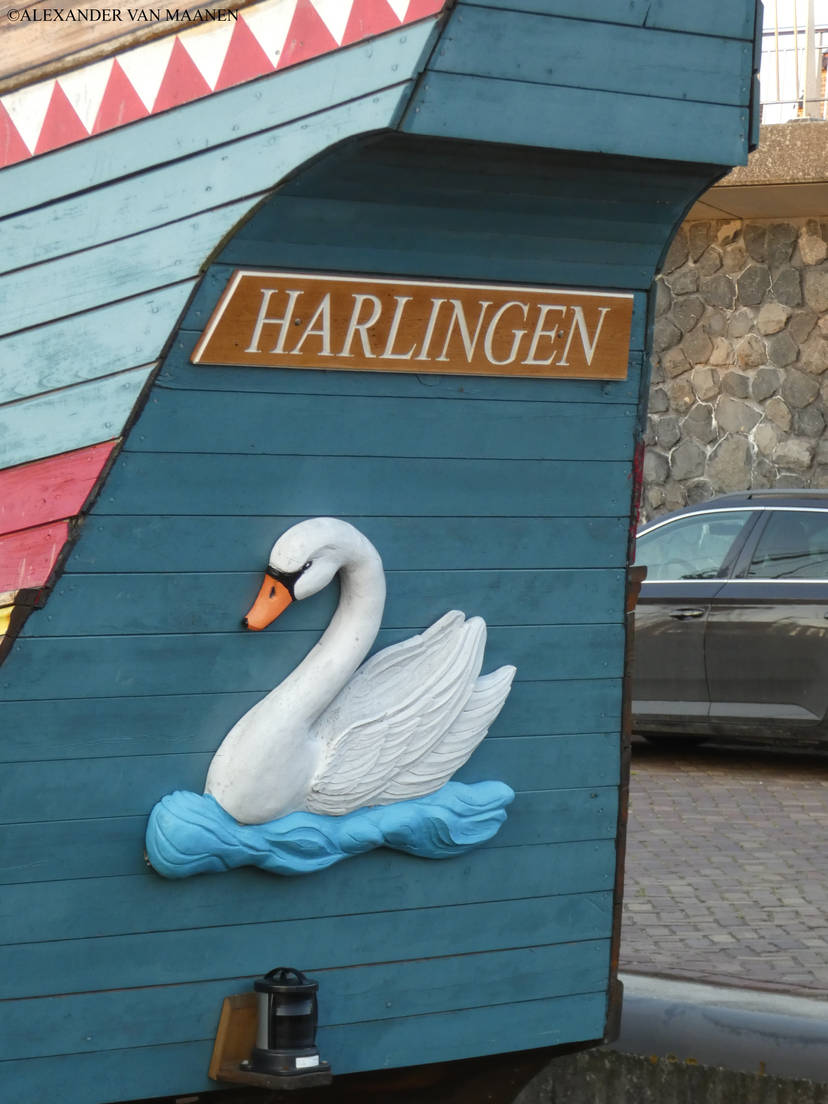
Dutch sailing ship Witte Swaen


Harlingen, Netherlands 21 September 2024

Replia of the ship of Willem Barentsz (around 1550 Formerum, Terschelling, Netherlands-20 June 1597 Nova Zembla) on an expedition bound for the East Indies but stranded on Nova Zembla [Novaya Zemlya]. Building ordered in 2010, launched at Harlingen in 2018. The Barentsz Sea is named after Barentsz who discovered Spitsbergen and Bear Island.

Sunday, 19 April 2020

Large numbers of Russian fishing vessels active in northern seas according to the Dutch newspaper Middelburgsche courant dated 10 December 1785

An item dated St. Petersburg, Russia 12 November reported that 305 vessels were sent from Archangelsk for the fishery off Spitsbergen, Nova Zembla and other northern coasts. One was of Onega and which was used as experiment for whaling with very good catch results which could be a base for more expeditions.

Tuesday, 25 April 2017

Russian (Project 7) destroyer Grozny 1936-1957

Gnevny-class


Storizhevoi-class variants

Laid down at the Zhdanov yard, St. Petersburg, Russia with yard number 502 on 31 July 1936, launched on 21 December 1935m commissioned on 9 December 1938, transferred via the Baltic-White Sea canal between 1939-1940 and added to the Northern Fleet and sunk while used as target for nuclear experiments off Nova Zembla in 1957. Part of the Baltic Fleet. Built under the 2nd Five-Year Plan.

Project 7. Gnevny-class sometimes also referred to as the Gremyashchiy-class. P.O. Trakhtenberg of the Central Design Bureau headed by A.V. Nikitin used for this class the Italian destroyer Alfredo Oriani design and with comparable shortcomings like structural weakness and lacking sufficient seaworthiness in all weather conditions. To solve those shortcomings was chosen to stop further building of the Type 7 and to continue with the modified Type7U design or Storizhevoi-class (some times also called Soobrazitelnyy-class). Of the 36 planned units was the building of 6 cancelled.

General technical class details. With a displacement of 1.612 (standard)-2.039 (full load) and as dimensions 112,8 x 10,2 x 4,8 metres or 370.1 x 33.6 x 15.9 feet. The machinery consisted of 2-shaft GTZA-24 geared steam turbines and 3 water tube boilers supplying 50.500 shp during trials resulting in a speed of 39,37 knots (trials) and with a speed of 19,82 knots in a range of 2.640 nautical miles. Crew numbered 197 (peace)-236 (war). The armament consisted of 4x1-13cm/5.1” B-13 guns, 2x1-7,62cm/3” 34-K anti aircraft guns, 2x1-12,7mm/0.50” DK or DShK machineguns, 3x3-53,3cm/21.0” torpedo tubes, 60-95 mines and 25 depth charges. 

Russian (Project 7) destroyer Gremyashchiy 1936-1957

Gnevny-class


Storizhevoi-class variants

L laid down at the Zhdanov yard, St. Petersburg, Russia with yard number 515 on 23 July 1936, launched on12 August 1937, commissioned on 12 August 1938, transferred via the Baltic-White Sea canal between 1939-1940 and added to the Northern Fleet and sunk while used as target for nuclear experiments off Nova Zembla in 1957. Part of the Baltic Fleet. Built under the 2nd Five-Year Plan.

Project 7. Gnevny-class sometimes also referred to as the Gremyashchiy-class. P.O. Trakhtenberg of the Central Design Bureau headed by A.V. Nikitin used for this class the Italian destroyer Alfredo Oriani design and with comparable shortcomings like structural weakness and lacking sufficient seaworthiness in all weather conditions. To solve those shortcomings was chosen to stop further building of the Type 7 and to continue with the modified Type7U design or Storizhevoi-class (some times also called Soobrazitelnyy-class). Of the 36 planned units was the building of 6 cancelled.

General technical class details. With a displacement of 1.612 (standard)-2.039 (full load) and as dimensions 112,8 x 10,2 x 4,8 metres or 370.1 x 33.6 x 15.9 feet. The machinery consisted of 2-shaft GTZA-24 geared steam turbines and 3 water tube boilers supplying 50.500 shp during trials resulting in a speed of 39,37 knots (trials) and with a speed of 19,82 knots in a range of 2.640 nautical miles. Crew numbered 197 (peace)-236 (war). The armament consisted of 4x1-13cm/5.1” B-13 guns, 2x1-7,62cm/3” 34-K anti aircraft guns, 2x1-12,7mm/0.50” DK or DShK machineguns, 3x3-53,3cm/21.0” torpedo tubes, 60-95 mines and 25 depth charges.