An item reported that the Owers Light Vessel was bombed on 10 July but apparently not damaged.
Source
National Archive UK. CAB-66-9-42.

An item reported that the Owers Light Vessel was bombed on 10 July but apparently not damaged.
Source
National Archive UK. CAB-66-9-42.
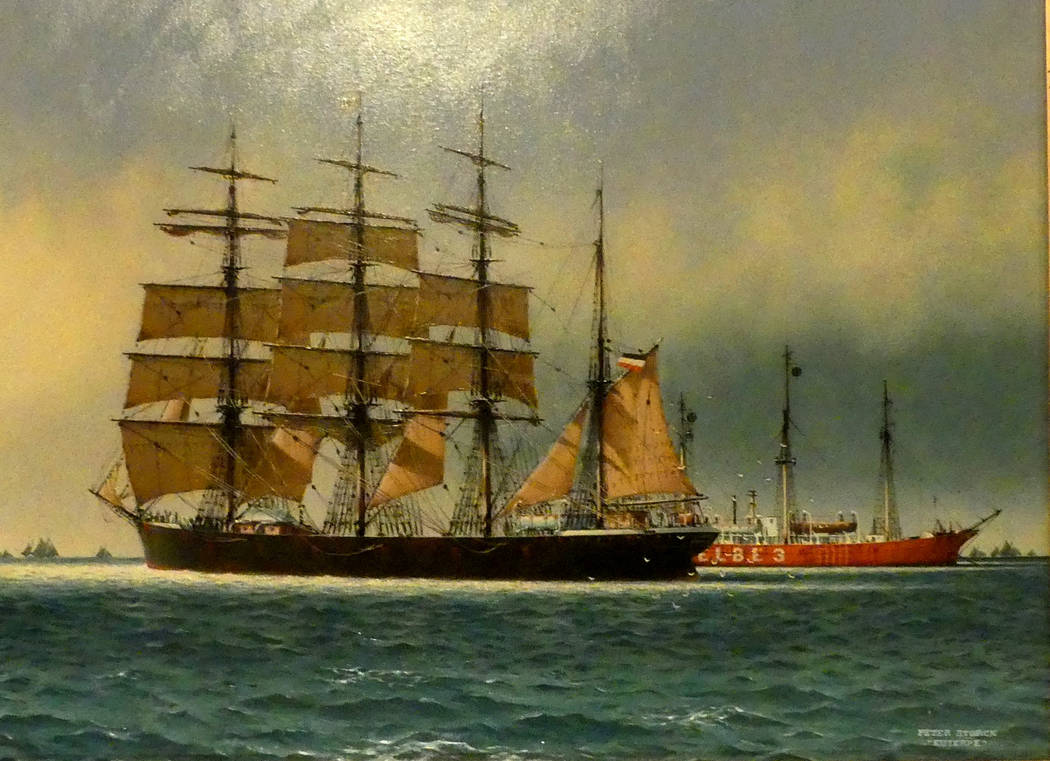
Oil painting by Peter Stork (born 1940)
Maritime Museum Hamburg, Germany, 2023.

Harlingen, Netherlands 5 July 2026
Former British Light vessel number 8, later converted into the discotheek Barocca , berthed between 1991-2000 in the Wijnhaven, Rotterdam and then laid up at Moerdijk, Netherlands and later in the Waalhaven, Rotterdam. Towed in June 2005 to Harlingen where she was modernized and converted into a floating radio station. Ordered by TRinity House, London, England in November 1946, launched by Philip&Son, Dartmouth, England with yard number 1171 on 15 October 1948, Kentish Knock station 1949-1953, Sunk station 1956-1959, Dudgeon Station 1959-1962, Outer Gabbard Station 1962-1965, Tongue station 1965-1975, sold and became discotheek Barocca in Rotterdam and renamed Jenni Bayton on 22 July 2006.

Bremerhaven, Germany 7 May 2026
Built by Eiderwerft AG, Tönning, Germany for account of the Königliche Wasserbau-Inspektion as Eider for the Eider estuary between 1908-1909, light in the North Sea during the First World War, as the Bürgermeister Anbendroth owned by the Cuxhaven Water and Shipping Authority stationed during the Second World War in the Baltic Sea, as beacon and Pilot station Elbe 3 positioned in the German Bight until 1966, finally decommissioned and became a museum ship.

Painted in 1895 by Robert Parlow (26 February 1835 Stepnica, Poland-1901).
Maritime Museum Hamburg, Germany

Terschelling, Netherlands 17-11-2025
Netherlands-flagged, homeport Amsterdam, Netherlands, IMO 8333635, MMSI 246253000 and call sign PCDT. Built as a lightship at Wichhorst, Hamburg, Germany in 1905 to serving in the entrance of the river Elbe. In 1984 restored and barquetine-rigged. Since 2005 owned by Tallship Company/Tallship Artemis, Wieuwens, Netherlands. Gross tonnage 380 tons, deadweight 73 tons and as dimensions 42,5 x 7,47 metres. Ex-Bürgermeister Bartels Elbe 2 renamed 1985. As lightship also fitted out with 3 masts. Replaced in 1974 by lighthouse Grosser Vogelsand and rebuilt into a passengers ship 1984-1985. Barquetine

Stanley, Falkland Islands/Islas Malvinas, January 2025
Built in 1854, replaced and rebuilt with a new fundation in 1906, since the Falklands War of 1982 out of service.

Call sign HSAN. Built by A/S Nakskov Skibsvaerft, Nakskov, Denmark in May 1927. After the Second World War even temporarily lightship in the mouth of the Menam River. Owner in 1939 Siam Steam Navigation Company, Bangkok, Siam, daughter company of the Danish East Asiatic Company. Oil fuelled. Gross tonnage 686 tons, under deck 504 tons, net tonnage 410 tons and as dimensions 199.9 (Loadline) x 32.5 x 11.01 x 9.7 feet.
An item referred to the Senior Naval Officr (S.N.O.) Baltic who reported that the light ships at the points 12 and 13 on the Baltic route and mine chart left their positions on account of ice.
Source
The National Archives, Kew Gardens, England CAB-24-98-79


Building ordered in 1906. launched as a reserve light vessel by AG Weser, Bremen, Germany with yard number 155 on 10 September 1906, decommissioned in 1985, sold to to the Deutsche Stiftung Sail Training Ship and renamed Alexander von Humboldt on 20 May 1988, homeport Bremen, converted into the training vessel TSG 404, sold in December 2011, commissioned in Feburary 2012, Bahamas-flagged, homeport Freeport, 2013 Antigua and Barbuda-flagged, homeport St. John’s, call sign V2KY6 and reflagged Germany, homeport Bremerhaven, call sign DHVH2 and in 2014 converted into a floating hotel. Displacement 396 metric tons and as dimensions 62.55 x 8.02 x 4.8 metres or 205.2 x 26.3 x 16 feet.


Laid down by Nederlandse Stoomboot Mij. Fijenoord, Rotterdam, Netherlands with yard number 135 on 4 April 1885 for account of the Department of Colonies, launched ion 3 or 5 December 1885, trial on 12 February 1886, commissioned at Hellevoetsluis, Netherlands on 16 February 1886, decommissioned on 11 July 1904 and handed over to the Government-Marine on 5 August 1906, converted to pilot light ship in 1922 and between May 1923-May 1924 coal hulk. Served in the Dutch East Indies. Costs while first time fitted out for the sea 600.000 Dutch guilders. Displacement 1.118 tons and as dimensions 62.60 x 9.50 x 4.30 metres. Iron built, wood covered and coppered. Crew numbered 78 Europeans-34 natives. With 1.050 ihp horsepower a speed of 12.75 miles. Armament consisted of 1-15cm A gun, 3-12cm K.A. guns, 1-7,5cm A gun and 3-3.7cm guns.
An item reported that a cargo ship was attacked by an enemy submarine 5 miles east of the Ambrose light vessel. Submarines of the enemy seemed to be especially active on the east coast of Florida, in the Gulf of Mexico and on the trans Atlantic shipping routes eastward of Newfoundland.
Source
Map Room Papers (Roosevelt Administration), 1942 - 1945. U.S. Joint Intelligence Committee. Daily summary No. 156 dated 15 May 1942

National Maritime Museum of Ireland, Dublin, Ireland April 2019. Artist Kenneth King.
Sunk by German aircraft on 19 December 1940. Of her crew were 6 men killed and 7 wounded. Built with yard number 124 by Dublin Dockyard Co. (Vickers Ireland), Dublin for account of the Commissioner of Irish Lights, Dublin. Gross register tonnage 734 tons, under deck 607 tons and as dimensions 60.44 x 9.88 x 4.24 metres or 198.3 x 32.4 x 13.9 feet. Call sign EIJF.

Tweede Binnenhaven Vlissingen, Netherlands between 1910-1920
Built
by Wilton Fijenoord, Rotterdam, Netherlands in 1910, converted from gas
lightning in electric lightning in 1926, in the Second World War towed to Kiel,
Germany but returned after the war and served until 1965 as the Lichtschip
Texel.


