Translate

Showing posts with label Iraq. Show all posts

Wednesday, 19 August 2026

Cuban cargo ship Bolivar 1976-1990

©Warshipsresearch.blogspot.com

Similar Bolivar, Juarez, San Martin, José Marti, O’Higgins, and Sandino. Built by Helsingør Skibsvaerft&Maskinbyggeri, Helsingør, Denmark with yard number 409 in 1976 forEmpresa Maritimo Portuaria de Importación, Havana, Cuba. Gross tonnage 9,656 tons, deadweight 14,500 tons, horsepower 11,200 bhp and speed 17,5 knots. Dimensions 154,1 x 19,8 x 9,5 metres. IMO 7420027. Locked up at Basrah when the war broke between Iracq and Iran broke out on 12 September 1980 and 23 September 1980. 

Tuesday, 13 January 2026

Sailors of British warships HMS Espeigle and Triad transferred to Tigris river patrol vessel according to the Weekly Intelligence Summary Nr. 10 for the week ending 11 September 1920

An item reported that naval ratings belonging to the HMS Espeigle (1) and the Triad (2) were used to crew two T-class vessels to patrol the narrows of the Tigris river, Mesoptamia [Iraq].

Notes

1. Part of Cadmus-class sloops preceded by Condor-class succeeded by Flower-class, launched at Sheerness Dockyard, England on 8 December 1900 and sold at Bombay, India on 17 September 1923.

2. Yacht. Launched at Caledon Shipbuilding and Engineering Co. on 9 November 1908, completed in June 1909, hired by the navy, pennant N88 in August 1914, special service vessel since 1 January 1920, became headquarters for the navy in the Persian Gulf and sold at Bombay, India in May 1933.

Source

The National Archives CAB-24-111-56. Weekly Intelligence Summary Nr. 10 for the week ending 11 September 1920.

Saturday, 10 January 2026

Crew of British screw steam sloop HMS Clio arrived at Basra, Iraq according to the Weekly Intelligence Summary Nr. 10 for the week ending 11 September 1920

An item reported that officers and ratings of the HMS Clio arrived at Basra [Iraq]. Probably the former was to be withdrawn and 4 Fly-class gunboats crewed by the navy. (1)

Note

1. Part of Cadmus-class sloops preceded by Condor-class succeeded by Flower-class, laid down at Sheerness Dockyard, England on 11 March 1902, launched on 14 March 1903, completed in 1904 and sold at Bombay, India to be broken up on 12 Novemben 1920.

Source

The National Archives CAB-24-111-56. Weekly Intelligence Summary Nr. 10 for the week ending 11 September 1920.

Monday, 25 December 2023

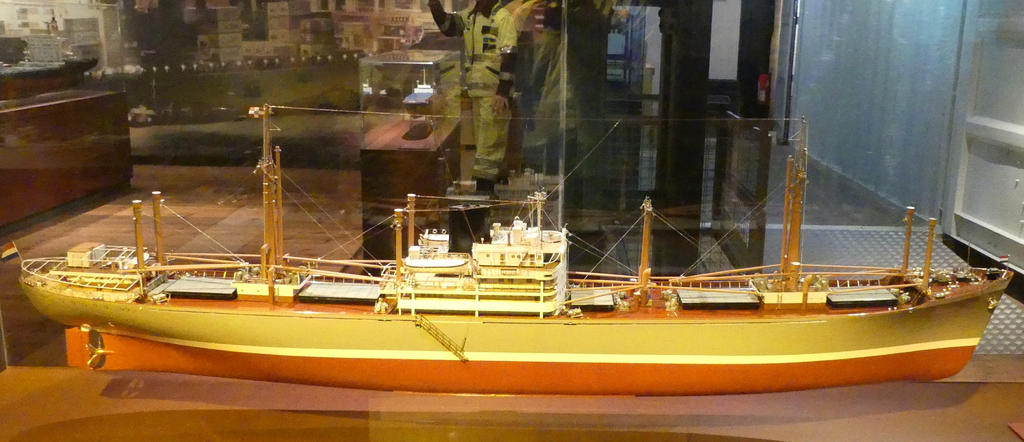
Dutch general cargo ship Wonasari 1951-1977 (Lucille 1977-1982)

Maritime Museum Hamburg, Germany

IMO 5392642. Laid down byHowaldtswerke Hamburg A.G., Hamburg, Grmany with yard number 874 on 27 August 1951, launched on 26 May 1952, delivered to N.V. Koninklijke Rotterdamsche Lloyd and manager Firma Wm. Ruys&Zonen, both Rotterdam, Netherlands on 3 September 1952, chartered by the KJCPL 1970-1972, sold to Uni-Ocean Lines Pte. Ltd., Singapore on 26 April 1977, renamed Lucille, damaged at Basrah during the war between Irak and Iran in 1980 and declared total loss in 1982. She was the first ship built for Dutch account in West-Germany since the Second World War and to serve on the line Hamburg,Germany-Indonesia. Gross tonnage 7,583 tons, net tonnage 4,210 tons, deadweight 10,882 tons, grain capacity 635,000 cubic feet, bale capacity 600,000 cubic feet and as dimensions 143.26 (between perpendiculars)-154.82 (over all) x 20.15 x 12.20 x 8.24 metres. Single screw, horsepower 8,250hp and speed 6 knots. 

Sunday, 26 June 2022

British defence vessel HMS Greenfly was towed to Nasiriya, Mesopotamia according to the Weekly Intelligence Summary No. 2 dated 15 January 1921

An item reported that the British defence vessel HMS Greenfly was towed to Nasiriya. Mesopotamia.

Note

1. Fly-class river gunboat, also called small China gunboat, especially designed for patrolling on the Tigris river, building ordered in February 1915, launched by Yarrow&Company in September 1915, paid off in March 1918 and sold at Basra, Iraq on 1 March 1923.

Source

The National Archives, Kew Gardens, England CAB/24/118/69

Wednesday, 22 June 2022

British river gunboat HMS Greenfly in Mesopotamia refloated according to the Weekly Intelligence Summary No. 1 dated 8 January 1921

An item reported that in Mesopotamia the British defence vessel Greenfly was refloated. (1)

Note

1. Fly-class river gunboat, also called small China gunboat, especially designed for patrolling on the Tigris river, building ordered in February 1915, launched by Yarrow&Company in September 1915, paid off in March 1918 and sold at Basra, Iraq on 1 March 1923.

Source

The National Archives, Kew Gardens, England CAB/24/118/41

Monday, 25 April 2022

British Royal Navy active in the Tigris-Euphrates area according to the Weekly Intelligence Summary Nr. 8 dated 28 August 1920

An item reported that the 2 British T-class river vessels (1) serving on the Tigris, Mesopotamia were manned from crew members of the British HMS Triad and Espiegle and used for patrolling in the Narrows. There were also vessels needed to serve on the Euphrates to support the military with transporting food supplies to Samawah [Iraq]. At the moment was all fighting around the last mentioned river going on.

Note

1. The Fly-class river gunboats also known as small China gunboats collectively known as the Tigris gunboat flotilla? These gunboats were used for patrolling on the Tigris in the Mesopotamian Campaign in the First World War.

Source

The National Archives CAB 24-111-18

Tuesday, 30 June 2020

Iraq tug Alarm (1919) in 1948

Ex.St. Ewe. Call sign GWTN. Gross tonnage432 tons, tonnage under deck 370 tons, net tonnage 5 tons and as dimensions 135.4 x 29.0 x 13.6 feet. Built by Myrdoch &Murray Ltd., Port Glasgow, Scotland in June 1919. Owned by Iraq Direcorate General of Navigation, Homeport Basra,Iraq -flagged.

Source
Lloyds Register 1947-1948.

Thursday, 2 January 2020

Iraq wanted own navy according to the Dutch newspaper Het Vaderland dated 5 July 1933


An item referred to the newspaper Daily Herald which reported that king Feisal of Iraq during his stay in England tried to interest England in building a navy for his country. If the needed budget was approved were in England two gunboats and two smaller warships to be built and a large naval dock at Bachra to be made.

Friday, 1 November 2019

Patrol vessel No. 1 of Iraq 1937->1959


Launched on 16 April 1937 at the yard of John I. Thornycroft&Company Limited at Woolston, Southampton, England and handed over in the summer. She was slightly armoured with bullet-proof plating. With a displacement of 67 tons and as dimensions 100 x 17 x (mean) 3 feet. The two Thornycroft 6 cylinder diesels supplied 280 bhp allowing a speed of 12 knots. The armament consisted of 1-3.7” howitzer, 2-3” mortars and 4 machineguns.

Monday, 16 September 2019

France wanted to built her own tankers according to the Dutch newspaper Algemeen Handelsblad dated 13 October 1935

An item dated Paris 12 October reported that France intended to build her own tanker fleet to transport the French Iraq petrol to the refineries in France. Recently was for this purpose already a large tanker launched and in the coming month en begin 1936 were three more tankers to be completed.

Friday, 11 January 2019

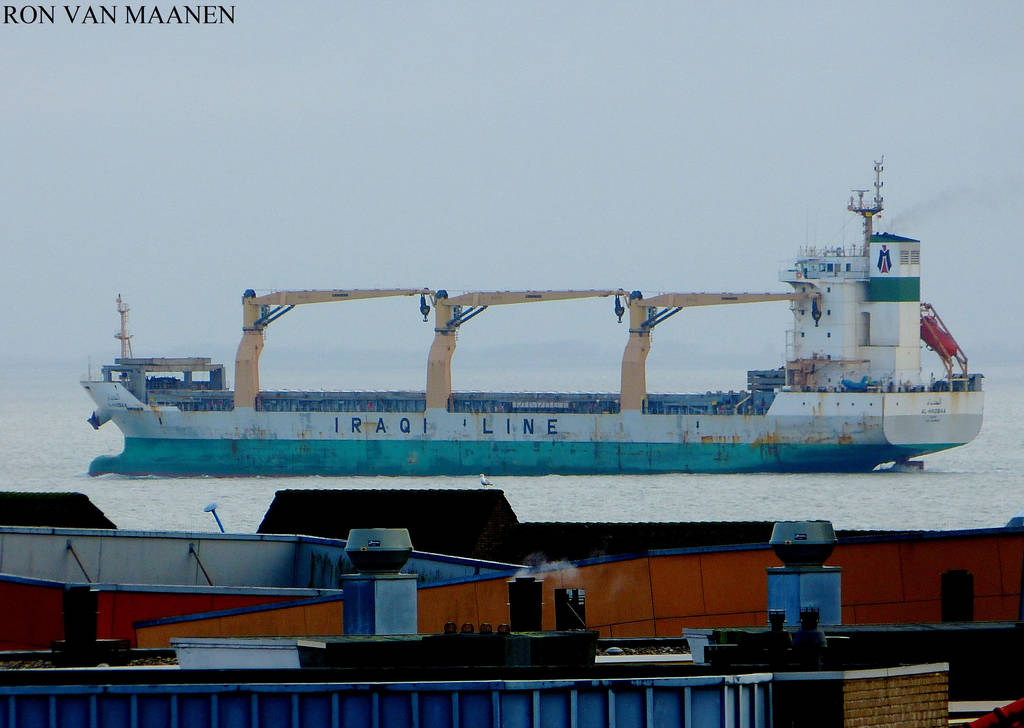
Iraqi general cargo ship Al Hadbaa 2014-

Schelde off Vlissingen, Netherlands 11 January 2019

Jordania-flagged, IMO 9649988, MMSI 438-31045 and call sign JYB345. Owned and managed by Iraq Government, Baghdad, Iraq. Built by Dae Sun Shipbuilding&Engineering, Pusan, South Korea in 2014. 

Saturday, 7 April 2018

Italian built torpedo boats for the Arab League according to a CIA report dated 5 January 1949

An item reported that the Baglietto Naval Yards at Varazze, Italy received orders to built 6 torpedo boats (so-called MASs) each with as building costs 140 million lire. The armament was to consist of 2-45cm torpedo tubes and 2-2 machineguns. Length 18,70 metres. The Asso engine delivered by Isotta Fraschini was to make a minimum speed of 42 knots possible and was to be teste during 70 minutes with 950hp and 10 minutes with full power. The boats were destined for the Arab League (1) and were contracted via the mediation of G.S. Sabbak of Beirut, Lebanon and M. Chacour, Damascus, Syria, who received 5% commission for this transaction.

Note
1. A organisation founded on 22 March 1945 at Cairo, Egypt consisting of the Kingdom of Egypt, Kingdom of Iraq, Transjordan (since 1949 Jordan), Lebanon , Saudi Arabia and Syria to which Yemen was added of 5 May 1945. Since then increased the number of members to 22 with Syria yet suspended since November 2011.

Source
The report was published on www.archive.org, document number CIA-RDP82-00457R002200330004-1

Sunday, 11 December 2016

Russian Project 206 Shtorm-class and Project 20E Mol class torpedo boats 1960->2006


Called by the NATO the Shershen-class. The Shershan-class was preceded by the project 183 Bolshevik torpedo cutter and succeeded by the Turya-class. Designing process started in 1956 whiel the first unit built at the Yaroslav Shipyard entered the service in October 1970. The Yaroslalv Shipyard, Sredne-Nevskiy and Sosnovskiy Shipyard built totally 80 of this class with the Yugoslavian Kraljevice Shipyard building another 10 in licence (Croatia captured in 1991 w of the former Yugoslavian boats). Except for the Soviet Union served Shershan-class torpedo boats in the navies of Angola, Bulgaria, Cambodia, Cape Verde islands, Congo, Egypt, East Germany, Vietnam. Guinea and Guinea-Bissau. Further more was the simplified version Project 206E (called by the NATO Mol produced for the export market (Ethiopia, Iraq, Somalia and Sri Lanka).

With a displacement of 148 9standard)-172 (full load) tons and as dimensions 34,08 x 6,72 x 1,46 (draught) x 1,5 (draft) metres. The machinery consisted of 3-4.000hp M-503A diesel engines allowing a maximum speed of 45 knots. The range varied between 850 nautical miles with a speed of 30 knots (cruising) respectively 460 nautical with a continuous speed of 42 knots. The crew cumbered between 20-24 men (included 2 officers). The armament consisted of 2-AK0230 3cm/65 guns (1x bow, 1x stern), 1x1-SAN-5 MANPAD air defence missiles, 2 depth charge racks and 4 OTA-53-206M 53,3cm torpedo tubes mounted on the sides. 

Monday, 13 June 2016

Polish minesweeper Project 254-M ORP Dzik, Bizon, Bóbr, Rosomak, Delfin, Foka, Mors, Rys, ORP Zbik


Of the T-43 class minesweepers which were built for the Soviet-Union, Poland, Albania, Algeria, Bulgaria, China, Cuba, Egypt, Indonesia, Iraq and Syria. General technical specifications were a displacement of 500 (standard)-569 (full load) tons and as dimensions 58 x 8,5 x 2,15 x 2,30 (draft) metres. Diesel engines provided totally 2.200 hp allowing a speed of 14 knots and with a speed of 10 knots a range of 3.800 nautical miles. The crew numbered 10 officers and 60 men. The armament consisted of minesweeping devices, 2x2-3,7cm guns, 2-12,7mm machineguns and 1 depth charge launcher for maximum 32 mines. With a steel made hull which was to be degaussed for active service. Designing started in 1946 ending in 1948 in an approved design. There were some subclasses. Project 254M built since 1955 had 2,5cm guns in stead of 12,7mm machineguns. Variable pitch-screws, deep mechanical sweeping, acoustic and magnetic sweeping devices and more modern anti submarine warfare (ASW) mortars.

ORP Dzik, pennant T-64, later 604
ORP Bizon, pennant T-65, later 605
ORP Bóbr, pennant T-66, later 606
ORP Rosomak, pennant T-67, later 607
ORP Delfin, pennant T-68, later 608
ORP Foka, pennant T-69, later 609
ORP Mors, pennant T-70, later 610
ORP Rys, pennant T-71, later 611
ORP Zbik, pennant T-72, later 612

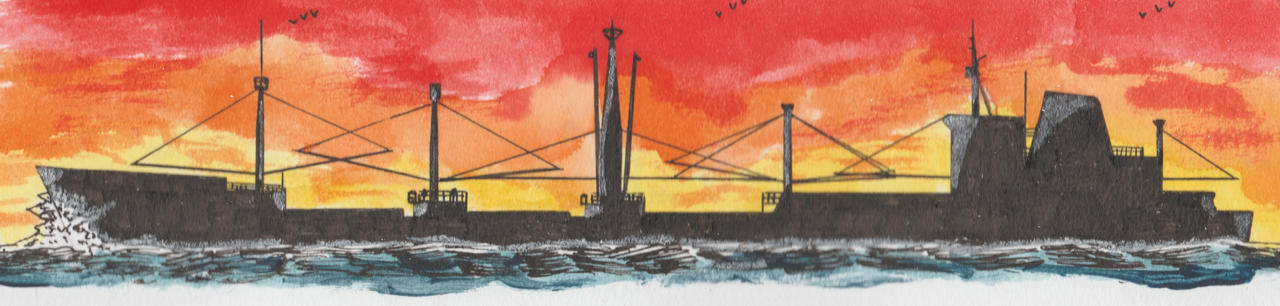
Polish minesweepers project 2465K ORP Zubr, Tur and Los


Of the T-43 class minesweepers which were built for the Soviet-Union, Poland, Albania, Algeria, Bulgaria, China, Cuba, Egypt, Indonesia, Iraq and Syria. General technical specifications were a displacement of 500 (standard)-569 (full load) tons and as dimensions 58 x 8,5 x 2,15 x 2,30 (draft) metres. Diesel engines provided totally 2.200 hp allowing a speed of 14 knots and with a speed of 10 knots a range of 3.800 nautical miles. The crew numbered 10 officers and 60 men. The armament consisted of minesweeping devices, 2x2-3,7cm guns, 2-12,7mm machineguns and 1 depth charge launcher for maximum 32 mines. With a steel made hull which was to be degaussed for active service. Designing started in 1946 ending in 1948 in an approved design. There were some subclasses. Project 254 K built since 1952 was fitted out with radar and the a new MT-2 minesweeping gear.

ORP Zubr, pennant T-61 later 601.
ORP Tur, pennant T-62 later 602.
ORP Los, pennant T-63 later 603.

Monday, 23 May 2016

Russian missile boat or fast attack craft Project 183R or Komar-class 1956-1980’s


With as subclass project 183 motor torpedo boat. Succeeded by the Osa-class. Totally were 112 units built which served in the navies of the Soviet Union, Algeria, Cuba, Ethiopia, Guinea, Egypt, Indonesia, Iraqi, North Korea, China, Syria and Vietnam. Displacement 61,5 (standard)-66,5 (full load) tons and as dimensions 25,4 x 6,24 x 1,24 (draught) x 2 (draft)metres. The machinery consisted of 3 shaft M-50F diesels delivering 4.800 hp allowing a speed of 44 knots and with a speed of 32 knots a range of 600 nautical miles/ The crew numbered 3 officers and 14 sailors. The armament consisted of 1x2-2,5cm 2M-3M gun for which 1.000 round were taken with her and 1 KT-67 missile launchers each loaded with 1 P-15 Termit/SS-N Styx anti ship missile.

Friday, 29 May 2015

Iraq landing ship medium Atika (L72) 1976-1991


Russian Project 773K  (called by the NATO Polnocny-C Class. Built at the Stocna Shipyard, Gdansk, Poland. Handed over on 3 May 1986 and sunk by British aircraft in the Gulf War on 30 (?) January 1991. Dimensions 81,30 x 9,30 x 2,30 metres with a displacement of 1.192 (standard)-1.305 (full load) tons. The armament consisted of 2x2-3cmAK-230 anti aircraft guns and 2-12,2c WM-40-tubet launchers. Fitted out with 2 Type 40DM diesel engines with a total horsepower of 4.400 bhp, a speed of 16,3 knots and with a speed of 13 knots a range of 965 nautical miles. Her crew numbers 118 men. Transport capacity 180 troops and 350 ton cargo included 6 tanks.

Wednesday, 8 April 2015

British forces captured German river vessels in Iraq according to the Dutch newspaper Het nieuws van den dag voor Nederlandsch-Indië dated 3 April 1918

An item dated London. England 1st referred to tidings received from Mesopotamia [Iraq] that British forces in the meantime already left Ana [Iraq] 70 miles behind them. Some Germans were taken prisoner of war and 2-4” guns mounted on river vessels were captured.

Saturday, 24 January 2015

Iraq grab hopper dredger Al Mosul 1958-

Steel-built. Launched at the shipyard Verschure&Co.’s Scheepswerf en Machinefabriek N.V., Amsterdam, Netherlands with yard number CO 375 for account of the Directorate of Ports and Navigation, Basrah, Iraq on 15 February and commissioned on 8 September 1958. Dimensions 63,20 (over all) x 12,10 x 4,88 (depth) metres, deadweight 1.200 ton and a register tonnage of 1.141 gross and 192 net tons. Hold capacity 166 cubic metres. Dredging depth 16,15 metres. Main engine 3x870 hp. Speed 11 knots. IMO no. 5007637.