Translate

Showing posts with label South Vietnam. Show all posts

Thursday, 24 September 2026

French warships Castor, Joussel and Fulton visited Sabang, Dutch East Indies in 1932

The Jaarboek van de Koninklijke Nederlandsche Zeemacht 1931-1932 reported that the French minelayer (1) Castor and submarines Joussel (2) and Fulton (3) visited Sabang, Dutch East Indies between 10-15 February 1932. The Dutch newspaper Bataviaasch nieuwsblad dated 11 February 1932 confirmed the arrival of the Castor at Sabang. During a ceremony was a wreath laid for the French sailors during the First World War buried at Sabang. The Joussel was called Joessel in the news item. The De Sumatra Post dated Friday 12 February report the arrival of the three ships on the Wednesday before with the Castor as mother ship. The submarines had each a crew numbering 44 men, the last 170 men. They left Toulon on 24 November 1931 en intended to leave next Monday towards Singapore and Saigon, French Indochina. The Deli courant dated 10 February reported the arrival at Sabang at 10:00 o’clock coming from Colombo, Ceylon. Commander-in-chief was corvette captain Augier. The Haagsche courant dated 12 February reported that during the First World War several foreign merchant ships were laid up at Sabang, which were not able to get safe to their homeport. Except for a large number of German ships were there also some French steamships of which deceased crew members were buried at Sabang.(4)

Notes

1. Launched by Swan, Hunter&Wigham Richardson Ltd., Neptune Yard, Low Walker with yard number 1010 on 29 August 1916, completed in November 1911 for account of the Russian government as icebreaker Kozma Minin, interned at Cherbourg, France in 1920, renamed Castor, converted into a minelayer and France-flagged, seized by Germany at Bizerte, French Tunisia on 8 December 1942, handed over to Italy, renamed FR 60, scuttled at Bizerte on 7 June 1943, refloated in 1946 and broken uyp on 18 August1947.

2. Q 109. Part of Joessel-class diesel-electric attack submarines preceded by Amride-class succeeded by Lagrange-class, laid down by Arsenal de Cherbourg in November 1913, launched on 21 July 1917, completed in May 1936 and stricken in May 1936.

3. Q 110. Part of Joessel-class diesel-electric attack submarines preceded by Amride-class succeeded by Lagrange-class, laid down by Arsenal de Cherbourg in November 1913, launched on 1 April 1919, completed in July 1920 and stricken in May 1936.

4. At Sabang were ensign Jacques Carissan and sailor Hamon Joseph Clairon buried after they died in the local hospital. Both men were wounded in the Battle of Penang of 28 October 1914 when the German light cruiser SMS Emden sunk the French destroyer Mousquet. The men were dropped by the same Emden at Sabang. 

Thursday, 2 July 2026

Strength of the Vietnamnese navy according to the Australia Station Intelligence Summary dated 1 July 1955

An item reported that the navy of South Vietnam was under the command of the French Naval Adjutant to the Chief of Staff to the Vietnamnese Armed Forces. The fleet consisted of 1 submarine chaser (ex-Mousquet), 3 YMS’s, 1 LSSL, 2-LSIL’s, 21 LCM’s, 3 LCU’s and 24 LCBP’s.

Source

Website Royal Australian Navy, Sea Power Centre.

Thursday, 10 October 2024

French naval air strength in South Vietnam decreased according to the Australia Station Intelligence Summary dated 1 February 1956

An item reported that the French naval air strength in South Vietnam was already limited to 6 Privateers, 1 Dakota, 4 Moranes and 12 Grumman Goose since the carrier Bois Bellau with a full complement of planes went back home.

Source

Website Royal Australian Navy, Sea Power Centre.

Tuesday, 16 July 2024

France withdrawing naval personnel in Vietnam in 1956 according to the Australia Station Intelligence Summary dated 7 January 1956

An item reported that France evacuated Tourane, South Vietnam and withdrew all her naval personnel from the posts of Cantho, Mytho, Vinh Long and Long Xuyen in the southern delta area. Posts including all facilities ere now in hands of the Vietnamnese navy.

Source

Website Royal Australian Navy, Sea Power Centre.

Sunday, 14 April 2024

Japan chartered larqe quantity of Vichy French merchant ships according to the U.S. Joint Intelligence Committee. Daily summary dated 5 April 1942

An item reported that Vichy France and the Japanese on 5 April decided that Japan would seize 100,000 tons of the French shipping in Indochina and elsewhere in the Far East. France proposed that Japan would charter 59,000 tons of large ships and 7,000 tons of smaller ships for the Shanghai-Philippines-Japan connection and another 20,000 tons which would France used for the connection between Indochina and Madagascar. The remaning 14,000 tons would be French controlled and used for the coastwise trade in Indochina. The ships were not be used for transporting troops and/or war stores, to be France-flagged and crewed with French officers and sailors. The J.I.C. commented thats proved the shortage of Japanese shipping.

Source

Map Room Papers (Roosevelt Administration), 1942 - 1945. U.S. Joint Intelligence Committee. Daily summary No. 116 dated 5 April 1942.

Monday, 12 February 2024

French survey vessel Ingenieur-en-Chef Girod handed over to the South Vietnamese navyaccording to the Australia Station Intelligence Summary dated 1 February 1956

An item reported that the French survey vessel Ingenieur-en-Chef Girod with 950 tons displacement was handed over to the South Vietnamese navy. This former US vessel had been in Indo-China waters since 1949 and recently used for surveying the New Cambodian harbour under construction in the Bay of Kompong Song. A French hydrographic expert stayed responsible for directing hydrographic missions and training Vietnamese. (1)

Note

1. The HQ 451 Hoa Giang ex-Dinr An, Ingenieur en Chef Girod, FS287, Governor Wright), dimensions 176 x 32 1/3 x 10 1/6 feet. Crew numbered 55 men. 2 G.M. diesel propulsion with 1,000 bhp a speed of 12 knots. In December 1955 sold to Vietnam and 1 December transferred. FS=Freight and Supply. In 1943 commissioned by the US Army and used for transport of munition, food and weapons in the Pacific. In 1948 brought to Manille to be used by the French Department for Public Affairs, loaned to the French navy in 1949? The FS-287 was a coast guard manned army vessel commissioned at the Wheeler Shipyard, Whitestone, NY on 1 March 1945 and decommissioned on 23 August 1945. Vesseltracking.net mentions a general cargo ship Ingenieur en Chef Girod, IMO 5161093, built in 1944, gross tonnage 560 tons and dimensions 53.9 (over all) x 9.8 metres?

Source

Website Royal Australian Navy, Sea Power Centre.

Tuesday, 24 October 2023

Strength of the South Vietnamese navy caccording to the Australia Station Intelligence Summary dated 1 December 1956

An item reported that the South Vietnamese navy consisted of 2 submarine chasers, 5 patrol craft, 3 minesweepers YMS type, the coast guard patrol vessels numbered 71 miscellaneous small craft, there were 2 auxiliaries and of landing craft 2 LS.S.L., 5 L.S.I.L., 2 L.S.M., 7 L.C.I., 63 L.C.M. (37 armoured, 26 unarmoured) and 103 L.C.V.P. (73 armoured, 30 unarmoured).

Source

Website Royal Australian Navy, Sea Power Centre.

Sunday, 1 October 2023

Strength of the South Vietnamese navy caccording to the Australia Station Intelligence Summary dated 1 December 1956

An item reported that the South Vietnamese navy consisted of 2 submarine chasers, 5 patrol craft, 3 minesweepers YMS type, the coast guard patrol numbered 71 miscellaneous small craft, there were 2 auxiliaries and of landing craft 2 LS.S.L., 5 L.S.I.L., 2 L.S.M., 7 L.C.I., 63 L.C.M. (37 armoured, 26 unarmoured) and 103 L.C.V.P. (73 armoured, 30 unarmoured).

Source

Website Royal Australian Navy, Sea Power Centre.

Saturday, 18 October 2014

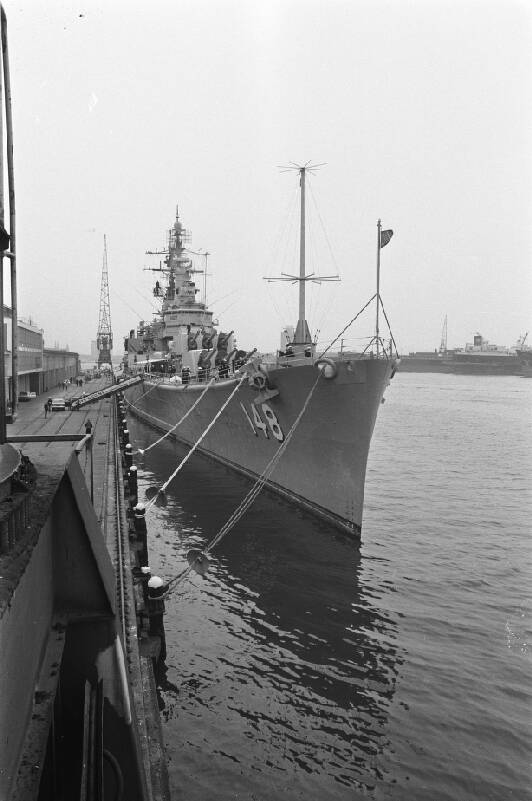
American cruiser USS Newport News (CA-148) 1945-1993

USS Newport News visiting Amsterdam, Netherlands
Bert Verhoeff/ANefo 1971. Beeldbank Nationaal Archief. CC Attribution-ShareAlike. Original

Of the Des Moines class-heavy cruisers. Described during her visit to Amsterdam, Netherlands as the largest cruiser of the world.  Laid down at the shipyard of Newport News Shipbuilding and Dry Dock Company, Newport News, Virginia, USA on 1 November, launched on 6 March 1948, sponsored by Mrs. Homer L. Ferguson, commissioned on 29 January 1949, decommissioned on 27 June 1975, stricken on 31 July 1968 and finally sold to be broken up to the Southern Scrap material Co. Ltd,m New Orleans, USA on 25 February 1993. Between September and October 1971 she visited harbours in England, Netherlands, Denmark, Finland and Germany.

The newspaper Nederlands dagblad dated 18 September 1971 reported that she would visit Amsterdam between 17 and 20 September berthed alongside the Passenger Terminal Amsterdam. On Saturday 18th and Sunday 19th was it possible to visit her between 13.00-16.00 o’clock.

With a displacement of 20.980 tons were her dimensions 218,69 x 23,32 x 8,2 metres or 717’6” x 27’x 27’1. The General Electric turbines and four boilers supplied 120.000 shp allowing a speed of 31,5 knots. Her crew numbered 31,5 knots. The armament consisted of 3x3-20,3cm/8” guns, 6x2-12,7cm/5” guns and 12-3” guns.

Friday, 15 November 2013

The French naval station at Saigon in 1864 according to the The London quarterly review

Thanks to the fact that nowadays more and more books and magazines are digitized we are able to read books that are some times for decades no longer available for the public for several reasons. That’s quite a pity while these books contains useful information while the archives are destroyed, incomplete or nor accessible.

P. 161: “From the level nature of the country there is nothing remarkable about the aspect of Saigon and its suburbs. The town is situated on the main stream of the Dong-nai, with a small anabranch or blind creek on its southern boundary. Here the shipping at

p. 162: anchor have ample room to swing with the tide and current, while there is depth of water sufficient to float a ship of the line, and space in what might be termed a great natural dock, for the construction of every appliance for repair of ships. As a naval station, perhaps there is no harbour in the East superior to that of Saigon, and the French are converting it into an important arsenal. It is on the water, therefore, that the observant traveller sees the chief life and bustle of the settlement, and its importance to a great nation like France. As the reach, on which the town is situated, opens up to view, he is surprised to see a line-of-battle ship, an old three-decker, at anchor; two large hulks as hospital and engineer ships, a frigate, a corvette, several gunboats, and one or two despatch steamers or tenders. These, surrounded with native canoes and ships' boats, plying to and fro, while the shrill pipe of the boatswain’s whistle is heard above the song of the sailors hoisting supplies on board, give a life and animation to the scene that is unexpected and full of interest. On the river bank, also, the chief works that meet the eye are of a naval character. Here is a ship-building yard, with a gunboat, perhaps, of native timber on the stocks; or men busy hammering the rivets of a small iron steamer which has been brought out in pieces. Piles of shot and shell are heaped up under sheds with guns and mortars ready for shipment. The sound of blows on the anvil leads the visitor to a range of workshops, where repairs to machinery are going on. The yard is strewed with boilers, boiler-plates, and duplicate shafts, wheels, and cranks of every kind, suitable for engines of small or great horsepower ; and the pieces of an iron floating dock are being put together, beside a dry dock for gun-boats already completed. Everywhere there is evidence that no expense is spared in making this a Cherbourg of the East; so that in a few years the French will have better means and appliances for refitting and repairing their ships of war at Saigon than we have at Hong-Kong. In addition to the navy yard and docks, the Messageries Impériales Steam Navigation Company have erected workshops for the repair of their machinery, and stores for supplies to their Indo-China line of steamers, which call at this port on their route to China. The vessels of this service are magnificent iron boats, supplied with officers from the Imperial navy, who may at any time be recalled. Thus naval officers are trained up to a practical knowledge of the Eastern seas and harbours, that will be of immense value to the fleets in India and China, which hitherto have depended greatly on foreign assistance to pilot the vessels in these dangerous waters; while the Company's boats will is times of emergency become available is transports, and from their strength and build would be serviceable as an armed flotilla.

Adjoining the navy-yard stand the artillery-barracks, the next important arm of this warlike colony. These are extensive, and form the dépôt of eight batteries, with abundant store of shot and shell. A contingent of Annamese have been drilled as auxiliary gunners and ordinary artillerymen, and have shown great aptitude for the service. The infantry of the line have inferior barracks to the artillery, and it is easily observable that they hold a subordinate position compared to that of their naval cosfrères. For one soldier you meet many sailors, and the sentries at all the government offices are blue-jackets. These buildings are grouped in the most central part of Saigon, formed of timber, and tastefully surrounded with gardens. Here is a telegraph-station with a clock-tower, from which electric wires radiate to every point of the compass, reaching to My-tho in the south, to Bien-hoa in the north, and the intermediate stations westward and on the frontier. Excellent roads have also been constructed leading to these points, which converge towards this station and the governor's residence, so that if any outbreak is reported among the natives, reinforcements can be sent without delay. Happily, eighteen months of peace have rendered these means of intelligence and transport comparatively idle. Still they are maintained in the most efficient state, for the day may come when they will be wanted on an emergency. On this head the Minister of War and Marine reports to the Chambers as follows:— ' We must not dissemble the circumstance, that our conquest and our pacification are of too recent date to allow us to consider our domination as definitively accepted by the former possessors of those rich countries. It is, then, essential to keep in Cochin-China forces sufficiently large to convince the Annamese who have submitted to the government of Hue of their impotence as respects ourselves.' With this view, the war establishment at Saigon is kept up to the strength of ten thousand men of all arms: eight batteries of artillery ; one ship of the line, one frigate, two corvettes, and fourteen gunboats.”

Source
“Cochin-China and Camboadia,” in: The London quarterly review, volumes 115-116, October 1864.

Friday, 7 December 2012

Naval strength of South Vietnam according to the Dutch newspaper Vrije Stem dated 4 April 1975

An item reported that the navy of South Vietnam consisted of nine frigates. 8 large patrol vessels, 45 gunboats, 7 coastal; minesweepers, 42 landing craft (included 21 small) and 1.000 river vessels varying between junks and small patrol vessels. Personnel strength 40.000 men.

Thursday, 16 February 2012

USA handed over river gunboats to South Vietnamese navy according to the Dutch newspaper Amigoe di Curacao dated 30 June 1969

An item reported that the general Creighton W. Abrahams, the American supreme commander in Vietnam as representative for the USA handed 64 river gunboats over the South Vietnamese navy. At that moment numbered the US navy 19,000 men and 600 ships.

Wednesday, 15 February 2012

The navies of USA and South Vietnam according to the Dutch newspaper Amigoe di Curacao dated 1 July 1970

An item reported that the American Secretary of Navy John Chafee announced that the US navy intended to stop in December with her operations in South Vietnam. The resting 125 patrol boats were in the coming period to be handed over to South Vietnam with American sailors just responsible for fitting out and training. The secretary told the press that the navy of South Vietnam numbered at that moment 39,611 men and at the end of the year posses 650 patrol boats. The US navy in Vietnam still numbered 27,000 men, a year ago were that 38,000 men and in 1971 no more as 12,000 men. However, the American 7th Fleet would station two carriers near the South Vietnamese coast and her ships still be active in international water near South Vietnam.

Thursday, 9 February 2012

USA using British hovercrafts in South Vietnam according to the Dutch newspaper Amigoe di Curacao dated 11 May 1966

An item reported that according to well informed sources in Saigon the US navy a week later would commissioned three British hovercrafts in Vietnam to be used in the Mekong delta. The armament consisted of machineguns and a crew of just four men. With a speed of more as 120 kilometres their purpose was to pursue Vietcong junks in shallow waters.

Tuesday, 31 January 2012

American patrol craft (PCER 848-class) USS Brattleboro (852) 1944-1965, Ngoc Hoi of South Vietnam 1966-1975 and Miguel Malvar of the Philippines 1976-


Ron van Maanen

The name Brattleboro was not earlier as given in early 1950, until was she known as the 852. Her keel was laid down on 28 October 1943 at the shipyard of Pullman Standard Car Manufacturing Company at Chicago, Illinois, launched on 1 March a year later and commissioned on 26 Mat and finally decommissioned on 1 November 1965. Handed over on 11 July to the South Vietnamese navy as the Ngoc Hoi (HQ-12) and purchased officially on 5 April 1976 by the Philippine Navy and renamed as a corvette RPS Miguel Malvar (PS-19) and since June 1980 classified as BRP but still in active service.

PCE=Patrol Craft Escort and as PCER=Patrol Craft Escort Rescue.

The main task of her and her sister ships was to transport wounded soldiers from the battle scene to specialised hospital ships while underway the first medical treatment was supplied. She was fitted out with a sickbay with accommodation for 75 men, and further more an own pharmacy operating room and a dark room. In contrary to a hospital ship was she not designated by a red cross and was she armed with 1-3” gun, 2-4cm guns, 6-2cm anti aircraft guns, hedgehog anti submarine rockets and depth charge launchers.

With a displacement of 914 long tons/929 tons (full load) were her dimensions 184.5 x 33 x 9.75 feet. She had range of 6,600 nautical miles with twin diesels allowing a maximum speed below the 14 knots in American service. Her crew numbered around 100 men in US service. As the Miguel Malvar refitted and rearmed between 1990-1991. With a crew of 85 men she is now armed with 1-7,6cm gun, 2x1-4cm guns, 32-cm guns and 4-12,7mm machine guns. Her maximum speed is nowadays 16 knots with a range of 6,600 nautical miles and a speed of 11 knots.