Translate

Showing posts with label Never realized projects. Show all posts

Wednesday, 9 September 2026

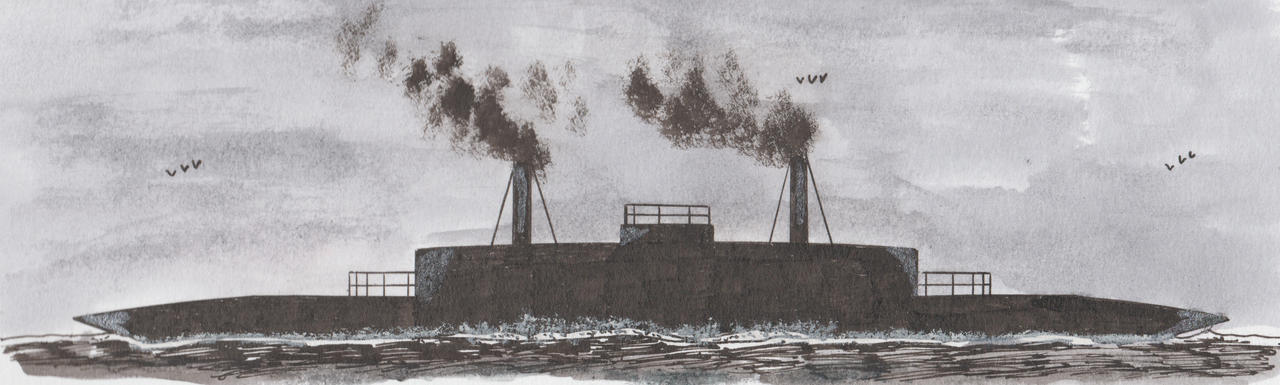
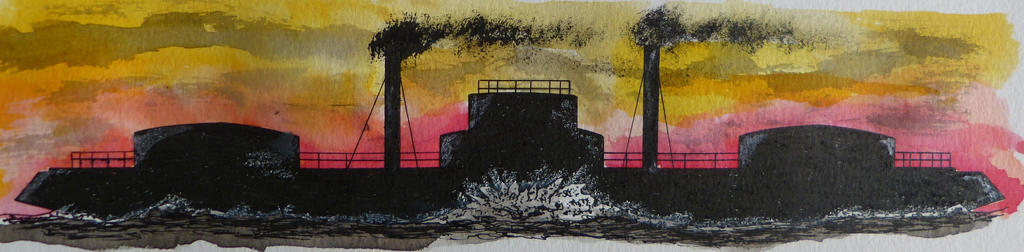
Design for a circular warship No. 3 by John Elder in 1868

©Warshipsresearch.blogspot.com

In the magazine The Artizan dated 1 July 1868 was a plate with figures and a small note published dealing with several designs for a ‘circular warship’ proposed by John Elder. He believed that such a ship with a widened beam could have a thicker and heavier armour and heavy guns compared with a ship of the common design and at the other hand a shallower draught and with a somewhat increased horsepower a comparable speed. The same year he read his paper Circular Ships of War, with immersed motive power for the United Service Institute in London, England. He executed experiments with his own construction and the common construction principles [the latter of a modern ironclad] including in all sorts of weather. It resulted in a draught around one-half of the draught of a common vessel allowing it to act in waters yet unaccessible. The power of rotation made it possible to act as a floating revolting turret or as a ram [like a gigantic circular saw).Diameter about 200 feet.

John Elder was a Scottish shipbuilder and marine engineer (8 March 1824 Glasgow, Scotland-17 September 1869 London, England). He worked for Randolph, Elder&Co., Glasgow, Scotland which became in 1886 the well known Fairfield Shipbuilding and Engineering Company.

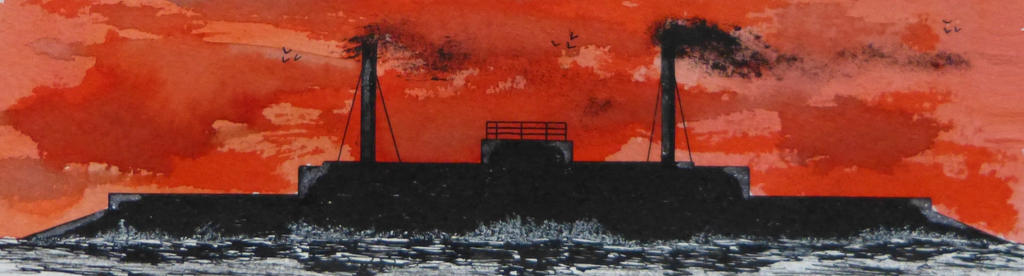
The Russian rear admiral Andrei Alexandrovich Popov designed in 1869 the Charodeika-class monitor-class for the defence of the Dniepr-Bug Estuary and Kerch Strait. Popov used Elder’s ideas but by further widening the beam created a real circular ship and instead of a convex hull his design was flat-bottomed for a minimum draught. The armament was however not heavy enough and after several new designs was a design with a displacement of 6,151 tons, a diameter of 46.0 metres/151 feet and 4-27.9cm/11” guns approved. With too high building costs estimated was the design scaled down ending in the Novgorod laid down in 1871 with a displacement of 2,531 tons, a diameter of 30.8 metres/101 feet and 2-27.9cm/11” rifled muzzle guns.

Friday, 4 September 2026

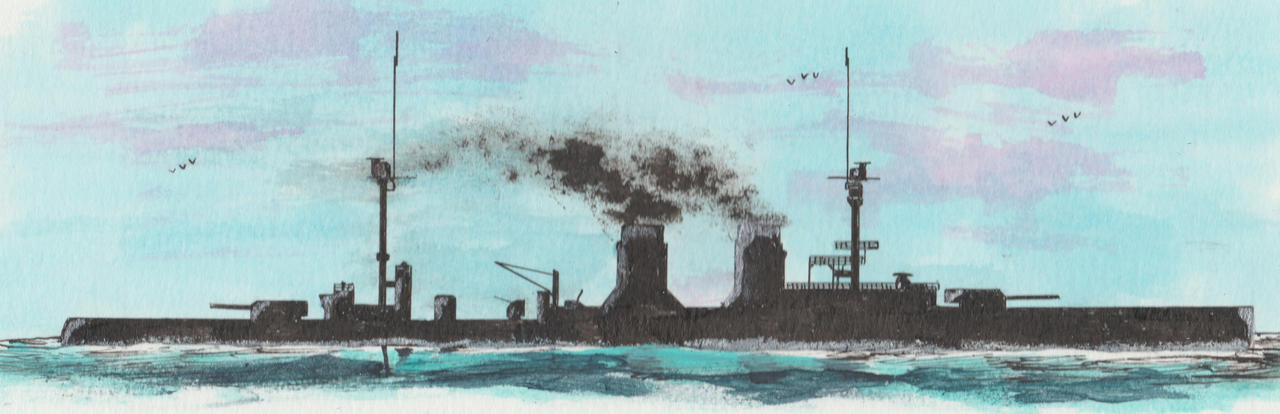
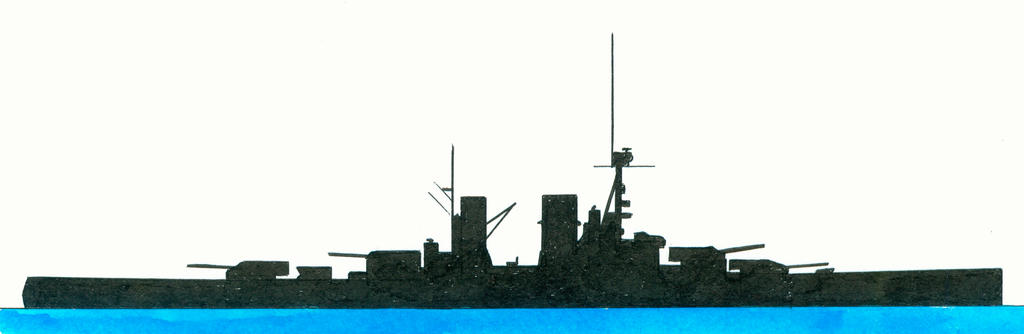
German battle cruiser study design GK 3531 dated 1918

©Warshipsresearch.blogspot.com

Dimensions 240 x 29,5 (maximum) x 9 (construction draught) and a displacement of 35,000 ton.

Armament 2x2-38xc cal 45 guns, 12x15 cm and 1 submerged bow torpedo tube.

Turbine propulsion,4 shafts, speed 31-32 knots, 16 coal and 15 oil fuelled boilers. 

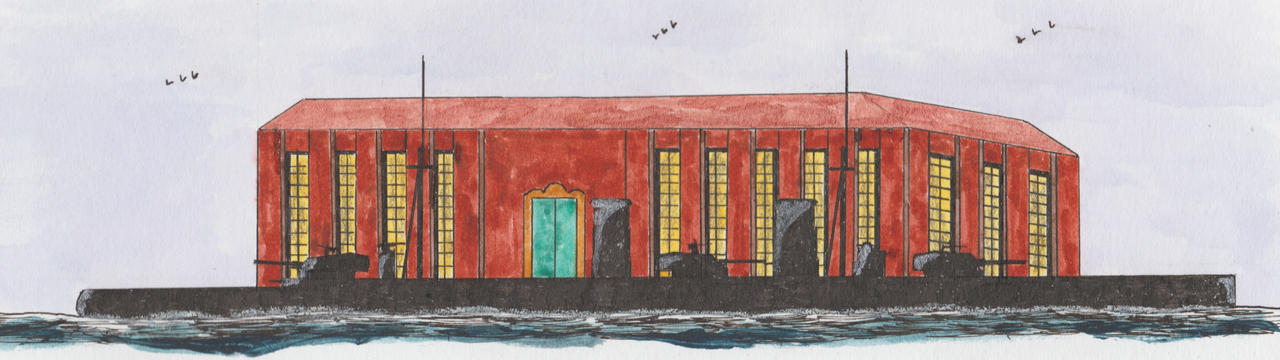
Austro-Hungarian design for a battle cruiser Project II dated June 1917

Displacement 30,000 tons with an armament of 2x3-38 cm guns L/45 guns, her secondary armament included 18x1-15cm L/50 guns. Speed 30 knots. Designed by Marinetechnisches Komitee (MTK). Never realized. 

Saturday, 29 August 2026

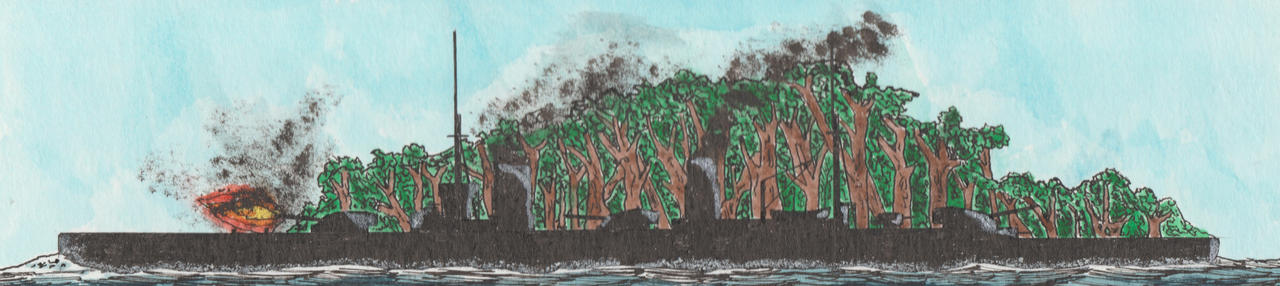
Austro-Hungarian design for a battle cruiser Project IV dated December 1917

©Warshipsresearch.blogspot.com

Displacement between 32,600-34,000 tons with an armament of 3x2-38 cm guns L/45 guns, 18x1-15cm L/50 guns, 4-15cm L/50 dual purpose guns and 6 submerged 53cm torpedo tubes. Speed 30 knots. Horsepowe 112,000hp. Range 8,000 nautical miles/15 knots. Designed by Marinetechnisches Komitee (MTK). Never realized. 

Monday, 24 August 2026

Proposal by William Haggett of the floating battery Prince of Wales A.2 dated 1862

Described in NPC9314 as “Gun deck over one vessel 70 guns with supplemental power fo extra speed and turning round”. Drawing NPC9315 is title ‘Battery with one vessel 70 guns” and shows “a combined deck floating battery, a single deck floating battery and the framing and plating”.Design of architect William Haggrtt from Sherborne, Dorset, England.(2)

Note

1. William Haggett (1808-1887), architect of profession and surveyot. Held some patents including Haggett’s Improved Method of Treating Metals&c. to increase their strength, filed 20 September 1859 and one dated 24 April 1862 for improvements in locomotive engines and carriages for railroads, tram and common roads.

Source

Website Royals Museums Greenwich Collection search. ID NPC9313-9314, See also NPC9315-9317-9318. 

Proposal by William Haggett of the floating battery Victoria A.1 dated 1862

Described as a combines three deck battery. Drawing NPC9310 mentioned a gun deck with 71 guns. Drawing NPV9311 illustrated what was possible if two ships with extra engines were combined: “Combination when more than 1 ship is employed with extra engines to give greater speed”. Drawing NPC9315 is title ‘Battery with one vessel 70 guns” and shows “a combined deck floating battery, a single deck floating battery and the framing and plating”. Design of architect William Haggett from Sherborne, Dorset, England.(1)

Note

1. William Haggett (1808-1887), architect of profession and surveyot. Held some patents including Haggett’s Improved Method of Treating Metals&c. to increase their strength, filed 20 September 1859 and one dated 24 April 1862 for improvements in locomotive engines and carriages for railroads, tram and common roads.

Source

Website Royals Museums Greenwich Collection search. ID NPC9310-9311-9312-9316. See also NPC9315-9317-9318.

Proposal by Peter Borrie for a 19th Century anonymous steam floating battery

Described as an improved safety iron twin steamship by engineer Peter Borrie, No. 3 Crescent, Minories, London, England.

Note

1. PeterBorrie (8 March 1802-South Latch, Abernyte, Perthsire, Scotland-10 January 1856 Middlesborough, England). Came in 1832 with the side connecting rod Borrie engine, designed by himself. Of Peter Borrie&Co., Tay Foundry, Dundee, Scotland producing marine engines for ships, parts of iron ships and locomotives, since 1840, went bankrupt in 1842-1843, apparently inventory sold in April 1846, established a shipyard at Middlebrough, England in 1853. Held a patent for a Safety Iron Twin Steamer dated 1850. Named Gemini was she suitable for transporting good, persons and cattle, mainly built of iron with two separate hulls placed side by side, with them them the paddlle box. At each end of this paddle box were deckhouses positioned. She was to serve on rivers and had a lenght of 157.5 feet, a beam on deck of 26.5 feet, with each hull being 8.5 broad and a space of 9.5 feet between them. If she was to serve at sea was her boam to be increased in proportion to length and the trade.

Sources

Website Royals Museums Greenwich Collection search. ID NPD0516 and 0517.

The Artizan, May 1844, p. 115

Saturday, 22 August 2026

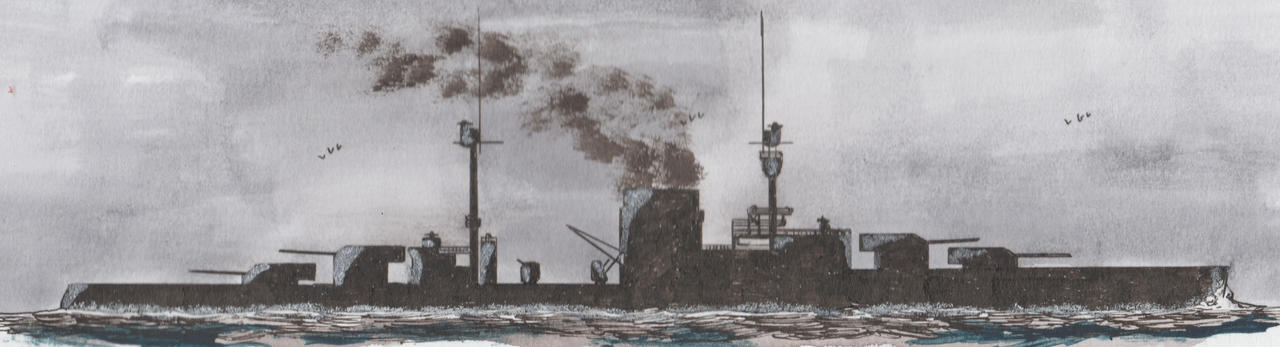
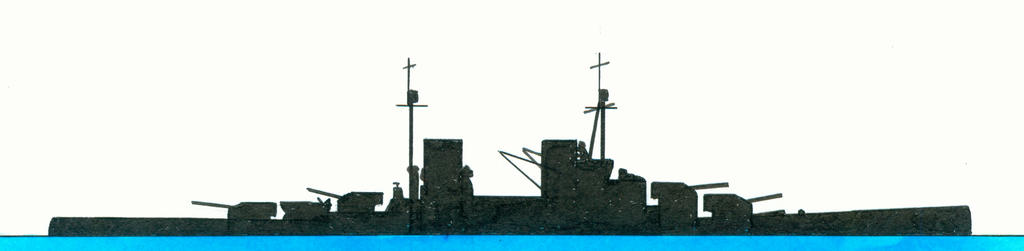
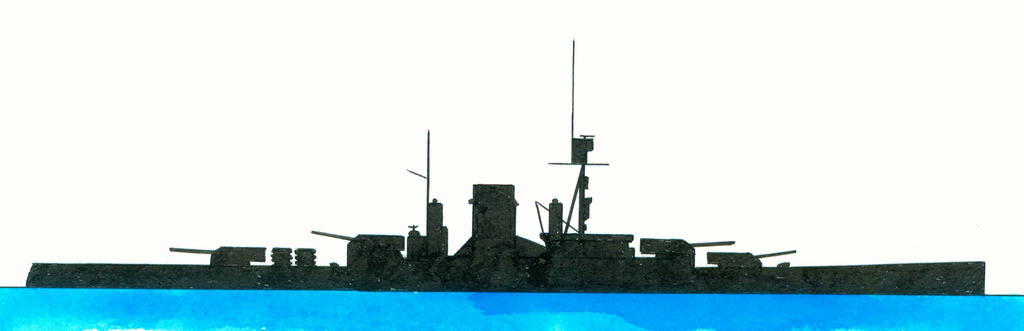
German battle cruiser study design GK 4542 dated 25 February 1918

Mackensen-class©Warshipsresearch.blogspot.com

GK 4542 design©Warshipsresearch.blogspot.com

Dimensions 240 x 33.5 (maximum) x 10 (construction draught) metres and a displacement of 45,000 tons. Armament 4x2-42 cm cal 45 guns, 12-15cm cal 45 guns and 1 submerged bow torpedo tube. Turbine propulsion with 4 shafts16 coal and 10 oil fuelled boilers, speed 28-30 knots. 

Thursday, 30 July 2026

Circular ironclads proposed by British commander G.H.U. Noel in 1876


Sharpened edge of the circular ironclad Noel proposed

Proposal No. 8 of John Elder in 1868©Warshipsresearch.blogspot.com

Proposal No. 10 of John Elder in 1868©Warshipsresearch.blogspot.com


Model of circular floating battery by John Elder. National Maritime Museum Greenwich ID SL2545


Model of Russian Popovka Novgorod 1873. National Maritime Museum Greenwich ID SLR105

Major C. Field published in 1900 an article dealing with proposals for warships which were never realized. At that moment was in England series of types of warships settled built in batches. In the past was that quite different. Since the introduction of the French ironclad La Gloire launched on 24 November 1859 was choosen for a methof of constant experiments or as he wrote: “In some foreign navies this system of constantly trying to make a ship radically different to anything that has preceded it still goes on, notably in France.” And there were numerous proposals, ideas and even models of warships by naval engineers and/or officers, private inventors which never were realized. One example was a couple of a circular ironclads by commander Noel inspired by the Russian circular ironclads (monitors) or popovkas designed by rear-admiral Andrei Alexandrovich Popov (21 September 1821 Russia-6 March 1889 Russia) and built as the Novgorod (1871-1874) and Vice-admiral Popov (1874-1876). Both ships were to serve in the Black Sea and the Sea of Azov. Popov was not the ony one interested in circular ships, for instance John Elder published in  The Artizan, dated 1 July 1868 an article "Circular vessels of war" over the effects of widening the beam illustrated by several more or less circular ships. In the Transactions of the Institution of Naval Architects, volume XVIII, 1876, is an article published by E.E. Goulaeff, “On Circular Iron-clads”, p. 43-61 and in the discussie pointed Jamieson of John Elder&Co. Out that the late John Elder already in May 1868 read a paper dealing about this subject, discussed it officers of various governments included Popov and that Popov even visited Glasgow in 1868 probably to gett full details. Goulaeff said clearly in his paper that Popov came in early 1869 with his circular ships concept.

Field described the popovkas as”In almost every point they are a failure ant is not likely that anyone would now expect a circular ship to be anything else. Imagine the power necesssary to drive the unwieldy affair throught hthe water, and the impossibility of speed.”

Dealing with the proposal of Noel his comment was equal negative: “The ship in the picture gives one the impression of a gigantic Quoit, and is, in fact nothing more rga a flaoting redoubt. It is, of course, intended for coast dfenece, and nowadays, whe we have grasped the fact that we must defend our own coast, or that of our enemy puts it out of court at once. The twelve big guns that peer over the armoured breatsworks are so mounted that on being fired, they recoil below it to be loaded. The edge of the ship was to be a huge sharp steel ring, so as to slice into an enemy; she was to have three screws, and four keels.

Brassey, sir Thomas. The British Navy: its strength, resources, and administration, volume III, Part III, Opinions on the shipbuilding policy of the Navy, London, 1883 dicusses the value of circular ships like the Povkas. Commander Noel (p.496) pleaded for circular ironclads to get an efficient coast-defence fleet. For the Thames and South-coast harbors he suggested 4 ironclads 1st class of around 8,500 tons and 6 circlar ironclads 2nd class of around 5,000 tons be stationed at other harbours. His opinion is followed that by the famous Sir E.J. Reed (p. 99) who stated that “Fore special purposes some modified form might be prerable, but generally speaking, the circular form is the best for floating armor to protect an included space, and also for giving that equal all-round command with your guns which is so desirable at sea. Starting then with this circular armoured citadel, and wishing to propel it at speed, there are several ways in which we cam deal with it.” and “I believe the circular form is itself quite compatible with high speed, and certainlu it possesses very great and numerous advantages in other respects.” Reed published a paper “On Circular Iron-clads published in the Journal of the Royal United Services Institute for Defence Studies, volume 20, 1876. In the same journal is the Naval Prize Essay of Noel “On the Best types of War-Vessels for the British Navy” published. It was in this essay that Noel described his circular ironclad or floating fort proposal:

1st-class, about 8,500 ton, diameter of 210 feet, 12-30.48cm/12” 35-ton guns mounted on an imrpoved Moncreiff system behind a breastwork of 14” armor, 6 feet high and circular in form with a diameter of 100 feet, deck outside breastwork is curved downward toward the outer edge of the ironclad and plated with 3.5” iron, the under surface nearest to the dge plated with 3.5 armor. Edge protected by a steel rim of immense strength, sharpened to cut the bow of an attacking ship which wanted to ram her. Speed 10 knots. Weight armour breastwork 500 tons, upper surface of armoured deck 1,700 tons, under surface 450 tons, total weight same as that of HMS Devastation.

2nd-class, about 5,000 ton, diameter of 150 feet, 10-25.4/10” 18-ton guns mounted on an improved Moncreiff system behind a breastwork of 12” armor, 5 feet high and circular in form with a diameter of 80 feet, plating outside 3” thick. Weight armour breastwork 270 tons, upper surface of armoured deck 700 tons, under surface of edge 230 tins, total weight about 1,200 tons.

Sir Gerard Henry Uctred Noel (5 March 1845 Stanhoe, Norfolk, England-23 May 1918 Fincham, Norfolk, England) served in the Royal Navy between 1895-1915 ending his career in the rank of Admiral of the Fleet. He published in 1874 the prize essay “The Gun, the Ram and the Torpedo. Manoeuvres and tactics of a naval battle in the present day”.

Source

Field, major C., “Warships that have never floated”, The 1d Pictorial Magazine or The Penny Pictoral Magazine, No. 35, volume 3, week ending 3 February 1900, p. 435-438 . Edited by Charles P. Sisley. 

Monday, 6 July 2026

German design GK 4532 for a battle cruiser dated 20 February 1918

Derffllinger-class©Warshipsresearch.blogspot.com

Never completed Mackensen-class©Warshipsresearch.blogspot.com

Never completed Ersatz Yorck-class©Warshipsresearch.blogspot.com

GK 4532 design©Warshipsresearch.blogspot.com

Construction displacement 45,000 tons and as dimensions 240 x 33.5 x 10 metres. Speed 30 (service)-31(maximum on measured mile) knots. Armament 3x2-43cm quick firing guns, 20-15cm quick firing guns, 1-submerged torpedo tube in the bow for 89 torpedo. Armour belt17-35cm, citadel 30cm, casemates 17cm, barbettes 35-25-150-10cm, gun turrets 34 (front)-25(sides)-deck15-25cm, conning tower 25-35 (fore)-25 (aft)cm, deck 60cm. 

Wednesday, 1 July 2026

Concept of a future battleship dated 13 March 1943

Drawing by Logan U. Reavis (1887, Saint Louis, USA, 1 June 1958 (Hempstead, USA)(1)

Japanese Yamato-class. ©Warshipsresearch.blogspot.com. Revised sketch Cincpac-Cingpoa 26 October 1944

American Montana-class©Warshipsresearch.blogspot.com

German H39 -class battleship variant B 1940©Warshipsresearch.blogspot.com

British HMS Vanguard. ©Warshipsresearch.blogspot.com

Russian Sovetsky Soyuz-class design variant 4x3-40,6m guns (Gannut). ©Warshipsresearch.blogspot.com

The armament was to consist of 15-45,72cm/18” guns in dometed, retractable turrets and which could for bomb-defence pulled inside the turrets, delivering with salvo 22 tons of metal with a impact velocity of 1,800 miles/hour.(2) Surfaced part of the ship was streamlined and turtle-backed. Protected by heavy air bomb proof horizontal armour. The funnel was also protected against bombs and was at the same time foundation for the catapult with a hangar below the stack to store the scout plane. The compartmentation in watertight compartments was on a large scale increased. Displacement 65,000 tons, beam 126 feet and speed 30 knots. 

Legend by the drawing

1. Triple mount 45,82cm 18”guns in stepped turrets

2. Barbette 

3. 12,44cm/4.9” guns

4. 15,24cm/6” guns

5. Smoke vent 

6. Access to hangar

7. Retractable catapult

8. Searchlight on retractable arm

9. High observation posts and gun positions

10. Retractable range finder 

11. Quick firing anti aircraft guns

12 Bridge and main control 

13. Breakwater 

14. Hollow steel masts, ladders inside

15. Underwater protection 

Notes

1. He was an industrial and marine working as illustrator and writers for newspapers but also for the United States Lines  and other shipbuilding related industry. In the 1950s he made promotional maps and brochures to celebrate the passenger ship ss United States which won the Blue Riband in 1932. 
2. The Yamato-class possessed 3x3-46cm/18.1” guns, so slightly larger calibre but less in number with 9 against 15 guns. The normal displacement of 65,027 tons was comparable. The never realized American Montana-class with a displacement of 64,240 tons was to be fitted out with12-40,6cm/16” 50 cal Mk 7 guns. The never realized British Lion-class with a standard displacement of 41,200 tons was to be armed with 3x3-40,6cm/16” guns while HMS Vanguard with a standard displacement of 45,200 tons was even armed with a smaller calibre namely 4x2-38,1cm/15” guns. In the French and Italian was the calibre of the main guns also 40,6cm/16”guns. The Russian navy choose for 40,6cm/16”, her Sovetsky Soyuz-class (project 23) was comparable with the Japanese Yamato-class dealing with the dimensions but weaker armed. Project II-2p was to be armed with 1x2-45,7cm and 1x4-22cm. The German battleships Bismarck and Tirpitz were armed with 4x2-38cm/15” guns, so far weaker than the Yamato. However the (theoretical) H-44 design with a displacement of 131,000 tons was to be armed with 50.8cm/20:  guns. 

Source

‘The shape of ships to come’ in: The navy of the Future, The Collier’s, 13 March 1943.

Tuesday, 30 June 2026

Concept of an armoured cruiser in the future dated 13 March1943

Drawing by Logan U. Reavis (1887, Saint Louis, USA, 1 June 1958 (Hempstead, USA)(1)

Admiral Graf Spee©Warshipsresearch.blogspot.com

Japanese imaginary pocket battleship Kadekuru or Kazekuru. ©Warshipsresearch.blogspot.com

Described as logical evolution of the existing heavy cruiser designs which escorted aircraft carriers during task force duties. Her much improved horizontal armour against air attacks was superior to that of existing cruisers. And further more could she with her anti aircraft armament provide a shield against enemy planes. This kind of cruisers were in fact highly mobile gun power with a speed of 28 knots, a displacement of 20,000 tons and as main dimensions 655 x 84 feet.(2,3) 

Legend for the drawing

1. Dual mount 27,94cm/11” guns in separated turrets

2. Scouting seaplane on retractable catapult

3. Retractable range finders

4. Narrowed superstructure

5. Armoured hatch cover

6. hangar

7. Dual purpose 15,24cm/6” guns

8. Quick firing anti aircraft armament

9. 20,32cm/8” deck armor

10.crane

11. Fire directors

12. Side smoke vent

Notes

1. He was an industrial and marine working as illustrator and writers for newspapers but also for the United States Lines and other shipbuilding related industry. In the 1950s he made promotional maps and brochures to celebrate the passenger ship ss United States which won the Blue Riband in 1932. 

2. Calibre of main armament comparable with the German heavy cruiser or armoured ship Admiral Grafspee although 8 (4x2) against 6 (2x3) 11"gums and which had a full load displacement of 16,280 tomns, as dimemnsion 610.3 x 71 x 24.1 feet.Speed 28,5 knots. 

3. It was believed that the Japanese navy also possessed pochet battleships with a displacement of 12,000 tons-14,000 tons but with 6-30,48cm/12cm" guns heavier armed.(3)

Source

‘The shape of ships to come’ in: The navy of the Future, The Collier’s, 13 March 1943.


Concept of a coastal battleship in the future dated 13 March 1943

Drawing by Logan U. Reavis (1887, Saint Louis, USA, 1 June 1958 (Hempstead, USA).

The described characteristics were special designed for amphibian operations and heavily enough armed to support invasion forces. Her strong anti aircraft armament was for self defence and protection of the invasion convoy she escorted. Possessed unusually heavy armour suitable for her major purpose namely ‘infighting’. to be able to operate in shallow-water waters was her draught to a minimum limited. Main dimensions 600 x 108 feet and a displacement of 25,000 tons. Speed 20-22 knots. 

Legend drawing

1. Triple mount 38.1cm/15”guns, retractable, in separated turrets

2. Principal Range finder

3. Narrowed superstructure

4. Catapult for seaplanes

5. 15.24cm/6”-guns

6. Access for tanks

7. Anti aircraft armament

8. Low elevation 38.1cm/15” guns 

9. Quadruple group of 15.24/6” guns

10 .aft venting deck

11. 38.1cm/15” deck armour 

12. Fire control posts

13. Hangar

Note

1. He was an industrial and marine working as illustrator and writers for newspapers but also for the United States Lines and other shipbuilding related industry. In the 1950s he made promotional maps and brochures to celebrate the passenger ship ss United States which won the Blue Riband in 1932. 

Source

‘The shape of ships to come’ in: The navy of the Future, The Collier’s, 13 March 1943.

Monday, 20 April 2026

Design German battle cruiser Q dated 1939

Ersatz Yorck-class. ©Warshipsresearch.blogspot.com

Design P-class. ©Warshipsresearch.blogspot.com

O-class. ©Warshipsresearch.blogspot.com

Preceded by Ersatz Yorck-class. Aim was to modify the P-class heavy cruisers design by fitting out with 3x2-38cm/15” instead of 28.3cm/11.1” calibre for the main armament. Displacement 29,364 (standard)-35,968 (full load) tons and as dimensiuons 248.2 (waterline)-256 (over all) x 30 x 8.02 metres or 814.4-839.111 x 98.5 x26.4 feet. Speed 35 knots. To be realized under the Plan Z. The project drawings were by 1940 complete and approved by Hitler and Raeder yet building finally cancelled. Ordered from the Germaniawerft, Kiel, Germany on 8 August 1939 and contract refined in September 1939. 

Saturday, 4 April 2026

Design of a battleship with a displacement of 28,500 tons by John Harvard Biles in 1914

There was just two forms of defence agansit a submarine attacking a target with her torpedoes. One was to destroy the submarine herself or improve the protection of the target, especially the bottom of the surface ship. In his article described Biles (1) some designs of battleships which should be able to keep fighting even after being torpedoed by a 21” torpedo. One of the solutions was to armor the bottom resulting in reducing her speed with 2 knots. The newest battleships had a form with a low resitance to forward motion. His idea was to develop a form better adapted to fitting and carrying armor despiter creating greater resistance or a reducing speed.

One design he suggested was without a reduced speed, upper armor and armament but able to fight next other dreadnoughts in the First or Second Battle Squadron and which was armored against torpedoes. Displacement 28,500 tons and as dimensions 570 (between perpendiculars)-600 (over all) x 91 (extreme) x 28.6. feet. Speed 21 knots. Armament 10-14” guns and 16-6” guns. Armour consisted on side at waterline 10”, above waterline 7 and 5”, below waterline 4”, on casemate 2”, on barbettes 12” and with 3” thick protected deck-plating.

Note

1. Sir John Harvard Biles (1854-1933) was Professor of Naval Architecture at the University of Glasgow, Scotland between 1891-1921.

Sources

Biles, sir John. “Battleship protection against submarine. Proposed increase of armor at the expense of decrease in speed” in Journal of the United States Artillery, volume 42, 1914.

Idem. “On the Protection of Battleships against Submarine Attack” in: Shipbuilding and Shipping Record, 9 July 1914.

T.G. Owens. “Some questions to battleship design” in: Shipbuilding and Shipping Record, 9 April 1914. 

Friday, 3 April 2026

American Senator Tillman hypothectical design 70,000 tons battleship dated 13 December 1916

©Warshipsresearch.blogspot.com

Design as result of senator Tillman requesting for a battleship of maximum size and strenght able to use the Panama Canal and existing harbor facilities. Never realized.

Dimensions 975 (waterline)-995.0 (over all) x 103 (waterline)-105.6 (molded on waterline)-108.0 (extreme) on waterline x 32.9 feet and a displacement of 70,000 tons. Freeboard maximum stem and A.P. 29’6”, at side M.P. 28’6”. Total depth at M.P. 62’0”. Deck height 2nd 10, 3 rd 9 and 4th 8. Metacenter above base 43.’, C. of G above Base 39.6’, G.M. 3.9’. Tons per inch immersion 19.2. Coefficients as notmal displacement of 70,000 tons: longitudinal .717-block .711-midship .99-water plane .764 and displacement-length 76.6.

Speed 26,5 knots/65,000 ehp. Range 12,000 nautical miles/10 knots. Electric drive propulsion.

Weights normal condition=70,000 tons:

Hull 31,813

Hull fittings (including 800 tons for gyro-stabilizers)3,000

Protection 15,621

Steam engineering 5,000

Reserve feed 900

Battery 5,197

Ammunition 3,546

Equipment 775

Outfit and 2/3 stores 11,000

Fuel oil 2/3 supply 2,000

Margin 48

Lenght of compartments boiler room-24’-air compressor róoms 24’, engineroom 84’-pomp rooms 12’-total machinery space 276’-motor rooms 48’.

Costs: hull 17,200,000-machinery 7,700,000-total C.&M. 24,900,000.

Armament 24-16" cal 50 guns, 21-5" quick firing guns (torpedo defence battery), 3 high power anti aircraft guns and 4-21 torpedo tubes.

Main side belt armor with an extreme width of 19 8 1/2", depth below water line 9'0" and thickness 13"-13"-7".

Barbettes 12 1/1"(heavy part thickness)-4" (light part thickness).

Turrets 13 (port)-10'9" (sides)-5' (top)-9" (rear).

Conning tower proper 16" and top 8" and tube heavy part 16"and light part 6".

Uptake protection 10"-7"-5".

Protective deck total middle 3" after 5".

Note

1. Benjamin Ryan Tillman (11 August 1847-3 July 1918), Democratic Party plotician, governor of South Craolina 1890-1894 and senator 1895-1918. See for instance: Construction of battleships. Remarks of Hon. Benjamin R. Tillman,... relative to the construction of 60,000-ton battleships; also copy of a Senate resolution instructing the Committee on Naval Affairs to make an investigation of the matter, together with an article entitled "Build the Limit," by Commander W.A. Moffett, United States Navy. Presented by Mr. Tillman. June 20, 1916.

Source

S. Naval History and Heritage Command. Bureau of Ships Spring Styles Book 1 1911-1925. S-584-108 preliminary design 171. 

Thursday, 2 April 2026

French fast escort design E 43 No. 4 dated January-February 1944

. ©Warshipsresearch.blogspot.com

Displacement 2,310 (light)-2,767 (trial-3,224 (light) tons. Length 118 metres. Number of funnels 1. Main armament guns 4-13cm guns.

Monday, 23 March 2026

British army surgeon annex inventor Dr. John Collis Browne proposed around 1879 his design of an ironclad

Dr. John Collis Browne (18 June 1819 Maidstone, Kent, England-30 August 1884 Mount Albion House, Ramsgate, England) was a surgeon serving in the British Army and who invented Chlorodyna to be used against cholera. Furthermore he was inventor of items to be used for yachts. What Wikpedia not mentioned was his proposal for an ironclad.

Huët referred in 1879 to Iron. The Journal of Science, Metals and Manufacturer No. 148 Vol. VY. New Series dated 13 November 1875, page 612 where a fast ship for ocean routes was described. The ship was presented at the Paris Maritime Exposition, the merit of the invention claimed by M. Bazin. Dr. J. Collis Browne however forwared documents and dreawing that the merit of inventing and applying the principle so far as the hull was concerned, was his. His schooner yacht Kala-Fishbuilt on this principle in 1872was exhibited to the French authorities at Boulogne in 1873. At the Paris exhibition could a working steam model of the invention be seen. In the Kensington Museum were the past two years models presented. Browne showed an engraving of a proposed ironclad on the same plan. The ironclad was to be fitted out with a beak 60 feet long at each end and with a deck long 224 feet. Hetr decks sloped outwards at an angle of around 40 degrees. Flat in her bilge and with a keel. Displacement calculated at 15,000 tons and with a freeboard of nearly 16 feet. Before the ship wnet into action was she water ballasted in tanks constructed for that purpose “so as to expose no more of her hull than is duly protected with armour. The depth occupied by the latter (measured on the slope) will be 12 feet and the vertical depth of the hull 40 feet. Herbuoyancy, it is estimated, will be such taht the 12 feet of freeboard may be plated with armour three feet thick! This vessels swells mout both laterally and longitudinally below the water line. The principle which governs this design is that of gaining the power of carrying an enormous weight by immersing as great a bulk a possible.”

Sources

Browne, Dr.J. Collis. “Wave lines: a short description of their true form, and how ships ought to be constructed to meet them”, in Marine Engineering News, London 1 January 1876.

Huët, A. La Locomotive marine. Etude sur le Transport Maritime a grande vitesse. La Haye, Pays Bas, 1879.

John Collis Browne. Wikepedia 22-3-2026 14:22. 

Sunday, 22 March 2026

British battle cruiser design I3 1920

HMS Hood. ©Warshipsresearch.blogspot.com

Design I3. ©Warshipsresearch.blogspot.com

Preceded by Admiral-class. Legend displacement51,570 tons and as dimensions 915 x 108 x 33 feet. Equipment 1,000-fuel 12,000-margen 260 tons. Armament 8,670 tons. Machinery etc. 6,430 tons. Armour&protection 14,600 tons. Hull 19,590 tos. Armament 3x3-18” cal 45 guns, 16-6” guns, 5-4.7” anti aircraft guns, 4 multiple pom-poms and 2 torpedo tubes. Horsepoower 180,000 shhp. Speed 32.5 knots.

Armour belt 12” inclined at 25°, bulkheads 11” (forward)-10” (aft) inclined at 25°, turrets 15” (face)-12” (sides)-9” (rear)-8” (roof). Barbettes 12” and 10”. Conning tower 12”-6” (roof). Torpedo bulkhead 1 3/4”. Armour deck 7” with 8”slope from ‘A’ to X’, 4” with 5” slope over machinery spaces, 6” with 7” slope over after 6” magazines and 4” with 5” slope aft and 7”, 5”,4” forward but not stem.

Sources

Brown, D.K. Nelson to Vanguard.

Brown, D.K. A Century of naval construction. The history of the Royal Corps of naval constructors.

Breyer, Siegfried. Battleships and battle cruisers, 1905-1970.

Burt, R.A. British Battleships 1919-1945.

Campbell, N.J.M. “Washington’s Cherrytrees. The evolution of the British 1921-1922 Capital Ships”, in: Warship, Vol. 1-4.

Friedman, Norman. British Battleships 1906-1946.

Johnston, Ian and Ian Buxton. The Battleship Builders.

Parkes, Oscar. 1860-1950. A History of Design, Construction and Armament British Battleships.

Raven, Alan and John Roberts. British battleships of World War Two.

Stern, Robert C. The Battleship Holiday. The Naval Treatries and Capital Ship Design.

Papers Sir Eustace Tennyson D'Eyncourt, Royal Museums Greenwich.

Warshipsresearchblogspot.com

https://en.wikipedia.org/wiki/G3_battlecruiser checked 27-2-2026

Design “G’” of a battleship by Italian general naval engineer Ferrati dated 1915

Italian battleship design-G'. ©Warshipsresearch.blogspot.com

French Normandie-class. ©Warshipsresearch.blogspot.com

French Lyon-class. ©Warshipsresearch.blogspot.com

Edgardo Ferrati (Turin, Italy 26 August 1862-Rome, Italy 18 December 1919) was in charge for the never completed Francesco Caracciolo-class battleships (8-38.1cm/15” guns). In 1899 director off naval construction at Castellammare and built the battleships Benedetto Brin, Vittorio Emanuele and Naples. Promoted in 1913 to the rank of lieutenant general and president of the committee for ship projects.Stationed in 1915 at La Spezia Arsenal. His design was to be an Italian answer on the French designs of the never realized Normandie (12-34cm guns) and Lyon (16-34cm guns)-classes and other battleship designs. Displacement 37,200 tons and length 225 metres. Armament 4x4-38.1cm cal 24 guns, 8x2-17cm cal 24 guns and 24x1-10.2cm cal 50 guns. Armour was 27cm and 17 cm just like previous desighns with an additional 310 tons for armour cm added. Design “F” had as armour 27cm for 66% of the ship length and with a reduced height up to her bow and the first rudder.

Sources

Bollettino d’Archivio, Dic. 1988, A Rastrelli.

Warshipsresearch.blogspot.com

Italian Navy Historic Office