Translate

Showing posts with label 15th Century. Show all posts

Sunday, 2 August 2026

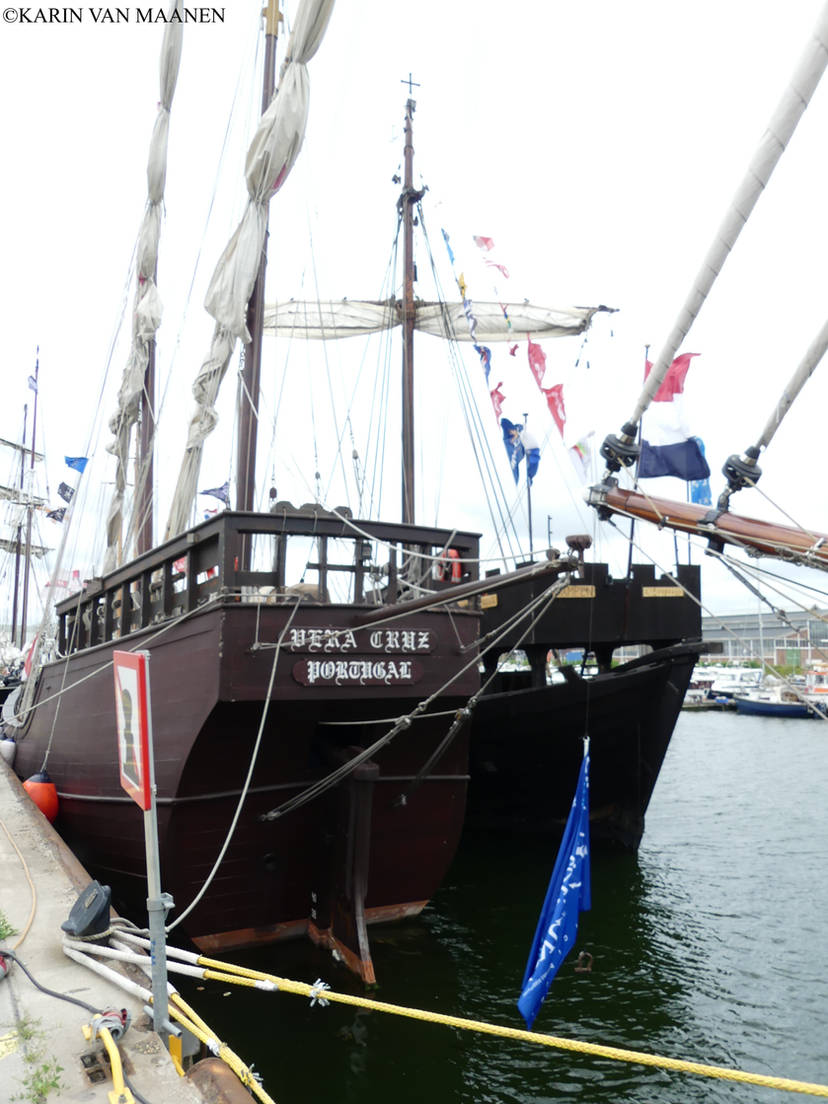
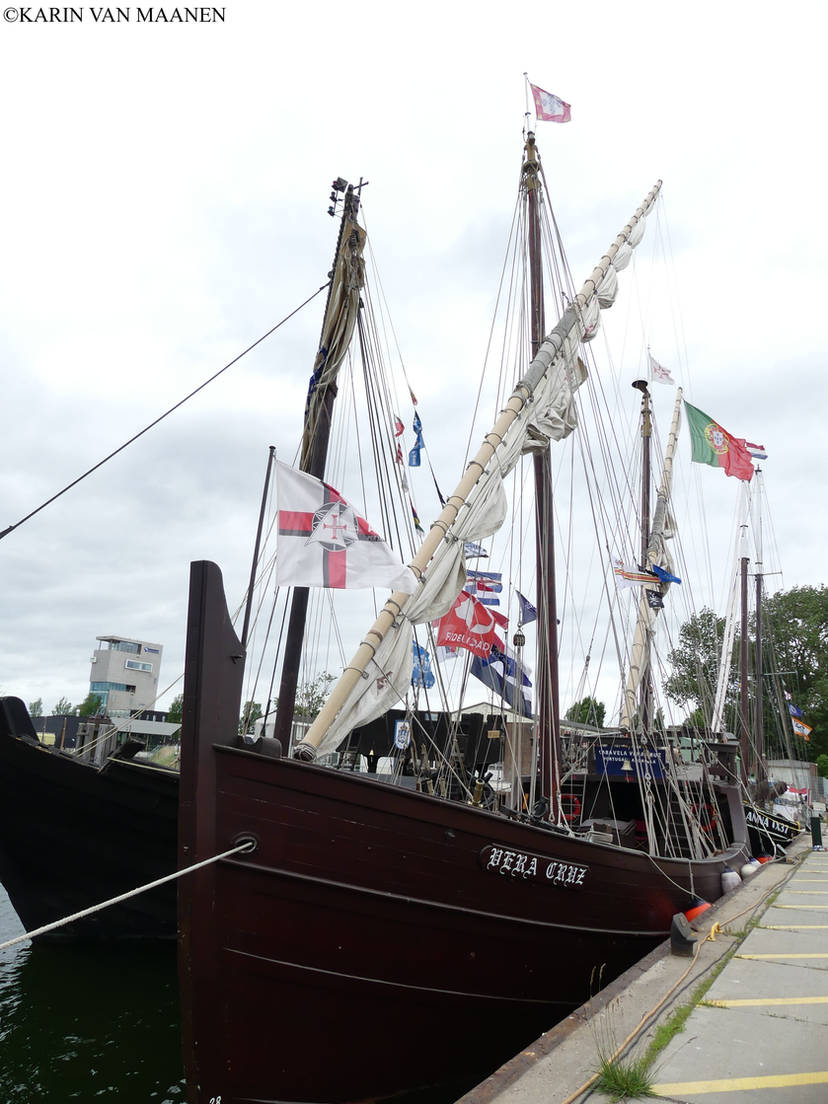
Portuguese caravel Vera Cruz sailing replica built in 2000


Vlissingen, Netherlands 4 June 2026

Portugal-flagged, homeport Lisbon, Portugal, MMSI 263804290 and call sign CRAH7. Operated by Aporvela. Dimensions 23.82 (hull)-26.00 x 6.65 x 3.30 x 27.69 (height)metres and sail area of 235 square metres. Built by shipyard of Vila do Conde, Portugal in 2000 representing a caravel from the 15th-16th Century. 

Tuesday, 31 December 2024

Ship at seal of Dutch city Purmerend

The city of Purmerend grew out of the fishing village of Purmer, located between the lakes of Purmermeer, the Beemstermeer and the Wormermeer. Founded in the early 15th Century, it gained city rights in 1434 and in 1484 also the right to organize weekly and annual markets, thus becoming a significant regional trade center. 


The oldest known city seal of Purmerend shows an oared ship with a shallow draft that was perfectly suited to transport goods on the inland waterways of North Holland. This copy of the seal was probably made around 1484 after an older example. Above the image of the ship (with the three barbs - the family crest of Willem Eggert - founder of the city - on the flag) is the family crest of Count Van Egmond, who granted Purmerend the market rights. It is likely that the ship carried a sail, like other craft in the Waterland region and it is estimated to be around 12 meters long.


This drawing is an interpretation by Laszlo Veres and Alexander Mari van Maanen after the seals of Purmerend.

Monday, 30 December 2024

Ships after Seals of Vlaardingen, Netherlands

Second small seal, located at the old City Hall of Vlaardingen (1650

Sigillography or sphragistics is a scientific discipline in the historical academic work for studying seals that is used for authenticating archival documents. It also finds use in maritime historical research, together with heraldry, thanks to the frequent presence of ships or related items on coats of arms and seals of cities and towns involved in mercantile shipping or fishery.

One specific example is the town of Vlaardingen, in the province of Zuid-Holland, in the Netherlands. The location of this settlement on the Maas river made it a convenient place to control and tax the passing merchant shipping. Vlaardingen had become a territorial property of the Counts of Holland by 985, and at some point during next three centuries it acquired a city charter, renewed and expanded in 1273 (with reference to a number of rights already received in earlier years). The present-day coat of arms depicts a lion, however this was only since 1616. The medieval seals dating from the 14th Century usually depicted a ship and only additionally a lion representing the Counts of Holland) and a Fleur-de-lis.

Left large city seal, used between 1351-1612 and right small seal, used between 1361-1509 

The reason for the presence of merchant ships on the oldest seals of Vlaardingen is easily explainable. The importance of shipping for the city's economy was mentioned already in some of the oldest written sources regarding its history. For example, a 1230 voyage to England is recorded, when master Gerardus van Fletinghe brought his ship loaded with wool. Over time England became more and more a primary destination of interest for ships sailing out of Vlaardingen. Eventually, however, fishery - herring fishery in particular - superseded merchant shipping as the most significant area of maritime activity in Vlaardingen, and by the 18th Century the city was the most important fishing port in the region.

Unfortunately, the 20th century has turned the tide against this once so impressive fishing community. The conservative attitude of the local fishermen, reluctant to invest in more innovative fishing techniques, led to their decline in comparison to their counterparts from Scheveningen and IJmuiden. By 1964, only 9 motor luggers were left and soon afterwards even those disappeared.

The ships presented on the medieval seals of Vlaardingen are often referred to as a cog. Cogs were clinker-built cargo vessels that were possibly introduced during the 10th century and adopted on a large scale by the 12th century, remaining in widespread use throughout the Middle Ages. Although the ships from the seals are very likely to be cargo ships, there being cogs is much less likely. However, historians remain in dispute in regard to the exact classification of the type of vessel presented.

Dutch historian Coenraad Postma wrote in his article about the coat of arms and seals of Vlaardingen that the so-called large seal of Vlaardingen showed a “1-mast cog with reefed sails”. His opinion was disputed by another author Dr. H. A.H. Boelmans-Kranenburg who pointed out the lack of typical characteristic features of a (Baltic) cog, which are the raised fore and aft castles. Another argument raised was that the cogs operated more often around the Zuyder Zee.

Boelmans-Kranenburg wondered if it were not the Dutch “hulk” type of ship, or possibly quite the opposite - a fishing vessel called the haringboot (herring boat), a predecessor of the well-known haringbuis (herring buss). Strong support for that last hypothesis is the presence of the gear mounted on the ship's bow and the recesses in the hull (suggesting that drift nets would be taken in from there), both of which were typical features of the haringboot.

Bl-191-1

The large seal used between 1351 and 1612 showed a ship with a rudder at the stern, so typical mostly for late-medieval and early-modern ships. There was, however, one smaller seal used between 1361-1509 depicting a more medieval ship with a reefed square sail. The rudder is not depicted but was likely a rudder positioned at the side.

According to Postma, another smaller seal depicted a 15th century 3-mast fishing or merchant vessel with 2 reefed sails. These findings were also (slightly) disputed by Boelmans-Kranenburg in the part regarding the possibility of the vessel in question being a merchant ship. Instead it was argued for a stylized herring buss being the most reasonable possibility.

Buss was a round-bilged keel ship, with 2 or 3 masts, the stern relatively high with gallery. The square-rigged mainmast and foremast (if available) could be lowered when fishing, the gaff rigged mizzen mast stayed upright. Something that Postma’s opponent also mentioned as proof for his claim that it was a buss. The lion of Holland can be seen depicted above a trestle. A typical trestle that was used by the buss when the masts were lowered down during fishing operations.

The herring buss derives its name from the Latin word “buscia”, which means “cargo ship.” Terms used for the herring buss were buyse, buse or buyssescip (Modern spelling buisschip). Historians agree that the first herring buss was probably laid down in Enkhuizen back in 1416. 

RP-P-2014-30 Een haringbuis, Meester W met de Sleutel, ca. 1490

The oldest known illustration of a herring buss was made around 1480, most likely by the goldsmith Willem Vanden Cruce of Brugge. It emerged as a popular type of ship and in 1620 around 2,000 were used for excursions as far as the Shetland Islands, with last one of them being built as late as 1841 at Vlaardingen itself. 

Awhile we know that 3 mast ships are well used during the second part of the 15th century we do not know if the buss would have had three masts in early development. The seals of Vlaardingen always have been modern and give undoubtedly an excellent contribution to Dutch maritime history.

Seal - Vlaardingen 1361-1509 

Large seal )grootzegel van Vlaardingen 1351-1612

Haringbuis. Small seal (kleinzegel) van Vlaardingen stadshuis 1400s-1650 

These drawings are interpretations by Laszlo Veres and Alexander Mari van Maanen after the seals of Vlaardingen.

Sources:

Zegels en wapens van steden in Zuid-Holland: Een bundel studiën onder leiding van Elisabeth C. M. Leemans-Prins; s-Gravenhage, 1966.

Ewe, H.: Schiffe auf Siegeln. VEB Hinstorff Verlag, Rostock 1972.

Ships after Seal prints. Laszlo Veres, Unpublished manuscript, Pécs, 2020.

Nationaal Archief, Grafelijkheid 27 november 1361.

Stadsarchief Vlaardingen, various publications.

Historisch Jaarboek Vlaardingen, various publications.

Thursday, 28 December 2023

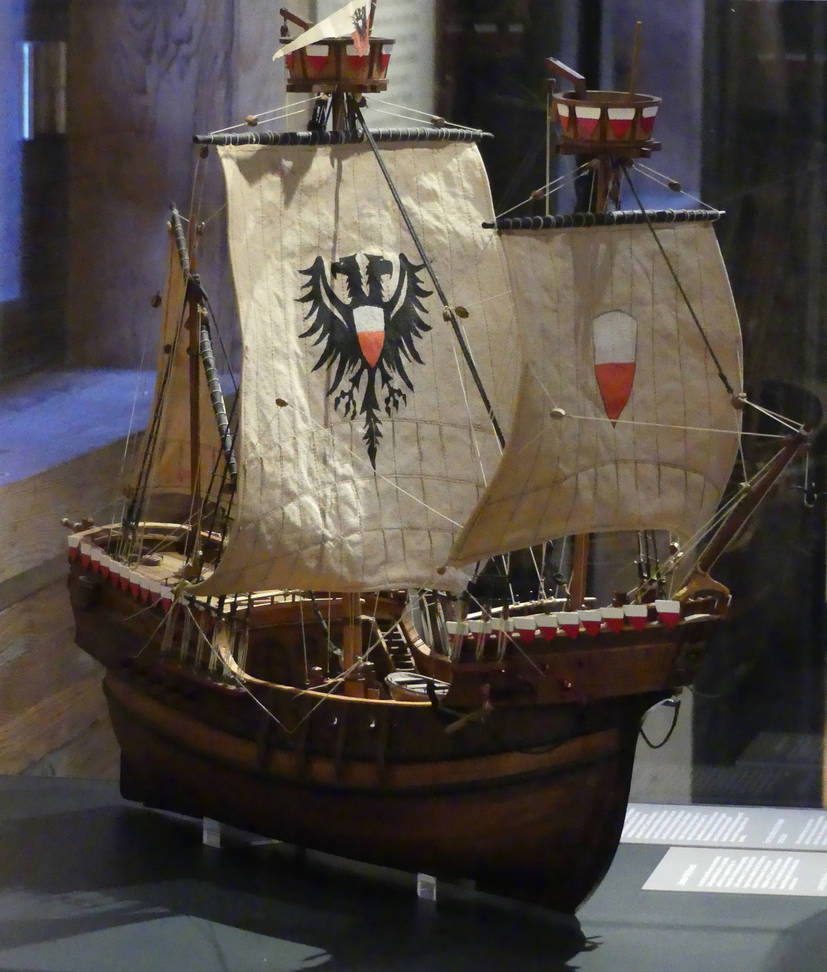
German Luebecker Holk end 15th Century


Maritime Museum Hamburg, Germany

The first large kraweel built ships in the Baltic Sea appeared in 1462. 

Friday, 5 January 2018

German replica 15th Hanseatic caravel Lisa von Lübeck 1999-


Rostock, Germany 10 August 2016

Germany-flagged, MMSI 211136000 and call sign DKVI. Laid down as a social project at Lübeck, Germany on 31 July 1999, launched on 27 March  2004 and commissioned in April 2005. Displacement 198 tons and as dimensions 30,12 (between perpendiculars)-35,9 (over all) x 9,3 x 2,86 (maximum) metres. Sail area 276 square meters and 1-347hp auxiliary diesel engine. Speed 8,5 knots. 

Wednesday, 4 October 2017

Swedish pinnace Nykopings Rosen 1596-1611

Built in 1596, lost in 1611, with an armament of 13 guns and a crew numbering 28 men.

Source
Sveriges krig 1611-1632. Stockholm, 1937, bilagsband 1. 

Saturday, 23 September 2017

Soviet warships passing Japanese coast according to a report of the American intelligence dated 16 July 1951

An item reported that two Soviet warships with the pennants X4 and X5 belonging to the 2nd Naval Squadron left on 20 June Dairen towards the south, passing Okinawa going northeast along the Japanese coast. On the 28th was the X4 on the position 147-30 and 40-00 and the X5 a day later 2:20 a.m. at 148-00 and 37-30. With a speed 0f 16 knots were the ship continuing a north east course. In the beginning of the same month was the same route followed by other Soviet warships passing Mokkaid arriving at Vladivistok.

Source
The report was published on www.archive.org, CIA document number CIA-RDP82-00457R008100430010-8. 

Sunday, 20 August 2017

The Bremen cog dated 1380s


German Maritime Museum, Germany August 2017

On 8 October 1962 was in Bremen the wreck of a cog dating from 1380 discovered and between 1962-1965 salvaged. The one-masted square-rigged carvel or clinker-built cog had a tonnage of 90 tons, displacement of 55 tons and as dimensions 23,27 x 7,62 x 4 (hold) metres although the figures are estimated using exhibition notes. There were later three almost dental replicas constructed named Ubena von Bremen, Hansekogge and Roland von Bremen.

Cogs or cog-built vessels are known of existing since the 10th century although becoming popular since the 12th century and built of oak. In first instance it were open ships which also could be rowed but since the 13th century the vessels were decked. In 948 was for the first time a cog mentioned in the Dutch town Muiden probably using the Norwegian trade vessel of the Knarr type developing into a sea going ship even with fore and aft castles for defence or war purposes. Around the 14th century reached the design the limits of further improving and increasing and needed to be replaced by a new designed ship. 

Tuesday, 15 August 2017

German 15th Century cog Die Bunte Kuh of Hamburg


Deutsches Schiffahrtsmuseum Bremerhaven August 2017

Original painting made by Hans Borhdt (1857-1945) in 1901 representing the Hanseatic cog Die Bunte Kuh which under command of Simon of Utrecht (14th Century-14 October 1437) made a end of the terror by the pirate Claus Störtebeker (around 1360-20 October 1401. He is in 1380 for the first time mentioned in 1380 in court documents of Wismar. Störtebeker was active in the Baltic for the Swedish against the Danes around 1389 and since 1396 he chose the side of the Frisians against the Dutch. He was taken prisoner by Simon of Utrecht off Heligoland and beheaded after a trial in 1401 although newest sources pointed out that he executed in 1400 and that the story of Simon of Utrecht and his in 1401 completed Die Bunte Kuh was not true. 

Tuesday, 6 September 2016

A Hungarian river gunboat of the second half of the 15th Century


With the Ottoman empire leaded by sultan Mehmed the Conqueror capturing after a siege of 53 days on 29 May 1453 Constantinople [nowadays known as Istanbul, Turkey] ended the Byzantine Empire, the former eastern part of the Roman Empire. The western part of the Roman Empire already fall in 476. The Ottoman Empire was since then involved in wars with European nations and increased further and further until the unsuccessful Turkish siege of the Austrian town Vienna in 1689 which was a turning point. Allied forces managed in the following years to drive Ottoman forces backwards with capturing southern part of Hungary and Transylvania. It is in this struggle between the Ottoman Empire and the East and Middle European world that historical well known figures like Vladislav III Draculea nicknamed Vlad Tepes and the Hungarian king Mathias Corvinus lived.

Vlad III is well known as Count Dracula since Bram Stoker wrote his well known Dracula in 1897. He was a voivode or prince of Wallachia, member of the House of Draculesti who lived between November/December 1431 (Segesvar, Transylvania which was part of the Kingdom of Hungary) and December 1476/January 1477 (Wallachia). He has been for several years in Turkish captivity. In later years he prove to be a harassment for the Ottoman forces accused of sadistic behaviour.

Mathias Corvinus (23 February 1442-6 April 1490) a contemporary of Vlad III and reigned as King of Hungaria and Croatia between 1458 and 1490 although his coronation was on 29 April 1464. In 1469 he was elected as King of Bohemia and since 1487 Duke of Austria.

Monday, 28 November 2011

Indian fort Murud-Janjira


This fort along the Indian western coast line at Murud was the only fort which was not captured by the Portuguese and the Dutch and English East India Companies. It was built of stone in 1490 and nowadays still existing with 19 round bastions fitted out with a large number of guns. The fort itself is in ruins.