Translate

Showing posts with label Haiti. Show all posts

Saturday, 7 February 2026

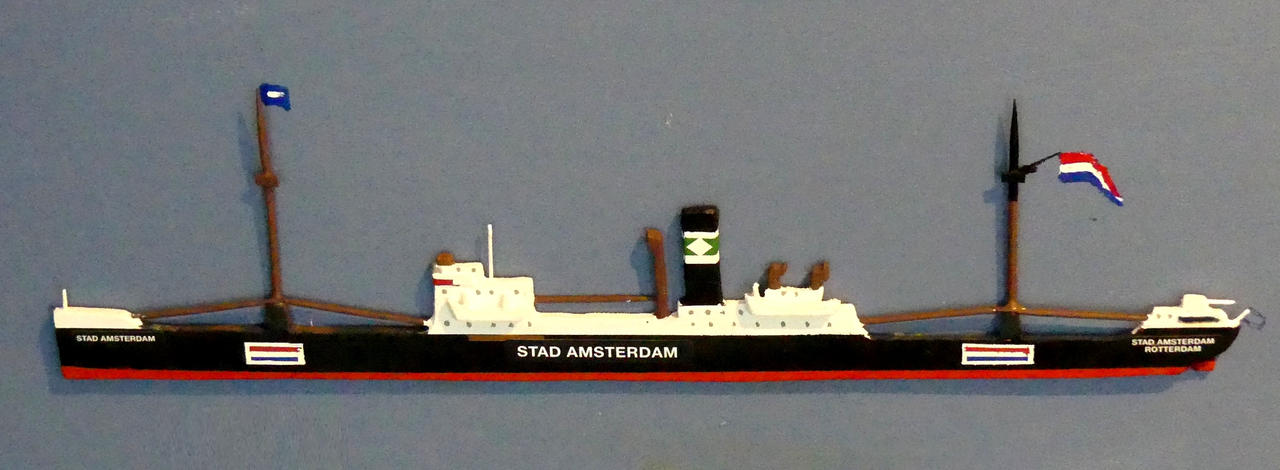
Dutch cargo ship Stad Amsterdam 1917-1942

Exhibition Varen voor Vrijheid. Museum Katwijk

Launched by Scheepswerf ‘Dordrecht’ N.V., Dordrecht, Netherlands with yard number 28 on 29 September 1917, delivered to manager N.V. Handels- & Transport Maatschappij Vulcaan, owner N.V. Stoomvaart Maatschappij Amsterdam, both at Rotterdam, Netherlands on 7 June 1920, manager Halcyon Lijn N.V., owner N.V. Stoomvaart Maatschappij Amsterdam, both at Rotterdam, Netherlands since 4 July 1920 and torpedoed and sunk by the German submarine U 164 off Haïti on 14 August 1942. She was underway from New York, USA to Trinidad due to engine problems forced to leave convoy TAW 15 on 19 August 1942.

According to the list and supplements 1-2 on 13 September 1945 BDZ No. 673 sent by the office of armament the Royal Netherlands Navy located at 41 East 42nd Street, New York 17, USA. There were no complete records available, so there were several sources used to compile the list. Sometimes the kind of guns gave indirect information regarding the origin such as 4”/BL and 12 pounder guns were British mostly supplied in the United Kingdom, Canada or Curacao. The 4.7” guns were old Japanese guns placed on some vessels in the begin of the war at Singapore and some 4” guns in the same period at Surabaya, Dutch East Indies. The trade in which the ship was used gave also an indication were the guns were supplied, for example involved in the Pacific trade means supplied at the West Coast.

Armed with 2-2cm guns supplied at New York on 28 July 1942

Source

Archieven van hoofd handelsbescherming en diverse handelsbeschermingsofficieren 1941-1946 inv.no. 53 (Nationaal Archief, The Hague, Netherlands. 

Wednesday, 19 February 2025

American battleship USS South Carolina sent to Haiti according to the Dutch newspaper Nieuwe Tilburgsche Courant dated 9 March 1914

South Carolina-class. ©Warshipsresearch.blogspot.com

An item dated Washington, USA 7th reported that at Haiti again riots broke out and the American battleship South Carolina was again sent to Port-au-Prince for protection of the foreigners there.(1)

Note

1. BB-26. Part of South Carolina-class battleships, preceded by Missisippi-class, succeeded by Delaware-class, laid down by William Cramp&Sons, Philadelphia, USA on 18 December 1906, launched on 11 July 1908, commissioned on 1 March 1910, decommissioned on 15 December 1921, stricken on 10 Novmber 1921 and sold to be broken up on 24 April 1924.  

Monday, 4 July 2022

British HMS cruiser Cambrian cruising in the Caribbean according to the Weekly Intelligence Summary No. 20 for the week ending 20 November 1920

An item reported that the British HMS Cambrian would due Colon, Panama on 2 December, bringing the British minister, Panama and the naval attache to Port Limon, Costa Rica and continue the voyage towards Belize, Jamaica, Santiago, Port au Prince, Haiti arriving around 15 January 1921 at Bermuda.(1)

Note

1. Of the C-class light cruisers Cambrian sub-class, preceded by Arethusa-class, succeeded by Danae-class, building ordered in September 1914, laid down by HM Dockyard Pembroke on 8 December 1914, launched on 3 March 1916, completed and commissioned in May 1916, finally decommissioned in July 1933 and sold to be broken up on 28 July 1934.

Source

The National Archives, Kew Gardens, England CAB-24-115-34 

Tuesday, 3 May 2022

Haitian president Lescot favored the establishment of a small American air base at Mole St. Nicolas according to the U.S. Joint Intelligence Committee. Daily summary dated 11 March 1942

An item reported that the Haitian president Lescot favored the establishment of a small air base at Mole St. Nicolas [Môle-Saint-Nicolas] with as main task protecting of the shipping in the Windward Passage. The J.I.C. mentioned the activities of Axis submarines in the Passage.(1)

Note

1. Antoine Louis Léocardie Élie Lescot (9 December 1883 Saint-Louis-du-Nord, Haiti–20 October 1974 Laboute Haiti), presiden 15 May 1941-11 January 1946.  


Source

Map Room Papers (Roosevelt Administration), 1942 - 1945. U.S. Joint Intelligence Committee. Daily summary No. 91 dated 11 March 1942.

Friday, 25 February 2022

American self-propelled 75 foot district patrol craft USS YP-80 according to the report of progress of naval construction dated 1 May 1942

Contractor. Elscot Boat Works Inc., Brooklyn, New York, USA  

Percentage of completion on 1 May 1942: 90.0 

Percentage of completion gain for April 1942: 5.0 

Laid down: 25 August 1942 

Launched: 20 March 1942 

Number of months between keel laying and completion:  

Date of completion as per contract or order: 26 January 1942 

Date of completion as reported by building yard on 11 January 1941: 19 January 1942 

Date of completion as last reported by building yard: 14 May 1942 

Months 11 January 1941 prediction: 3.8 behind 

Note 

1. Contract awarded on 30 June 1941, delivered and commissioned on 12 June 1942, handed over Haiti and renamed Indépendance (CG-12) in 1960.  

Sources 

Franklin Roosevelt D. Roosevelt Presidential Library&Museum. Bureau of Ships: reports 1 May 1942 FDR’s President’s Secretary’s Files (psfc000095).  

http://warshipsresearch.blogspot.com/

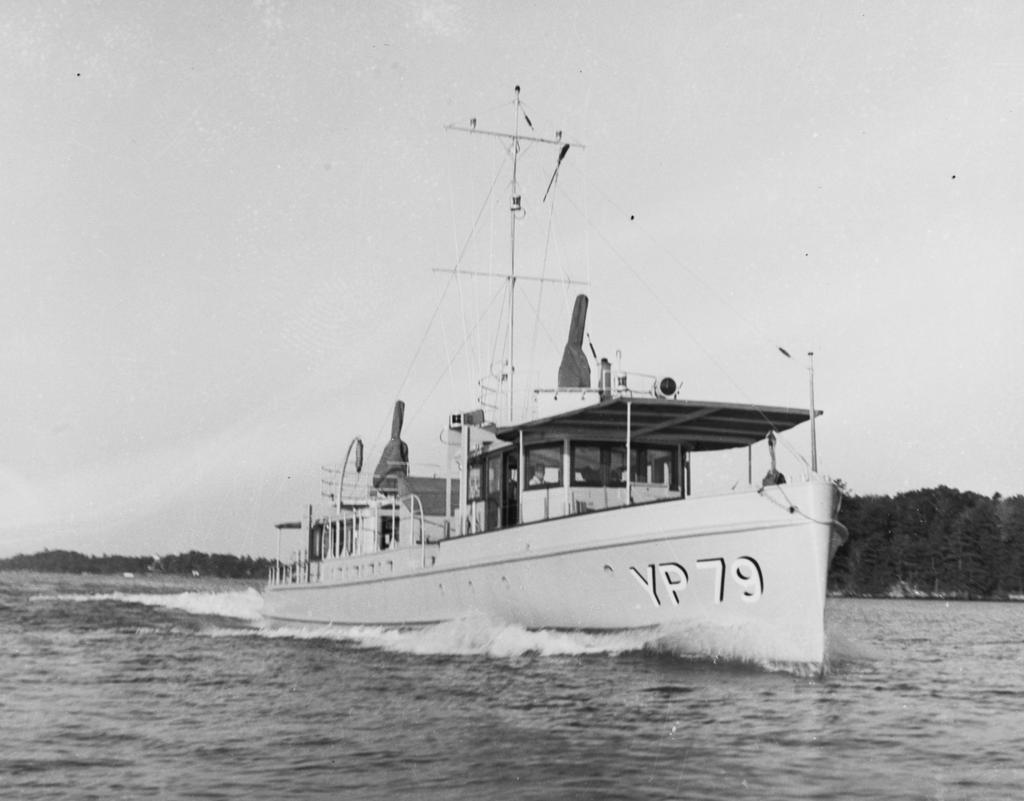
American self-propelled 75 foot district patrol craft USS YP-79 according to the report of progress of naval construction dated 1 May 1942

Contractor. Hutchinson Boat Works, Alexandria, New York, USA 

Percentage of completion on 1 May 1942: 84.0 

Percentage of completion gain for April 1942: 4.0 

Laid down: 3 October 1941 

Launched: 2 May 1942 

Number of months between keel laying and completion:  

Date of completion as per contract or order: 26 January 1942 

Date of completion as reported by building yard on 11 January 1941: 26 January 1942 

Date of completion as last reported by building yard: 20 June 1942 

Months 11 January 1941 prediction: 4.8 

Note 

1. Contract awarded on 30 June 1941, according to www.navsource.org launched on 20 April 1942, delivered and commissioned in August 1942, handed over to Haiti and renamed 22 Septembre (CG-11) in 1960 

Sources 

Franklin Roosevelt D. Roosevelt Presidential Library&Museum. Bureau of Ships: reports 1 May 1942 FDR’s President’s Secretary’s Files (psfc000095).  

http://warshipsresearch.blogspot.com/

Monday, 20 July 2020

French naval movements according to the Dutch newspaper Nieuwe Rotterdamsche Courant dated 20 August 1851

An item dated London 17 August referred to the necessity of having an own fleet of ships of the line regarded what was going on at France. On 28 July was at Brest a 50-gun frigate launched. A corvette with troops on board destined towards Haiti was to depart as soon as possible. The French main fleet consisting of 6 ships of the line and one steamboat was on 26 July off Cadiz and to start the 28th with cruising. On 25 July arrived the French admiral with a frigate, a corvette and a brig coming from South-America at Cadiz. With such a strong French fleet was England obliged to have within short time more as 4 ships of the line in the Mediterranean and one at Lisbon. The newspaper was pleased with the fact that recently two large British ships of the line were commissioned.

Saturday, 11 July 2020

The French navy in the South American area according to the Nederlandsche Staatscourant dated 16 June 1838

The newspaper Journal du Havre dated 12 June published more details dealing with the French naval blockades in the South American area just with a small number of vessels. Captain Bazoche blockaded the Mexican coast with just a frigate and a corvette. Admiral Leblanc blockaded the whole coast of the Argentinean republic with not more than a corvette as flagship and 2 or 3 smaller vessels. He was send to this coast due to the fact that the French consul was forced by the government to leave from Buenos Aires. The French admiral Villeneuve tried to stay neutral in the war between Peru and Chile despite both countries being also hostile towards France. Lucky enough hadn’t been necessary to blockade the ports of Haiti. According to tidings from master Rabardy who left with the merchant ship Napoleon 12 April Buenos Aires and 14 April Montevideo were since 1 April all merchant ships visited by the sloops of the 4 French warships. Admiral Leblanc permitted all neutral merchant ships at Buenos Aires to load their cargo and depart within 10 days. Another letter dated Buenos Aires 12 April reported the arrival of Leblanc with the corvette l’Expeditive at Buenos Aires and his adjutant handed over the French ultimatum to minister Arana allowing him just 3 hours to write an answer. Within short time it was made clear that there would be no answer before 26 or 27 April. In the afternoon of  26 April send Leblanc the captain of one of his ships to shore to demand an answer the same day. The same evening he got an unsatisfied answer and 28 April Leblanc made clear that he was going to blockade the coasts with his ships le d’Assas, la Camille, l’Expeditive and l’Allerte. Since 29 March visited none ships the harbours.

Wednesday, 8 July 2020

Haitian warships according to the Dutch government newspaper Nederlandsche Staatscourant dated 12 January 1843

This official Dutch government newspaper reported that recently became known that a corvette flying Haitian colours captured several Spanish ships and that the governor of Cuba sent some warships to end these hostile acts. According to the item recognized the European countries the republic Haiti as an independent nation  with the expressive condition that she was never allowed to fit out any warships. During several years she respected this condition but suddenly it seemed to be forgotten while a frigate of corvette bought in the United States was fitted out by the republic. The commanding officer at the British station in that area (Antilles) sir James Yeo prevented however that this frigate was used. As soon as she left the harbour she was pursued by the British navy and attacked causing a lot of Haitian sailors killed and she was forced to return to the harbour. She was heavily damaged and not able to sail again and she was since then neglected and declined.

Recently fitted Haiti however again a corvette out without anyone noticing it despite the British watching carefully these waters. Caused by heavy weather the corvette was forced to enter one of the harbours on the Spanish island Puerto Rico and seized by the Spanish government and declared prize. Haiti immediately fitted out a new vessel and this was the vessel that captured 3 Spanish ships off Santander. The captain general of the Spanish Antilles don Geronimo Valdez received the tidings of this capture and ordered a frigate, a corvette and a armed steamboat which were at his disposal to join the ships at the station of Puerto Rico and to go towards Haiti .The complete strength of this squadron would consist of a 50 gun frigate, 1 corvette, 3 brigs, 2 steamboats and several smaller vessels against one Haitian corvette. It was a long time ago according to the Dutch newspaper that Spain fitted outs such a large squadron elsewhere.

Monday, 15 June 2020

American schooner Pegasus bound for Haiti according to the Dutch newspaper De Curacaosche courant dated 23 November 1816

An announcement reported that the fast American schooner Pegasus would depart on next Wednesday 27th for Jacmel and Aux Cayes, Haiti. For more deatils could be asked her master John Daly on board of ship ship at Basden’s Werf or at Van Steenbergen&Franken, Breede Straat No. 36. The schooner made similar voyages in 1817.

Wednesday, 27 May 2020

Dutch tug Capesterre built in the Netherlands in 1909 according to the Dutch magazine Scheepvaart dated 31 December 1909

A list of the ships launched in 1909 reported the Dutch tug Capesterre built by Jonker&Stans, Hendrik-Ido-Ambacht  for account of John. Kievits&Co., Dordrecht, Netherlands.(1)

Note
1. The Scheepvaart dated 1 December 1909 reported her arrival at Le Havre, France on 27 November coming from Rotterdam, Netherlands while towed by the Dutch tug Rozenburg where she was to be loaded on a French steamship with as destination Port-au Prince, Haiti. According to Van Jonker en Stans tot Alblas 1901-1985 yard number 76 with as dimensions 13,63 x 12,00 x 3,75 x 2,20 metres.

Tuesday, 21 April 2020

Dutch brig Zr.Ms. Sperwer arrived at Curacao returning from Panama, Haiti and Venezuela according to the Dutch newspaper De Curacaosche courant dated 28 September 1850

An item reported the arrival at Willemstad, Curacao on he 23rd of the Dutch brig Zr.Ms. Sperwer captain lieutenant J.W.F. Frucht after visiting Port-au-Prince (Haiti), Chagres (Panama), Cartagena (Colombia) and Santa Martha. (Colombia).(1)

Note
1. Brig 1st class, laid down at the navy yard at Vlisingen, Netherlands on 13 May 1840, launched on 9 May 1845, dry docked at the navy yard at Hellevoetsluis, Netherlands 13-18 April 1849, 10-18 June 185225 February-4 March 1857, 1-4 June 1860 and 13-16 October 1868, stricken 1873, displacement of 546 tons and as dimensions 31,50 x 9,50 x 4,50 metres, an armament of 18 guns and a crew of 100 men.

Saturday, 8 February 2020

Scottish adventurer Gregor Macgregor lost his brig Hero off Haiti according to the Dutch newspaper De Curacaosche courant dated 4 September 1819

An item referred to tidings reporting that McGregor (1) lost his brig Hero on a reef off Aux Cayes, Haiti caused by worse seamanship. The salvaged stores, sails and rigging were sold on a public auction. The captain of the transport Tarantula from London refused to bring M’Gregor towards St. Andreas while he had not paid half of the freight costs according to the contract. When M’Gregor tried to force him, the captain suddenly left Aux Cayes saluting the wreck of the Hero with 13 gun shots. The Tarantula was commanded by the Dutchman Poolman who now was bound for Jamaica to find there a freight. He refused to deal further with M’Gregor.

Note
1. Gregor Macgregor (24 December 1786 Stirlingshire, Scotland-4 December 1845 Caracas, Venezuela) soldier, adventurer and active in the struggle of the Spanish South American colonies to retain independence.

Thursday, 23 January 2020

Haitian gunboat Liberté exploded according to the Dutch newspaper The Sumatra Post dated 28 October 1910

An item reported that the gunboat Liberté of the Haitian navy was destroyed near Port de Paix caused by an explosion. Of the crew were 70 men killed and just 20 saved. This item was confirmed by the newspaper Het nieuws van den dag voor Nederlandsch-Indië dated 27 October.

Saturday, 18 January 2020

The French navy in the Caribbean area according to the Nederlandsche Staatscourant dated 9 September 1825

Paris, 5 September. The French minister of navy of colonies count de Chabrol reported to the French king what happened in the meantime considering the situation at Haiti/St. Domingo. It was decided to send Baron de Mackay with an ordinance dated 17 April to protect the interests of the French trade. He left 4 May with the frigate la Circé Rochefort ordered to go immediately towards Martinique to consult lieutenant general Danzelot, governor of the colony and rear admiral Jurien commanding officer of the French squadron in the Antilles. Jurien was ordered to gather all his ships to be available between 15 and 20 June off Port Royal. Rear admiral Grivel commanding the squadron off Brazil was ordered to come towards Martinique to join Jurien. The la Medéa which left mid May France arrived 17 June at Fort Royal. The French crown also ordered that the 4 frigates l’Amphitrite, l’Antigone, la Flore and la Galathée had to be fitted out completely and to be able to depart immediately if requested. Also it was ordered that 2 ships of the line, 4 frigates and several small vessels were to be provisional commissioned or fitted out. There were just a few days required to do so. The squadron commanded by rear admiral Jurrien consisted 20 June of the ships of the line 80-gun l’Eylau and 74-gun le Jean Bart, 24-gun frigates la Venus and la Clorinde, 18-gun frigates la Nymphe, la Themis, la Magicienne, la Circé, la Medée and la Salamandre and 45 brigs or goelettes armed with 16,18 and 24 guns. Baron de Mackau commanding officer of the la Circé was ordered to depart some days before the squadron which was no to appear on the waters of Port-au-Prince before ordered to do so. De Mackau departed 23 June with a division consisting of the frigate and the brigs le Rusé and la Bearnaise Martinique and the other ships 27 June.

Thursday, 19 December 2019

Dutch bark Jean Baptiste underway from San Domingo towards the Netherlands according to the Dutch newspaper Middelburgsche Courant dated 1 December 1887

An item reported that that the Dutch bark ship Jean Baptiste (1) of De Groof&Co., Vlissingen, Netherlands departed on 29 October from Cape Haiti towards Fort Liberto, San Domingo and now returning to the Netherlands.

Note
1. Lijst van de Nederlandsche Oorlogs- en koopvaardijschepen met hunne onderscheidingsseinen uit het Internationaal Seinboek ten dienste van alle Natiën. Rotterdam, 1892. Callsign PFKH. Net tonnage 891 tonnen, 2.254,60 cubic metres or 795,90 tons of 2,83 cubic metres.

Monday, 28 October 2019

Storm destroyed part of the Haitian navy underway to attack the Dominican Republic according to the Dutch newspaper De Curacaosche courant dated 31 January 1846

An item referred to a statement of the president of the Dominican Republic general Santander dated 27 December 1845 reported the disaster for the Haitian navy. The admirals’ ship and 2 schooners stranded near Ma Louie before Porto Plata in the night of the 21st during a storm and were captured by the Dominicans. Among the prisoners of war were brigade general Cadet Antoine serving as admiral, colonel Juan Felipe, several officers and 119 sailors. The newspaper El Dominica dated the 18th reported that it concerned the schooners Union, Dieu Protége and La Guerriere. There were 149 survivors arriving in the town on 3rd January and taken to the prison. Rumors claimed that they had the intention to attack Porto Plata and killed everybody there. According to dements found on board consisted the Haitain navy of the bark ship President, the schooner Union with one16pd pivot gun and 6-16pd carronades, the schooner La Mouche with 2-8pd carronades, the schooner Dieu Protége, the schooner La Signifié (ex-La Vierge) with 2-12 pd carronades and 1-2pd gun and finally the schooner La Guerriere with a bronze 12pd gun and 4-8pd carronades of British calibre.

Monday, 26 August 2019

The brig William Galt with mining equipment towards Haiti according to the Nederlandsche Staatscourant dated 29 October 1825

London, 25 October. Last Thursday left the brig William Galt the Thames towards Falmouth and to depart from there towards Port-au-Prince. The brig had a cargo of tolls and engines for the gold and silver mining permitted by president Boyer of Haiti to the Haitian company. At Falmouth with come on board a so-called metals essasayeur, 2 captains and accompany of mine-workers.

Tuesday, 2 July 2019

Haitian expedition towards Dominican republic according to the Dutch newspaper Schiedamsche Courant dated 13 January 1849

London. From Haiti arrived tidings dated until 6 September according to which the new emperor Soolouque was busy with supplying titles of nobility to his generals and that he fitted out a expedition consisting of one corvette, one steamboat and 2 schooners with on troops against the Dominicans.(1)

Note
1. Emperor Faustin I (1782-6 August 1867), born as Faustin-Élie Souloique, a Haitian general who became through an election in 1847 president of Haiti and in 1849 proclaimed as emperor creating a black nobility. He didn’t succeed in capturing the Dominican Republic.

Tuesday, 4 June 2019

Dutch bark Jean Baptiste underway from Haiti towards Actona according to the Dutch newspaper Middelburgsche Courant dated 26 March 1887

An item reported that the Dutch bark ship Jean Baptiste (1) of De Groof&Co., Vlissingen, Netherlands passed on the 22nd Dungeness underway from Haiti towards Actona (Eloe) with a cargo of timber (logwood?)

Note
1. Lijst van de Nederlandsche Oorlogs- en koopvaardijschepen met hunne onderscheidingsseinen uit het Internationaal Seinboek ten dienste van alle Natiën. Rotterdam, 1892. Callsign PFKH. Net tonnage 891 tonnen, 2.254,60 cubic metres or 795,90 tons of 2,83 cubic metres.