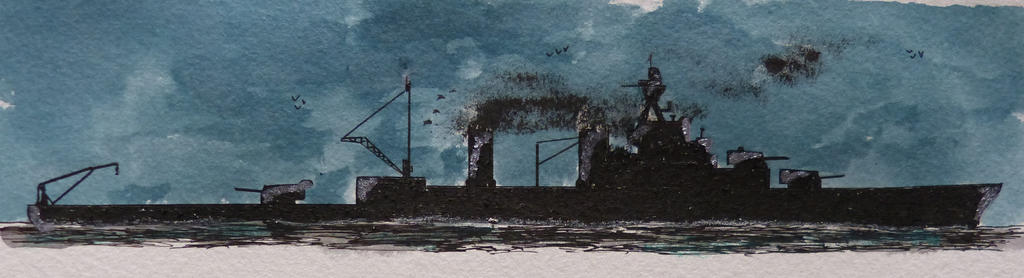
Laid down by Société Nouvelle des Forges et Chantiers de la Méditerranée, La Seyne-sur-Mer, France on 15 November 1933, launched on 26 October 1935, commissioned on 15 November 1937, decommmissioned on 1 May 1957, accommodation hulk since 1959, renamed Q457 on 31 December 1969 and broken up in 1970. Part of the La Galissonnière-class light cruiser preceded by Émile Bertin succeeded by planned De Grasse-class. General class technical characteristics. Displacement 7,600 (standard)-9,120 (full load) tons and as dimensions 179 x 17.5 x 5.35 metres or 587.3 x 57.4 x 17.6 feet. The propulsion consisted of 2-shaft geared turbines and 4 Indret boilers suplying 84,000 shp allowing a speed of 31 (knots)-35 (trial) knots and a range of 7,000 nautical miles/12 knots. Crew numbered 540 men. Armament consisted o x3-15.2 cm/6.0” guns,4x2-9cm/3.5” anti aircraft guns, 66x4-4cm/1.6”guns, 2x2-55cm/21.7” torpedo tubes and 2-4 flying boats, Armour consisted of a 10.5cm/4.1” thick belt, 3cm/1.2” end bulkheads, sides 12cm/4.7”, 3.8cm/1.5” deck and th turrets respectively conning tower protected by 10cm/3.9” respectively 9.5cm/3.7”.
Translate
Showing posts with label Natal. Show all posts
Tuesday, 12 December 2023
French light cruiser Montcalm 1933-1970
Émile Bertin
La Galissonnière class
Tuesday, 3 May 2022
Former commercial German and Italian pilots trained for flying bombers according to the U.S. Joint Intelligence Committee. Daily summary dated 11 March 1942
An item referred to a reliable British source reporting that German and Italian pilots which were earlier in commercial service on flights in South America and on the trans-Atlantic route were now trained to fly 150 bombers stationed in western France. It was believed that these bombers were to be used for attack the shipping from and to West African harbours and South American keypoints. The J.I.C. commented that these pilots were such valuable due to their knowledge of the West Africa-Natal route and areas and South American out-of-the-way places.
Source
Map Room Papers (Roosevelt Administration), 1942 - 1945. U.S. Joint Intelligence Committee. Daily summary No. 91 dated 11 March 1942.
Friday, 11 December 2020
Saturday, 21 September 2019
Increase of the naval base at Natal according to the Dutch newspaper De Tijd morning edition dated 20 March 1941
Lisbon, 19 March. The Brazilian secretary of navy Guilhem stated that the Brazilian cabinet intended to increase the naval base at Natal while this base caused by her geographic position opposite to Dakar in French Africa (Senegal ) was of a major strategic importance
Saturday, 26 January 2019
British transport Goth arrived at Gibraltar according to the Dutch newspaper Zierikzeesche Nieuwsbode dated 29 August 1899
An item reported that the transport Goth arrived at Gibraltar to transport a battalion of the regiment of Manchester towards Natal.
Note
1. The Second Boer War found place between 11 October 1899 and 31 May 1902 and ended in a defeat of the Boers and regaining British sovereignty of the Orange Free State and South African Republic (Transvaal). In 1920 became the Union of South Africa part of the Commonwealth.
Note
1. The Second Boer War found place between 11 October 1899 and 31 May 1902 and ended in a defeat of the Boers and regaining British sovereignty of the Orange Free State and South African Republic (Transvaal). In 1920 became the Union of South Africa part of the Commonwealth.
Sunday, 8 October 2017
The floating dock for Durban, South Africa according to the British magazine The Engineering dated 20 December 1901 and 8 August 1902
An item reported that the government of Natal [nowadays part of South-Africa] ordered a Messrs. Clark and Standfield floating graving dock to delivered by Messrs. C.S. Swan and Hunter Limited, Wallsend-in-Tyne, at the port of Durban at the end of 1902.
In the edition of 8 August 1902 was a photo of the dock published and sighted that she was launched on Wednesday afternoon sighted by a large audience. Although of the same type as the dock used at the British naval yard at Bermuda were her dimensions decreased. The dock was divided in 40 water tight-compartments and consisted of 3 pontoons connected with movable points to allow being separated and 2 side walls. The construction in this manner made it possible to dock one of her pontoons by herself. Dimensions 375 (maximum over platforms) x 88 feet and with a distance between the guard timbers on the side wall of 61 feet. It cold dock ships with a maximum beam of 60 feet and a maximum draught of 18 feet with timber keel-blocks with a height of 4 feet resulting in a freeboard of 4 feet. Except for the common timber-blocks were there also 24 sliding bilge blocks available which could be hauled under the ship using ropes from the main deck. The needed machinery consisting of 2 identical installations was situated in the upper portion of the two side walls with pumps delivered by the shipyard. Sudron&Co., Stockton, England manufactured the needed return-tube marine type boilers. Further more was the dock fitted out with horizon compound tandem steam engines made by W.H. Allen, Sons&Co. Linited , Bedford, England, which firm also made the electric light installation. To pull a hip into the dock were on each wall 2 steam capstans available and for centring the ship 4 mechanical side shores, also manually controlled with wheels from the top deck.
Source
https://www.gracesguide.co.uk/Main_Page
Wednesday, 23 May 2012
British transport Rubine wrecked according to the Dutch newspaper De Zeeuw dated Tuesday 12 December 1899
An item reported that the British transport Rubine underway with reinforcements towards Cape Town , South Africa was wrecked last Saturday off Kent, England . The Zierikzeesche Nieuwsbode dated Thursday 14 December reported that she was wrecked off Erith (Kent) while underway from Plymouth , England with reinforcements for Cape Town and Natal , England.
Note
1. The Second Boer War found place between 11 October 1899 and 31 May 1902 and ended in a defeat of the Boers and regaining British sovereignty of the
Subscribe to:
Posts (Atom)


