Translate

Showing posts with label Easter Islands. Show all posts

Sunday, 4 October 2026

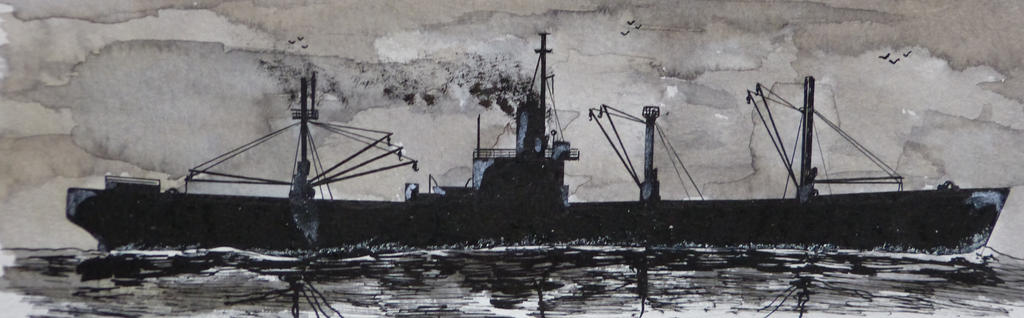
Russian dry cargo carrier Ivan Turgenev 1952-

Sister ship Saltykov-Shchedrin©Warshipsresearch.blogspot.com

Homeport Petropavlovsk-Kamchatsky. Part of Saltyjov-Shchedrin-class trawlers. Built by Josef Boel&Zonen, Boelwerf, Temse, Belgium in 1952. Principal dimensions 85,15 (between perpendiculars)-92.05 (over all) x 13.53 (moulded) x 5.74 (depth to main deck) x 21.00 (height of mast acorn above main deck) feet. Loaded draught 5.37 (fore)-5.91 (aft)-5.65 (mean) metres. Deadweight 2,989 tons, gross tonnage 2,672 tons and net tonnage 1,008 tons. 

Sunday, 1 September 2024

Russian cargo ship (ex-Immo 1923-1932) Volkhov 1932-1959

©Warshipsresearch.blogspot.com

Call sign UOBQ. Built by J. Frerichs&Co. A.G., Einswarden, Germany with yard number 319 in 1923. Gross tonnage 2,290 tons, under deck 2,021 tons, net tonnage 1,315 tons and as dimensions 296.2 x 42.8 x 19.6 x 20 (loaded) feet. Normal speed 8 knots. Small well forward, German type ventilators over fidley hatch and an unique construction of poop. 

Friday, 17 May 2024

Italian light cruiser Duca d’Aosta hit by torpedoes in August 1941

Warshipsresearch.blogspot.com

American naval attaché at Rome, Italy reported in September 1941 that according to a petty officer of the Italian light cruiser Duca d’Aosta that she was hit by two torpedoes on 4 August near Palermo. One hit under the bridge and the second one between the 3rd and 4th turrets. Heavily listing and down by the stern she managed to make a safe harbour.

Note

1. The Emanuele Filiberto Duca d’Oasta, part of Condottieri-class, laid down by O.T.O., Livorno on 29 October 1932, launched on 22 April 1934, commissioned on 13 July 1935, handed over on 2 March 1949 to the Soviet Union, commissioned on 30 March 1949, renamed Z15-Stalingrad-Kerch and stricken on 20 February 1959 to be broken up. Strangely enough she was never in any of the naval battles she participated or damaged in an air or submarine attack. So it should another cruiser the American naval attaché referred to.

Source

National Archives USA. Record Group 38: Records of the Office of the Chief of Naval Operations. Series: Secret Naval Attaches Reports. Estimate of potential military strength (pt.). Summaries. Reports from London, Paris, Brussels, Rome and Berlin. Roll M975-001.

Thursday, 1 September 2022

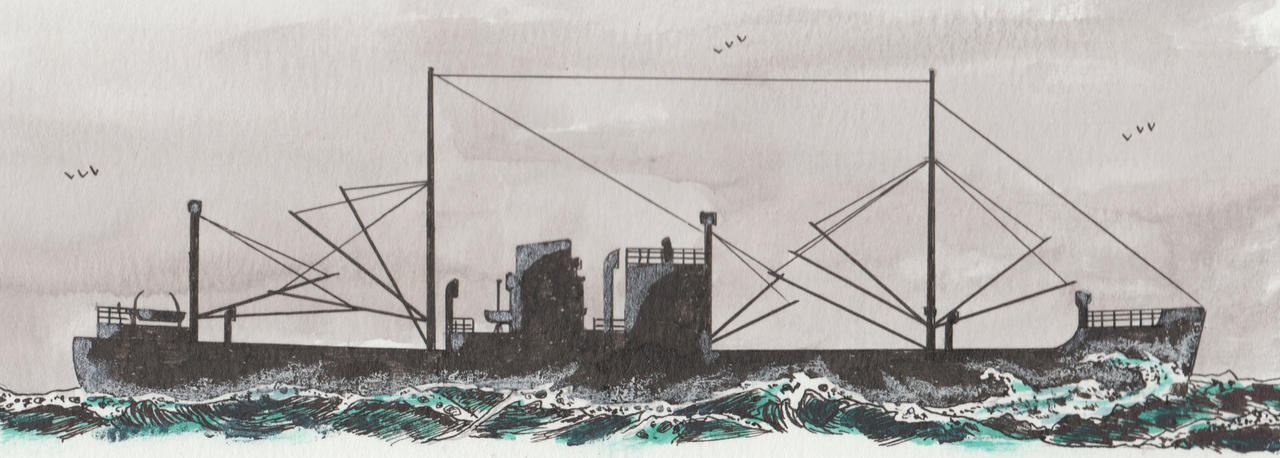
Russian general cargo ship (ex-William G.T’vault) Kuban 1943-1974, PSKL-48 1974, SKH-48 1977-1979)

Liberty ship. IMO 5197262. Laid down by Oregon Shipbuilding, Portland, Oregon, USA with hull number 2008 on 16 April 1943, launched on 5 May 1943, completed on 13 May 1943, hulked in 1972 and broken up in 1974 or in 1979. Owned by Far-Eastern Steamship Company. Deadweight 10,595 ton, deadweight cargo capacity 8,258 tons, gross tonnage 7,185 tons, net register tonnage 4,243 tons and as dimensions 126.67 (between perpendiculars)-134.57 (over all) x 17.37 (moulded) x 11.41 (depth to main deck) x 19.00 (height mast acorn above main deck) x 8.45 (fore loaded)-2.16 (fore light) x 8.45 (aft loaded)-3.0 (aft light) x 8.45 (mean loaded)-2.58 (mean light) metres , total bale cargo capacity 13,016 cubic metres, total grain cargo capacity 14,573 cubic metres. Speed 11.2 (in ballast)-10.2 (full loaded) knots. Fitted out with 1-2.500 ihp triple expansion steam engine.

Monday, 22 July 2019

Bulgarian tug KRZ-9 1986-

Bulgaria-flagged, homeport varna, BRS number 411360. Owned and managed by Odessos Shiprepair Yard. Gross tonnage 7,41 tons and as dimensions 10,65 (Conventional) x 3,90 x 1,62 x 1,20 metres and a summer freeboard of 426mm. Built by Sanfuegos, Cuba in 1986.

Source 
Bulgarian register op shipping on 20 July 2010 (http://www.bkrclass.org/reg_online/Find_Vessel.aspx). 

Thursday, 7 March 2019

Naval Shipyards at Fiume completing tugs according to a CIA report dated 25 February 1947

An item reported that during a meeting of the board of the Naval Shipyards at Fiume, Yugoslavia [nowadays Rijeka, Croatia] om 28 November 1946 was decided to complete three-1.000hp tugs of which the hull just partially were completed. It was yet unknown which kind of machinery was to be used. Lacking suitable cranes to install the 30 tons weighing boilers in the tugs was now considered to dismantle them an reassemble the boilers in the hulls.

Source
The report was published on www.archive.org, document number CIA-RDP82-00457R000300650004-7

Tuesday, 12 February 2019

Polish screw steam tug Bozymir active on the Oder according to a CIA report dated 27 January 1953


An item reported that on the sectionsingle  Kozle-Wroclaw-Redzin [the former German places Cosel-Breslau-Ransern] the Polish screw steam tug Bozymir master Pietr Ptok was active. Dutch built. Horsepower 250hp.(1)

A new river convoy was formed with below the last sluice near Redzonthe small tug Podhalanin especially used there for the local formation. Some barges were from there towed to their destination, others went on own power when the cargo was to be delivered according to a time schedule. If so such a barge needed minimal 8 days to go from Redzin to Szczecin, when towed maximum 5 days. The travel time for this section was just 48 hours. Were all the locks in full operation, the entrance to the sluice in Katy near Opole, the lock entrance at Groszowice [Groschowitz] and the point blow the bridge in Olava (alluvial sand deposits) were still potential problem areas.

Note
1. Single screw steam tug. The dimensions are then given as 26,50-28,00 x 5,70 (thrushes changed in 5,94)-5,76 (maximum beam altered in 6,00) x 1,30 (with 10 ton colas and boiler willed with water) x 2,1 metres. The machinery consisted of 1-250ihp triple expansion steam engine and a boiler with a heating surface of 83 square metres. The Nederlandsche Scheepsbouw Export Centrale acted as an intermediary between Dutch shipyards and the Polish organisation Polimex (Polsike Towarzystwo Eksporto-Importowe Maszyn i Marzedzi), Warszawa, Poland. Built by Boot, Leiden, Netherlands with yard number 148 in 1949.

Source
The report was published on www.archive.org, document number CIA-RDP80-00926A005900840001-6

Polish tug Buczek active on the Oder according to a CIA report dated 27 January 1953

An item reported that on the section Kozle-Wroclaw-Redzin [the former German places Cosel-Breslau-Ransern] the Polish tug Buczek was active. American type tug, now being repaired, horsepower 220hp.

A new river convoy was formed with below the last sluice near Redzonthe small tug Podhalanin especially used there for the local formation. Some barges were from there towed to their destination, others went on own power when the cargo was to be delivered according to a time schedule. If so such a barge needed minimal 8 days to go from Redzin to Szczecin, when towed maximum 5 days. The travel time for this section was just 48 hours. Were all the locks in full operation, the entrance to the sluice in Katy near Opole, the lock entrance at Groszowice [Groschowitz] and the point blow the bridge in Olava (alluvial sand deposits) were still potential problem areas.

Source
The report was published on www.archive.org, document number CIA-RDP80-00926A005900840001-6

Polish tug Obra active on the Oder according to a CIA report dated 27 January 1953

An item reported that on the section Kozle-Wroclaw-Redzin [the former German places Cosel-Breslau-Ransern] the Polish tug Obra master Frantisek Komander was active. American type tug.

A new river convoy was formed with below the last sluice near Redzonthe small tug Podhalanin especially used there for the local formation. Some barges were from there towed to their destination, others went on own power when the cargo was to be delivered according to a time schedule. If so such a barge needed minimal 8 days to go from Redzin to Szczecin, when towed maximum 5 days. The travel time for this section was just 48 hours. Were all the locks in full operation, the entrance to the sluice in Katy near Opole, the lock entrance at Groszowice [Groschowitz] and the point blow the bridge in Olava (alluvial sand deposits) were still potential problem areas.

Source
The report was published on www.archive.org, document number CIA-RDP80-00926A005900840001-6

Monday, 28 January 2019

Estonian long-range freezer trawler (ex-Mys Arkticheskiy 1976-1992) Oskar Luts 1992-2018 (Bukhta Gaydamak 2018)


Estonia-flagged, homeport Tallinn, Estonia, call sign UEUY and IMO 7611078. Ex-Mys Arkticheskiy renamed 1992 and Oskar Luts renamed 30 November 2018. As Bukhta Gaydamak Russia-flagged. Owned by the fishing company Ookean. Built at GP Chemorskiy Sudostroitelnyy Zavod-Nikolaev, Ukraine in 1976. Of the Kronshtadt type project 394 AM, preceded by the Mayakovski project 394. For fish meal and technical fish oil production. Dimensions 79,43 (between perpendiculars)-83,81 (overall) x 14,00 (moulded)-14,02 (extreme) x 10,01 (depth to upper deck) x 4,71 (loaded forward)-6,51(loaded aft), gross tonnage 1.163 tons, deadweight 1.182 tons and a total displacement of 3.800 tons. Speed 12,5 knots. Fuel capacity (diesel 600 ton and heavy fuel 167 tons)for 70 days. Accommodation for 93 persons. Crew numbered 63 persons. Three holds and a total capacity of 1.624 cubic metres; for frozen fish (-22 Celsius) 1.388 and fish meal 236 cubic metres. Daily production capacity freezing equipment 35-40 tons frozen fish in blocks of 10 kilo and of the fish meal plant 30-35 tons raw-fish. Capacity fish oil tanks 45,9 cubic metres. Fitted out with 1-1.470kW/2.000hp 8DR 43/61-B1 diesel. 

Wednesday, 5 September 2018

The Czechoslovakian CSPD motor tug Morava active on the Danube according to a CIA report dated 29 June 1955

An item dated 4 May 1955 reported the Czechoslovakian CSPD (Ceskoslovenska Plavda Dunajska) motor tug Morava on the Danube off Budapest, Hungary while towing 8 loaded barges upstream.

Source
The report was published on www.archive.org, document number CIA-RDP80-00810A007200560007-7

The Czechoslovakian CSPD motor tug Ondava active on the Danube according to a CIA report dated 29 June 1955

An item dated 4 May 1955 reported the Czechoslovakian CSPD (Ceskoslovenska Plavda Dunajska) motor tug Ondava on the Danube off Budapest, Hungary while towing eight loaded barges upstream.

Source
The report was published on www.archive.org, document number CIA-RDP80-00810A007200560007-7

Friday, 3 August 2018

East German tug No. 044 according to a CIA report dated 14 December 1953

An item reported that after 1 May 1953 was added to the fleet of the East German Deutsche Schiffahrts- und Umschlagsbetreibe (DSU) and stationed at DSU-Magdeburg the open tug with as number 044 and capacity of 674 tons.

Source
The report was published on www.archive.org, document number CIA-RDP81-01036R000100070044-6

East German tug No. 040 according to a CIA report dated 14 December 1953

An item reported that after 1 May 1953 was added to the fleet of the East German Deutsche Schiffahrts- und Umschlagsbetreibe (DSU) and stationed at DSU-Magdeburg the open tug with as number 040 and capacity of 749 tons.

Source
The report was published on www.archive.org, document number CIA-RDP81-01036R000100070044-6

East German tug No. 036 according to a CIA report dated 14 December 1953

An item reported that after 1 May 1953 was added to the fleet of the East German Deutsche Schiffahrts- und Umschlagsbetreibe (DSU) and stationed at DSU-Magdeburg the open tug with as number 036 and capacity of 699 tons.

Source
The report was published on www.archive.org, document number CIA-RDP81-01036R000100070044-6

Thursday, 20 November 2014

American whaler William Lee lying on the 4th at Paita, Peru according to the Whalemen’s Shipping List dated Tuesday 19 July 1859

An item reported that the whaling bark William Lee of Newport had to enter Paita, Peru on the 5th needing repairs. In January 1859 she was pierced by a swordfish in the starboard bow two feet under water and repaired at Tecamas. Just ten days after her departure was she on 7th May again pierced by a swordfish though copper, sheathing and oak with a total thickness of nearly 8“. Natives of Easter Island discovered the leak 7 feet under water. With both pumps standby was Paita reached with the leak with plugs, blankets and cotton provisional stopped.(1)

Note
1. Tonnage 134 tons, captain Martin, shipping agent Heman Smith, departed on 17 May 1859 towards the Atlantic