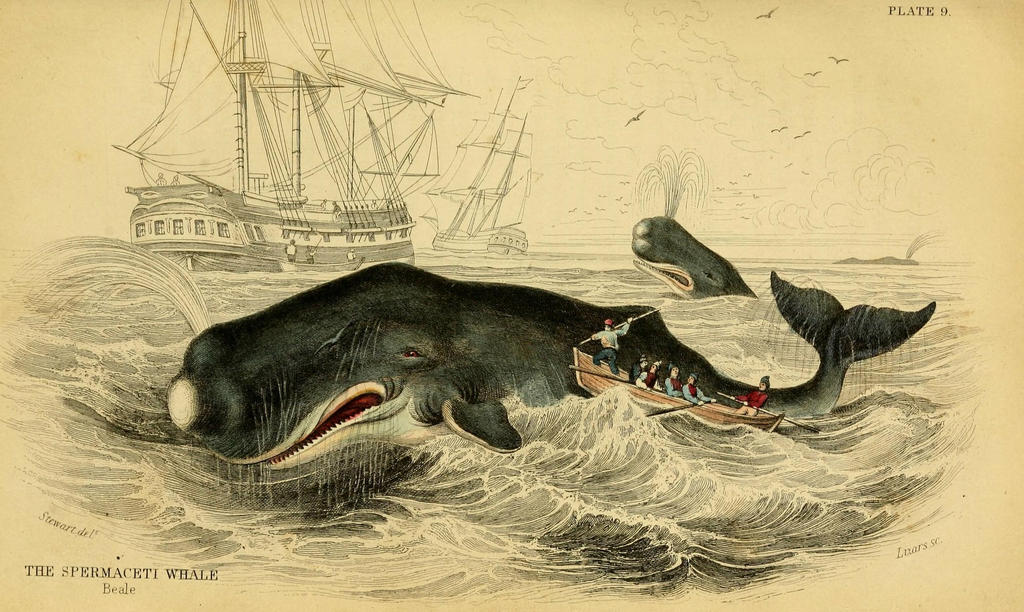
An item reported the arrival at Honolulu, Hawaii on 10 November of the American whaler Waverly master Kempton 25 barrels sperm oil 1,200 barrels whale oil 15,000 lbs bone

An item reported the arrival at Honolulu, Hawaii on 10 November of the American whaler Waverly master Kempton 25 barrels sperm oil 1,200 barrels whale oil 15,000 lbs bone
An item reported the arrival at Honolulu, Hawaii on 9 November of the American whaler Metacom master Bonney 150 barrels sperm oil 1,300 barrels whale oil 14,000 lbs bone
The American Military Attaché at Warsaw, Poland wrote in his report dated 18 October 1927 No. 469 that the Soviet Budget for 1927/1928 included a post of 46,000,000 million gold roubles for the building of battleships.
Source
National Archive. Record Group 165: Records of the War Department General and Special Staffs Series: Security Classified Correspondence and Reports. File Unit. Russia: Navy - MID 2503-16 THRU 2503-265. Roll 1443.
According to the list and supplements 1-2 on 13 September 1945 BDZ No. 673sent by the office of armament the Royal Netherlands Navy located at 41 East 42nd Street, New York 17, USA. There were no complete records available, so there were several sources used to compile the list. Sometimes the kind of guns gave indirect information regarding the origin such as 4”/BL and 12 pounder guns were British mostly supplied in the United Kingdom, Canada or Curacao. The 4.7” guns were old Japanese guns placed on some vessels in the begin of the war at Singapore and some 4” guns in the same period at Surabaya, Dutch East Indies. The trade in which the ship was used gave also an indication were the guns were supplied, for example involved in the Pacific trade means supplied at the West Coast.
Armed with 3-2cm guns and 1-3”cal 50 Ml 22-2 dual purpose gun supplied at Mobile, USA in March 1944.
Source
Archieven van hoofd handelsbescherming en diverse handelsbeschermingsofficieren 1941-1946 inv.no. 53 (Nationaal Archief, The Hague, Netherlands.

Surinamekade/Afgesloten IJ. Stadsarchief Amsterdam. OSIM00004005164
According to the list and supplements 1-2 on 13 September 1945 BDZ No. 673sent by the office of armament the Royal Netherlands Navy located at 41 East 42nd Street, New York 17, USA. There were no complete records available, so there were several sources used to compile the list. Sometimes the kind of guns gave indirect information regarding the origin such as 4”/BL and 12 pounder guns were British mostly supplied in the United Kingdom, Canada or Curacao. The 4.7” guns were old Japanese guns placed on some vessels in the begin of the war at Singapore and some 4” guns in the same period at Surabaya, Dutch East Indies. The trade in which the ship was used gave also an indication were the guns were supplied, for example involved in the Pacific trade means supplied at the West Coast.
Passenger-cargo ship launched by Reiherstieg Schiffswerft&Maschinenfabrik A.G., Hamburg, Germany with yard number 578 on 14 January 1927, delivered to H.C. Horn, Hamburg as Waltraut Horn on 17 April 1926, renamed Presidente Gomez on 16 January 1936, renamed Henry Horn on 12 November 1936, arrived in the Dutch West Indies van Hamburg and interned in the Fuikbaai/Nieuwpoort, Curacao on 30 August 1939, manager/owner Westindisches Schiffahrtskontor G.m.b.H. Hamburg and renamed Henry on 11 September 1939, detained at Nieuwpoort while a valuable cargo sugar was not delivered on 11 January 1940, seized by the Royal Netherlands Navy when her crew failed to scuttle her on 10 May 1940, renamed Bonaire manager Koninklijke Nederlandsche Stoomboot Maatschappij, Amsterdam, Netherlands/owner Staat der Nederlanden, owner/manager Koninklijke Nederlandsche Stoomboot Maatschappij, Amsterdam since August 1946, sold to be broken up by N.V. Holland, Hendrik-Ido-Ambacht, Netherlands arriving on 27 November 1957.
The Dutch newspaper De residentiebode dated 11 May 1940 reported that in the morning of 10 May the crews of the German ships Patricia, Alemania and Henry tried to scuttle their ships. The hatches of the Henry were opened but again all closed. All three crews were interned.
Armed with 2-2cm guns,at New York on 19 March 1943 supplied with 2-2cm guns and later with 1-3? gun.
Source
Archieven van hoofd handelsbescherming en diverse handelsbeschermingsofficieren 1941-1946 inv.no. 53 (Nationaal Archief, The Hague, Netherlands.
©Warshipsresearch.blogspot.com
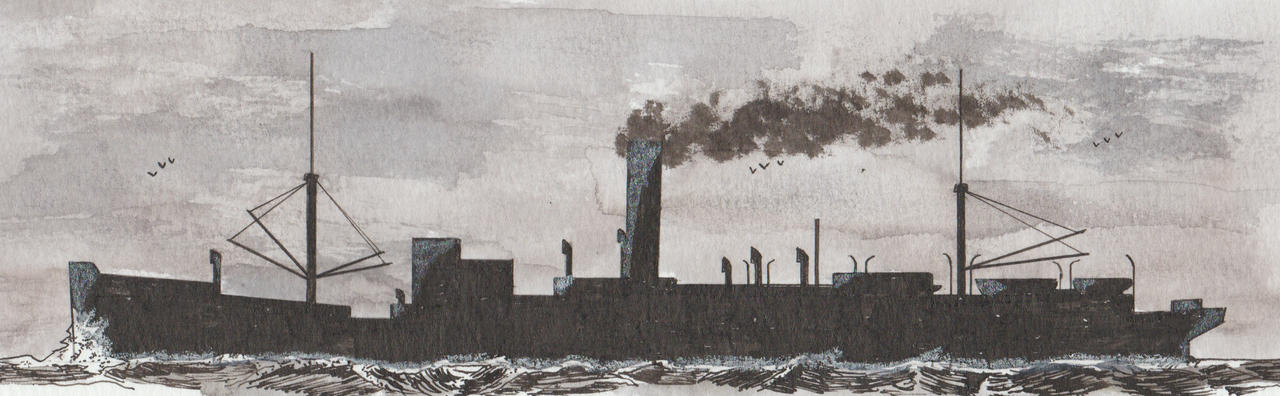
Similar Mansyu Maru (1912) and Siragi Maru (1912). Call sign JKLD. Owner in 1939 Kita Nippon Kisen, Tokyo, Japan. Built by Kawasaki Dockyard Co. Ld., Kobe, Japan in 1912 and torpedoed and sunk as a transport by the American submarine USS Queenfish on 9 September 1944. Gross tonnage 3,054 tons, under deck 2,663 tons, net tonnage 1,491 tons and as dimensions 324.0x 43.0 x 20.0 x 13.5 (light)-21 (loaded) feet. Reciprocating propulsion, 2 screws, horsepower 337 nhp, coal bunker capacity 285 tons, range 2,500 nautical miles/12.5 knots. and speed (normal cruising)- (maximum) knots.
An item reported the loss on 8 November of the Swedish cargo ship Vingaland, tonnage 2,734 tons, loaded with steel and general, underway from New York, USA to Glasgow, Scotland sunk when bombed by aircraft on the position 300 miles west mnorth west of Ireland. Not part of a convoy. Of her crew 22 men landed at Greenock, Scotland, 6 missing.
Source
National Archive UK. CAB-66-13-37.
An item reported that some survivors of the crews of the in the night of 17 December in the Hawaiian area torpedoed merchant ships ss Manini and ss Prusa were landed.
Source
Map Room Papers (Roosevelt Administration), 1942 - 1945. U.S. Joint Intelligence Committee. Daily summary No. 19 dated 29 December 1941

©Warshipsresearch.blogspot.com
Lying at the outbreak of the Second World War at Hong Kong and scuttled on 12 December 1941 and afterwards salvaged by the Japanese. Call sign MMZR. Launched by Ramage&Ferguson Ld., Victoria Shipyard, Leith, Scotland with yard nuber 208 for Newcastle&Hunter River S.S. Co. Ltd., Sydney, Australia on 2 February 1907 and sunk in an American USAF air attack on Haiphong on 12 July 1943. As Ariadne Moller owned by Moller Line Ltd., Moller’s Ltd., Shanghai, China. Gross tonnage 1,840 tons, under deck 1,555 tons, netto tonnage 985 tons and as dimensions 255.0 x 40.2 x 20.7 feet. Reciprocating propulsion, two screws and speed 11.5 (normal cruising)-12 (maximum) knots.
An item reported that according to Chinese military intelligence the Japanese intending to attack the Panama Canal and an unknown country presumably Colombia. All Caribean defence installations were informed and alert.
Source
Map Room Papers (Roosevelt Administration), 1942 - 1945. U.S. Joint Intelligence Committee. Daily summary dated 11 January 1942 No. 32.

©Warshipsresearch.blogspot.com
The Bureau of Construction and Repair was early October 1920 ordered to make a set of designs of submarine cruisers while in the future there could be a need for large submarine scouts. Considered very vulnerable to torpedo attacks lacking the side protection scheme as proposed for Type 3. Displacement 13,500 tons and as dimensions 490 (waterline) x 60.0 (waterline) x 29.0 feet. Speed 15.5 knots/8,800 shp. Range 10 knots/20,000 nautical miles. Propulsion 8x1,1000 bhp diesels driving generators, 4 main driving motors.Main armant 4x2-8” guns, 2-4” anti aircraft guns and 8-21” torpedo tubes (6 fore, 2 aft). Main side belt armour depth below waterline 5.0’ and thickness 90” over 40”. Protective deck 90”. Heavy part conning tower 3”. Conning tower proper thickness 6” and top 3”. Turrets thickness port 6”-sides 2”-top 3”-rear 2”.
Source
U.S. Naval History and Heritage Command 1911-1925 Spring Styles Book. S-584-166
An item referred to the J.I.C. comment that the day before probably three enemy submarines active in the Atlantic Theater were sunk of heavily damaged by attacks of aircraft, blimps and surface unit. A combination of this three types was successful in an attack off Atlantic City. Just one torpedo attack was reported namely 550 miles east south east of Cape Race.
Source
Map Room Papers (Roosevelt Administration), 1942 - 1945. U.S. Joint Intelligence Committee. Daily summary No. 44 dated 23 January 1942


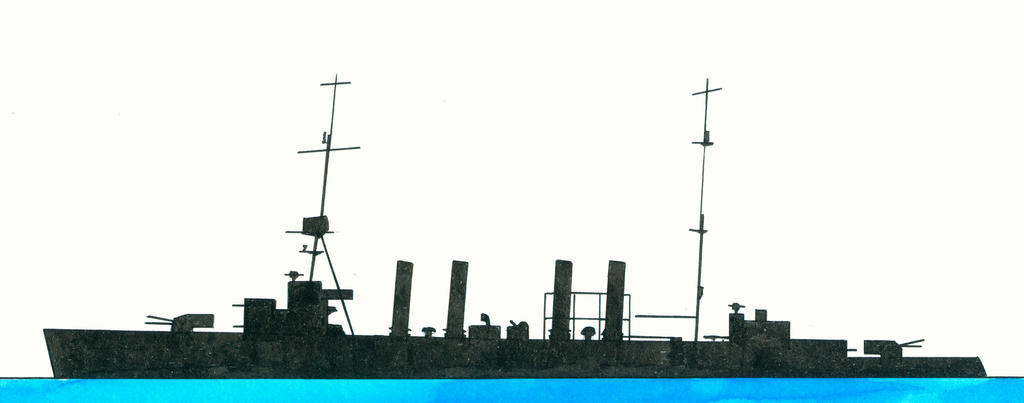
Part of Tenryū-class cruisers preceded by Chikuma-class succeeded by Kuma-class. Planned 8, cancelled 6 and completed 2. Designed as flagship for destroyer flotillas in 1915, ordered in 1916 Fiscal Year. Soon became clear to slow and outgunned by American cruisers like the Omaha-class. Between 1935-1936 considered to convert into a dedicated anti aircraft/anti submarine platforms, funding approved for Fiscal Year 1937, cancelled lacking building capacity and in 1983-1939 again cancelled. Laid down by Sasebo Naval Arsenal on 24 July 1917, launched on 29 May 1918, commissioned on 31 May 1919, sunk by American submarine USS Sand Lance north north east of Hachijojima and stricken 10 May 1944.
Sister ship Kuma. ©Warshipsresearch.blogspot.com

Part of Kuma-class preceded by Tenryū-class succeeded by Nagara-class. Designed as an answer on the heavier armed American Omaha-class and Dutch Java-class light cruisers. Ordered under 1917 Fiscal Year, laid down by Kawasaki Shipbuilding, Kobe, Japan on 24 November 1919, launched on 15 July 1920, commissioned on 10 October 1921, torpedoed by American submarine USS Flasher 570 nautical miles south of Hong Kong on 19 July 1944 and stricken on 10 September 1944.
An item reported her departure on 18 June, captain Lindholm to Ochotsk.
Source
Samuel C. Damon. The Friend. A monthly journal devoted to Temperance, Seamen, Marine and General Intelligence. Vol XV. Honolulu, 1858.
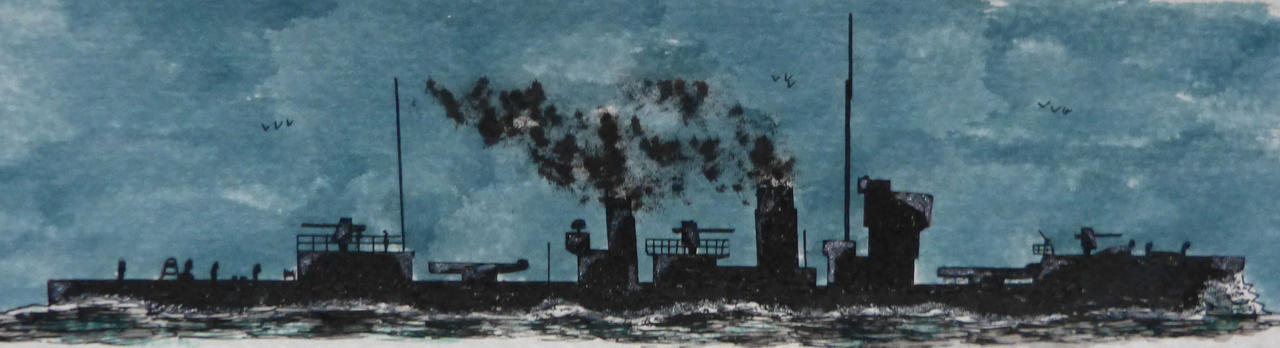


Part of Kamikaze-class (some times referred to as Kiyokaze-class) preceded by Wakatake-class succeeded by Mutsuki-class, 27 planned, 9 completed and 18 cancelled. By some experts consided to be a modified Minekaze-class destroyer. Laid down by Fujinagata Shipyards, Osaka on 5 March 1923, launched on 21 April 1924, renamed on 1 August 1928, torpedoed by the American submarine USS Pollack west of Ogasawara on 22 May 1944 and stricken on 10 July 1944.
Part of Kamikaze-class (some times referred to as Kiyokaze-class) preceded by Wakatake-class succeeded by Mutsuki-class, 27 planned, 9 completed and 18 cancelled. By some experts consided to be a modified Minekaze-class destroyer. Laid down by Maizuru Naval Arsenal as Dai-7 on 2 December 1922, launched on 30 October 1923, completed on 5 April 1924, renamed Matsukaze on 1 August 1928, torpedoed and sunk by the American submarine USS Swordfish 70 miles north east of Chichijma, Ogasawara Islands on 9 June 1944 and stricken on 10 August 1944.
©Warshipsresearch.blogspot.com
Sister ships Akagi Maru, Arima Maru, Asaka Maru and Awata Maru. Call sign JIQK. Laid down by Mitsubishi Jukogyo K.K., Nagasaki, Japan with yard number 627 on 2 December 1935, launched on 6 June 1936, completed on 10 September 1916, requisitioned by the navy on 23 November 1941, fitted out as auxiliary cruiser between 25 November-30 December 1941, heavily damaged by American carrier based aircraft underway from Truk towards Yokosuka as part of convoy 4215 and scuttled on 17 February 1944 and stricken on 31 March 1944. Gross tonnage 7,390 tons, under deck 6,531 tons, netto tonnage 4,328 tons and as dimensions 462.7 x 62.3 x 34.4 15 (light)-19 (loaded) feet. Diesel propulsion, horsepower 2,248 np/8,000 bhp, oil bunker capacity 2,500 tons included deep tanks, range nautical 36,000 miles/15 knots, 16 knots/105 rpm, 19 knots/118 rpm and speed 15 (normal cruising)-19 (maximum) knots.

©Warshipsresearch.blogspot.com
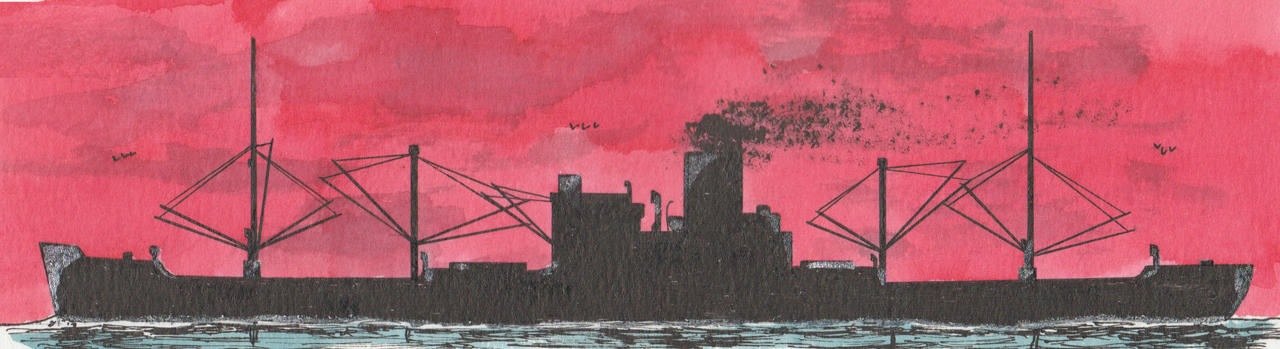
Call sign UOVF. Launched by Standard Shipbuilding Corporation, Shooter’s Island, New York, USA on 24 June 1918 for the US Shipping Board. According to the Belgian Shiplover No. 88 dated July-August 1962 p. 390 yard number 6, completed in September 1918 as Galesburg for Russian account renamed Volchovstroi or Volkhovstroi. Gross tonnage 4,943 tons, under deck 4,286 tons, net tonnage 2,982 tons and as dimensions 377.0 x 52.0 x 26.9 x 24 (loaded) feet.Normal cruising speed 9 knots.
An item reported that two Japanese submarines were attacked off Oahu, although with unknown results.
Source
Map Room Papers (Roosevelt Administration), 1942 - 1945. U.S. Joint Intelligence Committee. Daily summary No. 50 dated 29 January 1942

