Translate

Showing posts with label Angola. Show all posts

Wednesday, 3 December 2025

Portuguese cargo ship Maria Christina visited Lisbon, Portugal in July 1941

In his letter No. 855 dated Lisbon 8 July 1941 reported the German naval attaché in Portugal to the Oberkommando der Kriegsmarine at Berlin the marine traffic at Lisbon between 29 June-5 July 1941. Portuguese cargo ship Maria Christina, departed on 5 July towards Lobito, Portuguese Angola [nowadays People’s Republic of Angola]. Article 29223. Gross tonnage 3,265 ton. Loaded general cargo.

Source

Bundesarchive. RM 11-17. German naval attaché in Portugal. 

Friday, 21 November 2025

The German blockade runner Windhuk in November 1939

In a letter dated 13 April 1942 No. 1329 to the O.K.M./1 Abteilung Skl. was the so-called ‘Etappen’-organisation of the navy described. In the attachment were the blockade runners decribed used for this purpose. Ms. Windhuk. Not nloaded. Left Lobito, Portuguese Angola on 18 November 1939, arrived at Santos, Brazil on 7 December 1939. Transfer. Sabotaged in November 1941 and scuttled in harbour after opening the valves.(1)

Note

1. Launched by Blohm&Voss, Hamburg with yard number 506 on 27 August 1936, delivered to Woermann Linie A.G., Hamburg on 13 March 1937, active on the shipping line Germany-South West Africa-South Africa, arrived at Brazil disguised as the Japanese merchant ship Santos Maur, purchased by the USA from Brazil on 12 August 1942, towed to Rio de Janeiro, Brazil for repairs in January 1943, commissioned as troop transport USS Lejeune (AP-74) on 12 May 1944, decommissioned on 9 February 1948, stricken in July 1957 and broken up in 1966. 

Sunday, 5 October 2025

Portuguese gunboat Patria 1903-1931

©Warshipsresearch.blogspot.com

Built with the funds of the Great National Subscription after the 1890 British Ultimatum when Portugal claimed a large area between her colonies Mozambique and Angola covering most of Zimbabwe and Zambia and a large part of Malawi resulting in witdrawing Portuguese forces from areas which both countries claimed. Launched at Lisbon, Portugal on 27 June 1903, sent to the Macau Naval Station in 1908 and sold to China in 1931. 

Wednesday, 6 August 2025

Axis submarines stationed at Novo Redondo, Portuguese Angola according to the U.S. Joint Intelligence Committee. Daily summary dated 30 December 1941

An item reported that 3 Axis submarines were stationed at Novo Redondo [nowadays Sumbe], [Portuguese] Angola [ nowadays Republic of Angola]. The J.I.C. commented that the same source reported this on 8 and 18 Decembers and later sighted a British seaplane submarines.

Source

Map Room Papers (Roosevelt Administration), 1942 - 1945. U.S. Joint Intelligence Committee. Daily summary No. 20 dated 30 December 1941

Sunday, 6 July 2025

Portuguese steamship Pungue arrived at Lisbon, Portugal in October 1942

In his letter No. 1932 dated 26 October 1942 referred the German naval attaché in Portugal to the Oberkommando der Kriegsmarine at Berlin to the newspaper Seculo, Lisbon dated 18 October 1942 reporting that the Portuguese steamship Pungue coming from Luanda, Portuguese Angola [nowadays Republic of Angola] arrived at Lisbon with 90 pieces of cattle.

Source

Bundesarchive. RM 11-18. German naval attaché in Portugal. 

Wednesday, 31 January 2024

Portuguese bergantim Sao Jose de Africa 1786

Built in Angola in 1786.

Source

A. Marques Esparteira. Catalogo dos navios brigantinos (1640-1901). Lisboa, 1976.

Wednesday, 6 December 2023

Portuguese fragatinga Luanda 1782-1800

Built at Luanda [Angola?] in 1782, last mentioned in 1800, armament of 26 guns.

Source

A. Marques Esparteira. Catalogo dos navios brigantinos (1640-1901). Lisboa, 1976.

Tuesday, 27 June 2023

Fish-meal plant established at Porto Alexandre, Angola according to the Commercial Fisheries Review dated January 1960 no. 1

An item reported that a Norwegian firm equipped a complete fish-meal plant at Porto Alexandre, Angola with a daily capacity of 150 metric tons. Contract price was 80,000 pound sterling of 224,000 US dollars. The Norwegian firm would technically support the plant during a half year after it start operating. The contaxt between the firm and Angola dated from 1956 when the German market refused sundried fish meal, produced by many small plants.

Saturday, 29 May 2021

Portuguese bark Florinda lost according to the Dutch newspaper Rotterdamch nieuwsblad dated 27 December 1904

An item dated Loanda, [Angola?] 23rd reported that the Portuguese bark Florinda underway from Lisbon, Portugal towards Loanda [Luanda, Angola?] was lost at sea by fire. Her crew was saved at landed at Loanda.

Thursday, 21 May 2020

Portuguese passenger annex cargo twin screw ship Quanza 1929-1968


Owned by Companhia Colonial de Navegacao. Launched by Blohm&Voss, Hamburg, Germany with yard number 480 as the Portugal on 1 June 1929, completed on 5 September 1929, the same year renamed Quanza, and broken up in Spain in 1968. Most of the time active on the route Lisbon (Portugal)-Angola-South Africa-Mozambique and incidental towards South America. Gross register tonnage 6.636 ton, net register tonnage 3.944 tons and as dimensions 127,5 x 16,0 x 8,7 metres or 418.2 x 52.6 x 28.6 feet. Speed 14 knots.

Saturday, 18 April 2020

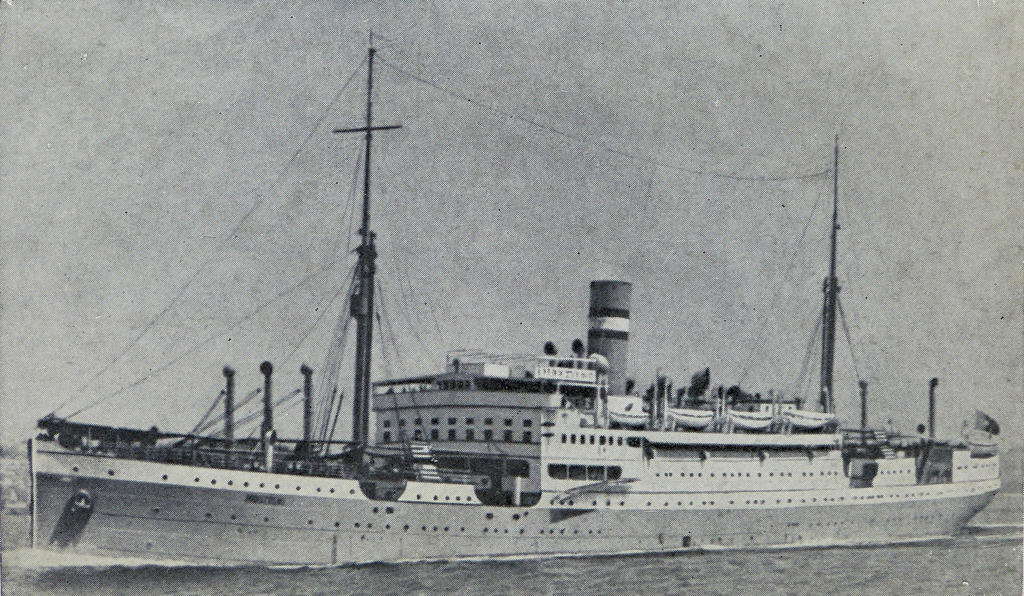
Portuguese passenger annex cargo ship (ex-Maria Christina 1907-1916, Sueh 1916-1920, Guglielmo Peirce 1920-1927, Maria Christina 1927-1929) Mousinho or Mouzinho 1929-1954


IMO 5602840 and call sign CSDW. Gross tonnage 8.410, under deck 5.830, net tonnage 5.236 tons and as dimensions 448,3 x 55.2 x 28.0 feet. Built by Fdr. Krupp Aktien Gesellschaft, Kiel, Germany with yard number 133 in 1907. According to Lloyds Register she also temporarily was named Convocrado. Owned by the Hamburg Amerika Linie, Hamburg, Germany, sold to the Turkish government and renamed Sueh in 1916, renamed to the French government in 1919, in 1920 so the Doc. Sicula American, Naples, Italy and renamed Guglielmo Peirce, since 1927 as the Maria Christina of Lloyd Sabaudo SApA, Naples and since 1929 owned by Compania de Navegacion, homeport Luanda, Angola, broken up since 5 October 1954 at Savona, (Vulcania), Italy.

Sunday, 2 February 2020

Dutch semi submersible heavy load carrier Mighty Servant 2 1983-2000 (T-2 2000)


Netherlands Antilles-flagged, homeport Willemstad, IMO 8130887. Built by Oshima Shipbuilding, Saika, Japan in 1983. Owned by Might Servant 2 N.V. and managed by Dockwise N.V., Willemstad, Netherlands Antilles. Capsized and sunk on 2 November 1999 off Singkip Island underway from Okpo [South Korea?] towards Angola. Salvaged and sold to be broken up arriving as the T-2 at Alang, India on 14 November 2000. Gross tonnage 21.162 tons, summer deadweight 25.743 tons and as dimensions 170,36 x 40,37 x 9,5 metres. Speed 14,25 knots.

Friday, 28 June 2019

Brazilian corvette (ex-Maria Isabel 1827-1831) Regeneracão 1831-1846


Dimensions 46,86 x 9,8 metres. Her armament consisted of 4-18pd guns and 22-32pd guns. Built in the USA and commissioned in the Brazilian navy as Maria Isabel in 1827 but when was renamed Regeneracão in 1831 when emperor D. Pedro I abdicated. In her active career used in actions against local rebellions and privateer on 1842 before she was laid up.Under captain Frederico Mariath arriving at Rio de Janeiro on 8th August 1837 coming from Para she captured off the island Tamaraci the Portuguese schooner Eugenia coming from Angola fitted out as slaver. It was clear that she just disembarked slaves. Making water she was deliberately stranded on the Itabagipe Beach, Salvador, Bahia, Brazil on 31 July 1846.

Friday, 26 October 2018

Portuguese gunboat Liberal visited Dutch East Indies in April-May 1900.

An item reported that the Portuguese gunboat Liberal visited Surabaya, Dutch East Indies between 20-28 April 1900 and Tandjong-Priok, Dutch East Indies on 23 May 1900.(1)

Note
1. Of the Liberal-class wit as sister ship the Zaire, launched hu Laird, Birkenhead, England on 9 August 1884, completed in 1884 and wrecked at Ambriz, north of Luanda, Angola on 22 June 1910.

Source
Jaarboek van de Koninklijke Nederlandsche Zeemacht 1899-1900. 

Thursday, 31 May 2018

Portuguese tug Sao Miguel 1973-

Ponta Delgada, Azores 14/15 April 2018

Portugal/Azores-flagged, homeport Ponta Delgada, Azores, IMO 7234961, MMSI 204600002 and call sign CSJV. External marking PD-19-EST. Gross tonnage 437 tons and as dimensions 38,49 (over all) x 10,42 (over all) x 5,35 (maximum) metres. Maximum speed 13,0 knots. Horsepowe 3.400bhp/2.535,38kW. Steel-built. Built by Soreframe, Lobito, Angola in 1973. Owned and managed by ASPM Sao Miguel e Santa Maria, Ponta Delgada, Azores. 

Saturday, 12 August 2017

French and Portuguese gunboats active at Noqui, Angola according to the Dutch newspaper Nieuwe Tilburgsche Courant dated 16 March 1884

An item reported the outbreak at Nokki [[Noqui, Angola] of hostilities between French, Dutch and Portuguese merchants and the natives at the factories. The French gunboat Sagittaire (1)and two Portuguese gunboats participated in the fights. The merchants fitted out an expedition against the natives but which was defeated with as result that the natives attacked and besieged the factories. The merchants forced to ask the international Congo-expedition for help.

Note
1. Of the Crocodile class of composite gunboats, launched in 1881 at Normand, Le Havre, France in 1881, completed in 1881 and stricken in 1896. 

Portuguese gunboat Tejo protecting Europeans at Noqui, Angola according to the Dutch newspaper Haagsche courant dated 26 March 1884

An item dated Lisbon, Portugal 24 March reported that again riots broke out at Nokki along the Congo-river and that the Portuguese gunboat Tejo(1) left Loanda, Angola towards Nokki [Noqui, Angola] to protect European citizens.

Note
1. Launched at the Arsenalda Marinha, Lisbon, Portugal in 1869, completed in 1869 and stricken in 1900. Wood-built. Modernized in the 1880’s. 

Saturday, 21 January 2017

Portugal shipping military towards Angola according to the Dutch newspaper De Telegraaf dated Saturday 5 December 1914

An item reported that on last Thursday at Lisbon, Portugal again several detachments were embarked with as destination Angola. On Wednesday stated the Portuguese minister president that 4 expeditionary corps were fitted out for service in Africa. 

Sunday, 11 December 2016

Russian Project 206 Shtorm-class and Project 20E Mol class torpedo boats 1960->2006


Called by the NATO the Shershen-class. The Shershan-class was preceded by the project 183 Bolshevik torpedo cutter and succeeded by the Turya-class. Designing process started in 1956 whiel the first unit built at the Yaroslav Shipyard entered the service in October 1970. The Yaroslalv Shipyard, Sredne-Nevskiy and Sosnovskiy Shipyard built totally 80 of this class with the Yugoslavian Kraljevice Shipyard building another 10 in licence (Croatia captured in 1991 w of the former Yugoslavian boats). Except for the Soviet Union served Shershan-class torpedo boats in the navies of Angola, Bulgaria, Cambodia, Cape Verde islands, Congo, Egypt, East Germany, Vietnam. Guinea and Guinea-Bissau. Further more was the simplified version Project 206E (called by the NATO Mol produced for the export market (Ethiopia, Iraq, Somalia and Sri Lanka).

With a displacement of 148 9standard)-172 (full load) tons and as dimensions 34,08 x 6,72 x 1,46 (draught) x 1,5 (draft) metres. The machinery consisted of 3-4.000hp M-503A diesel engines allowing a maximum speed of 45 knots. The range varied between 850 nautical miles with a speed of 30 knots (cruising) respectively 460 nautical with a continuous speed of 42 knots. The crew cumbered between 20-24 men (included 2 officers). The armament consisted of 2-AK0230 3cm/65 guns (1x bow, 1x stern), 1x1-SAN-5 MANPAD air defence missiles, 2 depth charge racks and 4 OTA-53-206M 53,3cm torpedo tubes mounted on the sides. 

Tuesday, 8 December 2015

Portuguese river steam gunboat Chaimite 1897-1921


Launched at the Arsenal da Marinha, Lisbon, Portugal in 1897, completed in 1898 and finally discarded in 1921. Displacement 341 (standard) tons and as dimensions 40,85 (between perpendiculars) x 8,00 x 2,00 (aft) metres. Horsepower 480 hp. Coal fired vertical machinery. Speed 11 knots. Her crew numbered 26 men. The armament consisted of 2x1-4,7cm Hotchkiss quick firing guns and 2 Nordenfeldt machine guns, Steel-built for service on the Zambezi.