Translate

Showing posts with label Indochina. Show all posts

Friday, 30 May 2025

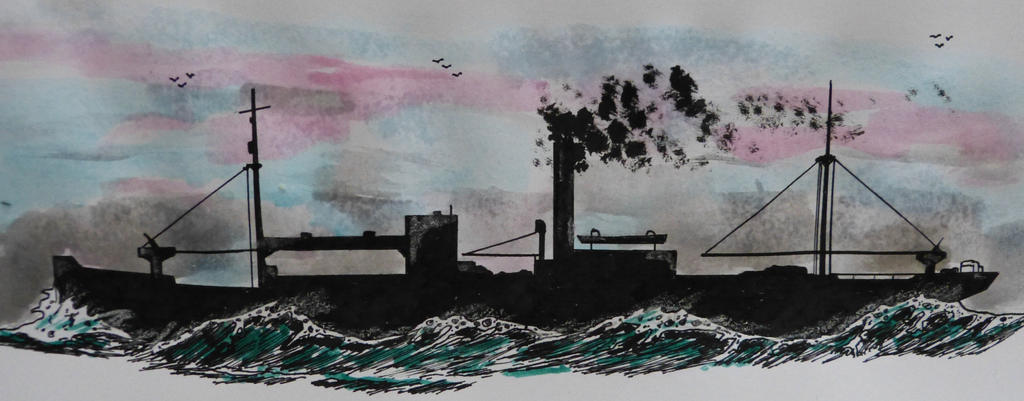
Japanese cargo ship (ex-Strathleven 1907-1916, Austral Crag 1916-1923) Misaki Maru 1923-1944

©Warshipsresearch.blogspot.com

Similar Misaki Maru, Asaka Maru, Syokyu Maru, Uga Maru, Unyo Maru and Zuiko Maru. Call sign JPZA. Launched by W. Hamilton&Co. Ltd., Glen Yard, Port Glasgow, Scotland with yard number 196 on 5 September 1907 and torpedoed and sunk by American submarine USS Barbel around 150 miles east of Quangngai, Indo China on 14 November 1944. Australian ownned 1916-1923. Gross tonnage 4,422 tons, under deck 4,107 tons, netto tonnage 3,277 tons and as dimensions 376.3 x 32/3 x 17.4 4 x 7.6 (light)-23 (loaded) feet. Reciprocating propulsion, single screw, horsepower 366 nhp, coal bunker capacity 600 tons, range 4,300 nautical miles/9 knots and speed 9 (normal cruising)-0 (maximum) knots. 

Wednesday, 8 November 2023

Chinese patrol vessels 1950s

Former Japanese auxiliary submarine chasers No. 1 class. Displacement 135 tons and as dimensions 96 x 19 x 9 feet. Second World War built. Ex-Kwang Kuo (ex-Japanese No. 223) and ex-Hsieng Feng (ex-Chinese Kao Mang, former Japanese). 


Thursday, 23 February 2023

British armoured cruiser HMS Kent visited the Dutch East Indies in 1907


Monmouth-class

The Jaarboek van de Koninklijke Nederlandsche Zeemacht 1906-1907 reported that the British armoured cruiser HMS Kent (1) visited Sabang (2), Dutch East Indies on 4 March 1907.

Notes

1. Part of Monmouth class armoured cruisers preceded by Drake-class succeeded by Devonshire-clas, laid down by Portsmouth Rotal Dockyard on 12 February 1900, launched 6 March 1901, completed on 1 October 1903 and sold to be broken up on 20 June 1920.

2. Sabang had an important coal bunkering station visited by merchant and warships. 

Friday, 11 November 2022

American aircraft attacked Haiphong according to the U.S. Joint Intelligence Committee. Daily summary dated 14 August 1942

An item reported that during the attack on 9 August on Haiphong, Indochina US Army bombers and fighters destroyed the main docks and warehouses in the vicinity and hitting 1-4,000 tons transport.

Source

Map Room Papers (Roosevelt Administration), 1942 - 1945. U.S. Joint Intelligence Committee. Daily summary No. 247 dated 14 August 1942.

Tuesday, 5 April 2022

French cruiser torpedo carrier La Foudre visited Sabang, Dutch East Indies according to the Dutch newspaper Bataviaasch nieuwsblad dated 27 June 1904


An item reported the visit of the French torpedo transport La Foudre at Sabang, Dutch East Indies. On deck were 2 submarines and 4 torpedo boats stored, well covered to prevent any details could be seen. She toke coal on board and left directly for Saigon. The Deli courant dated 24 June reported her arrival on 7 June at Sabang where she loaded 300 ton coal. She saluted with 21 shots accepted by the Dutch cruiser Zr.Ms. Gelderland. The Het nieuws van den dag voor Nederlandsch-Indië dated 4 October 1904 reported her arrival on short notice at Singapore with a flotilla of 9 torpedo boats bound for Saigom. Probably the ships would bunker at Singapore just like the last convoy did and not at Poeloe Weh, Dutch East Indies where French warships used to bunker. The new Entente and actions of the French consul resulted in ending the boycotting of Singapore by French naval authorities. The locomotief dated 30 May 1904 described her as a fast seaworthy ship with a sped of 19 miles transporting 8 torpedo boats and fitted out with a complete torpedo workshop. The torpedo boats were transported to the requested position and there launched.

Notes

1. Cruiser torpedo boat carrier, laid down by C.A. Gironde, Bordeaux-Lormont/ Schneider, Creusot, France in 1892, launched on 20 October 1895, commissioned on 23 October 1897 and sold to be broken up on 27 May 1922. She went twice to Saigon with torpedo boats and submarines (Protée, Lynx, Perle and Esturgeon). Stephen S. Roberts. French Warships in the Age of Steam 1859-1914.

2. Sabang was an important coal bunker station visited by Dutch and foreign merchant and warships.

Wednesday, 1 December 2021

Austrian screw steam corvette Saïda visited the Dutch East Indies in 1899

The Jaarboek van de Koninklijke Nederlandsche Zeemacht 1898-1899 reported that the Austrian corvette Saïda visited Batavia, Dutch East Indies between 11-17 April and 17-24 July 1899. The newspaper Bataviaasch nieuwsblad dated 18 April 1899 reported her departure towards Singapore, commanding officer was Couradi. The locomotief dated 18 April reported that the Dutch chief in command welcomed her etat-major in the evening of 15 April. The edition dated 15 April reported earlier that she was lying in the roads of Tandjong-Priok. The edition dated 20 April published an item dated Batavia 17 April reporting her departure via Singapore towards Saigon and that her commanding officer was called Louarde. The departure was on Monday morning 10.30 o’clock from Tandjong Priok. The Bataviaasch nieuwsblad dated 17 July reported her arrival coming from Singapore, commanding officer G. Couarde, 40 officers, 352 sailors, 10 guns. The edition dated 24 July reported her departure towards Port Victoria/Mahé, Seychelles calling her commanding officer now G. Conarde. De locomotief dated Thursday 20 July reported her arrival at Tandjong Priok on Monday morning coming from Singapore bound for Trieste and that she was the same ship that anchored of Tandjong Priok on 11 April.

Note 

1. Screw steam corvette, laid down by Marinearsenal Pola [nowadays Pula, Croatia] in September 1876, launched on 2 July 1878, completed on 14 August 1870, stricken on 26 February 1906, machinery removed in 1909, used as mine storage ship, renamed Minerva in 1912 was she after the First World War handed over to Italy as war reparation and broken up.

Thursday, 4 November 2021

British bark Manna Loa underway from the USA towards Indochina according to the Dutch newspaper Java-bode dated 9 April 1888

freAn item dated 6th reported the passing of Nieuw Anjer [nowadays Anyer, Indonesia] by the British bark Manna Loa underway from New York, USA towards Saigon, Indochina [Ho Chi Minh City, Vietnam].

Thursday, 30 September 2021

Japanese potential troop transport Milan Maru in December 1921

On 22 May 1922 (!) received the Dutch naval staff at The Hague, Netherlands from the Dutch embassy at Tokyo, Japan a detailed specification of Japanese merchant ships of minimum 1.500 tons tonnage usable for troop transport over sea on 13 December 1921. If the transport was over a short distance for instance Japan-Philippines or Japan-Chinese harbours was the transport capacity increased with 10% and on a distance within 24 hours even doubled. The figures were supplied by non-Japanese experts, partly based on the troop transports between Japan-China and Japan-Siberia. The transports were kept secret. At that moment was Japan already considered as a potential enemy. For each ship was mentioned how many troops included equipment could be transported over a longer distance, for instance to an island belonging to the Dutch East Indies. In February-March 1942 invaded Japan indeed the Dutch East Indies.

Speed 11 miles, net tonnage 3.409 tons, gross tonnage 5.467 tons, transport capacity  1.800 men and owned by Kokusai Maru. Cargo ship. Coal-fuelled.

Source

Archive Dutch Naval Staff 1886-1942 inventory number 137 (National Archive at The Hague, Netherlands.

Japanese potential troop transport Hoshu Maru in December 1921

On 22 May 1922 (!) received the Dutch naval staff at The Hague, Netherlands from the Dutch embassy at Tokyo, Japan a detailed specification of Japanese merchant ships of minimum 1.500 tons tonnage usable for troop transport over sea on 13 December 1921. If the transport was over a short distance for instance Japan-Philippines or Japan-Chinese harbours was the transport capacity increased with 10% and on a distance within 24 hours even doubled. The figures were supplied by non-Japanese experts, partly based on the troop transports between Japan-China and Japan-Siberia. The transports were kept secret. At that moment was Japan already considered as a potential enemy. For each ship was mentioned how many troops included equipment could be transported over a longer distance, for instance to an island belonging to the Dutch East Indies. In February-March 1942 invaded Japan indeed the Dutch East Indies.

Speed 11 miles, net tonnage 3.404 tons, gross tonnage 5.460 tons, transport capacity  1.800 men and owned by O.S.L. Cargo ship. Coal-fuelled.

Source

Archive Dutch Naval Staff 1886-1942 inventory number 137 (National Archive at The Hague, Netherlands

Friday, 16 July 2021

Japanese naval survey vessel (ex-Druzhba 1914-1920, Kodrus 1920-1926, Ullesmere 1926-1931, Chi Fu Hsing 1931-1937) Hakusa 1937-1945

Coal fuelled reciprocating steam machinery. Gross tonnage 3.841 tons, under deck 3.539 tons, net tonage 2.371 tons and as dimension 370 x 51 x 22.7 x 20 (loaded). Speed 9 knots. Also used as landing boat transport. Laid down as cargo annex passenger ship by William Gray&Co., Hartlepool, England for F.C. Svorono& di Pollone, launched on 14 April 1914, baptized Druzhba, completed in June 1914 was she registered in Russia, 1920 United Kingdom-flagged and owned, purchased by the Chinese government on 11 December 1931 was she commissioned as the patrol boat Chi Fu Hsing, captured by Japanese forces at Tsuinan/Cuinan in November 1937 and renamed Hakusa, converted by Mitsubishi Heavy Industries Shipyard into a surveying vessel staring on 28 January 1938 and registered on 20 February 1938, classified as special repair ship on 1 May 1944, the same month were 1-7.7mm and 2-13.2mm guns added to her armament and finally sunk by the American submarine USS Cobia (SS-245 off Cappe Camau, southern Indochina on 8 June 1945. Stricken from the navy list on 3 May 1947.

Thursday, 20 February 2020

British bark Strathmuit underway from the USA towards Indochina according to the Dutch newspaper Java-bode dated 17 September 1888

An item dated 15th reported the passing of Nieuw Anjer [nowadays Anyer, Indonesia] by the British bark Strathmuit underway from New York, USA towards Saigon, Indochina.

Saturday, 30 November 2019

British merchant ship Cathcart underway from Indochina towards Europe according to the Dutch newspaper Java-bode dated 16 August 1888

An item dated 14th reported the passing of Nieuw Anjer [nowadays Anyer, Indonesia] by the British ship Cathcart underway from Saigon, Indochina towards the Channel.

Thursday, 7 November 2019

Norwegian bark Alexander Lawrence underway from Dutch East Indie towards Indochina according to the Dutch newspaper Java-bode dated 22 July 1892

An item dated Batavia, Dutch East Indies 22nd reported the departure of the Norwegian bark Alexander Lawrence captain Dahl towards Saigon, Indochina.

Wednesday, 6 November 2019

Norwegian bark Alexander Lawrence underway from Indo-China towards France according to the Dutch newspaper Java-bode dated 19 September 1892

An item dated 17th reported the passing of Nieuw Anjer [nowadays Anyer] by the Norwegian bark Alexander Lawrence underway from Saigon, Indo-China towards St. Nazaire, France.

Wednesday, 24 July 2019

Danish ship Sass underway from Indochina towards England according to the Dutch newspaper De locomotief dated 21 April 1869

An item dated 28 March reported the passing of Sunda Strait by the Danish ship Sass captain Arentzen underway from Saigon, Indochina towards Falmouth, England.

Tuesday, 16 July 2019

German bark Henriette underway from Indochina towards Germany according to the Dutch newspaper Java-bode dated 4 July 1892

An item reported the passing on the 3rd of Nieuw Anjer, Dutch East Indies [nowadays Anyer] by the German bark Henriette underway from Saigon, Indochina towards Bremen, Germany.

Norwegian ship Naiden underway from Indochina towards England according to the Dutch newspaper De locomotief dated 26 February 1869

An item dated 16th reported the passing of the Sunda Strait by the Norwegian ship Naiden captain Nielsen underway from Saigon, Indochina towards Falmouth, England.

Monday, 24 June 2019

German bark Paul Rickmers underway from Indochina towards Germany according to the Dutch newspaper Java-bode dated 5 July 1892

An item reported the passing on the 3rd of Nieuw Anjer, Dutch East Indies [nowadays Anyer] by the German bark Paul Rickmers underway from Saigon, Indochina towards Bremen, Germany.

Wednesday, 19 June 2019

British bark Embleton underway from Western Australia towards Indochina according to the Dutch newspaper Java-bode 27 June 1892

An item reported the passing on the 26h of Nieuw Anjer, Dutch East Indies [nowadays Anyer] by the British bark Embleton underway from Albany, Western Australia towards Saigon, Indochina.

Tuesday, 14 May 2019

The French floating dock at Saigon according to the Atlantic monthly of November 1863

Thanks to the fact that nowadays more and more books are digitized we are able to read books that are some times for decades no longer available for the public for several reasons. That’s quite a pity while these books contains useful information while the archives are destroyed, incomplete or nor accessible.

P. 633: “In the latter part of the year 18G2 the Emperor of Cochin China was forced to cede to France the coveted provinces. Already new fortifications have arisen at Saigon, and dock-yards and coal-depots been established, and all steps taken for a permanent occupation of the territory. The following advertisement appeared in the London “Times” for January 23, 1863, -“Contract for transportation from Glasgow to Saigon of a floating iron dock in pieces. Notice to ship-owners. The administration of the Imperial Navy of France have at Glasgow a floating iron dock in pieces, which they require to be transported from that port to Saigon, Cochin China. The said dock, with machinery, pumps, anchors, and instruments necessary to its working, will weigh from two thousand to twenty-five hundred tons. Ship-owners disposed to undertake the transport are requested to forward their tenders to the Minister of Marine and Colonies previous to the fifth of February next.” Now, if we consider that the news of the cession of these provinces did not reach France until the close of the year 1862, that this advertisement is dated January 23, 1863, and that a dock of the magnitude described could hardly be constructed short of many months, we shall be satisfied, that, long before any definite articles of peace had been proposed, the Emperor had settled in his own mind just what region he would annex to his dominions.”

Source
John Davis Batcheck. The Atlantic monthly, volume 12, November 1863.