Translate

Showing posts with label 1st rate. Show all posts

Sunday, 6 April 2025

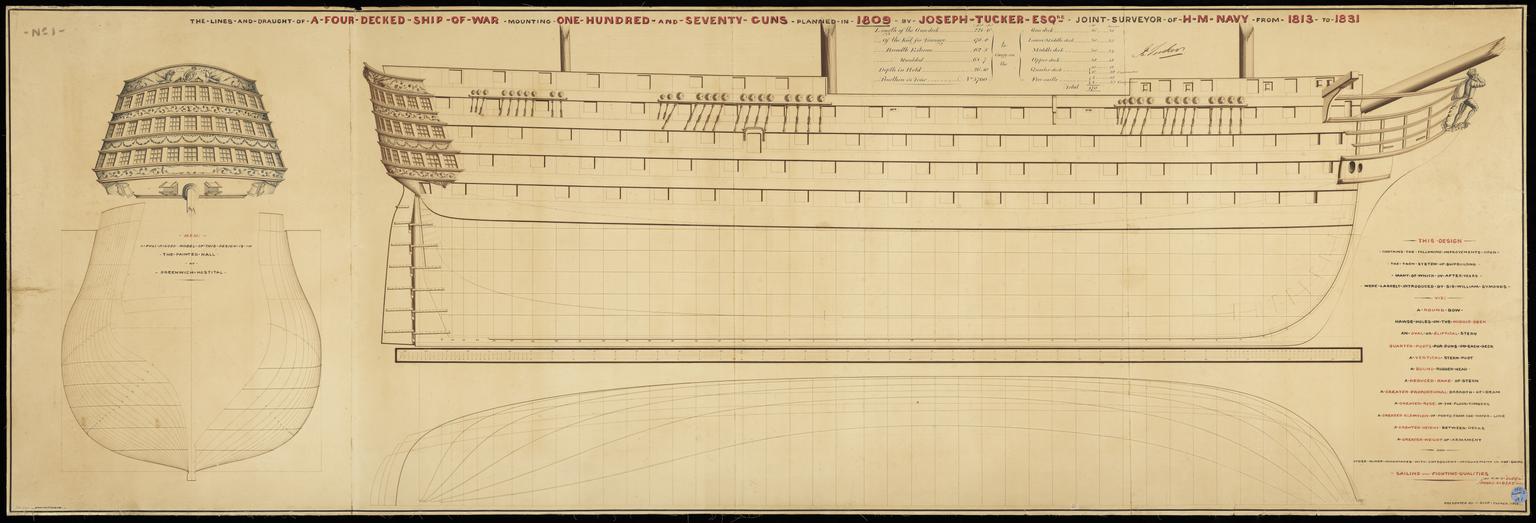
Design for British 170 guns 1st rate HMS Kent 1809

Designed by Joseph Tucker (about 1769-London, England 23 November 1838), Surveyor of the Navy between 1813-1831. Four decked ship-of the-line with totally 170 guns. Dimensions 178.8 (length of the keel for tonnage)-221.6 (length of the gundeck) x 61.7 (moulded)-62.5 (extreme) x 26.10 (depth in hold) feet. Burthen of 3,700 tons.

French 1st rate États de Bourgogne 1785-1790, Côte d’Or 1790-1793, Montahme 1793-1795, Peuple 1795, Océan 1795-1856

Prisoner-of-war model made in bone. Armed with 118-120 guns. Ordered on 30 September 1785, laid down by Arsenal de Toulon on 12 August 1786, launched on 8 November 1790, floating battery since 1851 and broken up between 1855-1856. 

British 100 guns 1st rate HMS Victory 1726-1744

Oil painting made in 1744. Ship proposed under the Establishment design 1733. Reconstruction of the frames of the in 1721 burned HMS Victory, ordered on 11 September 1733, laid down in 1736, launched on 23 February 1737 and lost in Western Approaches to the English Channel on 5 October 1744. 

Thursday, 11 April 2024

British school for gunnery HMS (ex-Queen Charlotte 1805-1859 ) Excellent 1859-1892

Building as a 1-104 guns sailing first rate ship of the line ordered on 9 July 1801, laid down by Deptford Dockyard in October 1805, launched on 17 July 1810, commissioned in January 1813, converted into a training ship and renamed Excellent in 1859 and sold to be broken up on 12 January 1892.

Source

Francis Elgar. The Royal Navy 1872-1880 in a series of illustrations. Lithographed in colours. From original drawings by W.F. Mitchell, esquire. Portsmouth, December 1880. 

Saturday, 14 October 2017

Swedish 1st rate Rutenkrans or Rosenkran 1599-1611

First mentioned in 1599, last mentioned in1611, an armament of 32 guns and a crew numbering 45 men.

Source
Sveriges krig 1611-1632. Stockholm, 1937, bilagsband 1. 

Wednesday, 4 October 2017

Swedish 1st rate Pelikanen 1595-1612

Built in 1595, last mentioned in 1612, with an armament of 34 guns and a crew numbering 130 men.

Source
Sveriges krig 1611-1632. Stockholm, 1937, bilagsband 1. 

Saturday, 30 September 2017

Venetian 1st rate Giove Fulminante 1667-1693

Launched at Venice in 1667, completed on 23 December 1667, deleted and dismantled 1693 (Barbensi) or broken up at the Arsenal since 11 June 1709 (wikepedia), dimensions 38,86-91 x 13,18 x 5,99 metres and an armament of 62 guns (28-20pd, 28-14pd, 6-12pd, 12-3pd).

Sources
I. Barbensi. “Major combatant ships of the Republic of Venice (1664-1797)”, magazine The Belgian Shiplover no. 155, personal correspondence with Jan Glete and https://it.wikipedia.org/wiki/Classe_Giove_Fulminante. 

Sunday, 3 September 2017

Dutch 1st charter Koning William, also called William 1688-1712

Of the admiralty Zeeland, built with subsidy by Adrian Janssen de Vriendt at Vlissingen, Netherlands 1in 688, first in service in 1692, last mentioned in 1712, dimensions 170 (prow) x 47 x 18, an armament of 90-94 guns and a crew numbering 350-550 men. In 1696 part of fleet lieutenant admiral Van Almonde, rear admiral A. den Boer, 350 men, begun 1696 flagship of lieutenant admiral Cornelis Evertse. 

Monday, 17 October 2016

British trials gunboat HMS Handy testing new 23cm gun according to the magazine Mitteilungen aus dem Gebiete des Seewesens dated 1890 no. 1

HMS Excellent

An item reported that on board of the British gunboat Handy (1) which was a tender of the artillery training ship Excellent (2) a 23cm breech loading gun was tested. With the gun was a maximum elevation of 40 degrees possible allowing a shooting range of 16 kilometres. Elswick engineers designed this new gun.

Notes
1. Launched at Armstrong, England on 30 December 1882, purchased by the Royal British Navy, served as trials gunboat, renamed Excellent in May 1891, Calcutta on 1 November 1916, Snapper in August 1917 and sold on 27 April 1922 becoming crane vessel Demon which still existed around 2012.
2. The former 1st rate Queen Charlotte, launched at the Deptford Dockyard on 17 May 1910, renamed Excellent and gunnery training ship since 31 December 1859 and sold on 12 January 1892.

Tuesday, 19 January 2016

Austrian naval personnel strength according to the Dutch magazine Marineblad dated 1904-1905 no. 7

An item referred to the magazine J.U.S.I. reporting that the Austrian navy numbered 10.906 men of which 3.122 served at land and 7.784 on board of ships. Of the officers served 201 at land, 272 in the Adriatic and Mediterranean squadrons, 128 on board of ships in foreign waters and 221 on training and guard ships.

Saturday, 19 September 2015

British 1st rate (ex-Naseby) Royal Charles 1667

After her capture. Painting by Jeronymus van Diest
Object Sk-A-1389. Rijksmuseum Amsterdam Netherlands. Original url

Drawing by Abraham Storck in 1672
Object RP-T-00-256. Rijksmuseum Amsterdam Netherlands. Original url

Object NG-MC-239. Rijksmuseum Amsterdam Netherlands. Original url

Her building as the Naseby by Peter Pett at Woolwich, England was ordered on 3 July 1654, launched on 12 April 1655, renamed Royal Charles on 23 May 1660 and captured by the Dutch during the famous raid on Chatham, England on 12 June 1667, never commissioned in the Dutch navy and finally broken up in 1673. Dimensions 131’0” keel)x 42’0” (original)-42’6” (beam) x 18'0", draught 21'6", 1.229 long tons (original)-1.258 tons burden, an armament of 76-86 guns and a crew numbering 400-650 men. The Dutch admiralty of the Maze decided on 17 February 1672 to sell her for breaking which to be executed within the Dutch frontiers. She was not earlier sold as on 24 April 1673in public for ƒ 5.000 to a certain person named Kerckhoff.

Monday, 29 December 2014

Dutch bark Evertsen underway from England towards Dutch East Indies according to the Dutch newspaper Java-bode 23 August 1892

An item reported the passing on the 21st of Nieuw Anjer, Dutch East Indies [nowadays Anyer] by the Dutch bark Evertsen underway from Liverpool, England towards Batavia, Dutch East Indies.(1)

Note
1. Callsign NRGB, homeport Amsterdam, Netherlands and a net capacity of 4.017,01 cubic metres or 1.418 tons of 2,83 cubic metres.

Sunday, 15 December 2013

The British and French navies in the Levant according to the Nederlandsche Staatscourant dated 22 September 1838

French newspapers published tidings from Malta dated 2 September according to which the British ships of the line Rodney (1), Minden (2) and Pembroke departed last Sunday from Malta. Not to Athens as was assured but towards the Dardanelles. The same day left the Rhadamantes (4) towards Smyrna. Admiral Stopford departed 30 August with the Prinses Charlotte (5), Vanguard (6) and Asia (7)probably via Athens towards the Dardanelles. The French packet boat reported that the French squadron commanded by admiral Gallois had left Smyrna probably also to the Dardanelles. The reason for the similarly movements of the British and the French was unknown.

1. 2nd rate, England, launched after 6 years on stocks at Pembroke Dock, England 18 June 1833, undocked Chatham, England as 70 guns screwsteamship 11 January 1860, broken up 1882, dimensions 206 x 54½ x ?, 2598 (1833)/2770 (1860) tons builders measurement, 70 (1833)/92 (1860) guns.
2. 3rd rate, England, launched at Bombay dockyard, India 19 June 1810, hospital hulk April 1842, sold at Hongkong 4 July 1861, dimensions 171½ x 49 x ?, 1721 tons builders measurement, 74 guns.
3. 3rd ratem launched at the shipyard Wigram, Wells&Green, Blackwall England on 27 June 1812, undocked on 3 February 1855 as a screw steamship, since 1858 of the Coast Guard, 1873 base ship, in 1890 as a receiving hulk renamed Forte and finally sold in 1905. With as dimensions 176'x 48.5' and a builders measurement of 1.758 tons and an armament consisting of 74 guns.
4. Paddlesteamsloop, wood-built, jury rigged, England, used as transport, ended as storship, designed by mr. Roberts, laid down at Plymouth dockyard, England September 1831, launched 16 April 1832, at Woolwich, England engines fitted, broken up 1864, dimensions 1647’7” (gundeck)/143’2” (keel for tonnage) x 32’10 (extreme) x 17'10", draught (light) fore 7'11", aft 9’4”, 813 tons builders measurement.
5. 1st rate, launched on 14 September 1825 at the Portsmouth dokyard, became in 1858 a receiving ship and sold in 1875. With as dimensions 198½ x 54, a 2443 tons builders measurement was she armed with 104 guns.
6. 3rd ratem launched on 2, August at the Pemrboke dok cyard, renamed in 1867 Ajax and finally broken up in 1875. With as dimensions 190 x 57, a 2609 tons builders measurement was she armed with 78 guns.
7. 2nd rate, launched at the Bombay dockyard, India 19 January 1824, sold 1908, dimensions 197 x 52, a 2289 tons builders measurement and armed with 84 guns.

Thursday, 25 October 2012

French submarine Fulton (Q110) 1919-1935


Launched on 1 April 1919 at the Arsenal de Cherbourg and stricken in July 1935.
With a displacement of 870 (surfaced)-1.247 (submerged) tons were her dimensions 74,0 x 6,4 x 3,6 metres or 242’9”x 21’0” 11’10”. Her crew numbered 47-53 men. The armament consisted of 8-17.7” torpedo tubes and 1-7,5cm gun. The 8 cylinder Schneider-Carels engines and electric motors allowed a speed of 16,5 (surfaced)-11 (submerged) knots and while surfaced with a speed of 10 knots a range of 4,300 nautical miles and while submerged with 5 knots 125 nautical miles. Sister ship Joessel.

Saturday, 29 September 2012

Losses of merchant ships due to German and Austrian submarines according to the Dutch newspaper Nieuwsblad van het Noorden dated 31 July 1916

An item reported that since Germany on 18 February 1915 announced to start her unrestricted submarine warfare the German-Austrian submarines destroyed at least 1.000 ships belonging to her enemy (the Entente) and to neutral countries. The result was that the USA entered the war 6 April 1917 as opponents of Germany because of this submarine warfare.