Translate

Showing posts with label Coal hulks. Show all posts

Monday, 22 December 2025

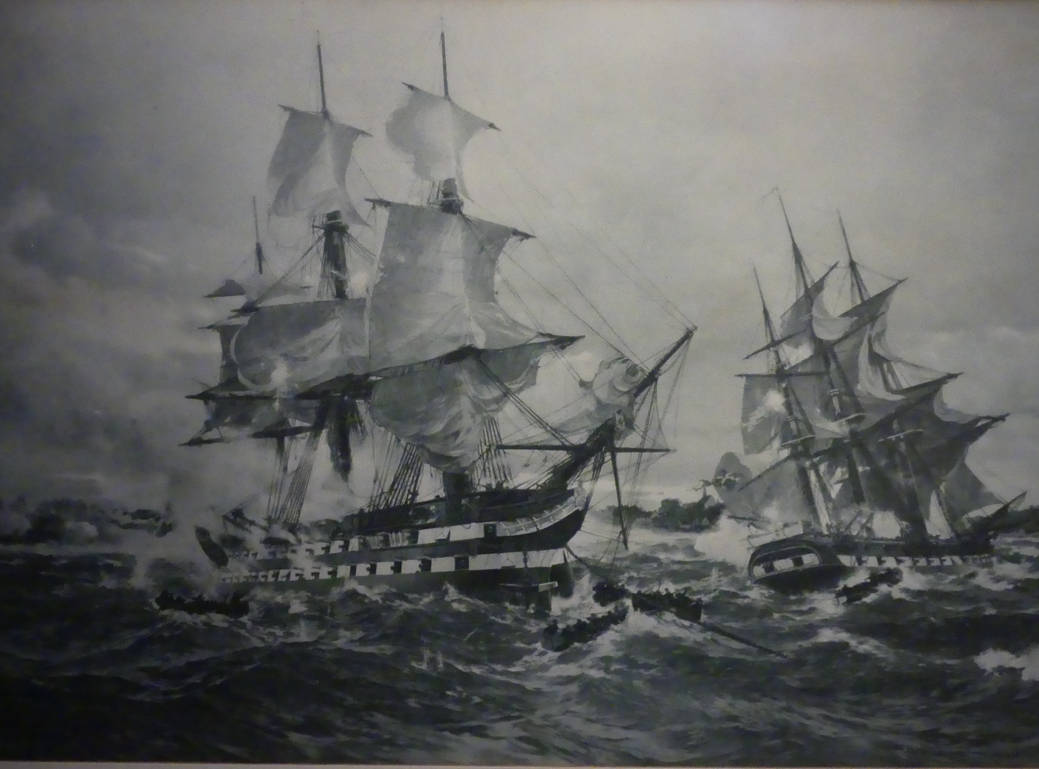
Danish warships Christian VIII and Gefion at Eckernförde, 5 April 1849

The ship of the line Chistian VIII or Christian den Ottendo exploded after being hit by the German coastal batteries and the Gefion was forced to surrender. Maritiem Museum Hamburg, Germany. 

Christian VIII designed by yard master A. Schifter was launched by the yard Nuholm, Copenhagen, Denmark on 22 May 1840, commissioned on 11 May 1841. Original to be named Prins Christian Frederik. The frigate Gefion was laid down in 1841, launched on 27 September 1843, renamed Eckernförde in 1849 as part of the fleet of Schleswig-Holstein, part of the Reichsflotte between 1850-April 1852, part of the Prussian navy and renamed Gefion in 1852, accommodation ship since 1870, stricken on 5 April 1880, decommissioned on 5 May 1880, became a coal hulk and broken up in summer 1891 at the Kaiserliche Werft, Kiel, Germany. 

Tuesday, 28 January 2025

British sailing barque Lady Elizabeth 1879-


Falkland Islands/Islas Malvinas, January 2025

Launched as a barque with yard number 98 by Robert Thompson Jr., Southwick, Sunderland, England on 6 June 1879, homeport London, since 1886 Castletown, Isle of Man and since 1906 Tvedestrand, Norway (owner Skibasaktiegeselskabet, Sundet, Boroen), departed Vancouver, Canada on 4 December 1912 destined for Delagoa Bay, [Portuguese] Mozambique, damaged off Cape Horn and afterwards striking Uraine Rock arrived she at Port Stanley, Falkland Island, there condemned and in June 1913 converted into a coal hulk, new owner Crown Receiver of Wrecks, drifted away to Whalebone Cove on 17 February 1936

Sunday, 14 April 2024

British troop transport HMS Himalaya 1851-1940

Laid down for account of the Peninsular and Oriental Steam Navigation Company, London for the route Southampton-Alexandria by C.J. Mare&Co., Leamouth, London, England in November 1851. launched on 24 May 1853, completed on 9 January 1854, bought by the British government on 14 July 1854, renamed C60 als coal hulk in December 1895, sold on 28 September 1920, private owner as coal hulk Himalaya at Portland Harbours and sunk in a Germain air attack on 12 June 1940.

Sources

Francis Elgar. The Royal Navy 1872-1880 in a series of illustrations. Lithographed in colours. From original drawings by W.F. Mitchell, esquire. Portsmouth, December 1880. 

Warshipsresearch.blogspot.com

Thursday, 4 April 2024

British unarmoured screw steam frigate HMS Shah 1870-1926

Was to be named Blonde but after the Persian shah Naser al-Din Sha Qajar (17 July 1831 Kahnamar, Iran-1 May 1896 Tehran, Iran) visited the United Kingdom in 1873 renamed Shah. Designed by the Director of Naval Construction 1863-1870 Sir Edward James Reed (20 September 1830 Sheerness-30 November 1906 London). Laid down by Portsmouth Dockyard on 7 March 1870, launched on 10 September 1873, completed in December 1904, converted into the coal storage hulk C.470, sold on 19 September 1919 and wrecked in Bermuda in 1926. Perhaps sold to the Danish salvage company Petersen&Albeck in 1934, towed to and broken up at Copenhagen.

Sources

Francis Elgar. The Royal Navy 1872-1880 in a series of illustrations. Lithographed in colours. From original drawings by W.F. Mitchell, esquire. Portsmouth, December 1880. 

Warshipsresearch.blogspot.com

Tuesday, 20 February 2024

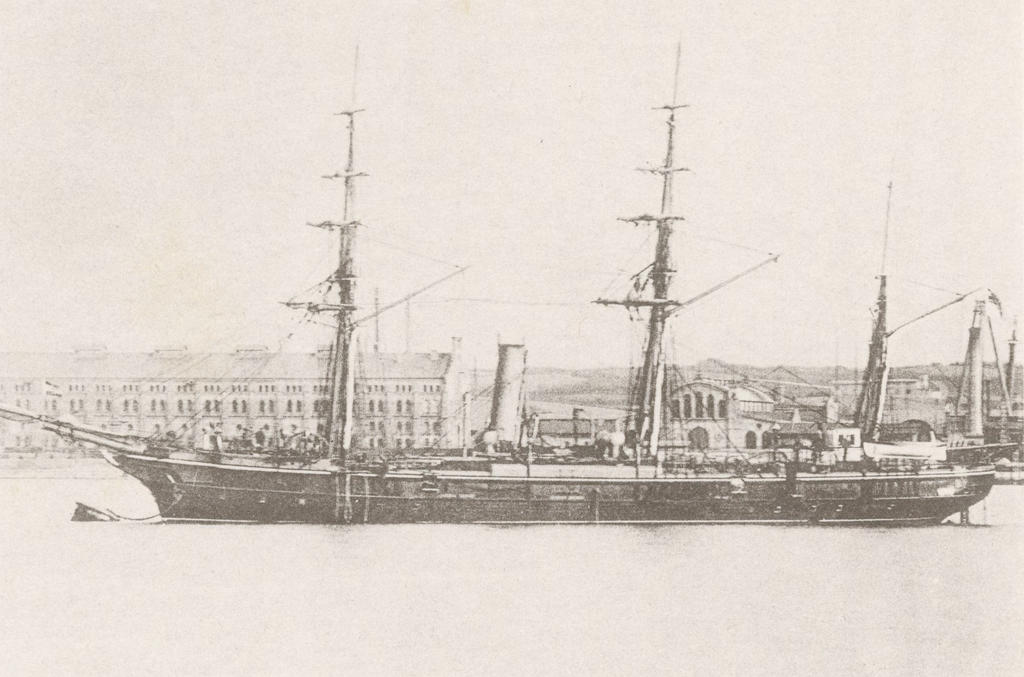
German gunboat SMS Möwe 1879-1910

Source Bundesarchive RM 3/22928 French photo album 1900

Launched by Schichau-Werke, Elbing, Germany on 13 May 1879, commissioned on 31 May 1880, survey vessel after 1895,stricken on 9 December 1905, hulked in the German colony of Jiaozhou, China and sold in 1910.

Wednesday, 19 January 2022

British coal hulk Jumna towed according to the Dutch magazine Marineblad dated 1913-1914 no. 6

An item reported that the British coal hulk Jumna towards the Firth of Forth  a former troop transport, was towed from the Medway towards the Firth of Forth to serve there.(1)

Note

1. Euphrates-class troop transport, building ordered in 1865, launched with yard number 190 by Palmers Shipbuilding and Iron Company, Hebburn, United Kingdom on 24 September 1866, coal hulk C110 since 1893 and sold as the hulk Oceanic in July 1922.

Thursday, 23 September 2021

German merchant ships seized in Siam according to the Dutch newspaper De Preanger-bode dated 7 August 1917

An item reported that on Sunday morning 5th Siamese warships took German merchant ships lying on the river in custody. Guarded men went on board and the ships were handed over and the Siamese flag was hoisted. This all happened before Siam declare the war on Germany. Officially was stared that on al most all large ships efforts were done to disable the machinery by unscrewing of the most vital parts. At the same moment as the Siamese boats boarded the German ships was were with small explosions the destruction completed. Excluded one of 2 were all steamships beyond repairs damaged. The lighters were undamaged. The newspaper Strait Times mentioned all German ships in Siamese harbours which were seized. Steamships were Chiengmai (1.815 gross, 1.080 net tons, built 1906), Deli (1.394, 726, 1899), Konsichang (2.043, 1,292, 1894), Landrat Schieff (1.640, 1.01, 1906), Patani (1,899, 1.086, 1907), Petchaburi (2.101, 1.373, 19010, Pitsanulok (2.019, 1,267, 19010, Samson (1.632, 988, 1902), steam lighters Tacheen (440, 248, 1901), Menam (464, 271, 1906), Patriu (455, 269, 19030, Chantaboon (421, 260, 1908), Bangpakong (455, 269, 19030, coal lighters Burg, Tesum, Gestemilnic, Bremerhaven, Lehe, Bremen, large coal hulks J.W. Wendt (1.806, 1.723, 1890), Aldebaram (1.913, 1.836, 1888) and the tugs Cyklops (151, 48, 1890) and Undine (176,-,1899). 

Tuesday, 2 January 2018

British armoured frigate HMS Northumberland 1861-1898, Acheron 1904-1909, C 8 1909-1926, C 68 1926-1927 and Stedmound 1927-1935

HMS Agincourt

Part of the Minotaur-class consisting of the Minotaur, Agincourt and Northumberland, preceded by Achilles and succeeded by Prince Consort-class. Building ordered on 2 September 1861, laid down by Millwall Iron Works, Millwall, London, England on 10 October 1861, launched on 17 April 1866, completed on 5 October 1868, commissioned in October 1868, refitted between 1873-1875 and 1885-1887, reserve between 1890-1898, hulked as stokers’ training ship at the Nore in 1898, renamed Acheron on 1 January 1904, coal hulk at Invergordon between 1909-1927, renamed C 8 in 1909, renamed C 68 in 1926, sold in 1927, resold and as the hulk Stedmound serving at Dakar, Senegal until she was broken up in 1935. Minotaur and Agincourt in fact half sisters.

Displacement 10.754 tons and as dimensions 122 (between perpendiculars) x 18,1 x 8,5 Metres or 400.4 x 59.5 x 27.9 feet. Machinery consisted of 1-2cylinder trunk steam engine of John Penn and Sons and 10 rectangular boilers supplying via one shaft 6.558 ihp (during the sea trials on 15 September 1868) allowing a speed of 7 (under sail)-14,1 knots. With a coal bunker capacity of 760 (normal)-1.400 (maximum) tons and a speed of 10 knots 2.825 nautical miles. She had five masts although three were planned in the original design, between 185-1879 2 removed and since then barque-rigged. Poor sailor. The screw could not be lifted out of the water when under sail. Crew numbered 705-800 men. Originally to be armed with 40-110pd Armstrong breech loading guns but never executed while the gun was no success. Original armament consisted of 4-23cm/9” rifled muzzle loading guns, 22-20cm/8” rifled muzzle loading guns, 2-17,8cm/7” rifled muzzle loading guns and 8 brozne howitzers to b used as saluting guns. Armour consisted of a 11,4cm/4.5”-14cm/5.5” thick belt, conning tower 11,4cm/4.5”, 14cm/5.5” thick bulkheads with the same thickness for her battery (length 56,2 metres/184.5 feet). Under layer of the armour was 25,4cm/10” teak. Unlike her half sister ships was not the complete hull protected as a result of compensating the weight of the guns. 

British armoured frigate HMS Agincourt 1861-1904, Boscawen III 1904-1905, Ganges III 1905-1909 and C 109 1909-1960

HMS Agincourt

Part of the Minotaur-class consisting of the Minotaur, Agincourt and Northumberland, preceded by Achilles and succeeded by Prince Consort-class. Building ordered on 2 September 1861, laid down by Laird, Son&Co., Birkenhead, England on 20 October 1861, launched on 27 March 1865, completed on 19 December 1868, commissioned in June 1868, training/depot ship for boys at Portland since 1893, renamed Boscawen III in March 1904, renamed Ganges II and stationed at Harwich in 1905, stationed at Sheerness since 1909 and there, converted into the coal hulk C 109 and broken up since 21 October 1960.

Displacement 10.798 tons and as dimensions 121,9 (between perpendiculars)-124,05 (over all) x 18,1 x 8,3 metres or 400-407 x 59.6 x 26.10 feet. Machinery consisted of 1-2cylinder horizontal return connecting rod steam engine of Maudslay and 10 rectangular fire-tube boilers supplying via one shaft 4.426 ihp (sea trials on 12 December 1865) allowing a maximum speed of 9,5 (under sail)-13,55 knots. With a range with a speed of 7,5 knots under steam and a coal bunker capacity of 750 tons 1.500 nautical miles. Five masts with a sail area of 3.008 square metres/32.377 square feet. Poor sailor. The screw could not be lifted out of the water when under sail. In 1893-1894 were three masts removed and since then barque rigged. Crew numbered 800 men. The wrought iron made armour consisted of a 11,4cm/4.5”-14cm/5.5” thick belt and 14cm/5.5” thick bulkheads. Armament consisted of 4-23cm/9” rifled muzzle loading guns and 24-18cm/7” rifled muzzle loading guns. Originally to be armed with 40-110pd Armstrong breech loading guns but never executed while the gun was no success. Rearmed in 1875 with 17-22,8cm/9” guns of which 2 were replaced around 1883 by 2-15,2cm/6” breech loading guns. Between 1891-891 armed with 4-12cm/4’7” quick firing guns, 8-3pd Hotchkiss quick firing guns, 8 machineguns and 2 torpedo tubes. 

Saturday, 9 December 2017

Dutch paddle steamship 2nd class Hr.Ms. Bromo converted into a guard ship in 1892

Model Rijksmuseum, Amsterdam, Netherlands. Original source


An item reported that in the period 1 October 1891-1 October 1892 the Dutch paddle steamship 2nd class Hr.Ms. Bromo was at the naval establishment at Surabaya, Dutch East Indies rebuilt into a guard ship replacing the Hr.Ms. Soerabaya on 1 April 1892.(1) 

Note
1. call sign GQDF, iron-built with wood-planked, rigged but very worse sail performance, on stocks at the shipyard of the Kon. Fabriek etc., Amsterdam, Netherlands in 1873, launched in 1874, engines and boilers repaired in 1877, temporarily guard ship at Batavia, Dutch East Indies 27 August-13 November 1883, decommissioned 15 March 1890, needed major repaired and at the same time fitted out as guard ship at Batavia, commissioned as guard ship at Surabaya, Dutch East Indies as replacement of the Surabaya on 1 April 1892, decommissioned and replaced by the Koning der Nederlanden on 1 December 1899, used as store ship for the army during South Celebes-expedition in 1905, fitted out as coal hulk and serving at Merauke in 1910, stricken in in 1914, towed from Merauke towards Surabaya in 1916, sold there on a public auction an the naval establishment to the K.P.M. at 09.00 o’clock 12 November 1917, dimensions 60 (between perpendiculars) x 9,39-16,17 (over side wheels) x 4 metre, horsepower 200 nhp/950 ehp, an armament of 2 rifled 16cm guns and 4-12cm guns, and a crew numbering 100-134 men (1885: 101 Europeans, 33 natives).

Source
Jaarboek van de Koninklijke Nederlandsche Zeemacht 1891-1892. 

Saturday, 7 October 2017

Dutch tug Witte Zee with tow underway England towards Canary Islands according to the Dutch newspaper De Tijd dated 24 July 1923

An item dated 24th reported that at 45.2 North latitude and 9.21 West longitude the Dutch tug Witte Zee was hailed underway from Cardiff, England towards Las Palmas, Canary Islands towing a coal hulk. 

Wednesday, 28 June 2017

American 5-mast schooner Edna Hoyt became coal hulk at Lisbon, Portugal according to the Dutch newspaper Het Vaderland dated 11 July 1938

An item reported that the American 5-mast schooner Edna Hoyt was condemned and lying in the harbour of Lisbon, Portugal where her a final fate as coal hulk awaited. She was built of wood in 1920 for the coastal trade. Despite lacking good sailing qualities was an economic ship. Recently she crossed the Atlantic Ocean and entered Lisbon on the return voyage while leaking.(1)

Note
1. Dimensions 224 x 41.1 x 20.8 (depth) feet. Built by Dunn and Elliot, Thomaston, Maine for account of the Superior Trading and Transportation Company. Towed in Lisbon by a Norwegian steamship in November 1937 and later sold to be broken up. Ship’s papers returned to her owner captain Harold G. Foss. 

Norwegian bark Flora collided in IJmuiden, Netherlands with coal hulk according to the Dutch newspaper Rotterdamsche nieuwsblad dated 8 July 1902

An item dated Ijmuiden, Netherlands 5th reported that the Norwegian bark Flora master Christensen when nearing the ballast wharf rammed the moored coal hulk Time is money causing a heavily damaged coal hulk included the lost of her mast with the complete fore deck an winch destroyed. 

Dutch tjalk Waterploeg became coal hulk at Hamburg, Germany according to the Dutch newspaper Algemeen Handelsblad dated 3 October 1910

An item reported that the Dutch tjalk Waterploeg master Van Veen was sold to the firm Sternburg, Hamburg, Germany to be used as coal hulk.