Translate

Showing posts with label Sicily. Show all posts

Wednesday, 14 January 2026

Italian sailing ship Nina M lost in 1917

According to a list of the Italian Department for transport over sea and by rail was she lost on 12 March due to submarine on the location 20 miles of Sicilian coastline. Tonnage 117 tons.

Source

Bundesarchiv RM 20/728.

Saturday, 30 December 2023

British convoy for Malta under heavy attack of German aircraft in 1941

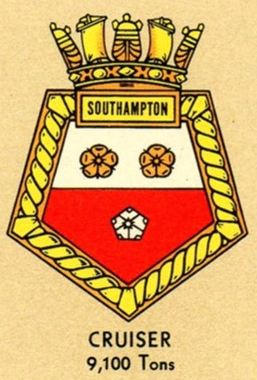
A selection of Ships' Badges of His Majesty's Royal Navies. Gutta Percha&Rubber Limited, 1942

German dive bombing Stukas and torpedo planes stationed in Sicily attacked a British convoy with urgently needed supplies for Greece passing the Straits of Sicily on 10 January. Although suffering heavy losses were the escort vessels of the convoy heavily damaged. The Southampton was so heavily damaged that she was to be scuttled. The damaged Illustrious reached Malta under own power where she was further damaged by attacking dive bombers. Furthermore was the Gallant damaged by a torpedo. It was clear that future pasages were to be more dangerous as had been in the past with only Italian opposition.

Notes

1. C83. Town-class light cruisers preceded by Arethusa-class succeeded by Crown Colony and Dido-classes, laid down by John Brown&Company, Clydebank, Scotland on 21 November 1934, launched on 10 March 1936, commissione on 6 March 1937 and scuttled off Malta on 11 January 1941.

2. 87. Illustrious-class aircraft carriers preceded by HMS Ark Royal and succeeded by Impacable-class. Building ordered on 13 April 1937, laid down by Vickers-Armstrongs on 27 April 1937, launched on 5 April 1939, commissioned on 25 May 1940, decommissioned in February 1955 and sold to be broken up in November 1956.

3. H59. G-class destroyer preceded by E and F-classes and succeeded by I-class, ordered on 5 March 1934, laid down by Alexander Stephen and Sons, Glasgow, Scotland on 15 September 1934, launched on 26 September 1935, completed on 25 Febuary 1935, sunk as a blockship at St. Paul’s Island in September 1943 and scrapped in 1953.

Source

National Archives USA. Record Group 38: Records of the Office of the Chief of Naval Operations. Series: Secret Naval Attaches Reports. Report dated Naval Attache at Rome dated 3 February 1941 No. 63-41. M975-002.

Friday, 30 December 2022

Troops picked up at Final by galleys according to the Dutch newspaper Oprechte Haerlemsche courant dated 10 January 1697

An item dated Milan, 19th December 1696 reported that troops no longer needed were to sent around March to Catalonia. The galleys of Naples, Sicilia and so on were to pick them up at Final.
Friday, 3 December 2021

Italian torpedo boat Vega 1935-1941

Laid down by Cantieri Navali del Quarnaro, Fiume. Italy (nowadays Rijeka, Croatia] on 14 November 1935. Launched on 21 July 1936. Commissioned on 12 October 1936. Lost off Pantelleria, Sicily in a battle with the British destroyer Hereward on 10 January 1941. Stricken on 18 October 1946. Spica-class sub-class Perseo, preceded by Curtatone-class, succeeded by Ariete-class. Displacement 642 (standard)-1.000 (full load)-1.023 (with mines) tons and as dimensions 81.95 x 8.20 x 2.33-3.05 metres. Two Tosi turbines and 2 Yarrow type boilers with 19.000 hp, 207 tons fuel bunker capacity and 34 knots speed. Range 1.892 nautical miles/15 knots and 683 nautical miles/30 knots. Crew numbered 99 men. Armament included 4x1-45cm/18” torpedo guns, 3x1-10cm/3.9” 47 cal guns, 4x2-13.2mm/0.5”guns and mines.

Sources

AMM. Paolo M. Pollina. Le Torpediniere Italiane. Officio Storico della Marina Militare. Rome, 1964.

Several editions of Jane’s Fighting Ships

http://warshipsresearch.blogspot.com/

Sunday, 3 October 2021

British destroyer HMS Westcott and submarines Odin, Otus and Grampys visited Tandjong Priok, Dutch East Indies according to the Dutch newspaper De locomotief dated 16 March 1939

An item reported that on on Monday evening a reception was organized on board of the British destroyer HMS Westcott commanded by J.A.C. Hill and 3 submarines [Odin, Otus and Grampys] lying at Tandjong-Priok, Dutch East Indies and which was visited by a large number of British and Dutch local residents.

Notes

1. Of the Admiralty W-class, preceded by S and Parker classes, succeeded by Thornycroft type destroyer leader, building ordered in December 1916, laid down by William Denny&Brothers Ltd, Scotland on 30 March 1917, launched on 14 February 1918, commissioned on 12 April 1918, converted into a long-range escort vessel in 1943, decommissioned on 26 June 1945 and sold to be broken up in 1946.

2. Of the O-class, preceded by L-class, succeeded by Parthian-class, laid down by Chatham Dockyard on 23 June 1927, launched on 5 May 1928, commissioned on 21 December 1929 and rammed and sunk by the Italian destroyeers Strale and Baleno in the Gulf of Taranto on 13 June 1940.

3. Of the O-class, preceded by L-class, succeeded by Parthian-class, laid down by Vickers-Armstrong, Barow-in-Furness, United Kingdom on 31 May 1927, launched on 31 August 1928 , commissioned on 5 July 1929, decommissioned in March 1946 and scuttled of Durban, South Africa in September 1946.

4. Of the Grampus-clas mine laying submarines, preceded by River-class, succeeded by T-class, laid down by Chatham Dockyard on 20 August 1934, launched on 25 February 1936, commissioned on 10 March 1937 and sunk by Italian naval forces in the Syracuse-Augusta area off Sicily on 16 June 1940.

Wednesday, 29 September 2021

Italian torpedo boat Circe 1937-1942

Laid down by Ansaldo Sestri, Italy on 29 September 1937. Launched on 27 June 1938. Commissioned on 4 October 1938. Lost on a collision off Sicily on 27 November 1942. Stricken on 18 October 1946. Spica-class sub-class Alcione, preceded by Curtatone-class, succeeded by Ariete-class. Displacement 679 (standard)-975-1.050 (full load) tons and as dimensions 81.42 x 7.92 x 2.41-3.09 metres. Crew numbered 99 men. Two Tosi turbines and 2 Yarrow type boilers with 19.000 hp, 215 tons fuel bunker capacity and 34 knots speed. Range 1.910 nautical miles/15 knots, 1.623 nautical miles/24 knots and 690 nautical miles/30 knots. 

Thursday, 24 January 2019

Sicilian galley Cardona in 1572

Part of the Holy League fleet commanded by Don Juan de Austria gathered off Gumenizas on 9 September 1572. Part of the left horn of the centre, commanded by captain Juan de Orta.

Source
Armada española desde la union de los reinos de castilla y aragon. C. Fernandez Duro, volume 2, 1896, 176-180. 

Sicilian galley Sicilia in 1572

Part of the Holy League fleet commanded by Don Juan de Austria gathered off Gumenizas on 9 September 1572. Part of the left horn of the centre, commanded by captain Jaime Losada.

Source
Armada española desde la union de los reinos de castilla y aragon. C. Fernandez Duro, volume 2, 1896, 176-180. 

Saturday, 5 January 2019

Sicilian galley Patrona of Sicilia in 1572

Part of the Holy League fleet commanded by Don Juan de Austria gathered off Gumenizas on 9 September 1572. Part of the left horn of the centre, commanded by captain Paulo Jordán Ursino.

Source
Armada española desde la union de los reinos de castilla y aragon. C. Fernandez Duro, volume 2, 1896, 176-180. 

Saturday, 13 January 2018

Italian sailing cargo ship (ex-Meta 1911-1957, Onice 1957-2016) Brigantes 2016-


As the Meta

Introduction
She is the first freighter currently in the Mediterranean Sea, used for sail cargo to transport organic and fair-trade goods, and currently undergoing restoration. A first phase of the refit works is being completed in the craft shipyard Da.Ro.Mar.Ci D'Amico of Trapani; it will be followed by the reconstruction of the interiors and the superstructures - most of them in wood -, the redesign and reconstruction of the sail system on the basis of original drawings, and the restoration of the electrical system with the integration of renewable energy sources (photovoltaic, aerodynamic turbines), so as to make the ship operational with zero emissions. By the end of 2018 will the restoration to be completed. The intention is to transport goods between North and Souh America and the Mediterranean Sea, such as organic coffee, cocoa, Azorean tea, and other products based on the broken routes concept and developments in commercial network of “sailing.” The brig, of 30 meters in length, has in fact a very large hold, and can load up to 220 tons of goods. The availability of professional training places for seamen (specialization on large sailing ships) and passenger accommodation, as well as the possibility of using the ship during maritime events complete the offer of the activities by her.


As a sailing cargo ship
We do not always think about the fact that most of our everyday goods, to be available on the market at competitive prices, are transported for long distances by sea on huge container ships fed by huge quantities of fossil fuels, contributing significantly to the emissions of carbon dioxide and polluting substances in the atmosphere and in the seas themselves. The transport company Brigantes Shipping Ltd., is founded by the brothers Oscar Kravina, master of the ax, Daniel Kravina, entrepreneur, the German naval engineer Tobias Blome and the Sicilian sailor Giuseppe Ferreri, and intends to propose a sustainable freight transport alternative thanks to the use of wind energy and self-produced renewable energy on board. Brigantes Shipping Ltd. is aimed at those operators active in the production of organic food and fair trade, which until now lacked the ability to transport their goods in a manner consistent with the company philosophy.


The commercial network of "sailing" is perfectly integrated with sustainable freight transport projects such as those related to rail mobility, electric mobility, projects for the recovery of animal traction by road or recovery of internal waterways. The possibility of interacting with digital platforms that optimize the efficiency of joint purchasing groups is interesting. It will be the task of Brigantes, together with the other members of the “Sail Cargo Alliance”, an alliance of free ship owners and managers of sailing ships, with the aim of “creating a healthy culture of transport that promotes the conservation of the environment for future generations ”, fill this gap.

The Brigantes and her role in maritime heritage, education and events
It will be possible to combine sailing transport with educational programs including academic (master, business school programs, teambuilding etc.) for groups of students and teachers on board, including the possibility of being actively included in the overall experience of ecological transport, from the producer to the distribution network, up to the final consumer. Countless are the ideal routes to create a fair trade cruise with transport of goods included, combining freight transport with sustainable tourism, and the organization of events on board, such as concerts, artistic events, theatrical performances, cooking classes.

History 
Launched at the C.H.Luhring shipyard, Elsfleth, Germany in 1911 as the gullet schooner Meta and used as a cargo ship between Germany and Denmark. At the beginning of the 1920s she was registered in the French merchant marine register and after sailing for a few years in the north of France, circumnavigated the Iberian peninsula and entered the Mediterranean to reach Tuscany where it was registered with the registration number 481 in the maritime compartment of Livorno, starting to sail transporting talc from Sardinia. In 1924 it was bought by Carlo Pezzica, a marble merchant in Carrara, on behalf of the shipowner Giovanni Marchetti of Carrara. In 1927 a two-cylinder internal combustion propulsion engine was added, but continued to hold the schooner rig with gabbells. In 1937 the new captain and ship owner Ferdinando Gianfranchi (called ‘il liscio”) sold it to captain Giovanni Fanciulli of the island of Giglio.


Until the 1950s between Sardinia and Tuscany active was she in 1957 by the Benetti shipyards of Viareggio converted into a motor ship. The reconstruction included dismantling of the sailing rig, adding a new and more powerful propulsion engine (Ansaldo, a supercharged 4-cylinder 180hp) and of the aft superstructures with four cabins and the control bridge. The only hatchway mast was positioned slightly aft, and a second one was added forward of it. A derrick between the two coats, with the relative branches of prow and stern, was installed to allow the loading of the load. At the stern were added superstructures: three single cabins to starboard and a small kitchen, the mess hall and the cabin usually used by the onboard cook, on the left. Above this structure, the bridge made by a small cabin that housed the wheel of the rudder and aft of it, a small independent divided space that housed the chart and the guard bed. The rudder was modified by inserting the classic “chain ice” system.


The Onice, drawings by Alexander Mari van Maanen

Renamed Onice was she sold to the island of Pantelleria (compartment Trapani) as part of the Pantelleria motovelieri that guaranteed the transport of goods of the small island of Sicily. Until 1998 active in this area, initially guaranteeing the transport of raisins, capers and various goods for Naples, Livorno, Tunisia, Malta and later in 1986 ensuring the supply of kitchen gas cylinders to the domestic needs of the island.

In 1998 forced the advanced age of the ship owner and the master and motorist nearing retirement to take the decision to end her activities as a cargo ship., the painful decision of disarmament was taken. In May 1998 the last trip from Pantelleria to Trapani was carried out with only fifty tons of ballast (marble dust) and in the morning of May 28th moored in the Roncilio pier. Laid up until 2016 she got a new chance starting with a restoration. The well known Eye of the Wind was as the Friedrich also built in 1911 sharing with the Meta the same dimensions.

Funding through Crowdinvesting
The restoration of the Brigantes is financed through donations of materials, voluntary work, but mainly through the crowd funding, that is the possibility of buying company shares, also becoming co-owners of the ship. Of the 800 shares put up for sale at a price of € 1,000 each, out of a total of 1600, more than 200 have already been sold, going to finance more than 25% of her restoration work in parallel: it was executed and paid for 80% of the work on the steel hull, at the craft yard Da.Ro.Mar.Ci D'Amico of Trapani. The last works of metallic carpentry and conservative painting are about to be completed. This financing model is inspired by the historic “carat model”, which has a long tradition in the naval transport sector: long before the participatory investment (crowdinvesting) became popular. Thanks to the cutting-edge technology, it was usual to divide the costs that buying or building a ship implied within a larger or smaller group of people, thus making the investment accessible to many, and thus distributing the dividends and co-ownership of the vessel itself.

The Brigantes in addition to goods and products consistent with the company philosophy, will therefore bring in our seas a message of change possible and within reach of anyone who really wants to be part of it.

 For more information about this ship watch her own website on WEBSITE BRIGANTES

Sunday, 27 August 2017

Sicilian galley San Lorenzo in 1572

Part of the Holy League fleet commanded by Don Juan de Austria gathered off Gumenizas on 9 September 1572. Part of the reserve commanded by Don Juan de Cardona. Commanding officer Lope de Figueroa

Source
Armada española desde la union de los reinos de castilla y aragon. C. Fernandez Duro, volume 2, 1896, 176-180. 

Sicilian galley Catalina in 1572

Part of the Holy League fleet commanded by Don Juan de Austria gathered off Gumenizas on 9 September 1572. Part of the reserve commanded by Don Juan de Cardona. Commanding officer?

Source
Armada española desde la union de los reinos de castilla y aragon. C. Fernandez Duro, volume 2, 1896, 176-180. 

Sicilian galley San Sebastian in 1572

Part of the Holy League fleet commanded by Don Juan de Austria gathered off Gumenizas on 9 September 1572. Part of the reserve commanded by Don Juan de Cardona. Commanding officer Juan de Boneta,

Source
Armada española desde la union de los reinos de castilla y aragon. C. Fernandez Duro, volume 2, 1896, 176-180. 

Sicilian galley San Juan in 1572

Part of the Holy League fleet commanded by Don Juan de Austria gathered off Gumenizas on 9 September 1572. Part of the reserve commanded by Don Juan de Cardona. Commanding officer Espició Vasallo.

Source
Armada española desde la union de los reinos de castilla y aragon. C. Fernandez Duro, volume 2, 1896, 176-180. 

Sicilian galley Capitana in 1572

Part of the Holy League fleet commanded by Don Juan de Austria gathered off Gumenizas on 9 September 1572. Part of the reserve commanded by Don Juan de Cardona.

Source
Armada española desde la union de los reinos de castilla y aragon. C. Fernandez Duro, volume 2, 1896, 176-180. 

Monday, 31 July 2017

Sicilian galley Vigilanza in 1572

Part of the Holy League fleet commanded by Don Juan de Austria gathered off Gumenizas on 9 September 1572. Part of the right wing commanded by Don Alvaro de Bazán, marqués de Santa Cruz. Commanded by Silvestro marqueto.

Source
Armada española desde la union de los reinos de castilla y aragon. C. Fernandez Duro, volume 2, 1896, 176-180. 

Thursday, 18 February 2016

Dutch 5th charter Harderwijk 1662-1693

Of the admiralty Amsterdam, also called frigate,built by Jan van Rheenen at naval yard at Amsterdam, Netherlands in 1662, still mentioned in 1693, dimensions (Amsterdam foot) 133 (prow) x 34-34½ x 14, an armament of 46 guns (1 April 1665: 4-18pd, 16-12pd, 20-8pd, 6-3pd), a crew numbering 205-230 men and a tonnage of 800 tons (French measurement). In 1665 part of squadron commanded by Tromp, captain Jacob Wildschut, 1666 captain Thomas Tobias, 1676 as part of fleet commanded by De Ruyter towards Sicily captain Matheus Neergang, in summer 1686 captain Van der Hoeven, fishery patrol and in 1688 captain Cornelis van der Zaan.

Monday, 26 October 2015

Galley squadron fitted out at Naples to cruise for privateers of the Barbary States according to the Dutch newspaper Amsterdamse courant dated 11 February 1758

An item dated Naples, Italy 14the January reported that the king of Naples ordered to launch the new galley for the admiral of the squadron which was to transport troops towards Sicily and than to cruise for privateers of the Barbary States. The squadron was now still lacking one galley.