Translate

Showing posts with label Mariana Islands. Show all posts

Saturday, 29 March 2025

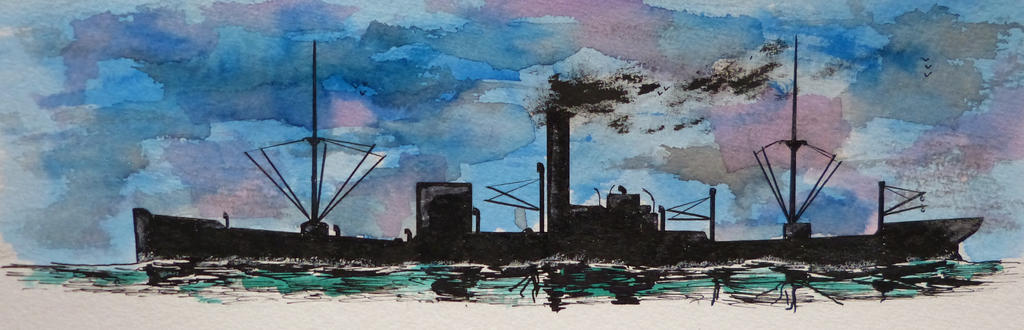
Japanese cargo ship Batavia Maru 1918-1944

©Warshipsresearch.blogspot.com

Sister ships Batavia Maru, Ganges Maru, Heimei Maru, Hiburi Maru, Hokuryu Maru, Indus Maru, Kairyu Maru, Surabaya Maru, Kayo Maru, Meiko Maru, Tonan Maru, Tosei Maru and Yamato Maru. Call sign JICD. Laid down by Osaka Iron Works Ld., Innoshima, Japan in 1918, launched in December 1918, completed on 26 January 1919, requisitioned by the army on 23 July 1937, became Allotted IJA No, 504, returned to owners in 1937, requisitioned by the army on 23 July 1942, sunk in an American air attack around 100 nautical miles west of Alamagan Island, Northern Marianas on 12 June 1944 and stricken on 31 July 1944. Gross tonnage 4,393 tons, under deck 3,677 tons, netto tonnage 2,731 tons and as dimensions 345.0 x 49.8 x 28.1 x 7.6 (light)-24 (loaded) feet. Reciprocating propulsion, single screw, horsepower 390 nhp, coal bunker capacity 1,200 tons, range 9,600 nautical miles/10 knots and speed 10 (normal cruising)-12 (maximum) knots. 

Saturday, 6 July 2024

Japanese cargo ship (ex-Ardgay 1917-1919, Ernemore 1919-1922, Tohkoh Maru 1922-1929) Toho Maru 1929-1944

Warshipsresearch.blogspot.com

Nanko Maru, Saiho Maru, Toho Maru and similar Ryusei Maru and Nansin Maru. Call sign JPYC. Laid down by Russell&Co., Port Glasgow, Scotland with yard number 704 on 22 October 1917, completed in January 1918 and torpedoed and sunk by the American submarine USS Pintado 250 miles west of the Marianas on 1 June 1944. Gross tonnage 4,717 tons, under deck 4,266 tons, net tonnage 2,930 tons and as dimensions 385.0 x 52.0 x 25.6 x 7.6 (light)-24 (loaded) feet. Reciprocating propulsion, single screw, 489 nhp, coal bunker capacity 1,850 tons, speed 12 knots (maximum) and range 13,000 nautical miles/10 knots. 

Tuesday, 26 December 2023

Japanese passenger-cargo ship Le Havre Maru 1919-1944

Call sign LLCD. Laid down by Osaka Iron Works Ld., Innoshima, Japan with yard number 938 in 1919, launched in March 1920, delivered on 25 May 1920, requisitioned by the army as troop tarnsport No. 130 on 14 October 1941 and torpedoed and sunk by the American submarine USS Pintado (SS-387) west north west of the Marianas on 6 June 1944. Gross tonnage 5,652 tons, under dck 5,148 tons, net tonnage 3,450 tons and as dimensions 407.2 x 50.8 x 30.0 x 9 (light)-26 (loaded) feet. Reciprocating propulsion, 559 nhp, coal bunker capacity 1,500 tons, range 10,000 nautical miles/10 knots and speed 10 (normal cruising)-13.5 (maximum) knots.

Friday, 1 April 2022

Allied naval force attacked the Ladrone Islands according to the U.S. Joint Intelligence Committee. Daily summary dated 7 March 1942

An item reported that according to the press an Allied naval force attacked the Ladrone Islands (Marianas Islands, north of Guam. The J.I.C. commented that she was not aware of the Japanese press reporting attacks on 24 Wake Island (24 February), Marcus Island (4 March) or on the Ladrone Islands.

Source

Map Room Papers (Roosevelt Administration), 1942 - 1945. U.S. Joint Intelligence Committee. Daily summary No. 87 dated 7 March 1942.

Friday, 11 March 2022

Japan searching for Allied naval forces and intensively training personnel for air attacks according to the U.S. Joint Intelligence Committee. Daily summary dated 15 March 1942

An item reported that extensive Japanese surface and air reconnaissance from bases in Japan, Chichijda (Bonin Islands) and Saipan (Marianas) was to discover without success Allied forces which were to believed on 10 March north of Wake Islands. At the same time were the Japanese emphasizing torpedo training especially for the aircraft. Coordinated air attacks were trained by a force consisting of 36 high-level bombers and 9 torpedo planes.

Source

Map Room Papers (Roosevelt Administration), 1942 - 1945. U.S. Joint Intelligence Committee. Daily summary No. 95 dated 15 March 1942.

Monday, 12 October 2020

Japanese single screw cargo ship (ex-Syotoku Maru 1938-1941) Shotoku Maru 1941-1943

Built by Hakodate Dock Co. Ltd., Hakodate. Japan in 1938. Owned by Shimatani Kisen K.K., Kobe, Japan. Call sign JPOJ. Gross tonnage 1.964 tons, under deck 1.600 tons, net tonnage 1.109 tons and as dimensions 270.6 x 40.0 x 2-.9 feet. Sunk by the American submarine USS Tunny (SS-282) off the west coast of Rota, Marianas on 28 June 1943. Used as an auxiliary gunboat. With a coal bunker capacity of 360 tons and a speed of 10 knots was the range 3.800 nautical miles. Speed 10 (cruising)-12 (maximum) knots.

Sunday, 25 September 2016

American squadron underway from Guam towards the Philippines according to the Dutch newspaper Bataviaasch nieuwsblad dated 1 February 1904

An item dated Tokyo, Japan 13th reported that an American squadron consisting of 3 battleships and 4 cruisers left Guam, Ladrones Islands ]=Mariana Islands] towards Manila, Philippines.(

Friday, 9 December 2011

The Japanese naval policy according to the Dutch newspaper Het Vaderland morning edition dated 13 February 1935

The Japanese newspaper Kainitsji reported the feelings of the navy and the problems which were expected that year and in particular the discomfort concerning the increase of the Russian submarine fleet stationed at Vladivostok and the defence of the Japan Sea. Japan intended in March to leave the League of Nations but every one expected that the Japanese mandate government over the South Sea islands was going to be part of the international conference.(1) The navy made clear that in her opinion there was none legal or other reason for Japan to give up this mandate which was allowed to Japan before the League was founded. Japan stated that when these islands were controlled by another country than Japan the peace in the Pacific seriously was threatened. Admiral Yamamoto (1) was that day by his arrival in Tokyo festive received by minister of foreign affairs Hirota, minister of navy Osoenu, high officers and a huge public. Immediately after his arrival went Yamamoto to the palace of the emperor. For the next day was a meeting of the ministers planned. He stated that Japan would do any concessions but that the Naval Conference was a necessity even if the preliminary meetings were not positive. He and admiral Chatfield (3) made no compromise plan said Yamamoto in a press statement. The naval discussions at London resulted in continuing the discussions between England, United States and Japan to sign a new naval treaty.

Notes
1. As the result of the First World War and the Treaty of Versailles approved by the League on 10 January 1920 received Japan the German rights in Shandong/Kiatschou and the German islands in the Pacific north of the equator (Palau Islands) and the mandate over the Mariana Islands or Marianas (included the Northern Mariana Islands excluded Guam), the Caroline Islands or Islas Carolinas and the Marshall Islands. Japan occupied these islands all ready in 1914.
2. Isoroku Yamamoto (Nagasaki 4 April 1884-underway to the Solomon Islands 18 April 1943) studied in 1919-1921 at the American Harvard university and in 1926-1928 appointed at the Japanese embassy in the USA. He was an opponent of staring a war with the USA. Promoted to naval general on 15 November 1940. He was in fact responsible for the attack on Pearl Harbour on 7 December 1941.
3. Alfred Ernle Montacute Chatfield, 1st Baron Chatfield (27 September 1873 Southsea-15 November 1967), First Sea Lord in 1933-1938, in 1935 promoted to Admiral of the Fleet.