An item reported the arrival at Honolulu, Hawaii of the American whaler Adeline, Buckley, of Newburyport, 37 months, 1,700 barrels.

Showing posts with label Sandwich Islands. Show all posts
Showing posts with label Sandwich Islands. Show all posts
Friday, 23 October 2026
American whaler Midas visited Honolulu, Hawaii according to the Sandwich Island Gazette and Journal of Commerce dated Saturday 24 September 1836
An item reported the arrival of the American whaler Midas, Spooner, of New Bedford, on 23 September at Honolulu, Hawaii coming from the whaling grounds.
American sealing schooner Ionic visited Honolulu, Hawaii according to the Sandwich Island Gazette and Journal of Commerce dated Saturday 17 September 1836
An item reported the departure by the American sealing schooner Ionic, Clark, on 10 September from Honolulu, Hawaii to the sealing grounds.
American whaler Henry Astor spoken according to the Sandwich Island Gazette and Journal of Commerce dated Saturday 17 September 1836
An item reported that the American whaler Henry Astor, Rawson, of Hudson, 600 barrels was spoken six weeks from the Sandwich Islands.
American whaler Meridian visited Honolulu, Hawaii according to the Sandwich Island Gazette and Journal of Commerce dated Saturday 10 September 1836
An item reported the departure of the American whaler Meridian, Fisher on 3 September van Honolulu to the whaling grounds.
Wednesday, 21 October 2026
Provisions on board of a English whaler in 1828
An item referred to the Sandwich Islands Gazette: “The following extract is made from the log-book of an English Whale-ship, formerly in these seas with thirty-six men. Provisions expended on board the ship during the year 1828: -5,324 lbs. salt pork; 5,472 lbs. salt beef; 4,200 lbs. fresh pork; 792 lbs. fresh beef; 8,710 lbs. biscuit; 54 gallons pearl barley; 360 gallons flour; 216 gallons molasses; 20 gallons oatmeal; 240 gallons split peas;160 gallons peas, vice coffee; 24 gallons rice; 440 gallons rum ; 120 gallons vinegar; 8,100 onions; 500 pears; 12 melons; 40 bushels sweet potatoes; 144 pumpkins; 2,000 oranges; 1 bushel Chili peppers; 52 terrapin; 3200 cocoa nuts; 220 bread fruit; 120 bunches plaintains; 120 sugar canes; 66 fowls; 63 papias; 90 pine apples; 50 citrons; 150 taro roots; 8 bushels limes; 3360 lbs. Irish potatoes; besides cabin stores, as tea, coffee, sugar, butter, cheese, &c., and many hundreds weight of fish. Poor fellows!”
Source
Parbury’s oriental herald and colonial intelligencer, volume 1, 1838
Tuesday, 22 September 2026
American whaler John Wells spoken off Hope Island according to the newspaper The Polynesian dated 12 February 1853
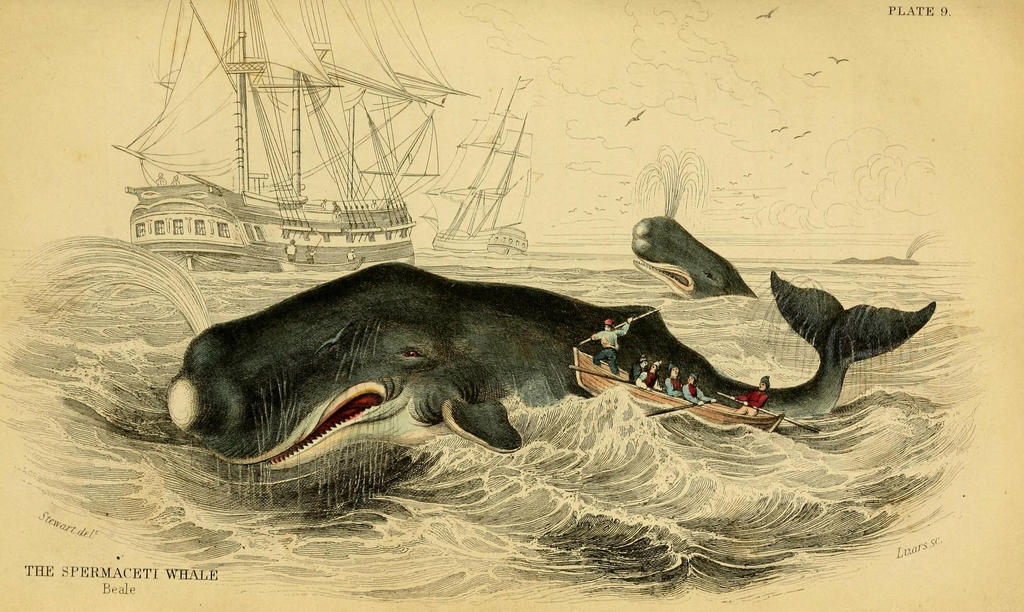
An item reported that the American ship Dover off New London heard of spoken off Hope Island on 4 December 1852 the American whaler John Wells of New Bedford 2 months from Sandwich Islands 100 barrels sperm oil
Friday, 24 February 2023
American master Walker with the Kingfisher bound home according to the Australian newspaper The Sydney Morning Herald dated 13 February 1860
An item dated Mongonui 23 January referred to the American whaler Jireh Swift which reported that master Walker sold his part of the George and Mary and departed home on 28 November 1859 from the Sandwich Islands with the Kingfisher (late Palmer).
Wednesday, 10 February 2021
The House of Lords’ interview with South Sea whaling entrepreneur Charles Enderby on 6 April 1838
An item referred to the interview with Charles Enderby of the firm of Charles, Henry and George Enderby, which firm for several years was involved in the South whaling. His father [Samuel, 17 January 1719 September 1797] started with whaling in the South in 1775. Before he he was involved via his agents in the USA. He did not gave an exact number of the number of whalers possessed by his firm, just saying a good many although less then in the past. Enderby thought that in 1794 the first time ws that one of their whalers visited New Zealand. Since then they continued visiting New Zealand for obtaining supplies for instance spars. The timber there was of a very good quality. A voyage to and back from New Zealand took 4 months; trading vessels commonly returned via Cape Horn. Natives were also hired as crew member now and in the past and considered generally to be good and well-behaven seaman. Enderby even stated much better that British sailors. They served the whole voyage. Some of them were chiefs and some served as harpooners.
Enderby was asked if he believed that a tax could
cause excesses elsewhere particularly at the Society Islands. He denied the
latter but saying that heavy taxes would result in visits to Papua New Guinea,
in fact all Pacific islands. At the moment was the annual number 100 ships and
it was possible that 40-50 should go elsewhere. He referred to the very high
charges in Chilean and Peruvian harbours with as results that whalers just
occasionally paid a visit. He could not confirm what the charges were in
Valparaiso, Chile while none of his whalers had been there in the last decades.
His whalers were active between the poles, Japan and Sandwich Islands and made
voyages of 2-4 years with an average of 3 years 3 months. One of his ships had
been involved in an excess at the Friendly Islands when an apprentice deserted
and the native refused to assist to get this man. He fired with his six with
grape loaded guns and afterwards landed with a boat of which the crew was cut
off. Such excesses were usually to blaim the masters although quite a lot of
the problems was caused when sailors interfered with women.
Source
Report from the Select Committee of the House of Lords
appointed to inquire into the present state of the islands of New Zealand and
The Expediency of regulating the Settlement of British Subjects therein; with
the minutes of evidence taken before the committee and an index thereto.
Ordered to be printed 3 April 1838.
Thursday, 3 October 2019
Russia seizing island to be used as whaling station according to the Dutch newspaper Leeuwarder courant dated 12 August 1817
An item dated London, England 1st referred to the National
Advocate stating that Russia
seized an island in the Pacific near the Sandwich Islands
and which was in the meantime strengthened and to be used as a whaling
station.. Furthermore was said that whaling was important for Russia while this country used a
huge quantity of train oil. The newspaper expected that with a capable
government using all available means on short notice Russian ships could be
seen all over the world.


Saturday, 2 April 2016
US Navy founding coals bunker stations on American Samoa and the Sandwich islands according to the Dutch magazine Marineblad dated 1892-1893 no. 6
An item referred to the Army and Naval Journal reporting that the US Navy intended to found a coal bunker station at Pago Paga, Samoa Islands [American Samoa]. The negotiations for buying the necessary area for building the necessary buildings and a 270 feet long quay were still going on. It was expected that a similar station would be founded on the Sandwich Islands.
Sunday, 22 March 2015
Maritime flag of Sandwich Islands around 1848

J.W. Norie/J.S. Hobbs. Three hundred and six illustrations of the maritime flags off all nations. London, 1848.
Thursday, 15 January 2015
Clipper ship Syren arrived at New Bedford, USA with catches of American whalers according to the Whalemen’s Shipping List dated Tuesday 16 August 1859
An item reported the arrival on Thursday 11th of the clipper ship Syren Captain Green of Boston, USA and the Gladiator captain Luce of New Bedford, USA fully loaded with oil and whalebone coming from the Sandwich Islands. The Syren left Honolulu, Hawaii on 16th April and the Gladiator on 31st March.
Sunday, 11 January 2015
American whalers Belle and Arctic lying at Guam on 19 March according to the Whalemen’s Shipping List dated Tuesday 16 August 1859
A letter written by captain Brown on board of the bark Belle (1) of Fairhaven reporting her lying at Guam on 19th March. Since she left the Sandwich Islands (2) consisted her catch of just 50 barrels sperm oil. He intended the same day to leave towards the Bonin Islands for a cruise. Brown also reported that arrival in the 18th of the Arctic (3) captain Phillips of Fairhaven without a catch since leaving the Bonin Islands.(4)
Notes
1. Tonnage 320 tons, shipping agent Edmund Allen, departed on 22 October 1857 towards the Pacific.
2. Hawaii?
3. Tonnage 431 tons, shipping agent Edmund Allen, departed on 23 July 1858 towards the Pacific.
4. The archipelago Bonin islands or Ogasawara Islands in the Pacific Ocean.
Notes
1. Tonnage 320 tons, shipping agent Edmund Allen, departed on 22 October 1857 towards the Pacific.
2. Hawaii?
3. Tonnage 431 tons, shipping agent Edmund Allen, departed on 23 July 1858 towards the Pacific.
4. The archipelago Bonin islands or Ogasawara Islands in the Pacific Ocean.
Friday, 29 November 2013
The British HMS 5th rate Blonde bringing the bodies of the king and queen of Hawaii back according to the Nederlandsche Staatscourant dated 31 July 1824
London, 24 July. The newspaper l’Etoile published the news that the government had ordered that the bodies of the King and Queen of the Sandwich islands [Hawaii] were to be brought on board of the frigate the Bleue [the HMS Blonde] commanded by captain Lord Byron and transported to the island Owihi to be buried there as they had wished.(1)
Source
http://en.wikipedia.org/wiki/HMS_Blonde_(1819)
Note
1. 46-gun 5th rate of the Apollo-class. Ordered 11 December 1812, laid down at the Deptford Dockyard March 1816, launched 12 January 1819 and completed 1824, renamed Calypso 9 March 1870 and sold on 28 February 1895. She “departed Woolwich on 8 September 1824 with the bodies of King Kamehameha II and Queen Kamamalu of the Kingdom of Hawaii who had died while trying to visit King George IV.”
Source
http://en.wikipedia.org/wiki/HMS_Blonde_(1819)
Note
1. 46-gun 5th rate of the Apollo-class. Ordered 11 December 1812, laid down at the Deptford Dockyard March 1816, launched 12 January 1819 and completed 1824, renamed Calypso 9 March 1870 and sold on 28 February 1895. She “departed Woolwich on 8 September 1824 with the bodies of King Kamehameha II and Queen Kamamalu of the Kingdom of Hawaii who had died while trying to visit King George IV.”
Monday, 18 June 2012
British cable ship Dominia towards the Pacific according to the Dutch newspaper Het nieuws van den dag voor Nederlandsch-Indië dated 13 September 1926
An item dated London 123 September reported that the Dominia world largest cable ship left Greenwich a day earlier towards the Pacific to lay down a cable between Vancouver and the Fanning Isles south of the Sandwich Isles. The cable with a length of 3,500 nautical miles was the longest cable ever of one piece. Every day were 200 nautical miles of cables to be laid some times on a depth of 3,400 fathoms.
Friday, 16 September 2011
The Prussian merchant ship Mentor arriving at Swinemunde according to the Nederlandsche Staatscourant dated 28 October 1824
Swinemunde, Prussia, 14 October. The day before yesterday arrived the Prussian ship Mentor of 200 Prussian lasten master J.A. Harmsen and senior merchant Willem Oswald with 22 sailors at Swinemunde after a voyage around the world or 39.000 sea miles. Fitted out by merchants of Berlin with Prussian manufactures of the factory of F. en E. Delius of Bremen she left the river Wezer 16 December 1822 towards the West coast of South America visiting the Sandwich Islands, Java and Saint Helena and returning full loaded including tea from Canton. Not a singe sailor was lost during the voyage. Without dropping her anchor she entered the harbour despite her draught of 14½ feet. In 1818 started works in Swinemunde while the water was just 6½ feet deep, nowadays 17 or 18 feet. On board of the Mentor was a large amount of foreigners when she returned.
Subscribe to:
Posts (Atom)