Translate

Showing posts with label Heligoland. Show all posts

Saturday, 22 November 2025

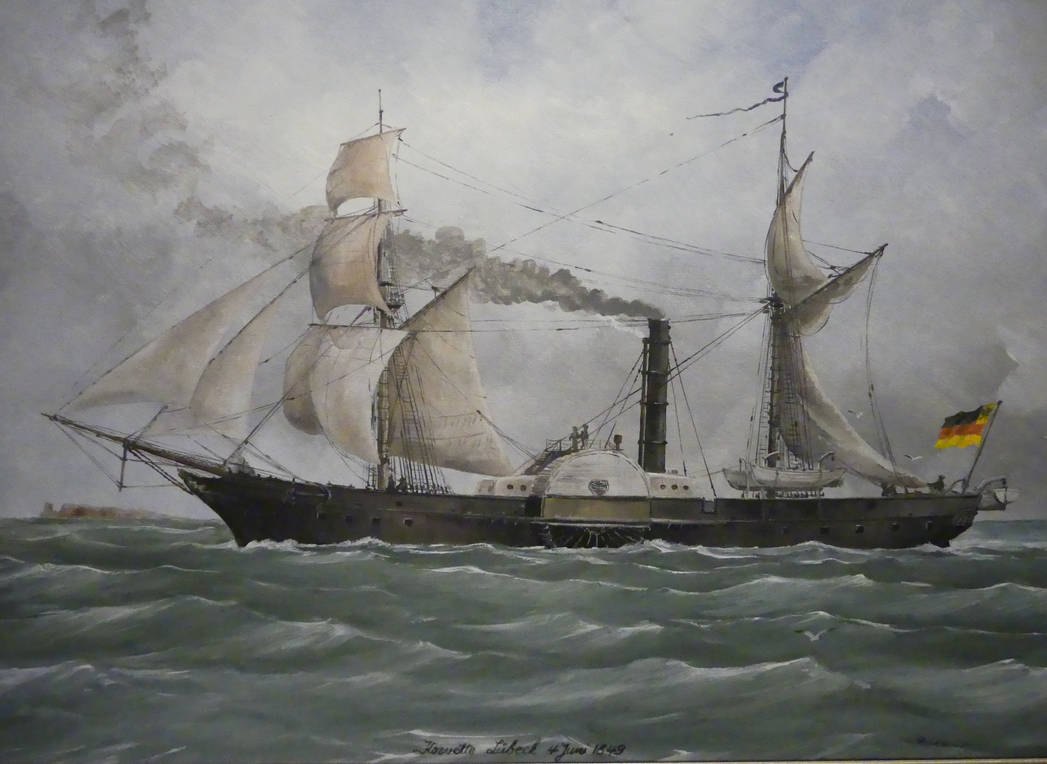
German corvette Lübeck 1846-1853

Klaus Roskamp (1941). Oil painting. Maritime Museum Hamburg, Germany

Launched by S.&H. Morotn&Co., Leith, Scotland in September 1844, purchased by the Hanseatische Dampfschifffahrts-Gesellschaft in 1846, renamed Lübeck on 16 April 1846, part of the short lived Hamburger Flotilla since 23 June 1848, part of the Federal Navy since 15 October 1848, participated in the battle against the Danish navy off Heligoland on 4 June 1849, sold to the General Steam Navigation Co. Ltd., London, England on 12 December 1852, in service as British Newcastle in March 1853 and broken up in October 1858. Displacement 335 tons and as dimensions 44.50 (waterline)-49.99 (over all) x 6.48-12.6 x 3.34 metres. 

Monday, 10 November 2025

British submarine HMS Salmon attacked and damaged two German light cruisers in December 1939

German light cruiser Leipzig . ©Warshipsresearch.blogspot.com

German light cruiser Nürnberg. ©Warshipsresearch.blogspot.com

An item reported that British aircraft sighted in the fore noon of Wednesday 13 December German destroyers 1290 miles west of Jutland. The British submarine HMS Salmon (1) spotted a German naval force consisting of two pocket battleships, 2-8” cruisers and 2-5.9”cruisers going west atacking a Leipzig-class cruiser. Result was a strenghtening of the Northern Patrol and extra ships made available for protecting the Canadian troop transport now underway. Submarines were ordered to take strategic positions to untercept the German warships and destroyers were to sweep and patrol in the North Sea. Germany later confirmed that one cruiser was damaged. Aircraft patrolling since daylight 14 December sighted in the afternoon in the neighbourhead of Heligoland 1 battleship, 1 cruiser and 3 destroyers. Enemy aircraft prevented an attack on these ships.

Note

1. Part of S-class preceded by Rainbow-class succeeded by River-classs. Laid down by Cammell Laird, Birkenhead, England on 15 June 1933, launched on 30 April 1934, commissioned on 8 March 1935 and sunk on 9 July 1940 probably due to hitting a mine off Norway. She sighted on 11 December damaging with torpedoes the German light cruisers Leipzig and Nürnberg and was hunted by destroyers for tow hours but managed to escape.

Source

The National Archives, Kew Gardens, England CAB-66-4-13 Weekly Résumé (No. 15) of the naval, military and air situation from 0700 7 December to 0700 14 December 1939. 

Saturday, 13 September 2025

German light cruiser SMS Mainz 1907-1914

SMS Mainz. ©Warshipsresearch.blogspot.com

SMS Magdeburg. ©Warshipsresearch.blogspot.com

Part of Kolberg-class preceded by Dresden-class succeeded by Magdeburg-class. Ordered under the contract name Ersatz Jagd, laid down by AG Vulcan, Stettin, Germany in September 1907, launched on 23 January 1909, commissioned on 1 October 1909 and sunk during the Battle of Heligoland Bight against the British Royal Navy on 28 August 1914.

Thursday, 27 February 2025

German battleship SMS Zähringen collided with torpedo boat according to the Dutch newspaper Bataviaasch nieuwsblad dated 16 September 1912

Wittelsbach-class. ©Warshipsresearch.blogspot.com

Zähringen as target©Warshipsresearch.blogspot.com

An item dated Berlin, Germany 15th reported that during the fleet manoeuvres off North Heligoland a German torpedo boat collided with the German battleship SMS Zähringen and sunk. Seven of the crewmembers of the torpedo boat were missing.(1)

Note

1. Part of pre-dreadnought battleships Wittelsbach-class preceded by Kaiser Friedrich III-class, succeeded by Braunschweig-class, laid down at the Germaniawerft at Kiel, Germany in November 1899, launched 12 June 1901, commissioned 25 October 1902, in 1917 fitted out as a target ship, April 1919 decommissioned, stricken on 11 March 1920 and disarmed, until 1926 serving as a hulk was she in 1927-1928 rebuilt as a wireless controlled target ship, on 18 December 1944 sunk by British planes in Gotenhafen [Gdynia, Poland], was she raised and deliberately scuttled as a block ship on 26 March 1945 and finally in the years 1949-1950 broken up. 

Wednesday, 26 June 2024

British cruiser HMS Cordelia arrived at Copenhagen, Denmark according to the Weekly Intelligence Summary (W.I.S.) No. 10 dated 12 March 1921

Warshipsresearch.blogspot.com

An item reported the arrival on 9 March of the British cruiser HMS Cordelia at Copenhagen, Denmark coming via the Kiel Canal from Heligoland.(1)

Note

1. Part of C-class Caroline sub-class light cruisers, preceded by Arethusa-class, succeeded by Danae-class, laid down by HM Dockyard Pembroke on 21 July 1913, launched on 23 February 1914, completed and commissioned in January 1915, last time decommissioned in December 1922 and sold to be broken up on 31 July 1923.

Source

The National Archives, Kew Gardens, England CAB-24-121-21

Friday, 28 July 2023

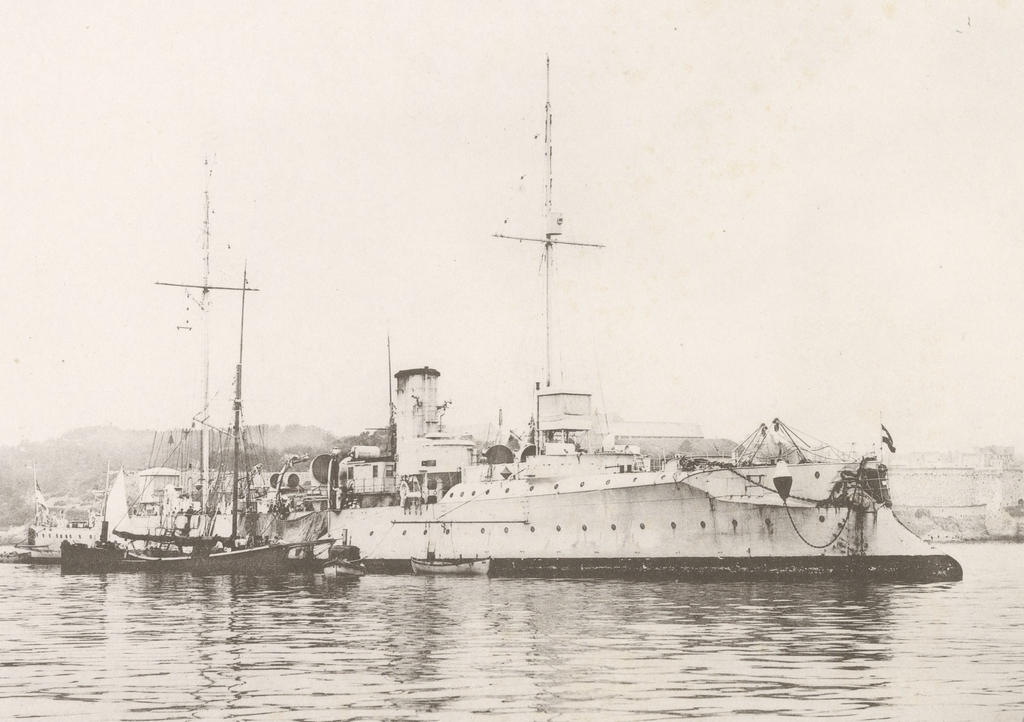
German aviso SMS Hela 1893-1914

Source Bundesarchive RM 3/22928 French photo album 1900


Preceded by Meteor-class succeeded by Gazelle-class. Laid down by AG Weser, Bremen, Germany in December 1893, launched on 28 March 1895, commissioned on 3 May 1896 and torpedoed and sunk by the British submarine HMS E9 off Heligoland on 13 September 1914.

Sunday, 2 July 2023

German naval clauses of the Treaty of Versailes still not completed according to the Weekly Intelligence Summary No. 19 for the week ending 20 August 1921

An item referred to the naval clauses of the Treaty of Versailles still to be completed concerning Germany:

-of the harbour material to be delivered 9,400 tons of the first and 74,490 tons of the second instalment. Although all arrangements were completed, final delivery could not be given before 31 July 1922 whil most of the tonnage was under construction;

-of the destruction of surplus war material was at Berlin&Cuxhaven 90, at Kiel 80 and at Wilhelmshaven 70% completed;

-destruction of plant in factories surplus to post-war requirements;

-settlement of number and location of post-war magazines and destruction of surplus;

-control of submarine diesel engines in accordance with decision of Conference;

-disarmament of the mine sweeping vessels on completition of minesweeping and

-35% of material to be delivered for light cruisers surrenderedto France and Italy was still to be handed over.

It was in the meantime proposed to withdraw the Heligoland Sub-commission on 1 October 1921.

Source

The National Archives, Kew Gardens, England CAB-24-127-5

Sunday, 18 June 2023

British cruiser HMS Castor bound for Heligoland and England according to the Weekly Intelligence Summary No. 19 for the week ending19 March 1921

An item reported that the British cruiser HMS Castor was to depart from Copenhagen, Denmark on 22 March bound for Heligoland and Sheerness, England.

Note

1. C-class Cambrian sub-class light cruiser, preceded by Arethusa-class, succeeded by Danae-class, laid down by Cammell Laird, Birkenhead, England on 28 October 1914, launched on 28 July 1915, completed and commissioned in November 1915. decommissioned in May 1935 and sold to be broken up on 30 July 1936.

Source

The National Archives, Kew Gardens, England CAB-24-121-62

Monday, 3 April 2023

German submarines leaving Heligoland towards the United Kingdom according to the Weekly appreciation of matters of naval interest No.13 week ended 15 March 1919

An item reported that of the five German submarines departing from Heligoland destined for Harwich, England as reported in the last appreciation just 3 three arrived. One, probably the U.B. 133 lacking engines and crew was picked up by a Dutch trawler and brought to IJmuiden, Netherlands and the fate of the fifth one unknown.

Source

The National Archives, Kew Gardens, England CAB-23-76-100

Saturday, 10 September 2022

British HMS light cruiser Cordelia bound for the Baltic according to the Weekly Intelligence Summary No. 9 dated 5 March 1921

C-class Caroline sub-class light cruisers

An item reported that the British HMS light cruiser Cordelia left Portsmouth, England on 5 March bound for Heligoland and Copenhagen, Denmark.(1)

Note

1. Part of C-class Caroline sub-class light cruisers, preceded by Arethusa-class, succeeded by Danae-class, laid down by HM Dockyard Pembroke on 21 July 1913, launched on 23 February 1914, completed and commissioned in January 1915, last time decommissioned in December 1922 and sold to be broken up on 31 July 1943.

Source

The National Archives, Kew Gardens, England for the week ending 5-3-1921, CAB-24-120-8

Friday, 10 June 2022

British light cruiser HMS Carysfort visiting Germany and Heligoland according to the Weekly Intelligence Summary No. 23 dated 11 December 1920

An item reported that the British light cruiser HMS Carysfort (1) departed Sheerness, England on 18 December bound for Hamburg, Germany and would leave there on 20 December for Heligoland and the next day back to Sheerness.

Note

1. Part of the C-class light cruisers Caroline sub-class, preceded by Arethusa-class, succeeded by D-class. Building ordered in July-August 1913, laid down on 25 February 1914, launched on 14 November 1914, completed in June 1915 and sold to be broken up in August 1931

Source

The National Archives, Kew Gardens, England CAB/24/116/95

Saturday, 31 July 2021

Construction German navy harbour on Heligoland progressing according to the Dutch magazine Marineblad dated 1909-1910 no. 8

An item reported that the construction of the German harbour for small cruisers and torpedo vessels on Heligoland made good progress. Estimated costs around 30 million Mark

Sunday, 18 July 2021

German Greenland commandeur S. Adriaensen returned home according to the Dutch newspaper Amsterdamsche courant dated 16 August 1803

An item dated 8th August reported the recent arrival at Tonningen [Tönning, Germany] of the German commandeur S. Adriaensen returning from Greenland bound for Hamburg, Germany with 80 quardelen seal bacon. In the roads were lying two anonymous Greenland. According to pilots of Heligoland captured a British frigate the commandeurs Bosch en P. Hansen and which were sent to England coming from Greenland. 

Thursday, 1 October 2020

German aviso SMS Hela 1893-1914

drawing Ron van Maanen


Laid down by AG Weser, Bremen, Germany in December 1893, launched on 28 March 1895, commissioned on 3 March 1896, modernized between 1903-1910 and sunk on 13 September 1914 southwest of Helgoland by the British submarine HMS E9. Original technical characteristics. Dimensions 104,6 (waterline)-105 (overall) x 11 x 4,46 (fore)-4,64 (aft) metres or 343.2-344.6 x 36.1 x 14.8-15.3 feet and a displacement of 2.027 (design)-2.082 (full load) tons. Crew numbered 178 (including 7 officers)-195 (including 8 officers) men. Armour consisted of a 2cm/0.79"-2,5cm/0.98" thick deck and the conning tower was protected by 3cm/1.2". Armament consisted of 4x1-8,8cm/3.5" SK L/30 quick firing guns, 6x1-5cm/2" SK L/40 quick firing guns and 3x1-45cm/17.7" torpedo tubes. The machinery consisted of 2 triple expansion steam engines and 6 locomotive boilers supplying via 2 screws 5.900 ihp allowing a speed of 20-20.5 (trial) knots. With a speed of 12 knots and 350 ton coal bunker capacity was her range 3.000 nautical miles. 

Friday, 21 June 2019

German cruiser SMS Hela visited Brest, France according to the Dutch newspaper De Locomotief dated 29 June 1899

An item referred to the Figaro which reported the German cruiser Hela (1) visiting Brest, France to transport a seriously ill sailor to the naval hospital there. When she arrived in the roads was the flag of admiral Sallandrouze de Lamornaik (2), commanding officer of the Northern squadron saluted. The German commanding officer paid a visit to admiral Barrera (3). Arriving at 14:00 o’clock departed the Hela at 19:00 o’clock.

Notes
1. The SMS Hela, preceded by the Meteor-class, succeeded by Gazelle class. Laid down by AG Weser, Bremen, Germany in 1893, launched on 28 March 1895, commissioned on 3 May 1896 and sunk by the British submarine HMS E9 on 13 September 1914 near Helgoland. Aviso reclassified in 1899 as light cruiser.
2. Jean-Charles-Alexandre Sallandrouze de Lamornaix (16 April 1840 Paris, France-18 September 1899 Cherbourg. France), vice admiral.
3. Édouard Pierre Antoine Barrera (17 January 1836 Perpignan, France-27 July 1903 Saint-Martin-Vésuble, France) was vice admiral, first second in command of the Northern Squadron, later commanding officer, in naval service 1852-1903. 

Sunday, 2 June 2019

The Danish navy and her torpedo boats in 1882 according to the Middelburgsche Courant

The local Dutch newspaper Middelburgsche Courant dated 25 January 1882 published an extract of an article dealing with so-called fish torpedo in a German naval magazine. The author of this article claimed that Denmark was by far most superior in the torpedo branch. The Danish navy possessed the best torpedo boats and the best equipment to guide the torpedos towards the enemy. Although the Danish navy was insignificant she was able to close the entrance to the East Sea totally by using fish torpedos. Denmark also possessed islands close to the German naval harbour Kiel with other words a continuous threat for the German navy. The author pointed also the importance of Helgoland as a location for a torpedo station to close the Elbe.

Thursday, 31 August 2017

Germany founding wireless telegraphy coastal stations according to the Dutch magazine Marineblad dated 1902-1903 no. 8

An item referred to the Mittheilungen aus dem Gebiete des Seewesens reporting that in Germany several wireless telegraphy coastal stations on short notice were to be founded. All warships and several torpedo boats already were fitted out with such devices. As potential stations were named Memel, Brüsterort, Rügen, Waldermünde, Bülk, Rixhöft, Sasznitz, Dazsserort, Marienleuchte auf Fehmarn, Sylt, Heligoland and Borkum. 

Tuesday, 15 August 2017

German 15th Century cog Die Bunte Kuh of Hamburg


Deutsches Schiffahrtsmuseum Bremerhaven August 2017

Original painting made by Hans Borhdt (1857-1945) in 1901 representing the Hanseatic cog Die Bunte Kuh which under command of Simon of Utrecht (14th Century-14 October 1437) made a end of the terror by the pirate Claus Störtebeker (around 1360-20 October 1401. He is in 1380 for the first time mentioned in 1380 in court documents of Wismar. Störtebeker was active in the Baltic for the Swedish against the Danes around 1389 and since 1396 he chose the side of the Frisians against the Dutch. He was taken prisoner by Simon of Utrecht off Heligoland and beheaded after a trial in 1401 although newest sources pointed out that he executed in 1400 and that the story of Simon of Utrecht and his in 1401 completed Die Bunte Kuh was not true. 

Wednesday, 17 May 2017

German submarine SMS U-18 slightly damaged when hitting breakwater at Heligoland according to the Dutch magazine Marineblad dated 1913-1914 no. 6

An item reported to the Monitor de la Flotte dated 13 September which reported that the German submarine U-18 while entering Helgoland hit a breakwater without being heavily damaged.

Note
1. Building ordered on 6 May 1910, laid down at the Kaiserliche Werft Danzig on 27 October 1910, launched on 25 April 1912, commissioned on 17 November 1912 and scuttled outside the Hoxa Sound after being rammed by the British trawler Dorothy Gray on 23 November 1914. Her attack on the British fleet at Scapa Flow was fruitless while the British fleet was absent. 

Friday, 12 May 2017

The maritime conditions for Germany as a result of the armistice according to the Dutch newspaper Rotterdamsch nieuwsblad dated 22 February 1919

An item referred to the Times reporting that the maritime conditions of the new armistice probably would demand from Germany to hand over 8 battleships and immediately 8 cruisers, 40 destroyers and 50 torpedo boats. All submarines were to be destroyed within 14 days just like the submarine docks. The auxiliary cruisers were to be disarmed and were added to the list of seized merchant ships for war reparation. German labourers supervised by the allies were to break up the fortress on Heligoland. The Peace Conference would decide what to do with this island.