Translate

Showing posts with label Floating drydocks. Show all posts

Tuesday, 28 April 2026

Soviet Union transferring floating docks from Black Sea to the Far East according to the Australia Station Intelligence Summary dated 1 July 1955

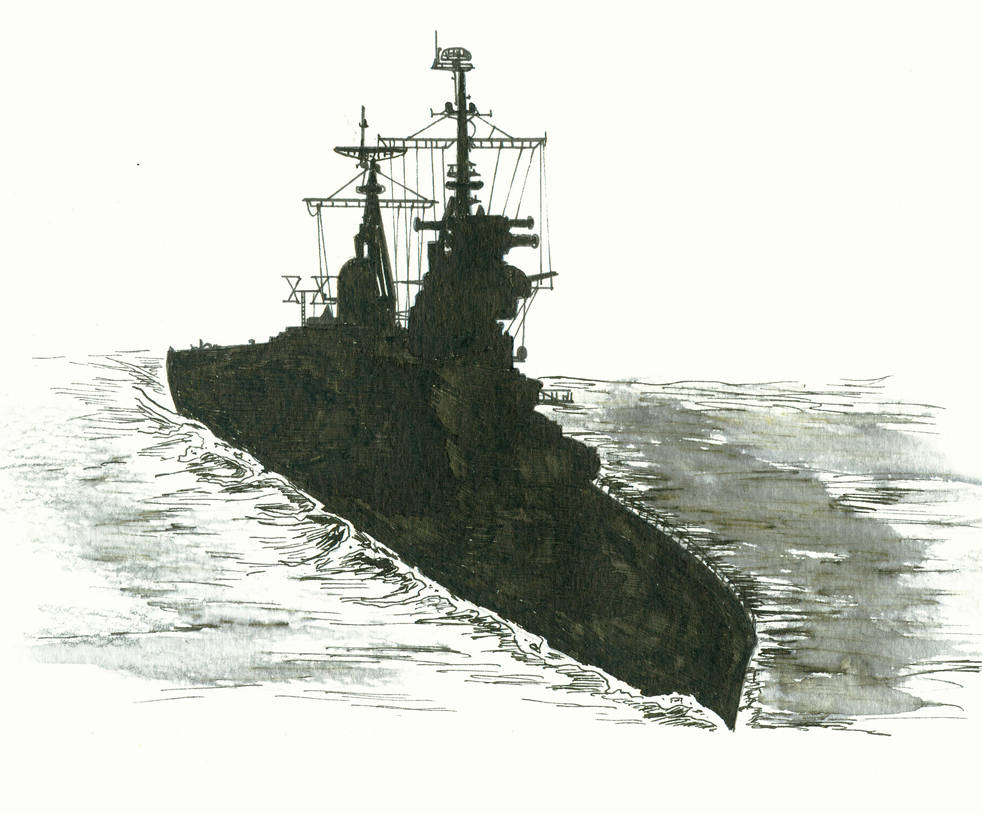
Sverdlov-class cruisers. ©Warshipsresearch.blogspot.com

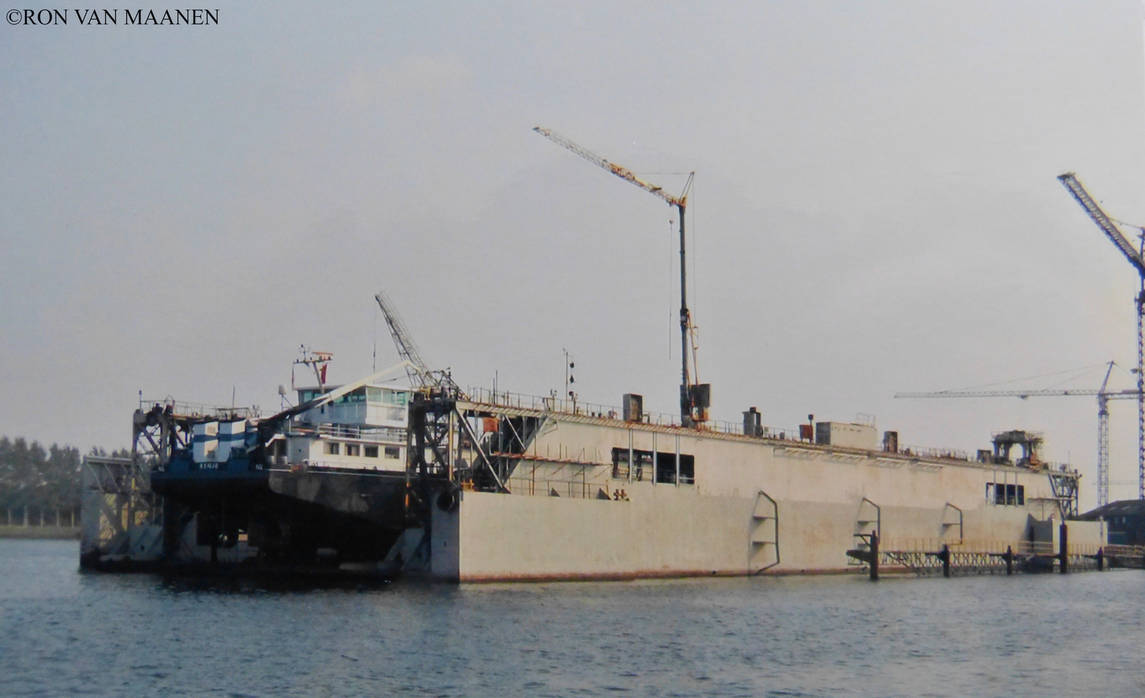
An item reported that two Soviet reinforced concrete floating in four sections were underway from Kherson, Ukraine, Black Sea to what was believed Petropavlovsk, Kamtchatka. Dimensions estatimated to be 700 x 120 feet and should be able to lift Sverdlov-class cruisers. There were already three smaller docks available at Petropavlovsk. The transfer of the two larger docks indicated a possible stationing of those cruisers in the Pacific in 1955 and Petropavlovsk becoming a major naval base.

Source

Website Royal Australian Navy, Sea Power Centre.

Monday, 16 June 2025

Floating dock sunk in the harbour of Nikolaev as reported on 27 July 1943

In his letter dated Nikolaev (Mykolaiv, Ukraine 27 July 1943 reported captain W. Wilstermann Hafeninspekteur des R.K.S. Seetra.Niko. to the Bevollmächtigten für die Deutsche Seeschiffahrt im Schwarzen Meer the ships sunk or run aground in the harbour of Nikolaev. A 30,000 tons dock. A Dutch salvage company was already quite what time busy with salvaging her but it was a really difficult job. The dock was for some time seized by Romania and in the meantime were the pumps, aggregates and hoses disappeared.

Source

Deutsches Historisches Institut Moska. Records 500 findbuch 201253-file 186. 

Monday, 9 June 2025

Reinforced concrete dock in the harbour of Nikolaev as reported on 27 July 1943

In his letter dated Nikolaev (Mykolaiv, Ukraine 27 July 1943 reported captain W. Wilstermann Hafeninspekteur des R.K.S. Seetra.Niko. to the Bevollmächtigten für die Deutsche Seeschiffahrt im Schwarzen Meer the ships sunk or run aground in the harbour of Nikolaev. A reinforced concrete dock not worth to be salvaged while the bottom was destroyed and lacking engines and pumps. Was not an obstacle for marinetraffic.

Source

Deutsches Historisches Institut Moska. Records 500 findbuch 201253-file 186. 

Tuesday, 8 April 2025

USS Dewey YFD-1 floating dry dock in serviceable condition according to the U.S. Joint Intelligence Committee. Daily summary dated 11 January 1942

An item reported that American local naval and marine forces at Mariveles, Philippines were active in the defence of the Bataan Peninsula and Corregidor. The Dewey drydock was in serviceable condition.(1)

Note

1. USS Dewey YFD-1 floating dry dock laid down by Maryland Steel. Co., Sparrow Points, Maryland, USA in begun 1905, launched on 10 June 1905, towed to the Philippines in 1905-1906, scuttled at Mariveles on 8 April 1942, salvaged by the Japanese, towed to the Manila Bay and sunk by American aircraft on 12-13 November 1944.

Source

Map Room Papers (Roosevelt Administration), 1942 - 1945. U.S. Joint Intelligence Committee. Daily summary dated 11 January 1942 No. 32. 

Sunday, 6 April 2025

Brazilian floating dry dock Affonso Penna and battleship São Paulo

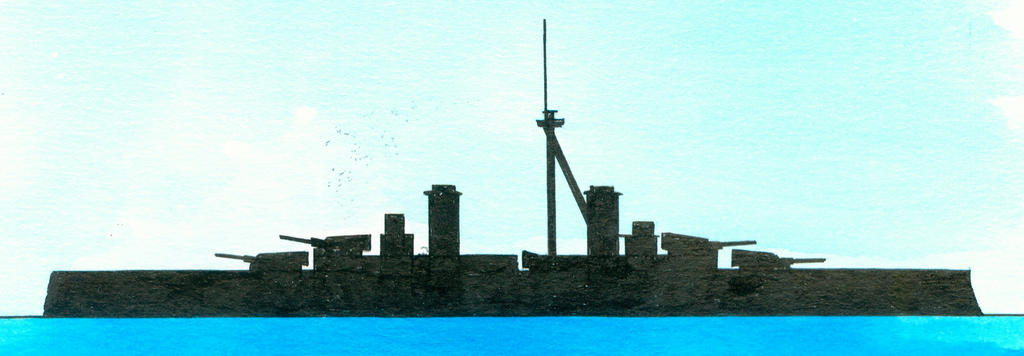
Minas Geraes-class. ©Warshipsresearch.blogspot.com

Bolted sectional floating dry dock, ordered by Ministry of Transport and Public Works, Rio de Janeiro, Brazil, launched by Vickers, Sons&Maxim Ltd., Barrow-in-Furness, England with yard number 400 in June 1910, completed in July 1910 and delivered to the navy, towed by the Dutch tugs Rode Zee and Zwarte Zee, arriving on 29 September 1910 at Rio de Janeiro, sunk off the south west point of Ilha das Enxadas being in poor condition on 19 July 1953 and probably scrapped.

Part of Minas Geraes-class, preceded by Deodoro-class succeeded by Rio de Janeiro (which became the British HMS Agincourt) and planned Riachuelo, laid down by Vickers, Sons&Maxim Ltd., Barrow-in-Furness, England on 30 April 1907, launched on 19 April 1909, commissioned on 12 July 1910, refitted in the USAbetween June 1918-7 January 1920 stricken on 2 August 1946 and lost in a gale underway to the United Kingdom to be broken up on 6 November 1951. 

Friday, 28 March 2025

Large number of Japanese warships gathered at Truk according to the U.S. Joint Intelligence Committee. Daily summary dated 13 January 1942

An item referred to a photographic reconnaissance of Truk pointing out the presence of a floating dock. There were 24 enemy vessels sighted including 1-8” cruiser, 14 destroyers, 4 seaplane carriers, 2 supply ships, 1 hospital ship and possible an aircraft carrier. The New Zealand government feared a Japanese attack on the Fiji Islands from ships concentrated in the eastern Marshalls.

Source

Map Room Papers (Roosevelt Administration), 1942 - 1945. U.S. Joint Intelligence Committee. Daily summary dated 13 January 1942 No. 34 

Monday, 9 September 2024

Russian Black Sea floating dock lying at Sowjetskaja in 1938

A letter of the German naval attache in Japan dated Tokyo, Japan 19 January 1938 reported that the Japanese Admiralty informed him that according to one source the Russian floating dock brought from the Black Sea towards East Asia was lying at Sowjetskaja.

Source

High Command of the Kriegsmarine (OKM). Case 36

Monday, 4 March 2024

British naval floating drydock towed to Alexandria, Egypt in 1939

American Naval Attaché at London, England reported on 24 July 1939 No. 670 that the large British naval dry dock leaving Portsmouth on 24 June towed by three Dutch tugs arrived at Alexandria, in the morning of 20 July and was moored to a specially prepared berth. During the voyage of 6 weeks no accident occured. On board was a crew of 70 dockyard men and men of the towing company..(1)

Note

1. The Dutch newspaper De Avondpost dated 8 July 1939 reported that the involved Dutch tugs were the Zwarte, Witte Zee and Thames of L. Smit&Co,’s Internationale Sleepdienst, Rotterdam, Netherlands,  it was a 31,000 tons dry dock passing Gibraltar on 5 July. The dock was manned by 58 men commanded by the Dutch merchant captain J.C. de Baar. The dock was fitted out with bath rooms, hospital, canteen and even a swimming pool.

Source

National Archives USA. Record Group 38: Records of the Office of the Chief of Naval Operations. Series: Secret Naval Attaches Reports. Estimate of potential military strength (pt.). Summaries. Reports from London, Paris, Brussels, Rome and Berlin. Roll M975-001.

Friday, 16 June 2023

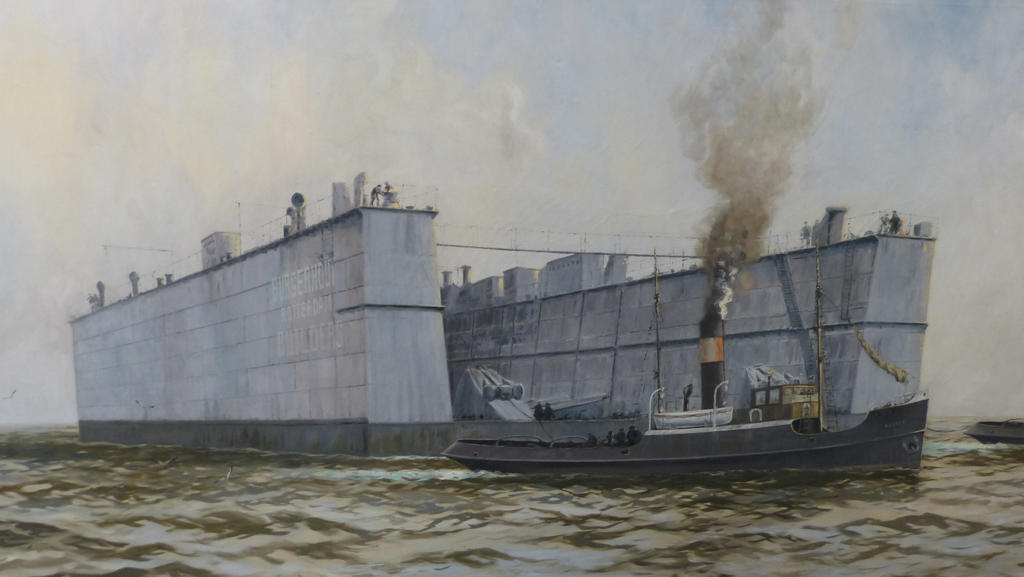
Dutch drydock for the Dutch East Indies built in 1923

Maritiem Museum Rotterdam 22 September 2022

Detail of the Panorama Burgerhout, painted by Adolf Bock (5 August 1890 Berlin, Germany-13 January 1968 Helsingborg, Sweden) in 1928 for account of Burgerhout’s Machinefabriek en Scheepswerf N.V., Rotterdam, Netherlands.

Built by Burgerhout’s Machinefabriek en Scheepswerf N.V., Rotterdam, Netherlands for the Droogdok Maatschappij, Tandjong Priok, Dutch East Indies in 1923.

The Dutch newspaper Het nieuws van den dag voor Nederlandsch-Indië dated 5 December 1921 reported that the 8,000 tons dock was ordered. The edition dated 2 December 1922 reporte the recent launching [Tuesday17 October] of the first part consisting of 4 pontoons of the totally 7. Built in cooperation with the Hamburger Dockbauburö Paul Matthiesen and Max Müller, Hamburg, Germany. The Duth newspaper Scheepvaart dated Monday 12 February 1923 reported the launching on the Saturday before of the second part of the dock stating that it measured 8,000 tons and main dimensions 156.40 (over all) x 29 (maxiim) x 3,20 (height pontoons) x 10 (height side walls) metres. The Dagblad van Noord-Brabant dated 16 November reported a safe arrival at Tandjong Priok after her departure on 11 July from the Waalhaven, Rotterdam towed by the Dutch tugs Humber en Poolzee.

Friday, 1 July 2022

Peru acquired floating dock for submarines according to the Weekly Intelligence Summary No. 20 for the week ending 20 November 1920

An item reported that except for the two small submarines recently purchased by Peru from Italy now also a 1,200 ton floating dock for submarines was acquired.

Source

The National Archives, Kew Gardens, England CAB-24-115-34

Saturday, 14 August 2021

The establishment of the Droogdok Maatschappij Tandjong Priok at the naval base Tandjong Priok, Dutch East Indies on 6 August 1946

In 1946 ordered the Dutch supreme commanding officer in the Far East by order no. 62 to investigate the harbours including shipyards in the Dutch East Indies and Netherlands New Guinea. In those so-called Sitraps (Situation reports) was information collected dealing with the available facilities, personnel and vessels/boats. The Dutch East Indies fell in Japanese hands in the Second World War when the Dutch forces surrendered on 8 March 1942 until Japan surrendered on her turn on 15 August 1945. On 17 August 1945 declared nationalistic leaders like Soekarno and Hadda the independence of what was called the Republic Indonesia. The result was a struggle for years before the Netherlands forced by international pressure accepted the Indonesian independence on 29 December 1949.

An item reported that the Droogdok Maatschappij Tandjong Priok possessed one floating dry dock with as main dimensions 125,30 (over pontoons) x 20,40 (between beams)-21,40 (dock floor) and a lifting capacity of 5.000 tons. After months of repairs and fitting out could the dock be again used for docking of ships. On 6 August 1946 was with success the Dutch landing craft Hr.Ms. LT 101 docked. One 5-tons dock crane was in serve again, the second one was yet not mounted but used on the wharf of the K.P.M. workshops.

There was one side slipway and one slipway on which the ships were pulled up. The side slipway was only used for new building with a maximum length corresponding with 2.000 tons. At the moment however with lacking sleds, gutters and keel blocks would it take a long time even before the dock could be used again.

The slipway on which the ships were pulled had a maximum weight capacity of 2.000 tons. The slip wagon [sled?] had as dimensions 80 x 12 metres/. The steel towing line had to be replaced, a new one was already available. In the meantime was the slipway winch under repair. Afterwards was the slipway again able her maximum capacity.

The buildings of the workshops were in very worse condition and most of the roofs were covered with atap and old iron. A lot of the roof beams and pillars were to be repaired of replaced. Due to the fact that ships lying in the harbour demanded the major part of the repair capacity continued the work at the buildings just slowly. Equipment was after repairs for around 60% again in good condition. The hoist cables of the cranes on the site need to be replaced. Although in acceptable condition was the capacity of the lifting equipment in the workshops limited to 60% partly due to the condition of the buildings. Tools were still after repairs just for about 60% in reasonable condition. There was some improvement in obtaining stores. In the first week of August 1946 were daily around 495 Indonesian and 236 Chinese labourers working, the fact that there were just 90 koolies resulted in quite what stagnation in carrying out the work.

Source

Archive Dutch Marinestaf (1942) 1945-1948 inventory number 197, National Archive, The Hague.

Saturday, 31 July 2021

New British floating docks able to dock largest battleships according to the Dutch magazine Marineblad dated 1909-1910 no. 8

An item reported that one of the two British floating docks approved under the latest budget was to be stationed at Portsmouth, England and the other one on the Medway. Building costs each 200.000 pound sterling and a lifting capacity of 35.000 ton. Were able to dock the largest battleship even if these battleships were damaged. 

Monday, 26 April 2021

Friday, 23 April 2021

Japan starting constructing at Kure of a large floating dock according to the Dutch magazine Marineblad dated 1909-1910 no. 8

An item reported that at Kure, Japan was started with the construction of a third dry dock to be completed in 1911. With a length of almost 200 metres was to be able to dock ships of 30.000 tons

Wednesday, 3 March 2021

Several dry docks (to be) delivered to the British Royal Navy according to the magazine Mitteilungen aus dem Gebiete des Seewesens dated 1913 No. 5

An item reported that the floating dry docks for Portsmouth and the Medway already were delivered. A small floating dry dock for destroyers was berthed at Harwich and a dock for submarines to be stationed at Dover was completed at Sheerness. In the meantime was a floating dry dock for destroyers to be stationed at Portland ordered and to be delivered in next administrative year.

Sunday, 21 February 2021

American workshop floating drydock (machinery) YRD (M) 8 in 1945

Dimensions 150.0 x 34.0 feet.  Built by Puget Sound Bridge&Dredging Co., Seattle, Washington, non-self-propelled.

Source

Bureau of Ship. Navy Department. Ships’ Data US Naval Vessels. Vol III. Auxiliary, district craft and unclassified vessels, 15 April 1945

American workshop floating drydock (machinery) YRD (M) 7 in 1945

Dimensions 150.0 x 34.0 feet.  Built by Puget Sound Bridge&Dredging Co., Seattle, Washington, non-self-propelled.

Source

Bureau of Ship. Navy Department. Ships’ Data US Naval Vessels. Vol III. Auxiliary, district craft and unclassified vessels, 15 April 1945.

American workshop floating drydock (machinery) YRD (M) 6 in 1945

Dimensions 150.0 x 34.0 feet. Built by Puget Sound Bridge&Dredging Co., Seattle, Washington, non-self-propelled.

Source

Bureau of Ship. Navy Department. Ships’ Data US Naval Vessels. Vol III. Auxiliary, district craft and unclassified vessels, 15 April 1945