Translate

Showing posts with label British Guiana. Show all posts

Tuesday, 15 September 2026

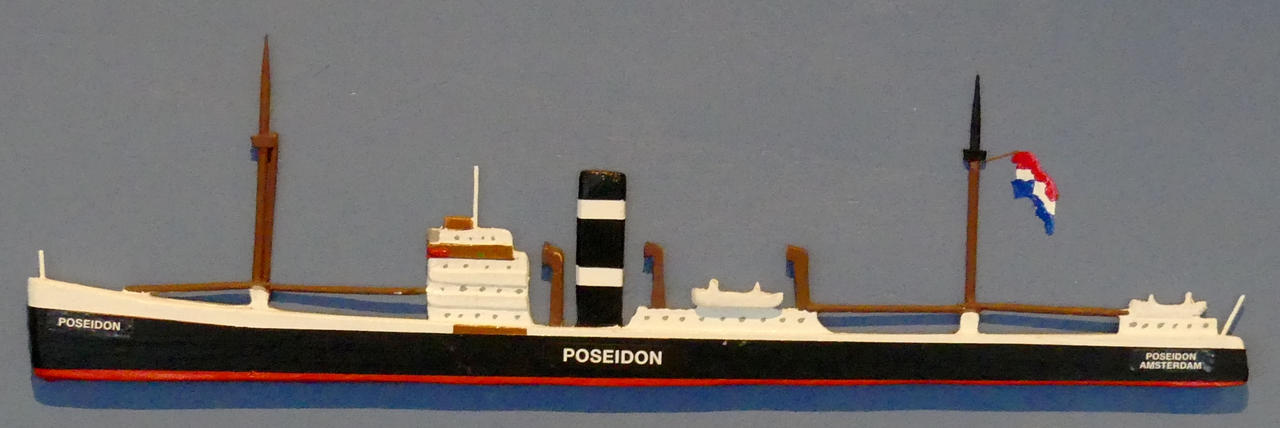
Dutch cargo steam ship Poseidon 1921-1942

Exhibition Varen voor Vrijheid. Museum Katwijk

Launched by Dunlop, Bremner&Co. Ltd., Port Glasgow, Scotland with yard number 341 in 1921, delivered in March 1921 to the Koninklijke Nederlandse Stoomboot-Maatschappij N.V., Amsterdam, Netherlands, left Trinidad on 26 May 1943 underway from Demerara, British Guiana [nowdays Guyana] towards New York, USA and disappeared. Presumably sunk by the German submarine U 55 in the early morning of 28 May 1942 north east of Barbados. 

Sunday, 6 August 2023

British sloop HMS Valerian cruising in the Caribbean according to the Weekly Intelligence Summary No. 19 for the week ending 27 August 1921

Arabis-class©Warshipsresearch.blogspot.com

An item reported that the British sloop HMS Valerian was to visit Dominica on 1 September, Barbados on 8 September, Demerara on 22 September and Trinidad on 6 October.(1)

Note

1. Arabis-class minesweeping sloops preceded by Azalea-class succeeded by Aubrieta-class. Laid down by Charles Rennoldson and Company, South Shields in 1915, launched on 21 February 1916, stationed at Royal Navy Dockyard, Bermuda and lost in the Havana-Bermuda hurricane on 22 October 1926.

Source

The National Archives, Kew Gardens, England CAB-24-127-74

Thursday, 13 October 2022

Enemy submarines sinking bauxite loaded cargo ships according to the U.S. Joint Intelligence Committee. Daily summary dated 6 March 1942

An item reported that since 20 February enemy submarines sunk three bauxite loaded cargo ships coming from the Guianas. (1) The J.I.C. commented that at that moment the Guianas delivered 40% of the bauxite needed or the aluminium-production in the USA.

Note

1. The Co-operative Republic of Guyana (in 1942 still British Guiana), French Guiana and Dutch Guiana or Suriname.

Source

Map Room Papers (Roosevelt Administration), 1942 - 1945. U.S. Joint Intelligence Committee. Daily summary No. 86 dated 6 March 1942.

Saturday, 9 April 2022

At least 36 enemy submarines active according to the U.S. Joint Intelligence Committee. Daily summary dated 13 March 1942

An item reported that the enemy divided her submarine over the next probably positions: 11 at varying distances off the North American Coast between Cape Hatteras and 100 miles east of Newfoundland (which one near Hatteras, two or three are close to the coast between Cape Henry and Nantucket and three to the southward of Cape Race), 3 submarines in the area just covered and the longitude of the Azores, 1 north of the Azores, four are between the longitude of the Azores and the Bay of Biscay, two southeast of Bermuda, seven in the West Indies-Caribbean area (1 north of eastern Cuba, three south of Cuba, 1 near St. Lucia), 1 off British Guiana, around 4 between Iceland and Ireland and 3 off Liberia, totally around 36 submarines.

Source

Map Room Papers (Roosevelt Administration), 1942 - 1945. U.S. Joint Intelligence Committee. Daily summary No. 93 dated 13 March 1942. 

Wednesday, 12 January 2022

British battle cruiser HMS Renown visiting harbours in the Caribbean according to the Weekly Intelligence Summary Nr. 8 dated 28 August 1920


An item reported that after the visit by H.R.H. The Prince of Wales [the later king Edward VIII] to Jamaica was cancelled, changed also the program of the British battle cruiser HMS Renown. She was to depart from Colon, Panama on 14 September, arriving at Grenada on 17 September, the next day at Trinidad, at Demerara, British Guiana [Guyana] on 21 September, Antigua on 24 September, three days later at Bermuda and finally leaving from there on 29 September bound for Portsmouth, England.

Note

1. Of the Renown-class with as sister ship the Repulse. Original laid down as an improved Revenge-class battleships design but when the First World War broke out was her completion delayed and afterwards completed as battle cruisers. Building ordered on 30 December 1914, laid down at Fairfield, Govan, Scotland on 25 January 1915, launched on 4 March 1916, commissioned on 20 September 1915 and sold on 19 March 1948.

Source

The National Archives CAB 24-111-18

Friday, 26 November 2021

British cruiser HMS Cambrian replaced the Weymouth at Demerara according to the Secret Admiralty Weekly Intelligence Summary No. 2 dated 17 July 1920

Weymouth-class

An item reported that the British light cruiser HMS Cambrian (1) replaced the cruiser HMS Weymouth (2)  at Demerara, British Guinea on 11 July, the latter leaving for Colon [Colón, Panama?] the same day.

Notes

1. Of the C-class light cruisers Cambrian sub-class, preceded by Arethusa-class, succeeded by Danae-class, building ordered in September 1914, laid down by HM Dockyard Pembroke on 8 December 1914, launched on 3 March 1916, completed and commissioned in May 1916, finally decommissioned in July 1933 and sold to be broken up on 28 July 1934.

2. Of the Town-class light cruisers Weymouth sub-class, succeeded by Arethusa-class, laid down by Armstrong Whitworth, Elswick, England on 19 January 1910, launched on 18 November 1910, commissioned in October 1911 and sold to be broken up on 2 October 1928.

Source

The National Archives CAB-24-109-68. Secret Admiralty Weekly Intelligence Summary No. 2 dated 17 July 1920

Wednesday, 3 November 2021

British cruiser HMS Calliope became stationship at Demerara, British Guiana according to the Secret Admiralty Weekly Intelligence Summary No. 3 dated 24 July 1920

An item reported that the HMS Calliope (1) replaced the Cambrian (2) at Demerara, British Guiana.

Notes

1. Of the C-class light cruisers Calliope sub-class, preceded by Arethusa-class, succeeded by Danae-class, laid down by Chatham Dockyard on 1 January 1914, launched on 17 December 1914, commissioned in June 1915 and sold to be broken up on 28 August 1931.

2. Of the C-class light cruisers Cambrian sub-class, preceded by Arethusa-class, succeeded by Danae-class, building ordered in September 1914, laid down by HM Dockyard Pembroke on 8 December 1914, launched on 3 March 1916, completed and commissioned in May 1916, finally decommissioned in July 1933 and sold to be broken up on 28 July 1934.

Source

The National Archives CAB-24-109-98. Secret Admiralty Weekly Intelligence Summary No. 3 dated 24 July 1920.

Tuesday, 26 October 2021

British cruiser HMS Calliope to replace HMS Cambrian at Demarara according to the Secret Admiralty Weekly Intelligence Summary No. 2 dated 17 July 1920

HMS Champion sister ship of the Calliope

An item reported that HMS Calliope (1) departed on 15 July from Bermuda to replaced the British light cruiser HMS Cambrian (2) at Demerara, British Guinea.

Notes

1. Of the C-class light cruisers Calliope sub-class, preceded by Arethusa-class, succeeded by Danae-class, laid down by Chatham Dockyard on 1 January 1914, launched on 17 December 1914, commissioned in June 1915 and sold to be broken up on 28 August 1931.

2. Of the C-class light cruisers Cambrian sub-class, preceded by Arethusa-class, succeeded by Danae-class, building ordered in September 1914, laid down by HM Dockyard Pembroke on 8 December 1914, launched on 3 March 1916, completed and commissioned in May 1916, finally decommissioned in July 1933 and sold to be broken up on 28 July 1934.

Sunday, 29 August 2021

British warships sent to Demerara to support local government according to the Secret Admiralty Weekly Intelligence Summary No. 1 dated 10 July 1920

HMS Weymouth

An item reported that the British HMS Weymouth (1) was sent to Demerara where she was expected on 8th July to be replaced by HMS Cambrian (2) 3 days later. Due to serious disturbance threatening requested the Governor of British Guinea for the assistance of a warship.(3)

Notes

1. Of the Town-2nd class or light cruisers, Weymouth sub-class consisting of the Weymouth, Dartmouth, Falmouth and Yarmouth, succeeded by the Arethusa-class. Building ordered under the 1909-1910 Programme. Laid down at Armstrong Whitworth, England with yard number 827 on 19 January 1910, launched on 18 November 1910, commissioned in October 1911 and sold to Hughes Bolckow, Blyth, England be broken up on 2 October 1928.

2. Of the C-class light cruisers Cambrian sub-class, preceded by Arethusa-class, succeeded by Danae-class, building ordered in September 1914, laid down by HM Dockyard Pembroke on 8 December 1914, launched on 3 March 1916, completed and commissioned in May 1916, finally decommissioned in July 1933 and sold to be broken up on 28 July 1934.

3. The Dutch newspaper Suriname dated 16 July 1920 reported a strike by personnel of the Demerara Foundry Ltd., Sprostins Foundry Co, and Electric Company at Georgetown.

Source

The National Archives CAB-24-109-33. Secret Admiralty Weekly Intelligence Summary No. 1 dated 10 July 1920

Friday, 18 June 2021

American cruiser USS Detroit (C10) ordered to go as fast as possible to Venezuela according to the Dutch newspaper De grondwet dated 12 September 1899

An item reported that the American cruiser USS Detroit (1) lying in the harbour of Philadelphia, USA received ordered to depart immediately towards La Guayara, Venezuela probably as the message reporting riots in the Venezuelan interior.(2)

Notes

1. C-10. Part of the Monthomery-class unprotected cruisers, preciedd by Cincinnati-class and succeeded by Columbia-class. Building authorized under an Act of Congress dated 7 September 1882, launched by Columbian Iron Works, Baltimore, Maryland, USA on 28 October 1891, commissioned on 20 July 1893, decommissioned on 1 August 1905, stricken on 12 July 1910 and sold to be broken up on 22 December 1910. With a displacement of 2.128 (standard)-2.271 (full load) tons and as dimensions 269.6 x 37 x 14.7 feet (mean)or 82.14 x 11 x 4.45 metres. The 2 vertical triple expansion reciprocating steam engines supplied 5.400 ihp via 2 screws allowng a speed of 17 knots. Furthermore was she schooner-rigged. Her armour consisted of a 1.1 cm/7/18” thick deck with the conning tower protected by 5.1cm/2” armour. The armament consisted of 2x1 15.2cm.6” 40 cal guns, 8x1-12.7cm/5” cal 40 guns, 6x1-5.2cm/2.2”/6 pd guns, 2x1-3.7cm/1.5” guns, 2 Gatling guns and 3-45cm/18” torpedo tubes.

2. Probably caused by the Venezuelan crisis of 1895, when the United Kingdom claimed the Venezuelan territories Essequibo and Guayana Esequiba as part of British Guiana [nowadays Guyana]. 

Monday, 21 December 2020

The enemy submarines on the Atlantic Ocean according to the U.S. Joint Intelligence Committee daily summary dated 1 May 1942

An item reported that the number of enemy submarines active in the Atlantic Ocean west of the longitude of the Azores was estimated to number 24 units by 30 April. One of the two enemy submarines seemed to leave her position off the Brazilian coast for a new position of the coast of British Guiana.

Source

Map Room Papers (Roosevelt Administration), 1942 - 1945. U.S. Joint Intelligence Committee. Daily summary No. 142 dated 1 May 1942

Monday, 6 April 2020

Dutch frigate ship Pauline arrived at Middelburg, Netherlands coming from Demerara according to the Dutch newspaper Middelburgsche Courant dated 27 October 1831

An item dated Middelburg, Netherlands the 25th reported the arrival the same day of the Dutch frigate ship Pauline captain L.M. Hoffmann coming from Demerara with a cargo of sugar and coffee.

Saturday, 22 February 2020

Russian 3-mast schooner Lembit arrived at Vlissingen, Netherlands coming from British Guyana according to the Dutch newspaper Vlissingse Courant dated 4 September 1912

An item dated Vlissingen, Netherlands 4th reported the arrival that morning of the Russian 3-mast schooner Lembit captain Krankle coming from New Amsterdam, British Guyana loaded with greenheart bound for the Dutch firm N.V. Houthandel voorheen G. Albertsz Lzn.&Co., Middelburg, Netherlands.

Monday, 16 December 2019

Dutch frigate ship Pauline departed Middelburg, Netherlands towards Demerara according to the Dutch newspaper Middelburgsche Courant dated 31 July 1832

An item dated Middelburg, Netherlands the 30th reported the departure on the 28th of the Dutch frigate ship Pauline captain L.M. Hoffmann towards Demerara.

Wednesday, 7 August 2019

Dutch frigate Pauline arrived at Demarara coming from Middelburg. Netherlands according to the Dutch newspaper Middelburgsche Courant dated 6 November 1832

An item dated Middelburg, Netherland the 5th reported the arrival on 5 September of the Dutch frigate ship Pauline captain L.M. Hoffmann at Demerara coming from Middelburg.

Tuesday, 4 June 2019

Dutch bark Jean Baptiste underway from Grangemouth, Scotland towards Demeraire according to the Dutch newspaper Middelburgsche Courant dated 21 September 1887

An item reported that that the Dutch bark ship Jean Baptiste (1) of De Groof&Co., Vlissingen, Netherlands underway from Grangemouth, Scotland arrived on the 17th August at Demeraire, British Guiana [nowadays Guyana] with a cargo of coal.

Note
1. Lijst van de Nederlandsche Oorlogs- en koopvaardijschepen met hunne onderscheidingsseinen uit het Internationaal Seinboek ten dienste van alle Natiën. Rotterdam, 1892. Callsign PFKH. Net tonnage 891 tonnen, 2.254,60 cubic metres or 795,90 tons of 2,83 cubic metres.

Monday, 1 October 2018

British tug Purpleheart 1952->1987


United Kingdom-flagged and IMO 5287483. Built by Messrs. Sprostons Limited, Georgetown, British Guiana for account of the British Guiana Timber Limited in 1952. Register number 315446. Dimensions 67.2-70.9 x 17.6 feet, gross register tonnage 100-101 tons and net register tonnage 42 tons. Machinery consisted of 1 270bhp 4tew 6 cylinder Lister-Blackstone diesel and a Lister auxiliary engine. Speed 10 knots. 

Monday, 27 October 2014

British convoy underway from Portsmouth, England towards Cork, Ireland according to the Dutch newspaper Opregte Haarlemsche Courant dated 18 December 1813

An item reported that on the 9th the British ship of the line HMS Leviathan (1), sloops Talbot (2) and Echo (3) and the gun brig Protector (4) left Portsmouth, England towards Cork, Ireland escorting a fleet of ships. Among the latter ships were the Adeona captain Wilson and the Canada captain Crawleij both bound for Demerara.(5)

Notes
1. 3rd Rate Leviathan, launched at Chatham dockyard, England on 9 October 1790, convict ship in 1816, target in 1846, sold in 1848 and with an armament of 74 guns.
2. Sloop, launched at the shipyard of Heath, Teignmouth, England on 22 July 1807, sold on 23 November 1815, with an armament of 18 guns.
3. Brig sloop, Cruizer-class, launched at the shipyard of Pelham, Frindsbury England on 1 July 1809, broken up in 1817, with an armament of 18 guns.
4. Gun brig, launched at the shipyard of Warren, Brightlingsea, England on 1 February 1805, survey vessel in 1817, sold to be broken up in 1833 and an armament of 12 guns.
5. Since 1815 was Demerara part of the British colony British Guiana nowadays Guyana. Until 1815 a Dutch colony.

Saturday, 20 September 2014

Brazilian sloop Primeiro de Março departed Surinam towards Demerara according to the Dutch newspaper De West-Indiër dated 30 November 1892

An item reported the departure from Paramaribo, Surinam on the 29th of the Brazilian corvette Primeiro de Março (1) captain lieutenant José Ramos da Fonseca towards Demerara.(1)

Notes
1. Sloop, built at the Rio Janeiro Dockyard in 1881, converted ingo a training ship 1904.
2. British Guiana nowadays Guyana.

Sunday, 13 April 2014

Dutch frigate ship Pauline departed Middelburg, Netherlands towards Demerara according to the Dutch newspaper Middelburgsche Courant dated 15 November 1834

An item dated Middelburg, Netherlands the 14th reported the departure on the 13th of the Dutch frigate ship Pauline captain L.M. Hoffman towards Demerara.