Type ship. Master D. Robertson. Tonnage 353 tons. Built at Scarborough? in 1800. Owner Kincaid M.Kinzie. Port where registered Leith.
Source
List of the shipping registered in the different ports of Scotland. Glasgow, 1821.

Type ship. Master D. Robertson. Tonnage 353 tons. Built at Scarborough? in 1800. Owner Kincaid M.Kinzie. Port where registered Leith.
Source
List of the shipping registered in the different ports of Scotland. Glasgow, 1821.
Type Brig. Master R. Bruce? Tonnage 235 tons. Built at Peterhead in 1817. Owner R. Skelton&Co. Port where registered Aberdeen.
Source
List of the shipping registered in the different ports of Scotland. Glasgow, 1821.
Between July-September 1882 was the United Kingdom in war with Egyptian and Sudanese troops ending in the British occupation of Egypt. The British government chartered between July-August a lot of merchant steamships for transporting troops, stores etc. from the United Kingdom to Egypt including the Rewa.
Source
The Nautical Magazine. Fifty-first year. Volume VII. July 1882.
The expedition carried out by the British Empire against the Ethiopian Empire or Abyssinia found place between 4 December 1867-13 May 1868. Purpose was to rescue imprisoned missionaries and government representatives and to punish the Ethiopian Empire. For that purpose was a large military force sent transported with a large number of merchant ships chartered in England and at Bombay.
Number transport B.1. Register tonnage 487 tons. Tonnage engine room 163 42/100 tons. Gross tonnage 650 42/100 tons. Horsepower 120 hp. Screw. Alled speed 9.5 knots Coal. Number of day’s coal that can be stowed in bunkers 14. Alleged consumption per diem tons: 18. Built of iron. Rates per ton per month if discharged at home 2:16:0. Number of months for which engaged 6. Day of entrance into pay 1-9-1867. Extra payment, if any, made on discharge none. Accommodation for officers:10. Accommodation non-commissioned officers and men 234 natives. Remarks 13-5-1868 in Annesley Bay, arrived on 3 March from Suez, Egypt with mails, having also on board 1 officer, 4 horses and 750 tons of water pipes, barley etc. Discharged at Bombay on 22 August 1868.
Master W. Deacon. Tonnage 650 tons. Dimensions 200.0 x 28.0 x 16.2 feet. Built at Glasgow, Scotland in July 1863, owners British India, S.N.C. Lim. and homeport Glasgow.
Sources
Trevenen, major J. and captain Henry M. Hozier. Record of the Expedition to Abyssinia compiled by order of the secretary of state for war, vol. I, 1870.
Lloyd’s Register 1868.
Antarctic sealing ground Crozet Islands. Rigging brig. Captain Bailey, tonnage 99 tons, sailed from Mystic, Connecticut in June 1838 and arrived at home on 8 April 1839 with 100 barrels sea-elephant oil.
Source
Goode, George Brown. The fisheries and fishery industries of the United States. Section V. History and methods of the fisheries. Volume II, Washington, 1887.
Antarctic sealing ground south seas. Rigging ship. Captain Holmes, tonnage 298 tons, sailed from Mystic, Connecticut on 11 July 1838 for the South Seas and arrived at home on 5 September 1839 with 1,300 barrels of sea-elephant oil. Tender was schooner Plutarch of 81 tons, captain Stevens. Departed on 1 December 1839, captain McKinstry and wrecked on New Holland on 8 JUly 1840.
Source
Goode, George Brown. The fisheries and fishery industries of the United States. Section V. History and methods of the fisheries. Volume II, Washington, 1887.
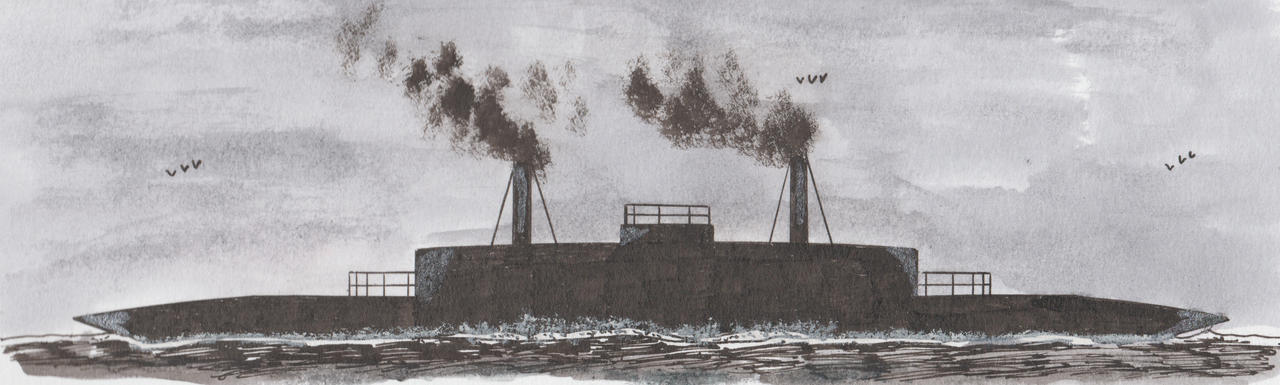
©Warshipsresearch.blogspot.com
In the magazine The Artizan dated 1 July 1868 was a plate with figures and a small note published dealing with several designs for a ‘circular warship’ proposed by John Elder. He believed that such a ship with a widened beam could have a thicker and heavier armour and heavy guns compared with a ship of the common design and at the other hand a shallower draught and with a somewhat increased horsepower a comparable speed. The same year he read his paper Circular Ships of War, with immersed motive power for the United Service Institute in London, England. He executed experiments with his own construction and the common construction principles [the latter of a modern ironclad] including in all sorts of weather. It resulted in a draught around one-half of the draught of a common vessel allowing it to act in waters yet unaccessible. The power of rotation made it possible to act as a floating revolting turret or as a ram [like a gigantic circular saw).Diameter about 200 feet.
John Elder was a Scottish shipbuilder and marine engineer (8 March 1824 Glasgow, Scotland-17 September 1869 London, England). He worked for Randolph, Elder&Co., Glasgow, Scotland which became in 1886 the well known Fairfield Shipbuilding and Engineering Company.
The Russian rear admiral Andrei Alexandrovich Popov designed in 1869 the Charodeika-class monitor-class for the defence of the Dniepr-Bug Estuary and Kerch Strait. Popov used Elder’s ideas but by further widening the beam created a real circular ship and instead of a convex hull his design was flat-bottomed for a minimum draught. The armament was however not heavy enough and after several new designs was a design with a displacement of 6,151 tons, a diameter of 46.0 metres/151 feet and 4-27.9cm/11” guns approved. With too high building costs estimated was the design scaled down ending in the Novgorod laid down in 1871 with a displacement of 2,531 tons, a diameter of 30.8 metres/101 feet and 2-27.9cm/11” rifled muzzle guns.
Between July-September 1882 was the United Kingdom in war with Egyptian and Sudanese troops ending in the British occupation of Egypt. The British government chartered between July-August a lot of merchant steamships for transporting troops, stores etc. from the United Kingdom to Egypt including the Verona.
Source
The Nautical Magazine. Fifty-first year. Volume VII. July 1882.
In 1856 broke the Second Opium War out as a result of western powers trying to force the Chinese Qing dynasty to open the frontiers for foreign trade and to obtain more influence. A treaty signed in 1858 was to end the war and give the western powers more or less what they wanted. A combined British-America-French effort to pass the Taku forts and go on to Pei-ho (nowadays Hai River) failed and France and the United Kingdom decided to sent out a combined expedition with the first French ships leaving France on 5 December 1859. A joint ultimatum of both countries dated 8 March 1860 was refused on 8 April 1860 followed by fighting. To transport their troops and stores France and especially England hired several merchant ships. Not found back in Lloyds Register 1860.
Source
Léopold Pallu de La Barrière. Expédition de Chine en 1860. Paris, Imprimerie Impériale, 1863, p. 15.
Antarctic sealing ground. Rigging ship. Captain Smith, tonnage 492 tons, sailed from New London to Desolation Island on 25 July 1838 and arrived at home on 1 May 1839 with 3,700 barrels of sea-elephant oil.
Source
Goode, George Brown. The fisheries and fishery industries of the United States. Section V. History and methods of the fisheries. Volume II, Washington, 1887.
Antarctic sealing ground southern seas. Rigging schooner. Arrived in 1838 at Stonington with 3,000 fur-seal skins.
Source
Goode, George Brown. The fisheries and fishery industries of the United States. Section V. History and methods of the fisheries. Volume II, Washington, 1887.
All steamships employed by the British government as transports carried the Naval Reserve flag with a yellow anchor in the fly. They were numbered consecutively with their numbers painted on each bow and quarter. Steamships prepared in India for the Egyptian campaign had red figures on a white ground, the ones at England black figures on a white ground.
Source
Wadhams, U.S.N. lieutenant Albion V. "Transports. Egyptian campaign", Proceedings of the United States Naval Institute, volume VIII No. 4, p. 615. Annapolis, 1882.
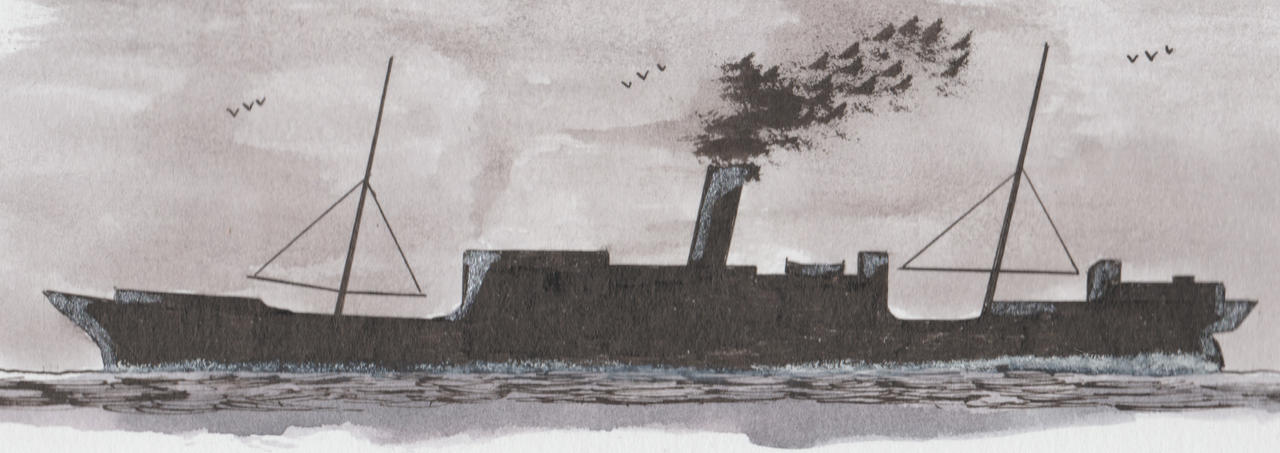
©Warshipsresearch.blogspot.com
As ss Eastern operated by the Eastern&Australian Steamship Co., London, England. Call sign JBDB. Owner in 1939 Harada Kisen K.K. Homeport Kobe, Japan. Built by R. Napier&Sons Ld., Glasgow, Scotland in April 1899 and sunk by American carrier aircraft on 18 October 1944 off Luzon/Camiguin, Philippines. Gross tonnage 3,589 tons, under deck 2,958 tons, net tonnage 2,272 tons, deadweight 4,284 tons and as dimensions 352.0 x 42.2 x 19.8 x 14.6 (light)-24 (loaded) feet. Reciprocating propulsion, one screw, coal bunker capacity 1,117 tons, horsepower 469nhp, range 6,000 nautical miles/11 knots and speed 11 (normal cruising)-14 (maximum) knots.

Scientific American Supplement dated 1 December 1888
Ordered by the Russian emperor Alexander III on 20 May 1888, launched at the Baltic Shipyard on 19 May 1890, commissioned in March 1891, during the First World War lying at Petrograd before she in begun June 1917 was transferred to Helsingfors {Helsinki, Finland] , laid up in reserve in 1920, converted into a floating submarine base in the early 1930s, commissioned on 20 August 1936, reconverted into a floating ship in 1954, target ship for testing anti ship missiles in 1961 and the same year sunk in the Gulf of Riga when struck by a missile. Could be broken up in early 1970s.

Scientific American Supplement 8 December 1888
Laid down by Chatham Dockyard on 11 11 April 1884, launched on 27 October 1885, commissioned in May 1888 and sunk as target on 18 February 1908. Part of Part of Conqueror-class.
Antarctic sealing ground southern seas. Rigging schooner. Tonnage 81 tons. Of Stonington. Made 2 sealing voyages in 1835 and 1837 and came back with 3,500 fur-seal skins.
Source
Goode, George Brown. The fisheries and fishery industries of the United States. Section V. History and methods of the fisheries. Volume II, Washington, 1887.
Antarctic sealing ground southern seas. Rigging schooner. Arrived at Stonington in 1837 with 1,500 fur-seal skins.
Source
Goode, George Brown. The fisheries and fishery industries of the United States. Section V. History and methods of the fisheries. Volume II, Washington, 1887.

Scientific American Supplement dated 14 July 1888
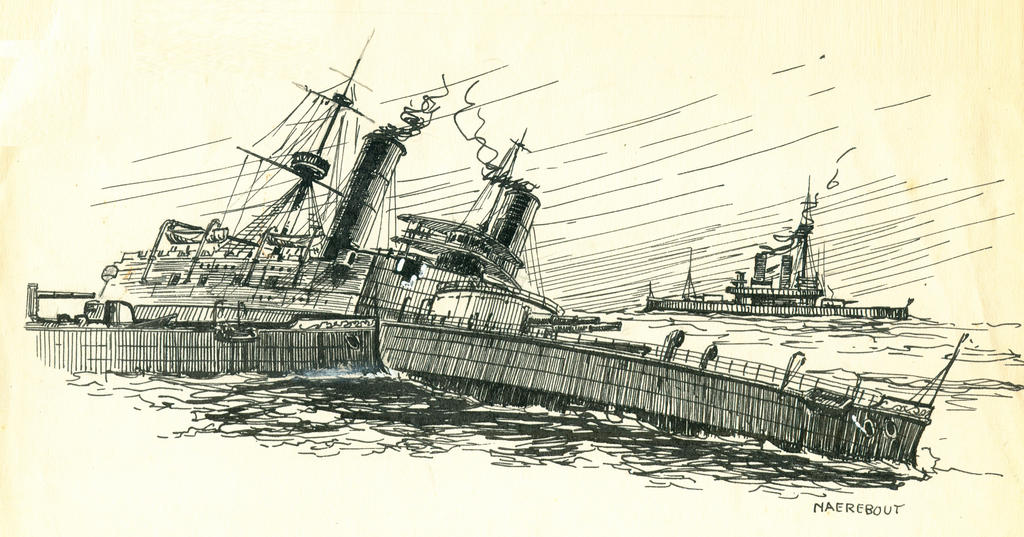
Victoria in sinking condition ©G.J. Frans Naerebout
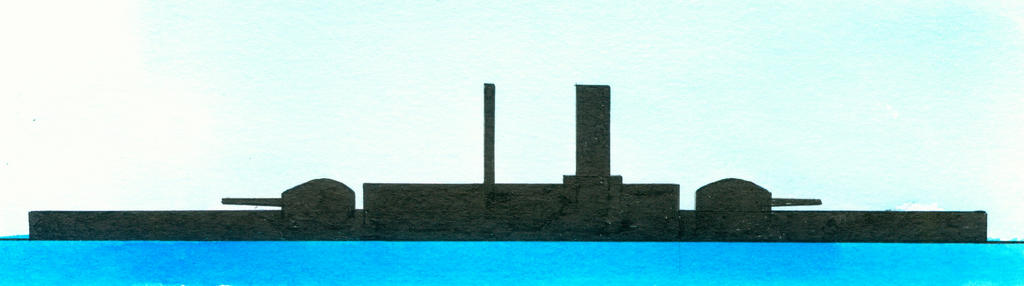
Trafalgar-class©Warshipsresearch.blogspot.com
Part of Victoria-class consisting of the Victoria and Sans Pareil, preceded by Admiral-class succeeded by Trafalgar-class. Improved HMS Conqueror-design and originally known as the new Conquerors. Nicknamed the Slipper and together serving with her sister ship the pair of slippers. Laid down with yard number 490 by Armstrong, Mitchell&Co., Elswick, England on 13 June 1885, launched on 9 April 1887, commissioned in March 1890 and sunk in a collision with the HMS Camperdown in the Mediterranean on 22 June 1893.

Scientific American Supplement Volume XXV 14 April 1888
The illustration showed the preparations on board of the HMS Edinburgh to defend herself with machine guns and Martin-Henry rifles against an attacking torpedo boat.The Edinburgh was described as “the most powerful vessel now afloat of the British Navy” and in November 1887 commissioned for service in the Mediterranean under the command of captain Henry St Leger Bury Palliser (1839-1907).
Part of Colossus-class ironclads preceded by Ajax-class succeeded by Admiral-class. Ex-Majestic but renamed Edinburg on 16 March 1882. Laid down by Pembroke Dockyard, England on 20 March 1879, launched on 18 March 1882, completed on 8 July 1887, coast guard ship since 1894, converted into a target ship in 1908 and sold to be broken up by Thos W. Ward in 1910.
Between July-September 1882 was the United Kingdom in war with Egyptian and Sudanese troops ending in the British occupation of Egypt. The British government chartered between July-August a lot of merchant steamships for transporting troops, stores etc. from the United Kingdom to Egypt including the Atlantic.
Source
The Nautical Magazine. Fifty-first year. Volume VII. July 1882.

