Translate

Showing posts with label 3rd rate. Show all posts

Thursday, 27 August 2026

Boys of Clyde training Cumberland visiting British frigate HMS Aurora in 1876

Drawing by Captain Grier. The Illustrated London News dated 13 May 1876

For the Boys of the Cumberland (1) was 1 May a holiday and they were invited by Mr. John Burns of Castle Wemyss (2) and Captain Grant of (3) the HMS Aurora (4) to visit her. With the steam tug Wild Huntsman were they at noon transported to Greenock. A select party invited by Burns came also on board. There was a gun drill held, directed by Grant folowed by other exercises.

Notes

1. Former 3rd rate of 70 guns. Laid down by Chatham Dockyard in April 1836, launched on 21 October 1842, handed over to the The Clyde Industrial Training Ship Association and became a training ship for destitute and homeless boys from Glasgow, Scotland in 1869 and burned on 17 February 1889.

2. John Burnes, 1st Baron Inverclyde (24 June 1829 Glasgow, Scotland-12 February 1901, Castle Wemyss, Scotland). Shipowner. Advocated a good coastal defence and proposed that the government should use merchant ships for war purposes. Partner in the Cunard Steamship Company. He participated in the setting up of a training ship which became the Cumberland.

3. Henry Duncan Grant 12 October 1834-November 1896), rose to the rank of admiral. During his voyages Grant made a lot of sketches and drawings between 1866-1900 which are kept by Archives at Yale

4. Wood-built screw steam frigate HMS Aurora launched by Pembroke Dockyard, England on 22 June 1861, commanded since 12 July 1875 by Grant, paid off on 19 June 1877 and broken up at Devonport, England in December 1881. 

Sunday, 6 April 2025

British 70 guns 3rd rate HMS Berwick 1747-1760

Model was used to instruct Prince William Henry who became later King William IV. The establishment design of the HMS Berwick was proposed in 1733, ordered on 5 December 1740, launched at Deptford Dockyard on 13 June 1743 and broken up at Chatham Dockyard, England in 1760. 

Saturday, 30 December 2023

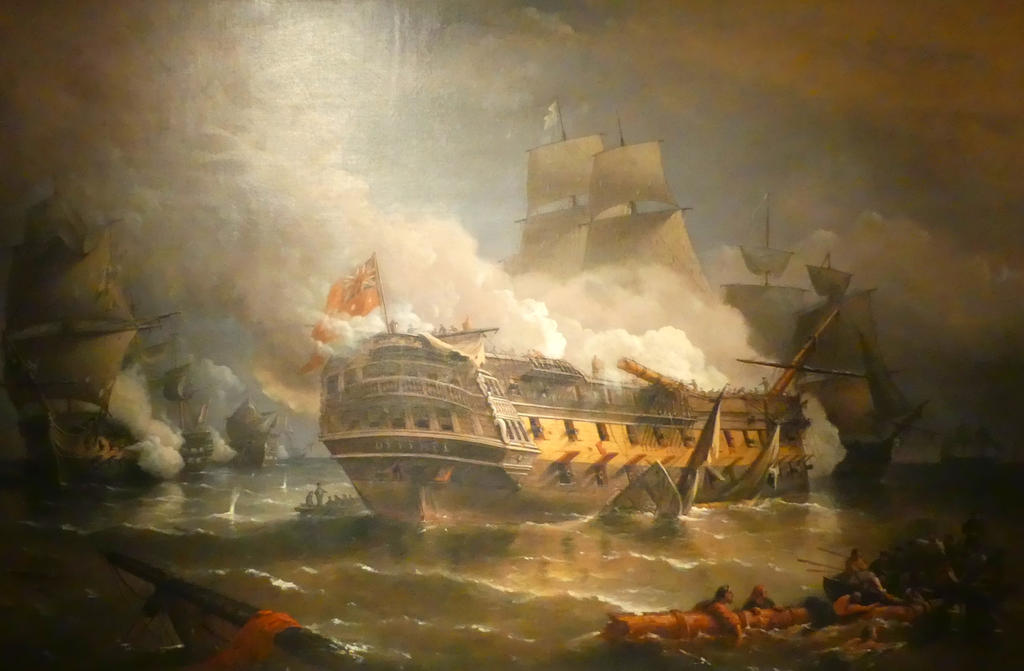
British 3rd rate HMS Defence at the end of the battle in 1794

Maritime Museum Hamburg, Germany

Richard Brydges Beechey (1808-1895). Oil on canvas. Building ordered on 15 December 1758, launched by Israel Pownoll, Plymouth Dockyard, England on 31 March1763, badly damaged during the Glorious First of June 1794 battle and wrecked on 24 December 1811. 

Saturday, 5 September 2020

American whaler Cammillus arrived at St. Helena according to the The Cape of Good Hope Gazette dated Friday 22 April 1836

An item reported the arrival at the island of St. Helena on 23 March of the American whaler Cammillus master E.D. Topping returning from a whaling cruise bound for Sag Harbour, USA.

American whaler Neptune arrived at St. Helena according to The Cape of Good Hope Gazette dated Friday 22 April 1836

An item reported the arrival at the island of St. Helena on 21 March of the American whaler Neptune master E. Sayre returning from a whaling cruise bound for Sag Harbour, USA.

American whaler Ontario arrived at St. Helena according to the The Cape of Good Hope Gazette dated Friday 22 April 1836

An item reported the arrival at the island of St. Helena on 1 March of the American whaler Ontario master J. Parker returning from a whaling cruise bound for Sag Harbour, USA.

Friday, 14 June 2019

British squadron visited Grenada according to the Dutch newspaper De Curacaosche courant dated 18 July 1829

An item reported the arrival at St. George’s Granada on the day before of a British squadron entering the bay around 09.00 o’clock. It were the flagship of vice admiral Fleeming HMS Barham (1) sir John Louis, HMS Shannon (2) captain Clement, HMS Grasshopper (3) captain Dear and the Arachne (4) captain Smith, coming from Trinidad.

Notes
1. Former 3rd rate launched at the shipyard of Perry, Wells&Green, Blackwall, England on 8 July 1811, reduced to a 50-gun ship in December 1826, broken up in September 1840, original armament of 74 guns and a builders measurement of 1.761 tons. The edition dated 18 May 1844 mentioned that the British razeed ship of the line HMS Barham was repaired at the shipyard of H. van der Meulen&Co. on Curacao, Dutch West Indies without supplying the year, but probably in 1829 after she run aground at Bonaire, Dutch West Indies.
2. 5th Rate, launched at the shipyard of Brindley, Frindsbury, England 5 May 1806, receiving ship 1832, renamed Saint Lawrence 11 March 1844, broken up at Chatham, England 1859,with an armament of 38 guns.
3. Grasshopper, brig-sloop, of the Cruizer-class, launched at the Portsmouth Dockyard, England on 17 May 1813, sold in 1832, with an armament of 18 guns.
4. Brig sloop of the Cruizer-class, launched at the shipyard of Hills, Sandwich, England on 18 February 1809, sold in 1837 and with an armament of 18 guns.

Sunday, 8 October 2017

Swedish 3rd rate Vastervik 1628-1648

Built in 1628, last mentioned in 1648, tonnage of 160 last, an armament of 24-32 guns with a crew numbering 60-132 men.

Sources
Sveriges krig 1611-1632. Stockholm, 1937, bilagsband 1.
Sevenska flottan skeppslista 1645-1684. 

Friday, 17 February 2017

British 3rd rate HMS Cornwallis underway from the British Indies towards Ceylon according to the Dutch newspaper Java Government Gazette dated 23 March 1816

An item reported the departure from Bombay, British Indies on 27 December 1815 of the British HMS Cornwallis commodore R. O’Brien towards Ceylon. (1)

Note
1. Of the Venguer-class 3rd rate ships of the line, building ordered on 25 July 1810, laid down by Jamsetjee Bomanjee Wadia at the Bombay Dockyard, British Indies in 1812, launched on 12 May 1813. converted into a jetty on 1875, renamed Wildfire in 1916 and broken up in 1957. 

Sunday, 20 December 2015

French destroyer Somali (1917) in 1923

Launched at Kawasaki, Japan in 1917, completed in 1917, displacement 675 tons, horsepower 10.000 hp, coal-fired reciprocating machinery and an armament of 1-4.7” gun, 4-12pd guns and 4 torpedo tubes.(1)

Source
Archive Dutch Naval Staff 1886-1942 (National Archive at the Hague, Netherlands)  inventory number 155. Fleets (the British Empire and foreign countries) on 1 February 1923.

Note
1. Brassey‘s naval and shipping annual 1923. Dimensions 272 x 24 x 7.10 Feet. Maximum trial speed 29 knots. The tubes were twins.

Tuesday, 30 December 2014

Dutch 3rd charter Veluwe 1688-1705

Of the admiralty Maze, built by Jan Salomonsz van den Tempel at the naval yard at Rotterdam, Netherlands in 1688, with storm damaged sold to be broken up at Portsmouth, England in 1705, dimensions (Amsterdam foot) 153 x 40 1/3 x 15½, an armament of 64-68 guns and a crew numbering 325-405 men. Commanding officers 1690 captain Matthias de la Cave and part of the fleet commanded by Ph. van Almonde, in 1691-1692 C. van Brakel, voyage to the North Sea and Channel, in 1694-1695 M. Paradijs, voyage to Mediterranean, in 1696 J. van Convent, voyage to Channel and Spanish and Portuguese coasts as part of the squadron commanded by G. Evertsen, in 1700-1701 C. van Brakel voyages to Skagerrak and Sont, Channel and the Azores, in 1700 part of the fleet commanded by Ph. van Almonde which sailed into the Sont and bombarded Copenhagen, Denmark, in 1702 part of the fast sailing squadron of the Dutch British fleet, captain Wassenaer Starrenburg and in 1704 convoy duties.

Monday, 29 December 2014

Spanish ship Lena underway from Philippines towards Spain according to the Dutch newspaper Java-bode dated 26 January 1870

An item dated 22nd reported the passing of the Sunda Strait by the Spanish ship Lena underway from Manila, Philippines towards Cadiz, Spain.

Thursday, 27 November 2014

British ship of the line HMS Canada captured Spanish frigate Leocadia according to the Dutch newspaper Hollandsche historische courant dated 16 June 1781

An item dated London, England 8th referred to a letter written by sir George Collier commanding officer of the British 74-gun ship of the line HMS Canada (1) dated Cork, Ireland 25th May reporting that on the 1st the Spanish frigate Leocadia armed with 34  but pierced for 40 guns armed a battle of 30 minutes was captured. The Spanish captain lost his right arm. The frigate brought into Cork was the only coppered Spanish warship.

Note
1. Her building was ordered on 1 December 1759m launched at the Woolwich Dockyard on 17 September 1765, prison ship 1810 and finally broken up in 1834.

Monday, 27 October 2014

British convoy underway from Portsmouth, England towards Cork, Ireland according to the Dutch newspaper Opregte Haarlemsche Courant dated 18 December 1813

An item reported that on the 9th the British ship of the line HMS Leviathan (1), sloops Talbot (2) and Echo (3) and the gun brig Protector (4) left Portsmouth, England towards Cork, Ireland escorting a fleet of ships. Among the latter ships were the Adeona captain Wilson and the Canada captain Crawleij both bound for Demerara.(5)

Notes
1. 3rd Rate Leviathan, launched at Chatham dockyard, England on 9 October 1790, convict ship in 1816, target in 1846, sold in 1848 and with an armament of 74 guns.
2. Sloop, launched at the shipyard of Heath, Teignmouth, England on 22 July 1807, sold on 23 November 1815, with an armament of 18 guns.
3. Brig sloop, Cruizer-class, launched at the shipyard of Pelham, Frindsbury England on 1 July 1809, broken up in 1817, with an armament of 18 guns.
4. Gun brig, launched at the shipyard of Warren, Brightlingsea, England on 1 February 1805, survey vessel in 1817, sold to be broken up in 1833 and an armament of 12 guns.
5. Since 1815 was Demerara part of the British colony British Guiana nowadays Guyana. Until 1815 a Dutch colony.

Saturday, 6 September 2014

British frigate HMS Barham visited Willemstad, Curacao according to the Dutch newspaper De Curacaosche courant dated 31 October 1829

An item reported the arrival at Willemstad, Curacao of the British frigate HMS Barham captain Sir John Luis flagship of vice admiral C. Fleeming coming from la Guayra, Venezuela.(1)

Note
1. 3rd Rate launched at the shipyard of Perry, Wells&Green, Blackwall, England on 8 July 1811, reduced to a 50-gun ship in December 1826, broken up in September 1840, original armament of 74 guns and a builders measurement of 1.761 tons. The edition dated 18 May 1844 mentioned that the British razeed ship of the line HMS Barham was repaired at the shipyard of H. van der Meulen&Co. on Curacao, Dutch West Indies without supplying the year, but probably in 1829 after she run aground at Bonaire, Dutch West Indies.

British frigate HMS Barham visited Willemstad, Curacao according to the Dutch newspaper De Curacaosche courant dated 12 December 1829

An item reported the arrival at Willemstad, Curacao in Tuesday 8th of the British frigate Barham captain Sir John Louis, flagship of vice admiral Fleeming coming from Puerto Cabello. Left on Thursday towards Jamaica.(1)

Note
1. 3rd Rate launched at the shipyard of Perry, Wells&Green, Blackwall, England on 8 July 1811, reduced to a 50-gun ship in December 1826, broken up in September 1840, original armament of 74 guns and a builders measurement of 1.761 tons. The edition dated 18 May 1844 mentioned that the British razeed ship of the line HMS Barham was repaired at the shipyard of H. van der Meulen&Co. on Curacao, Dutch West Indies without supplying the year, but probably in 1829 after she run aground at Bonaire, Dutch West Indies.

Thursday, 4 September 2014

British 3rd rate HMS Wellesley arrived at Point de Galle, Ceylon according to the Dutch newspaper Java Government Gazette dated 23 March 1816

An item reported the arrival at Point de Galle, Ceylon on 8 December 1815 of the British HMS Wellesley commanded by J. Bayley coming from Trincomalee.(1)

Note
1. 3rd Rate, building ordered on 3 September 1812, laid down at the Bombay Dockyard, British Indies in May 1813, launched on 24 February 1815, guard ship 1854, renamed as training ship Cornwall in 1868, sunk during a German air attack 20 September1940, salvaged in 1948, broken up, dimensions 145’11½“ (keel)-175’10 ¾”(over all) x 47’5” z 21 (hold). a 1745 75/94 tons builders measurement and an armament of 74 guns.

Monday, 1 September 2014

Tenders asked for supplying British frigate HMS Barham at Curacao according to the Dutch newspaper De Curacaosche courant dated 9 May 1829

An announcement dated Curacao the 9th asked for tenders for the daily delivery of around 420 pound fresh beef of the best quality, around 550 pounds fresh bread and around 450 pound sea biscuit son behalf of the British frigate HMS Barham.(1)

Note
1. 3rd Rate launched at the shipyard of Perry, Wells&Green, Blackwall, England on 8 July 1811, reduced to a 50-gun ship in December 1826, broken up in September 1840, original armament of 74 guns and a builders measurement of 1.761 tons. The edition dated 18 May 1844 mentioned that the British razeed ship of the line HMS Barham was repaired at the shipyard of H. van der Meulen&Co. on Curacao, Dutch West Indies without supplying the year, but probably in 1829 after she run aground at Bonaire, Dutch West Indies.

Thursday, 28 August 2014

British frigate HMS Barham visited Willemstad, Curacao according to the Dutch newspaper De Curacaosche courant dated 26 September 1829

An item reported the departure from Willemstad, Curacao on last Wednesday by the British ship of the line HMS Barham captain Sir John Louis flagship or vice admiral Fleeming to cruise although she was expected to return.(1)

Note
1. Former 3rd rate launched at the shipyard of Perry, Wells&Green, Blackwall, England on 8 July 1811, reduced to a 50-gun ship in December 1826, broken up in September 1840, original armament of 74 guns and a builders measurement of 1.761 tons. The edition dated 18 May 1844 mentioned that the British razeed ship of the line HMS Barham was repaired at the shipyard of H. van der Meulen&Co. on Curacao, Dutch West Indies without supplying the year, but probably in 1829 after she run aground at Bonaire, Dutch West Indies.

Nobody interested in salvaging guns and anchors of British ship of the line HMS Barham according to the Dutch newspaper De Curacaosche courant dated 27 June 1829

In an announcement referred the commanding officer of the British ship of the line HMS Barham on the 26th to the fact that apparently nobody was interested in a contract to salvage the guns and anchors of the Barham dropped into sea off the Oostpunt of Bonaire. He now asked if anyone would lease a vessel fitted out with sails, anchors and so on daily basis. The necessary hoists and other equipment necessary for hoisting guns and anchors out of the water and the labourers were supplied by the Barham. The insurance costs and rent were paid by the British government. Tenders were within 8 days awaited by the skipper Cole.(1)

Note
1. Former 3rd rate launched at the shipyard of Perry, Wells&Green, Blackwall, England on 8 July 1811, reduced to a 50-gun ship in December 1826, broken up in September 1840, original armament of 74 guns and a builders measurement of 1.761 tons. The edition dated 18 May 1844 mentioned that the British razeed ship of the line HMS Barham was repaired at the shipyard of H. van der Meulen&Co. on Curacao, Dutch West Indies without supplying the year, but probably in 1829 after she run aground at Bonaire, Dutch West Indies.