Translate

Showing posts with label Russia. Show all posts

Monday, 3 August 2026

Assembly in Russia of German built submarines in 1925

In a report dated Riga, Latvia 31 May 1925 No. 4694 was referred to report 4511 (2503-176) dealing with German built submarines and assembled in Russia and to be added to the Black Sea Fleet. This could partially be confirmed using a reliable source. It were six submarines which was fairly well established although several reports claimed a number of 8 which was doubtful. Identification numbers of the submarines while under construction of the ways were reported as O.O. 2-6 plus one more which was unnumbered. It was unclear if the boats were assembled at Kronstadt or at the Putiloff works. Two more were reported named Panter and Tigr (ex-Kommissar and Kommunar) with a speed of 10/15 knots but this could no be confirmed.

Source

National Archive. Record Group 165: Records of the War Department General and Special Staffs Series: Security Classified Correspondence and Reports. File Unit. Russia: Navy - MID 2503-16 THRU 2503-265. Roll 1443.

Saturday, 18 April 2026

Russian protected cruiser Oleg 1902-1919

Askold. ©Warshipsresearch.blogspot.com

Bogatyr-class. ©Warshipsresearch.blogspot.com

Part of the Bogatyr-class cruiser of which were 5 planned but 4 completed preceded by Askold succeeded by Novik. Laid down by Admiralty Shipyard, Saint Petersburg, Russia on 6 July 1902, launched on 14 August 1903, commissioned on 24 June 1904, torpedoed and sunk by the British speedboat CMB-4 at Kronstadt, Russia on 17 June 1919, partly salvaged in 1919 and 1933 and her last remains salvaged and broken up in 1938. 

Wednesday, 20 August 2025

Russian intellligence ship RFS (ex-Pelengator SSV231 1987-2000) Vasily Tatichev 2000-

Passing Helsingborg 19 August 2025

Facebook group Under Broen

Part of Vishnua- or Meridian-class (Project 864) preceded by Balzam-class succeeded by Yury Ivanov-class. Launched with yard number 864/6 by Remontowa Shipbuilding SA, Gdansk, Poland on 27 November 1987,, commissioned on 23 July 1988 and renamed on 31 January 2000.

Monday, 18 August 2025

The Russian Amu Daria Flotilla described in 1892

On the river Amu Daria is a flotilla (1) active consisting of the two large steamships Czar and Czaritsa and further more barges, boats and so on. The boats used everywhere were called kaiyuks and towed upstream by men or horses. There were several hundred of kaiyks which were all Khivan owned, flat-bottomed with as dimensions 35-50 length and 2-4 feet depth and could transport 1,000 poods [pounds?] cargo and 150 men. Every summer Kazalinsk was visited by around hundred boats coming from the river Oxus loaded with grain, fruit, timnber and from the Aral Sea limestone. The town Petro-Alexandrofsk in the Amu Daria section of the Syr Daria Province is a terminal station of the Amu Daria flotilla.

Note

1. Sometimes referred to as Oxus-flotilla which is the ancient name for the river Amu Darya in Central Adia flowing through Tajikistan, Turkmenistan, Uzbekistan and Afghanistan.

Source

Journal of the United Service Institution of India, vol. XXI, January 1892, no. 89 p. 224 and 254. 

Thursday, 24 July 2025

The Russian Amu Daria Flotilla described by G.N. Curzon in 1889

Curzon wrote that the Oxus flotilla had not been able to realize a good connection between Tcharjui and Kerki or Bosaga due to river navugation problems and that was chosen for a railway. The flotilla consisted of 5 vessels inluding the paddle steam ships Czar and Zaritsa of 165 tons, dimensions 150 x 23 x 2.5 (loaden) feet, horsepower of 500 hp and speed 16 miles in smooth water. The first one was launched in September 1887, costs 14,000l. Both ships with a crew of 30 men were able to transport 300 men and 20 officers. At hte moment was one active between Amu Daria and Petro Alexandrovsk just above Khiva and the other one upstream to Kerki.(1) In his reading ‘The Transcaspian Railway’ on 11 March 1889 said Curzon that the flotilla was partially constructed at Tcharjui.(1)

Note

1. The Amu Daria Flotilla was sometimes referred to as Oxus-flotilla which is the ancient name for the river Amu Darya in Central Asia flowing through Tajikistan, Turkmenistan, Uzbekistan and Afghanistan.

Sources

George N. Curzon. Russia in Central Africa in 1889 and the Anglo-Russian Question. London, 1889, p. 148-149 and 264.

Proceedings of the Royal Geographical Society and monthly record of geography. Volume 11, p. 290. 

Tuesday, 8 July 2025

Soviet Volga River-Caspian Sea Flotilla in 1919

An item reported that the Volga River-Caspian Sea Flotilla possessed in 1919 over 150 guns of various calibers and over 130 machine guns.

Source

S.A. Tyushkevich. The Soviet Armed Forces: A History of Their Organizational Development. A Soviet View. Moscow, 1978. 

Soviet Volkhov River-Lake Il’men Flotilla in 1919

An item reported that the Volkhov River-Lake Il’men Flotilla numbered 200 men on 1 April 1919 existed just for a short period.

Source

S.A. Tyushkevich. The Soviet Armed Forces: A History of Their Organizational Development. A Soviet View. Moscow, 1978. 

Tuesday, 2 July 2024

Japanese battleships Mishima and Mikaza underway towards Nikolajew according to the Dutch newspaper Bataviaasch nieuwsblad dated 27 April 1920


Russian Admiral Senyavin. Warshipsresearch.blogpost.com

An item dated Tokyo, Japan 24th reported that the Japanese battleships Mishimu (1) and Mikaza (2) escorted a military expedition towards Nikolajew to protect the there living Japanese. In the meantime were the Japanese at Noord Aghalien [North Sakhalin] taken on board without any resistance. The expedition was just to be protective and not to be aggressive according to the Japanese government.

Notes

1. Part of Russian Admiral Ushakov-class coastal defence ships preceded by Gangut, laid down as Admiral Senyavin by Baltic Works, St. Petersburg, Russia on 2 August 1982, launched on 22 August 1894, commissioned in 1896, stricken on 28 May 1905, captured by Japan, commissioned as 2nd class coastal degence vessel Mishima on 6 June 1905, stricken on 10 October 1935 and sunk as target on 5 May 1936.

2. Preceded by Asahi succeeded by Katori-class, building ordered on 26 September 1898, laid down by Vickers, Sons&Maxim, Baroow-in-Furness, England on 24 January 1899,  launched on 8 November 1900, commissioned on 1 March 1902 and stricken on 20 September 1923. Still existing as memorial ship. 

Sunday, 16 June 2024

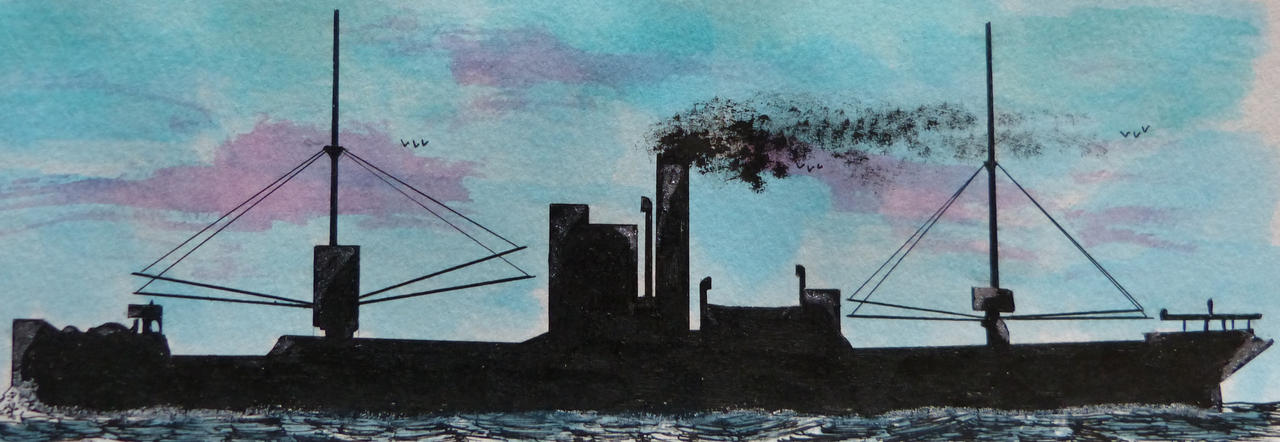
Russian cargo ship (ex-Messina 1921-1935) Ternei 1935-

Warshipsresearch.blogspot.com

Call sign UPIQ. Homeport Vladivostok. Built by F. Schichau, Danzig, Germnay in 1921. Gross tonnage 1,470 tons, under deck 1,270 tons, net tonnage 825 tons and as dimensions 253.7 x 38.2 x 16.6 18 (loaded) feet. Normal cruising speed 8 knots. Original remark that the profile was based on old information and considered to be not accurate. The profile is improved by me using a wartime photograph. 

Tuesday, 4 June 2024

Russian convoy to leave on short notice for the USA as reported in August 1942

American naval attaché at Moscow, Russia reported in August 1942 that according to Russian officials a convoy of several Russian ships was to depart on short notice via the Northern Passage to the USA.

Source

National Archives USA. Record Group 38: Records of the Office of the Chief of Naval Operations. Series: Secret Naval Attaches Reports. Estimate of potential military strength (pt.). Summaries. Reports from London, Paris, Brussels, Rome and Berlin. Roll M975-001.

Tuesday, 30 April 2024

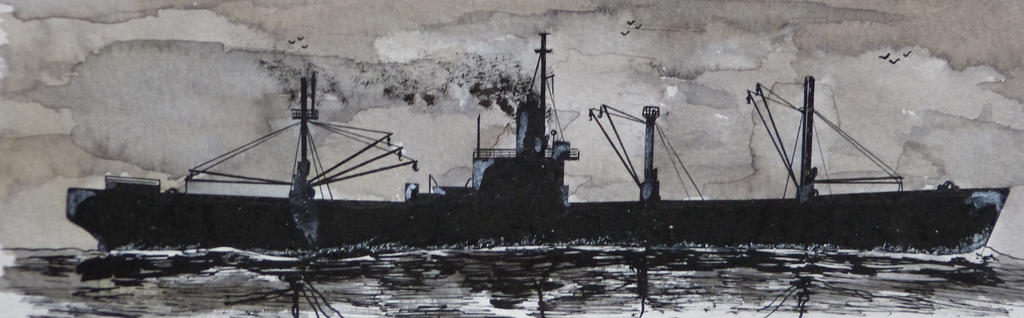
Russian merchant ship ss Emelian Fugachev active in the Pacific on 1 July 1944

Warshipsresearch.blogspot.com

A report from Op-16-FT, Washington, USA dated 1 July 1944 serial FT-49-44 described all Soviet merchant ships active in the Pacific. On 15 June 1944 were 207 Russian merchant ships with a total gross tonnage of 891,591 tons active in transpacific and coastal waters.This number included for instance 36 Liberty ships. 70% or 627,649 gross tons participated in regular transpacific traffic destinated for Siberian harbors and 95 vessels or 264.942 gross tons in the coastal waters. The 207 vessels excluded 7 icebreakers.

Gross tonnage 7,176 tons. Type freighter. Built in 1943. Speed 12 knots. Fuel oil. International call sign UUMJ. Service transpacific. Remarks EC-2 lend-lease. Ex-Louis Agassiz.

Source

Map Room Papers (Roosevelt Administration), 1942 - 1945. MR450(7) Sec 2 Location of Russian Ships, 1942-1945

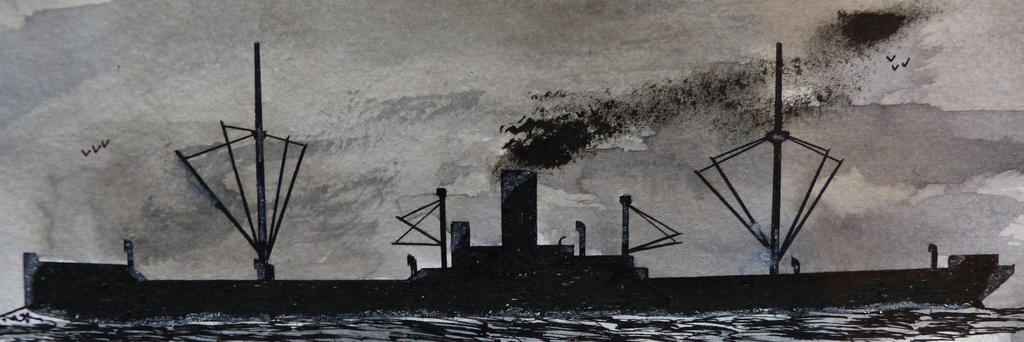
Russian merchant ship ss Emba active in the Pacific on 1 July 1944

A report from Op-16-FT, Washington, USA dated 1 July 1944 serial FT-49-44 described all Soviet merchant ships active in the Pacific. On 15 June 1944 were 207 Russian merchant ships with a total gross tonnage of 891,591 tons active in transpacific and coastal waters.This number included for instance 36 Liberty ships. 70% or 627,649 gross tons participated in regular transpacific traffic destinated for Siberian harbors and 95 vessels or 264.942 gross tons in the coastal waters. The 207 vessels excluded 7 icebreakers.

Gross tonnage10,195 tons. Type tanker. Built in 1944. Speed 15 knots. Fuel oil. International call sign UOUS. Service transpacific. Remarks lend-lease.

Source

Map Room Papers (Roosevelt Administration), 1942 - 1945. MR450(7) Sec 2 Location of Russian Ships, 1942-1945

Sunday, 31 March 2024

Japanese passenger-cargo ship Melbourne Maru 1929-1945

Call sign JIFC. Laid down by Yokohama Dock Co. Ld., Yokohama, Japan on 12 June 1929, launched on 15 December 1929, completed on 28 March 1930, requisitioned by the army as troop transport AA No. 911 on 25 December 1941 and destroyed in a Russian air attack ar Rajin, Chosen (nowadays Rashon, North Korea) on 9 August 1945. Gross tonnage 5,423 tons, under deck 4,955 tons, net tonnage 3,219 tons and as dimensions 380.0 x54.5 x 34.2 x 9 (light)-24 (loaded) feet. Diesel propulsion, 489 nhp, 846 tons bunker oil capacity, range 22,000 nautical miles/13.5 knots. Speed 13.5 (normal cruising)-6 (maximum) knots. 

Saturday, 16 March 2024

Russian fish carrier Pamyat Ilicha 1989-

Off South Korea 16 March 2024

Russia-flagged, IMO 8811675, MMSI 273211110 and call sign UFYW. Built by Nordic Yards Wismar, Wismar, Germany in 1988. Owner Baltmed Reefer Services, Athens, Greece and manager Olympia, Kaliningrad, Russia. 

Thursday, 14 March 2024

The strength of the Russian Northern Fleet in September 1942

American naval attaché at Moscow, Russia reported in September 1942 that according to information given by Russian official to the Astalusna, Moscow the Northern Fleet consisted of 16 submarines, 6 destroyers, 5 motor torpedo boats, 64 minesweepers, 20 small patrol vessels, 2 minelayers and 24 auxiliary patrol vessels of 200-400 tons. “Alusna was told by the Soviets that the above data was give to no other nation. Alusna asked that this information be kept in strict secrecy.”

Source

National Archives USA. Record Group 38: Records of the Office of the Chief of Naval Operations. Series: Secret Naval Attaches Reports. Estimate of potential military strength (pt.). Summaries. Reports from London, Paris, Brussels, Rome and Berlin. Roll M975-001.

Friday, 5 January 2024

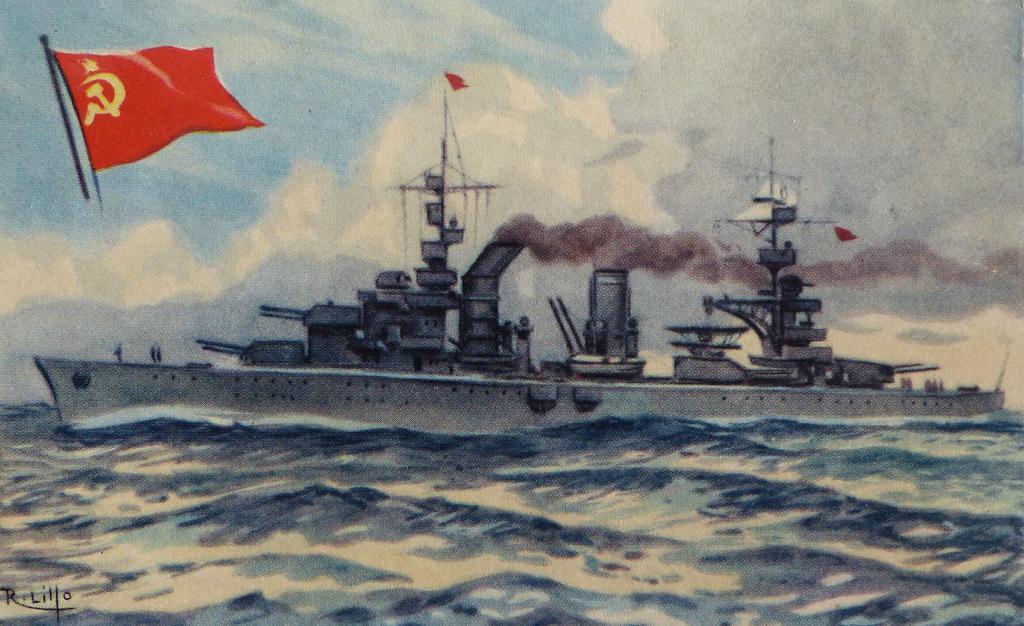
Russian Baltic Fleet in November 1941

Original postcard Chocolate La Estrella
Named Petrovlovsk 1909-1921, Marat 1921-1943, Petropavlovsk 1943-1950 and Volkhov 1950-1953

Oktyabrskaya Revolyutsiya  as Gangut

Maxim Gorki

Kirov

American naval attaché at Moscow, Russia reported in November 1941 that the Russian Baltic Fleet consisted of 2 battleships [Oktyabrskaya Revolyutsiya and Marat), 2 heavy (?) cruisers (Kirov and Maxim Gorki), 4 Destroyer Leaders, 20 new,2 old and 3 mall destroyers, 1 mine layer, 23 minesweepers, 30 motor torpedo boats, 5 submarine tenders, submarines: Tujhosrep (?) class 3, King 13, Oil 3, Love 1, Dog 29, Shch 30, Mike 3 and 2 former Estonian. Lost 4 old destroyers.

Source

National Archives USA. Record Group 38: Records of the Office of the Chief of Naval Operations. Series: Secret Naval Attaches Reports. Èstimate of potential military strength (pt.). Summaries. Reports from London, Paris, Brussels, Rome and Berlin. Roll M975-001.

Monday, 25 December 2023

Moral of Russian defenders of Sevastopol very high in 1941

Gangut-class battleship Parizhskaya Kommuna was very active during the siege. Original appearance

American naval attaché at Moscow, Russia reported in December 1941 referring to a British observer with the Russian Black Sea Fleet that the morale of the Russian defenders of Sevastopol was very high and he expected that the city was hold.

Note

1. Siege of Sevastopol by German forces between 30 October 1941-29 June 1942 when Sevastopol fell. On 4 July 1942 was Cherson captured and the Crimea controlled by the Germans.

Source

National Archives USA. Record Group 38: Records of the Office of the Chief of Naval Operations. Series: Secret Naval Attaches Reports. Estimate of potential military strength (pt.). Summaries. Reports from London, Paris, Brussels, Rome and Berlin. Roll M975-001.

Sunday, 24 December 2023

Russian Gibbs&Cox hybrid battleship design “C” dated July 1938

Aircraft carrier-battleship design able to take 24 planes and 4 floatplanes with her for which she was fitted out with 2 catapults. Displacement 46,520 (standard)-55,200 (normal) tons and as dimensions 820 (waterline)-845 (over all)-115 (waterline)-118 (maximum) x 33.4 (normal) feet. Lenght flight deck 320 feet. Propulsion consisted of  4 sets geared turbines and 8 boilers with a total horsepower of 200,000 ship allowing a maximum speed of 31 knots and a range of respectively 2,900 nautical miles/31 knots, 12,000/20 and 16,000/15. Armament consisted of 10-40.46cm/16” (2x3 fore, 1x4 aft), 10x2-12.7cm/5” guns and an unknown number of 2.79cm/1.1” guns and machine guns. Never realized. 

Thursday, 21 December 2023

Panamanian reefer (ex-Nedfreezer 1983-1992, Medemsand 1992-2009) Gabu Reefer 2009-


Puerto de Las Palmas de Gran Canaria, Islas Canarias, Spain 14 December 2023

Cameroon-flagged, IMO 8300949, MMSI 613590000 and call sign TJMC996. Cameroonian registered, but owned by a Panamanian shell company, established to hide a beneficial ownership, which is possibly Russian. It is specialised in the transport of frozen small pelagic fish, mainly transhipped from fishing vessels in Guinea-Bissau. As Nedfreezer Netherlands-flagged, owner Rederij m.s. “Nedfreezer”, as Medemsand Panama-flagged, owner International Legend Sa, since 2009 as Gabu Reefer owner Fishing&Cargo Services SA, 2009-2018 Comores-flagged, homeport Moroni, MMSI 616852000 and call sign D6FJ2since then Cameroon. Keel laid down on 10 February 1983, launched on 1 July 1983 and completed on 15 November 1983 by Jonker & Stans, Hendrik-Ido-Ambacht, Netherlands. The forepart was built by H.H.Bodewes, Millingen, Netherlands.

Wednesday, 20 December 2023

Italian battleship Giulio Cesare 1910-1948 and Russian training ship Novorossiysk 1949-1956 (1957)

Dante Alighieri

Conte di Cavour-class

Andrea Doria-class

French Courbet-class

Laid down at the shipyard of Gio. Ansaldo&C., Genoa, Italy on 24 June 1910, launched on 15 October a year later, completed on 14 May 1914, commissioned on 7 June was she decommissioned on 18 May 1928. Between 1933 and 1937 modernized/rebuilt was she again commissioned on 3 June 1937, since early 1942 training ship, decommissioned on 15 December 1948 and handed over to the Soviet navy on 4 February 1949. Renamed and used as a training ship until she sunk on 29 October 1955 due to a (German) mine explosion. Stricken on 24 February 1956, salvaged on 4 May 1957 and broken up. Part of Conte di Cavour-class preceded by Dante Alighieri succeeded by Andrea Doria-class. Designed by rear admiral Edoardo Masdea as an answer on the French Courbet-class. Original general characteristics displacement 23,458 (standard)-25,489 (deep load) tons and as dimensions 176 (over all) x 28 x 9.3 metres or 577.5 x 91.01 x 30.6 feet. Steam turbine propulsion with 4 turbines and 20 water tube boilers allowing a speed of 21.5 knots. Crew numbered 1,000 men. Armament 3x2&2x2-30.5cm/12” guns, 18x1-12cm/4.7” guns, 14x1-7.62cm/3” guns and 3-45cm/17.7” torpedo tubes. Armour consisted of a waterline belt thick 25cm/9.8”-13cm/5.1”, a deck thick 2.4cm/0.9”-4cm/1.6”, with the turrets, barbettes and coning towers protected by respectively 28cm/11.0”-24cm/9.4”, 23cm/9.1”-13cm/5.1” and 28cm/11.0”-18cm/7.1”.