
©Warshipsresearch.blogspot.com
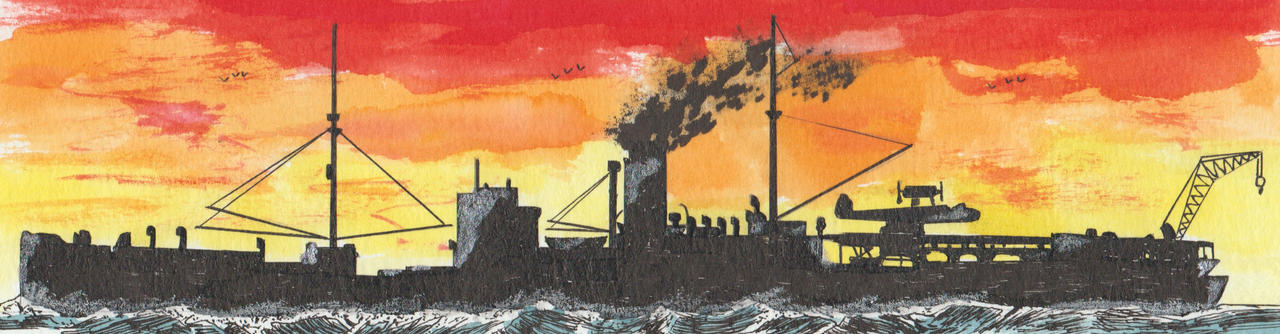
In mid thirties possessed the German airline Lufthansa four mother ships from which planes were catapulted for the mail service between Europe (Azores) and the United States (New York). Two of the four ships were especially built for the Lufthansa. (1) Launched at the Deutsche Werke AG, Kiel, Germany 14 March 1925 as the freighter Schwarzenfels for account if the DDG Hansa and handed over to the company 16 July of the same year. Her dimensions were 148,8 x 18,4 x 8,49 metres and a measurement of 7,894 BRT. The 6-cylinder diesel engine supplied 3,600 hp allowing a speed of 12 knots with her two screws. As a freighter numbered her crew 45 men and was there accommodation available for maximum 10 passengers. Her sister ships were the Braunfels, Rotenfels, Altenfels, Neuenfels and Weissenfels. She was bought by the Lufthansa 28 February 1934 and fitted out at Bremen with a Heinkel K-7 catapult. Returning planes landed on the water surface and were with a 12 tons crane of Kampfnagel taken back on board again. She was rebuilt in 1939 again to be used on the German Antarctic Expedition 1939-1939 to search for a suitable whaler station. Her hull was strengthened considered the ice and she was fitted out with an auxiliary diesel. Her launching platform was shortened and strengthened. When the Second World War broke out she was seized by the German Luftwaffe 12 October 1939 to serve as a catapult ship for night flyers. Torpedoed by the British submarine HMS Terrapin on 24 March 1944 was she beached in the Flekkefjord and in May-June 1944 temporarily refloated and transported to Bergen where she was again damaged due to a British air attack 4 October of the same year. She was not complete repaired but since February 1945 used as a store ship for the Marineausrüstungstselle (M.A.S.T.) in the Oslofjord. After the war she was taken by the British Royal Navy and since January 1946 used as an accommodation ship at Sandvika, Oslofjord and finally loaded with 1.400 tons of poison, gas and ammunition scuttled in the Skagerrrak. Call signs as the Schwarzenfels first QMBH and later DOFW and as the Schwabenland DOFW.


