Translate

Showing posts with label Civil War. Show all posts

Saturday, 25 July 2026

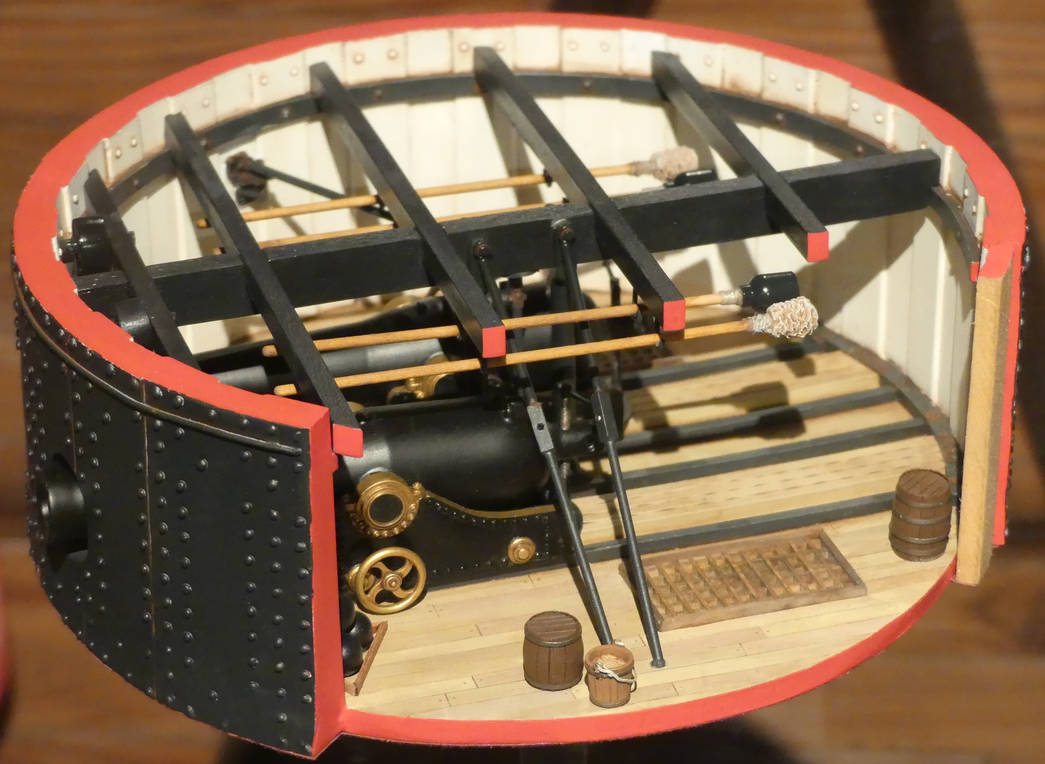
Cross section gun turret American monitor USS Monitor 1861-1862

Model Maritime Museum Hamburg, Germany, 2023.

Ordered on 4 October 1861, laid down by Continental Iron Works, Greenpoint, Brooklyn, USA on 25 October 1861, launched on 30 January 1862, commissioned on 25 February 1862, lost at sea due to a storm off Cape Hatteras, North Carolina, USA on 31 December 1862 and wreck found back on 27 August 1973. 

Monday, 23 February 2026

The tender for an American steam ironclad sent in by A. Beebe in 1861

The Secretary of the Navy Gideon Welles (1) submitted the Congress on her session of 4 July 1861 with a report of the building of armored vessels abroad especially France and the United Kingdom. He recommended that the USA would built one of more of such ironclad-steamships or floating batteries. The Congress ordered him on 3 August to appoint the so-called Ironclad Board of 3 skilful naval officers to investigate plans and specifications of such steamships for which building 1,500,000 was available. The appointed officers were the commodores Joseph Smit (2) and Hiram Paulding (3) and the captain Charles H. Davis.(4) They were assisted by Assistant Secretary of the Navy Gustavus Fox.

In an advertisement dated 7 August 1861 was asked for tenders “from parties who are able to execute work of this kind, and who are engaged in it, of which they willfurnish evidence with their offer, for the construction of one or more iron-clad steam vessels of war, either of iron or of wood and  irón combined, for sea or river service, to be of not less thanten nor over sixteen feet draught of water; to carry an armament of from eighty to one hundred and twenty tons weight, with provisions and stores for from one hundred and sixty-five to three hundred persons, according to armament, for sixty days, with coal for eight days. The smaller draught of water, compatible with other requisites, will be preferred. The vessel to be rigged with two masts, with wire-rope standing rigging, to navigate at sea. Ageneral description and drawings of the vessel, armor, and machinery, such as the work can be executed from, willbe required. The offer must state the cost and the time for completingthe whole, exclusive of armament and stores of all kinds, the rate of speed proposed, and must be accompanied by a guarantee for the proper execution of the contract, if awarded." The commission examined and commented all recived tenders. Recommended were thepropositions of Bushnell & Co., New Haven, Connecticut; Merrick & Sons, Philadelphia, and J. Ericsson, New York, which would “absorb $1,290,250 of the  appropriation of $1,500,000, leaving $209,750 yet unexpended. The commission recommended further that armor with heavy guns be placed on one of our river craft, or,  if none will bear it, to construct a scow, which will answer to plate and shield the guns, for the river service on the Potomac, to be constructed or prepared by the government at the navy  yard here for immediate use.

In a resolution of the Senate dated 24 July 1868 asked she the Secretary of the Navy all facts necessary for a complete history of the origin and building of the ironclad Monitor. His letter dated the next day was to supply the asked information.

A. Beebe, New York, 82 Broadway. “Specification and sketch defective. Plan not approved. Price $50,000-length of vessel 120 feet-breadth of beam 55 feet-depth not stated-time 100 days-draught of water 6 feet-displacement 1,000 tons-speed per hour 8 knots.

Source

Letter of the Secretary of the navy communicating, in compliance with a resolution of the Senate of the 24th instant, information  in relation to the construction ofthe iron-clad Monitor. 40th Congress 2d Session Senate ex. Doc. No. 86.

Notes

1. Gideon Welles (1 July 1802 Glastonbury, Connecticut, USA-11 February 1878 Hartford, Connecticut, USA), United States Secretary of the Navy 7 March 1861-4 March 1869.

2. Joseph Smith (30 March 1790, Boston, Massachusetts, USA-17 January 1877, Washington, D.C., USA), served in the US Navy between 1809-1871 ending in the rank of rear admiral.

3. Hiram Paulding (11 December 1797 Cortlandt, New York, USA-20 October 1878 Huntington, New York, USA), served in the UD Navy between 1811-1870 ending in the rank of rear admiral.

4. Charles Henry Davis (16 January 1807 Boston, Massachusetts, USA-18 February 1877 Washington, D.C., USA), served in the US Navy between 1823-1877 ending in the rank of rear admiral.

5. Gustavus Vasa Fox (3 June 1821 Saugus, Massachusetts, USA-29 October 1883 Lowell, Massachusetts, USA), Assistant Secretary of the Navy 1 August 1861-25 November 1866, served in the US Navy between 1838-1856 ending in the rank of lieutenant. 

Sunday, 22 February 2026

The tender for an American steam ironclad sent in by Wm. Kingsley in 1861

The Secretary of the Navy Gideon Welles (1) submitted the Congress on her session of 4 July 1861 with a report of the building of armored vessels abroad especially France and the United Kingdom. He recommended that the USA would built one of more of such ironclad-steamships or floating batteries. The Congress ordered him on 3 August to appoint the so-called Ironclad Board of 3 skilful naval officers to investigate plans and specifications of such steamships for which building 1,500,000 was available. The appointed officers were the commodores Joseph Smit (2) and Hiram Paulding (3) and the captain Charles H. Davis.(4) They were assisted by Assistant Secretary of the Navy Gustavus Fox.

In an advertisement dated 7 August 1861 was asked for tenders “from parties who are able to execute work of this kind, and who are engaged in it, of which they willfurnish evidence with their offer, for the construction of one or more iron-clad steam vessels of war, either of iron or of wood and  irón combined, for sea or river service, to be of not less than ten nor over sixteen feet draught of water; to carry an armament of from eighty to one hundred and twenty tons weight, with provisions and stores for from one hundred and sixty-five to three hundred persons, according to armament, for sixty days, with coal for eight days. The smaller draught of water, compatible with other requisites, will be preferred. The vessel to be rigged with two masts, with wire-rope standing rigging, to navigate at sea. Ageneral description and drawings of the vessel, armor, and machinery, such as the work can be executed from, willbe required. The offer must state the cost and the time for completingthe whole, exclusive of armament and stores of all kinds, the rate of speed proposed, and must be accompanied by a guarantee for the proper execution of the contract, if awarded." The commission examined and commented all recived tenders. Recommended were thepropositions of Bushnell & Co., New Haven, Connecticut; Merrick & Sons, Philadelphia, and J. Ericsson, New York, which would “absorb $1,290,250 of the  appropriation of $1,500,000, leaving $209,750 yet unexpended. The commission recommended further that armor with heavy guns be placed on one of our river craft, or,  if none will bear it, to construct a scow, which will answer to plate and shield the guns, for the river service on the Potomac, to be constructed or prepared by the government at the navy  yard here for immediate use.

In a resolution of the Senate dated 24 July 1868 asked she the Secretary of the Navy all facts necessary for a complete history of the origin and building of the ironclad Monitor. His letter dated the next day was to supply the asked information.

Wm. Kingsley, Washington, D. C., page 10, proposes a rubber-clad vessel, which we can not recommend. No price or dimensions stated.

Source

Letter of the Secretary of the navy communicating, in compliance with a resolution of the Senate of the 24th instant, information  in relation to the construction ofthe iron-clad Monitor. 40th Congress 2d Session Senate ex. Doc. No. 86.

Notes

1. Gideon Welles (1 July 1802 Glastonbury, Connecticut, USA-11 February 1878 Hartford, Connecticut, USA), United States Secretary of the Navy 7 March 1861-4 March 1869.

2. Joseph Smith (30 March 1790, Boston, Massachusetts, USA-17 January 1877, Washington, D.C., USA), served in the US Navy between 1809-1871 ending in the rank of rear admiral.

3. Hiram Paulding (11 December 1797 Cortlandt, New York, USA-20 October 1878 Huntington, New York, USA), served in the UD Navy between 1811-1870 ending in the rank of rear admiral.

4. Charles Henry Davis (16 January 1807 Boston, Massachusetts, USA-18 February 1877 Washington, D.C., USA), served in the US Navy between 1823-1877 ending in the rank of rear admiral.

5. Gustavus Vasa Fox (3 June 1821 Saugus, Massachusetts, USA-29 October 1883 Lowell, Massachusetts, USA), Assistant Secretary of the Navy 1 August 1861-25 November 1866, served in the US Navy between 1838-1856 ending in the rank of lieutenant.

Saturday, 7 February 2026

The tender for an American steam ironclad sent in by Wm. Norris, New York in 1861

The Secretary of the Navy Gideon Welles (1) submitted the Congress on her session of 4 July 1861 with a report of the building of armored vessels abroad especially France and the United Kingdom. He recommended that the USA would built one of more of such ironclad-steamships or floating batteries. The Congress ordered him on 3 August to appoint the so-called Ironclad Board of 3 skilful naval officers to investigate plans and specifications of such steamships for which building 1,500,000 was available. The appointed officers were the commodores Joseph Smit (2) and Hiram Paulding (3) and the captain Charles H. Davis.(4) They were assisted by Assistant Secretary of the Navy Gustavus Fox.

In an advertisement dated 7 August 1861 was asked for tenders “from parties who are able to execute work of this kind, and who are engaged in it, of which they willfurnish evidence with their offer, for the construction of one or more iron-clad steam vessels of war, either of iron or of wood and  irón combined, for sea or river service, to be of not less than ten nor over sixteen feet draught of water; to carry an armament of from eighty to one hundred and twenty tons weight, with provisions and stores for from one hundred and sixty-five to three hundred persons, according to armament, for sixty days, with coal for eight days. The smaller draught of water, compatible with other requisites, will be preferred. The vessel to be rigged with two masts, with wire-rope standing rigging, to navigate at sea. Ageneral description and drawings of the vessel, armor, and machinery, such as the work can be executed from, willbe required. The offer must state the cost and the time for completingthe whole, exclusive of armament and stores of all kinds, the rate of speed proposed, and must be accompanied by a guarantee for the proper execution of the contract, if awarded." The commission examined and commented all recived tenders. Recommended were thepropositions of Bushnell & Co., New Haven, Connecticut; Merrick & Sons, Philadelphia, and J. Ericsson, New York, which would “absorb $1,290,250 of the  appropriation of $1,500,000, leaving $209,750 yet unexpended. The commission recommended further that armor with heavy guns be placed on one of our river craft, or,  if none will bear it, to construct a scow, which will answer to plate and shield the guns, for the river service on the Potomac, to be constructed or prepared by the government at the navy  yard here for immediate use.

In a resolution of the Senate dated 24 July 1868 asked she the Secretary of the Navy all facts necessary for a complete history of the origin and building of the ironclad Monitor. His letter dated the next day was to supply the asked information.

Wm. Norris, New York, 26 Cedar street.“Iron boat without armor. Too small, and not received. Price $32,000-length of vessel 83 feet-breadth of beam 25 feet-depth of hold 14 feet- time 60 to 75 days-draught of water 3 feet-displacement 90 tons-speed not stated.

Source

Letter of the Secretary of the navy communicating, in compliance with a resolution of the Senate of the 24th instant, information  in relation to the construction ofthe iron-clad Monitor. 40th Congress 2d Session Senate ex. Doc. No. 86.

Notes

1. Gideon Welles (1 July 1802 Glastonbury, Connecticut, USA-11 February 1878 Hartford, Connecticut, USA), United States Secretary of the Navy 7 March 1861-4 March 1869.

2. Joseph Smith (30 March 1790, Boston, Massachusetts, USA-17 January 1877, Washington, D.C., USA), served in the US Navy between 1809-1871 ending in the rank of rear admiral.

3. Hiram Paulding (11 December 1797 Cortlandt, New York, USA-20 October 1878 Huntington, New York, USA), served in the UD Navy between 1811-1870 ending in the rank of rear admiral.

4. Charles Henry Davis (16 January 1807 Boston, Massachusetts, USA-18 February 1877 Washington, D.C., USA), served in the US Navy between 1823-1877 ending in the rank of rear admiral.

5. Gustavus Vasa Fox (3 June 1821 Saugus, Massachusetts, USA-29 October 1883 Lowell, Massachusetts, USA), Assistant Secretary of the Navy 1 August 1861-25 November 1866, served in the US Navy between 1838-1856 ending in the rank of lieutenant. 

Saturday, 24 January 2026

The tender for an American steam ironclad sent in by Neafie & Levy, Philadelphia in 1861

The Secretary of the Navy Gideon Welles (1) submitted the Congress on her session of 4 July 1861 with a report of the building of armored vessels abroad especially France and the United Kingdom. He recommended that the USA would built one of more of such ironclad-steamships or floating batteries. The Congress ordered him on 3 August to appoint the so-called Ironclad Board of 3 skilful naval officers to investigate plans and specifications of such steamships for which building 1,500,000 was available. The appointed officers were the commodores Joseph Smit (2) and Hiram Paulding (3) and the captain Charles H. Davis.(4) They were assisted by Assistant Secretary of the Navy Gustavus Fox.(5)

In an advertisement dated 7 August 1861 was asked for tenders “from parties who are able to execute work of this kind, and who are engaged in it, of which they willfurnish evidence with their offer, for the construction of one or more iron-clad steam vessels of war, either of iron or of wood and  irón combined, for sea or river service, to be of not less than ten nor over sixteen feet draught of water; to carry an armament of from eighty to one hundred and twenty tons weight, with provisions and stores for from one hundred and sixty-five to three hundred persons, according to armament, for sixty days, with coal for eight days. The smaller draught of water, compatible with other requisites, will be preferred. The vessel to be rigged with two masts, with wire-rope standing rigging, to navigate at sea. Ageneral description and drawings of the vessel, armor, and machinery, such as the work can be executed from, willbe required. The offer must state the cost and the time for completingthe whole, exclusive of armament and stores of all kinds, the rate of speed proposed, and must be accompanied by a guarantee for the proper execution of the contract, if awarded." The commission examined and commented all recived tenders. Recommended were thepropositions of Bushnell & Co., New Haven, Connecticut; Merrick & Sons, Philadelphia, and J. Ericsson, New York, which would “absorb $1,290,250 of the  appropriation of $1,500,000, leaving $209,750 yet unexpended. The commission recommended further that armor with heavy guns be placed on one of our river craft, or,  if none will bear it, to construct a scow, which will answer to plate and shield the guns, for the river service on the Potomac, to be constructed or prepared by the government at the navy  yard here for immediate use.

In a resolution of the Senate dated 24 July 1868 asked she the Secretary of the Navy all facts necessary for a complete history of the origin and building of the ironclad Monitor. His letter dated the next day was to supply the asked information.

Neafie & Levy, Philadelphia. “No plans or drawings, therefore not considered. Neither price nor time stated. Length of vessel 200 feet-breadth of beam 40 feet-depth of hold 15 feet-draught of water 13 feet-displacement 1,748 tons-speed per hour 10 knots.”(6)

Source

Letter of the Secretary of the navy communicating, in compliance with a resolution of the Senate of the 24th instant, information  in relation to the construction ofthe iron-clad Monitor. 40th Congress 2d Session Senate ex. Doc. No. 86.

Notes

1. Gideon Welles (1 July 1802 Glastonbury, Connecticut, USA-11 February 1878 Hartford, Connecticut, USA), United States Secretary of the Navy 7 March 1861-4 March 1869.

2. Joseph Smith (30 March 1790, Boston, Massachusetts, USA-17 January 1877, Washington, D.C., USA), served in the US Navy between 1809-1871 ending in the rank of rear admiral.

3. Hiram Paulding (11 December 1797 Cortlandt, New York, USA-20 October 1878 Huntington, New York, USA), served in the UD Navy between 1811-1870 ending in the rank of rear admiral.

4. Charles Henry Davis (16 January 1807 Boston, Massachusetts, USA-18 February 1877 Washington, D.C., USA), served in the US Navy between 1823-1877 ending in the rank of rear admiral.

5. Gustavus Vasa Fox (3 June 1821 Saugus, Massachusetts, USA-29 October 1883 Lowell, Massachusetts, USA), Assistant Secretary of the Navy 1 August 1861-25 November 1866, served in the US Navy between 1838-1856 ending in the rank of lieutenant.

6. Neafie, Levy&Co., was a shipbuilding and engineering company at Philadelphia, Pennsylvania, USA between 1844-1907. She built in 1862 the American submarine USS Aligator. 

Friday, 26 December 2025

The tender for an American steam ironclad sent in by John Westwood, Cincinnati, Ohio in 1861

The Secretary of the Navy Gideon Welles (1) submitted the Congress on her session of 4 July 1861 with a report of the building of armored vessels abroad especially France and the United Kingdom. He recommended that the USA would built one of more of such ironclad-steamships or floating batteries. The Congress ordered him on 3 August to appoint the so-called Ironclad Board of 3 skilful naval officers to investigate plans and specifications of such steamships for which building 1,500,000 was available. The appointed officers were the commodores Joseph Smit (2) and Hiram Paulding (3) and the captain Charles H. Davis.(4) They were assisted by Assistant Secretary of the Navy Gustavus Fox.

In an advertisement dated 7 August 1861 was asked for tenders “from parties who are able to execute work of this kind, and who are engaged in it, of which they willfurnish evidence with their offer, for the construction of one or more iron-clad steam vessels of war, either of iron or of wood and  irón combined, for sea or river service, to be of not less thantennor over sixteen feet draught of water; to carry an armament of from eighty to one hundred and twenty tons weight, with provisions and stores for from one hundred and sixty-five to three hundred persons, according to armament, for sixty days, with coal for eight days. The smaller draught of water, compatible with other requisites, will be preferred. The vessel to be rigged with two masts, with wire-rope standing rigging, to navigate at sea. Ageneral description and drawings of the vessel, armor, and machinery, such as the work can be executed from, willbe required. The offer must state the cost and the time for completingthe whole, exclusive of armament and stores of all kinds, the rate of speed proposed, and must be accompanied by a guarantee for the proper execution of the contract, if awarded." The commission examined and commented all recived tenders. Recommended were thepropositions of Bushnell & Co., New Haven, Connecticut; Merrick & Sons, Philadelphia, and J. Ericsson, New York, which would “absorb $1,290,250 of the  appropriation of $1,500,000, leaving $209,750 yet unexpended. The commission recommended further that armor with heavy guns be placed on one of our river craft, or,  if none will bear it, to construct a scow, which will answer to plate and shield the guns, for the river service on the Potomac, to be constructed or prepared by the government at the navy  yard here for immediate use.

In a resolution of the Senate dated 24 July 1868 asked she the Secretary of the Navy all facts necessary for a complete history of the origin and building of the ironclad Monitor. His letter dated the next day was to supply the asked information.

John Westwood, Cincinnati, Ohio. “Vessel of wood with iron armor, plan good enough, but the breadth not enough to bear the armor. No detailed specification; no price or time stated, only a general drawing. Not recommended.

Source

Letter of the Secretary of the navy communicating, in compliance with a resolution of the Senate of the 24th instant, information  in relation to the construction ofthe iron-clad Monitor. 40th Congress 2d Session Senate ex. Doc. No. 86.

Notes

1. Gideon Welles (1 July 1802 Glastonbury, Connecticut, USA-11 February 1878 Hartford, Connecticut, USA), United States Secretary of the Navy 7 March 1861-4 March 1869.

2. Joseph Smith (30 March 1790, Boston, Massachusetts, USA-17 January 1877, Washington, D.C., USA), served in the US Navy between 1809-1871 ending in the rank of rear admiral.

3. Hiram Paulding (11 December 1797 Cortlandt, New York, USA-20 October 1878 Huntington, New York, USA), served in the UD Navy between 1811-1870 ending in the rank of rear admiral.

4. Charles Henry Davis (16 January 1807 Boston, Massachusetts, USA-18 February 1877 Washington, D.C., USA), served in the US Navy between 1823-1877 ending in the rank of rear admiral.

5. Gustavus Vasa Fox (3 June 1821 Saugus, Massachusetts, USA-29 October 1883 Lowell, Massachusetts, USA), Assistant Secretary of the Navy 1 August 1861-25 November 1866, served in the US Navy between 1838-1856 ending in the rank of lieutenant. 

Thursday, 18 December 2025

The tender for an American steam ironclad sent in by William H. Wood, Jersey City, N. J. in 1861

The Secretary of the Navy Gideon Welles (1) submitted the Congress on her session of 4 July 1861 with a report of the building of armored vessels abroad especially France and the United Kingdom. He recommended that the USA would built one of more of such ironclad-steamships or floating batteries. The Congress ordered him on 3 August to appoint the so-called Ironclad Board of 3 skilful naval officers to investigate plans and specifications of such steamships for which building 1,500,000 was available. The appointed officers were the commodores Joseph Smit (2) and Hiram Paulding (3) and the captain Charles H. Davis.(4) They were assisted by Assistant Secretary of the Navy Gustavus Fox.

In an advertisement dated 7 August 1861 was asked for tenders “from parties who are able to execute work of this kind, and who are engaged in it, of which they willfurnish evidence with their offer, for the construction of one or more iron-clad steam vessels of war, either of iron or of wood and  irón combined, for sea or river service, to be of not less thantennor over sixteen feet draught of water; to carry an armament of from eighty to one hundred and twenty tons weight, with provisions and stores for from one hundred and sixty-five to three hundred persons, according to armament, for sixty days, with coal for eight days. The smaller draught of water, compatible with other requisites, will be preferred. The vessel to be rigged with two masts, with wire-rope standing rigging, to navigate at sea. Ageneral description and drawings of the vessel, armor, and machinery, such as the work can be executed from, willbe required. The offer must state the cost and the time for completingthe whole, exclusive of armament and stores of all kinds, the rate of speed proposed, and must be accompanied by a guarantee for the proper execution of the contract, if awarded." The commission examined and commented all recived tenders. Recommended were thepropositions of Bushnell & Co., New Haven, Connecticut; Merrick & Sons, Philadelphia, and J. Ericsson, New York, which would “absorb $1,290,250 of the  appropriation of $1,500,000, leaving $209,750 yet unexpended. The commission recommended further that armor with heavy guns be placed on one of our river craft, or,  if none will bear it, to construct a scow, which will answer to plate and shield the guns, for the river service on the Potomac, to be constructed or prepared by the government at the navy  yard here for immediate use.

In a resolution of the Senate dated 24 July 1868 asked she the Secretary of the Navy all facts necessary for a complete history of the origin and building of the ironclad Monitor. His letter dated the next day was to supply the asked information.

William H. Wood, Jersey City, N. J. Dimensions will not float the guns high enough. Not recommended. Price $ 255,000-length of vessel 160 feet-breadth of beam 34 feet-depth of hold 22 feet-time 4 months-draught of water 13 feet-displacement 1,215 tons-speed not stated.

Source

Letter of the Secretary of the navy communicating, in compliance with a resolution of the Senate of the 24th instant, information  in relation to the construction ofthe iron-clad Monitor. 40th Congress 2d Session Senate ex. Doc. No. 86.

Notes

1. Gideon Welles (1 July 1802 Glastonbury, Connecticut, USA-11 February 1878 Hartford, Connecticut, USA), United States Secretary of the Navy 7 March 1861-4 March 1869.

2. Joseph Smith (30 March 1790, Boston, Massachusetts, USA-17 January 1877, Washington, D.C., USA), served in the US Navy between 1809-1871 ending in the rank of rear admiral.

3. Hiram Paulding (11 December 1797 Cortlandt, New York, USA-20 October 1878 Huntington, New York, USA), served in the UD Navy between 1811-1870 ending in the rank of rear admiral.

4. Charles Henry Davis (16 January 1807 Boston, Massachusetts, USA-18 February 1877 Washington, D.C., USA), served in the US Navy between 1823-1877 ending in the rank of rear admiral.

5. Gustavus Vasa Fox (3 June 1821 Saugus, Massachusetts, USA-29 October 1883 Lowell, Massachusetts, USA), Assistant Secretary of the Navy 1 August 1861-25 November 1866, served in the US Navy between 1838-1856 ending in the rank of lieutenant. 

Wednesday, 17 December 2025

The tender for an American steam ironclad sent in by Donald McKay, Boston in 1861

The Secretary of the Navy Gideon Welles (1) submitted the Congress on her session of 4 July 1861 with a report of the building of armored vessels abroad especially France and the United Kingdom. He recommended that the USA would built one of more of such ironclad-steamships or floating batteries. The Congress ordered him on 3 August to appoint the so-called Ironclad Board of 3 skilful naval officers to investigate plans and specifications of such steamships for which building 1,500,000 was available. The appointed officers were the commodores Joseph Smit (2) and Hiram Paulding (3) and the captain Charles H. Davis.(4) They were assisted by Assistant Secretary of the Navy Gustavus Fox.(5)

In an advertisement dated 7 August 1861 was asked for tenders “from parties who are able to execute work of this kind, and who are engaged in it, of which they willfurnish evidence with their offer, for the construction of one or more iron-clad steam vessels of war, either of iron or of wood and  irón combined, for sea or river service, to be of not less thantennor over sixteen feet draught of water; to carry an armament of from eighty to one hundred and twenty tons weight, with provisions and stores for from one hundred and sixty-five to three hundred persons, according to armament, for sixty days, with coal for eight days. The smaller draught of water, compatible with other requisites, will be preferred. The vessel to be rigged with two masts, with wire-rope standing rigging, to navigate at sea. Ageneral description and drawings of the vessel, armor, and machinery, such as the work can be executed from, willbe required. The offer must state the cost and the time for completingthe whole, exclusive of armament and stores of all kinds, the rate of speed proposed, and must be accompanied by a guarantee for the proper execution of the contract, if awarded." The commission examined and commented all recived tenders. Recommended were thepropositions of Bushnell & Co., New Haven, Connecticut; Merrick & Sons, Philadelphia, and J. Ericsson, New York, which would “absorb $1,290,250 of the  appropriation of $1,500,000, leaving $209,750 yet unexpended. The commission recommended further that armor with heavy guns be placed on one of our river craft, or,  if none will bear it, to construct a scow, which will answer to plate and shield the guns, for the river service on the Potomac, to be constructed or prepared by the government at the navy  yard here for immediate use.

In a resolution of the Senate dated 24 July 1868 asked she the Secretary of the Navy all facts necessary for a complete history of the origin and building of the ironclad Monitor. His letter dated the next day was to supply the asked information.

Donald McKay, Boston. “Vessel, in general dimensions and armor, approved. The speed estimated slow. The cost precludes the consideration of construction by the board.Price, $1,000,000-length of vessel 227 feet-breadth of beam 50 feet-depth of hold 26.5feet-time 9 to 10 months-draught ofwater 14 feet-displacement 3,100 tons-speed per hour 6 to7 knots.”(6)

Source

Letter of the Secretary of the navy communicating, in compliance with a resolution of the Senate of the 24th instant, information  in relation to the construction ofthe iron-clad Monitor. 40th Congress 2d Session Senate ex. Doc. No. 86.

Notes

1. Gideon Welles (1 July 1802 Glastonbury, Connecticut, USA-11 February 1878 Hartford, Connecticut, USA), United States Secretary of the Navy 7 March 1861-4 March 1869.

2. Joseph Smith (30 March 1790, Boston, Massachusetts, USA-17 January 1877, Washington, D.C., USA), served in the US Navy between 1809-1871 ending in the rank of rear admiral.

3. Hiram Paulding (11 December 1797 Cortlandt, New York, USA-20 October 1878 Huntington, New York, USA), served in the UD Navy between 1811-1870 ending in the rank of rear admiral.

4. Charles Henry Davis (16 January 1807 Boston, Massachusetts, USA-18 February 1877 Washington, D.C., USA), served in the US Navy between 1823-1877 ending in the rank of rear admiral.

5. Gustavus Vasa Fox (3 June 1821 Saugus, Massachusetts, USA-29 October 1883 Lowell, Massachusetts, USA), Assistant Secretary of the Navy 1 August 1861-25 November 1866, served in the US Navy between 1838-1856 ending in the rank of lieutenant.

6. Identical to Donald McKay (4 September 1810 Nova Scotia, Canafa-20 September 1880 Hamilton, Massuchetts, USA), naval architect and shipbuilder at East Boston?

Tuesday, 16 December 2025

The tender for an American steam ironclad sent in by Whitney & Rowland in 1861

The Secretary of the Navy Gideon Welles (1) submitted the Congress on her session of 4 July 1861 with a report of the building of armored vessels abroad especially France and the United Kingdom. He recommended that the USA would built one of more of such ironclad-steamships or floating batteries. The Congress ordered him on 3 August to appoint the so-called Ironclad Board of 3 skilful naval officers to investigate plans and specifications of such steamships for which building 1,500,000 was available. The appointed officers were the commodores Joseph Smit (2) and Hiram Paulding (3) and the captain Charles H. Davis.(4) They were assisted by Assistant Secretary of the Navy Gustavus Fox.

In an advertisement dated 7 August 1861 was asked for tenders “from parties who are able to execute work of this kind, and who are engaged in it, of which they willfurnish evidence with their offer, for the construction of one or more iron-clad steam vessels of war, either of iron or of wood and  irón combined, for sea or river service, to be of not less thantennor over sixteen feet draught of water; to carry an armament of from eighty to one hundred and twenty tons weight, with provisions and stores for from one hundred and sixty-five to three hundred persons, according to armament, for sixty days, with coal for eight days. The smaller draught of water, compatible with other requisites, will be preferred. The vessel to be rigged with two masts, with wire-rope standing rigging, to navigate at sea. Ageneral description and drawings of the vessel, armor, and machinery, such as the work can be executed from, willbe required. The offer must state the cost and the time for completingthe whole, exclusive of armament and stores of all kinds, the rate of speed proposed, and must be accompanied by a guarantee for the proper execution of the contract, if awarded." The commission examined and commented all recived tenders. Recommended were thepropositions of Bushnell & Co., New Haven, Connecticut; Merrick & Sons, Philadelphia, and J. Ericsson, New York, which would “absorb $1,290,250 of the  appropriation of $1,500,000, leaving $209,750 yet unexpended. The commission recommended further that armor with heavy guns be placed on one of our river craft, or,  if none will bear it, to construct a scow, which will answer to plate and shield the guns, for the river service on the Potomac, to be constructed or prepared by the government at the navy  yard here for immediate use.

In a resolution of the Senate dated 24 July 1868 asked she the Secretary of the Navy all facts necessary for a complete history of the origin and building of the ironclad Monitor. His letter dated the next day was to supply the asked information.

Whitney & Rowland, Brooklyn, Greenpoint propose an iron gunboat, armor of bars of iron and thin plate over it. No price stated. Dimensions of vessel, we think, will not bear the weight and possess stability. Time 5 months. Not recommended. Length of vessel 140 feet-breadth of beam 28feet-depth of hold 13 feet-draught of water 8 feet.

Source

Letter of the Secretary of the navy communicating, in compliance with a resolution of the Senate of the 24th instant, information  in relation to the construction ofthe iron-clad Monitor. 40th Congress 2d Session Senate ex. Doc. No. 86.

Notes

1. Gideon Welles (1 July 1802 Glastonbury, Connecticut, USA-11 February 1878 Hartford, Connecticut, USA), United States Secretary of the Navy 7 March 1861-4 March 1869.

2. Joseph Smith (30 March 1790, Boston, Massachusetts, USA-17 January 1877, Washington, D.C., USA), served in the US Navy between 1809-1871 ending in the rank of rear admiral.

3. Hiram Paulding (11 December 1797 Cortlandt, New York, USA-20 October 1878 Huntington, New York, USA), served in the UD Navy between 1811-1870 ending in the rank of rear admiral.

4. Charles Henry Davis (16 January 1807 Boston, Massachusetts, USA-18 February 1877 Washington, D.C., USA), served in the US Navy between 1823-1877 ending in the rank of rear admiral.

5. Gustavus Vasa Fox (3 June 1821 Saugus, Massachusetts, USA-29 October 1883 Lowell, Massachusetts, USA), Assistant Secretary of the Navy 1 August 1861-25 November 1866, served in the US Navy between 1838-1856 ending in the rank of lieutenant. 

Monday, 15 December 2025

The tender for an American steam ironclad sent in by John C. Le Ferre in 1861

The Secretary of the Navy Gideon Welles (1) submitted the Congress on her session of 4 July 1861 with a report of the building of armored vessels abroad especially France and the United Kingdom. He recommended that the USA would built one of more of such ironclad-steamships or floating batteries. The Congress ordered him on 3 August to appoint the so-called Ironclad Board of 3 skilful naval officers to investigate plans and specifications of such steamships for which building 1,500,000 was available. The appointed officers were the commodores Joseph Smit (2) and Hiram Paulding (3) and the captain Charles H. Davis.(4) They were assisted by Assistant Secretary of the Navy Gustavus Fox.

In an advertisement dated 7 August 1861 was asked for tenders “from parties who are able to execute work of this kind, and who are engaged in it, of which they willfurnish evidence with their offer, for the construction of one or more iron-clad steam vessels of war, either of iron or of wood and  irón combined, for sea or river service, to be of not less thantennor over sixteen feet draught of water; to carry an armament of from eighty to one hundred and twenty tons weight, with provisions and stores for from one hundred and sixty-five to three hundred persons, according to armament, for sixty days, with coal for eight days. The smaller draught of water, compatible with other requisites, will be preferred. The vessel to be rigged with two masts, with wire-rope standing rigging, to navigate at sea. Ageneral description and drawings of the vessel, armor, and machinery, such as the work can be executed from, willbe required. The offer must state the cost and the time for completingthe whole, exclusive of armament and stores of all kinds, the rate of speed proposed, and must be accompanied by a guarantee for the proper execution of the contract, if awarded." The commission examined and commented all recived tenders. Recommended were thepropositions of Bushnell & Co., New Haven, Connecticut; Merrick & Sons, Philadelphia, and J. Ericsson, New York, which would “absorb $1,290,250 of the  appropriation of $1,500,000, leaving $209,750 yet unexpended. The commission recommended further that armor with heavy guns be placed on one of our river craft, or,  if none will bear it, to construct a scow, which will answer to plate and shield the guns, for the river service on the Potomac, to be constructed or prepared by the government at the navy  yard here for immediate use.

In a resolution of the Senate dated 24 July 1868 asked she the Secretary of the Navy all facts necessary for a complete history of the origin and building of the ironclad Monitor. His letter dated the next day was to supply the asked information.

John C. Le Ferre, Boston. “Description deficient. Not recommended. Sent a model, but neither price, time, nor dimensions stated.

Source

Letter of the Secretary of the navy communicating, in compliance with a resolution of the Senate of the 24th instant, information  in relation to the construction ofthe iron-clad Monitor. 40th Congress 2d Session Senate ex. Doc. No. 86.

Notes

1. Gideon Welles (1 July 1802 Glastonbury, Connecticut, USA-11 February 1878 Hartford, Connecticut, USA), United States Secretary of the Navy 7 March 1861-4 March 1869.

2. Joseph Smith (30 March 1790, Boston, Massachusetts, USA-17 January 1877, Washington, D.C., USA), served in the US Navy between 1809-1871 ending in the rank of rear admiral.

3. Hiram Paulding (11 December 1797 Cortlandt, New York, USA-20 October 1878 Huntington, New York, USA), served in the UD Navy between 1811-1870 ending in the rank of rear admiral.

4. Charles Henry Davis (16 January 1807 Boston, Massachusetts, USA-18 February 1877 Washington, D.C., USA), served in the US Navy between 1823-1877 ending in the rank of rear admiral.

5. Gustavus Vasa Fox (3 June 1821 Saugus, Massachusetts, USA-29 October 1883 Lowell, Massachusetts, USA), Assistant Secretary of the Navy 1 August 1861-25 November 1866, served in the US Navy between 1838-1856 ending in the rank of lieutenant. 

Monday, 8 December 2025

The tender for an American steam ironclad sent in by Henry R. Dunham, New York in 1861

The Secretary of the Navy Gideon Welles (1) submitted the Congress on her session of 4 July 1861 with a report of the building of armored vessels abroad especially France and the United Kingdom. He recommended that the USA would built one of more of such ironclad-steamships or floating batteries. The Congress ordered him on 3 August to appoint the so-called Ironclad Board of 3 skilful naval officers to investigate plans and specifications of such steamships for which building 1,500,000 was available. The appointed officers were the commodores Joseph Smit (2) and Hiram Paulding (3) and the captain Charles H. Davis.(4) They were assisted by Assistant Secretary of the Navy Gustavus Fox.

In an advertisement dated 7 August 1861 was asked for tenders “from parties who are able to execute work of this kind, and who are engaged in it, of which they willfurnish evidence with their offer, for the construction of one or more iron-clad steam vessels of war, either of iron or of wood and  irón combined, for sea or river service, to be of not less thantennor over sixteen feet draught of water; to carry an armament of from eighty to one hundred and twenty tons weight, with provisions and stores for from one hundred and sixty-five to three hundred persons, according to armament, for sixty days, with coal for eight days. The smaller draught of water, compatible with other requisites, will be preferred. The vessel to be rigged with two masts, with wire-rope standing rigging, to navigate at sea. Ageneral description and drawings of the vessel, armor, and machinery, such as the work can be executed from, willbe required. The offer must state the cost and the time for completingthe whole, exclusive of armament and stores of all kinds, the rate of speed proposed, and must be accompanied by a guarantee for the proper execution of the contract, if awarded." The commission examined and commented all recived tenders. Recommended were thepropositions of Bushnell & Co., New Haven, Connecticut; Merrick & Sons, Philadelphia, and J. Ericsson, New York, which would “absorb $1,290,250 of the  appropriation of $1,500,000, leaving $209,750 yet unexpended. The commission recommended further that armor with heavy guns be placed on one of our river craft, or,  if none will bear it, to construct a scow, which will answer to plate and shield the guns, for the river service on the Potomac, to be constructed or prepared by the government at the navy  yard here for immediate use.

In a resolution of the Senate dated 24 July 1868 asked she the Secretary of the Navy all facts necessary for a complete history of the origin and building of the ironclad Monitor. His letter dated the next day was to supply the asked information.

Henry R. Dunham, New York. “Vessel too costly for the appropriation. No drawings or specifications, not recommended. Price $ 1,200,000-length of vessel 325 feet-breadth of beam 60 feet-depth of hold not stated-time 15 to 18 months-draught of water 16 feet-displacement not stated-speed per hour 12 miles.

Source

Letter of the Secretary of the navy communicating, in compliance with a resolution of the Senate of the 24th instant, information  in relation to the construction ofthe iron-clad Monitor. 40th Congress 2d Session Senate ex. Doc. No. 86.

Notes

1. Gideon Welles (1 July 1802 Glastonbury, Connecticut, USA-11 February 1878 Hartford, Connecticut, USA), United States Secretary of the Navy 7 March 1861-4 March 1869.

2. Joseph Smith (30 March 1790, Boston, Massachusetts, USA-17 January 1877, Washington, D.C., USA), served in the US Navy between 1809-1871 ending in the rank of rear admiral.

3. Hiram Paulding (11 December 1797 Cortlandt, New York, USA-20 October 1878 Huntington, New York, USA), served in the UD Navy between 1811-1870 ending in the rank of rear admiral.

4. Charles Henry Davis (16 January 1807 Boston, Massachusetts, USA-18 February 1877 Washington, D.C., USA), served in the US Navy between 1823-1877 ending in the rank of rear admiral.

5. Gustavus Vasa Fox (3 June 1821 Saugus, Massachusetts, USA-29 October 1883 Lowell, Massachusetts, USA), Assistant Secretary of the Navy 1 August 1861-25 November 1866, served in the US Navy between 1838-1856 ending in the rank of lieutenant. 

Saturday, 6 December 2025

The tender for an American steam ironclad sent in by Benjamin Rathburn in 1861

The Secretary of the Navy Gideon Welles (1) submitted the Congress on her session of 4 July 1861 with a report of the building of armored vessels abroad especially France and the United Kingdom. He recommended that the USA would built one of more of such ironclad-steamships or floating batteries. The Congress ordered him on 3 August to appoint the so-called Ironclad Board of 3 skilful naval officers to investigate plans and specifications of such steamships for which building 1,500,000 was available. The appointed officers were the commodores Joseph Smit (2) and Hiram Paulding (3) and the captain Charles H. Davis.(4) They were assisted by Assistant Secretary of the Navy Gustavus Fox.

In an advertisement dated 7 August 1861 was asked for tenders “from parties who are able to execute work of this kind, and who are engaged in it, of which they willfurnish evidence with their offer, for the construction of one or more iron-clad steam vessels of war, either of iron or of wood and  irón combined, for sea or river service, to be of not less thantennor over sixteen feet draught of water; to carry an armament of from eighty to one hundred and twenty tons weight, with provisions and stores for from one hundred and sixty-five to three hundred persons, according to armament, for sixty days, with coal for eight days. The smaller draught of water, compatible with other requisites, will be preferred. The vessel to be rigged with two masts, with wire-rope standing rigging, to navigate at sea. Ageneral description and drawings of the vessel, armor, and machinery, such as the work can be executed from, willbe required. The offer must state the cost and the time for completingthe whole, exclusive of armament and stores of all kinds, the rate of speed proposed, and must be accompanied by a guarantee for the proper execution of the contract, if awarded." The commission examined and commented all recived tenders. Recommended were thepropositions of Bushnell & Co., New Haven, Connecticut; Merrick & Sons, Philadelphia, and J. Ericsson, New York, which would “absorb $1,290,250 of the  appropriation of $1,500,000, leaving $209,750 yet unexpended. The commission recommended further that armor with heavy guns be placed on one of our river craft, or,  if none will bear it, to construct a scow, which will answer to plate and shield the guns, for the river service on the Potomac, to be constructed or prepared by the government at the navy  yard here for immediate use.

In a resolution of the Senate dated 24 July 1868 asked she the Secretary of the Navy all facts necessary for a complete history of the origin and building of the ironclad Monitor. His letter dated the next day was to supply the asked information.

Benjamin Rathburn. “We do not recommend the plan for adoption. Price not stated; length of vessel not stated-breadth of beam 80feet-depth of hold 74feet; time not stated-draught of water 25 feet-displacement 15,000 tons-speed not stated. Specification incomplete.

Source

Letter of the Secretary of the navy communicating, in compliance with a resolution of the Senate of the 24th instant, information  in relation to the construction ofthe iron-clad Monitor. 40th Congress 2d Session Senate ex. Doc. No. 86.

Notes

1. Gideon Welles (1 July 1802 Glastonbury, Connecticut, USA-11 February 1878 Hartford, Connecticut, USA), United States Secretary of the Navy 7 March 1861-4 March 1869.

2. Joseph Smith (30 March 1790, Boston, Massachusetts, USA-17 January 1877, Washington, D.C., USA), served in the US Navy between 1809-1871 ending in the rank of rear admiral.

3. Hiram Paulding (11 December 1797 Cortlandt, New York, USA-20 October 1878 Huntington, New York, USA), served in the UD Navy between 1811-1870 ending in the rank of rear admiral.

4. Charles Henry Davis (16 January 1807 Boston, Massachusetts, USA-18 February 1877 Washington, D.C., USA), served in the US Navy between 1823-1877 ending in the rank of rear admiral.

5. Gustavus Vasa Fox (3 June 1821 Saugus, Massachusetts, USA-29 October 1883 Lowell, Massachusetts, USA), Assistant Secretary of the Navy 1 August 1861-25 November 1866, served in the US Navy between 1838-1856 ending in the rank of lieutenant. 

Thursday, 20 November 2025

The tender for an American steam ironclad sent in by S. Bushnell & Co., New Haven, Connecticut in 1861 and which was to become the USS Galena

USS Galena. ©Warshipsresearch.blogspot.com

CSS Virginia. ©Warshipsresearch.blogspot.com

The Secretary of the Navy Gideon Welles (1) submitted the Congress on her session of 4 July 1861 with a report of the building of armored vessels abroad especially France and the United Kingdom. He recommended that the USA would built one of more of such ironclad-steamships or floating batteries. The Congress ordered him on 3 August to appoint the so-called Ironclad Board of 3 skilful naval officers to investigate plans and specifications of such steamships for which building 1,500,000 was available. The appointed officers were the commodores Joseph Smit (2) and Hiram Paulding (3) and the captain Charles H. Davis.(4) They were assisted by Assistant Secretary of the Navy Gustavus Fox.

In an advertisement dated 7 August 1861 was asked for tenders “from parties who are able to execute work of this kind, and who are engaged in it, of which they willfurnish evidence with their offer, for the construction of one or more iron-clad steam vessels of war, either of iron or of wood and  irón combined, for sea or river service, to be of not less thantennor over sixteen feet draught of water; to carry an armament of from eighty to one hundred and twenty tons weight, with provisions and stores for from one hundred and sixty-five to three hundred persons, according to armament, for sixty days, with coal for eight days. The smaller draught of water, compatible with other requisites, will be preferred. The vessel to be rigged with two masts, with wire-rope standing rigging, to navigate at sea. Ageneral description and drawings of the vessel, armor, and machinery, such as the work can be executed from, willbe required. The offer must state the cost and the time for completingthe whole, exclusive of armament and stores of all kinds, the rate of speed proposed, and must be accompanied by a guarantee for the proper execution of the contract, if awarded." The commission examined and commented all recived tenders. Recommended were the propositions of Bushnell & Co., New Haven, Connecticut; Merrick & Sons, Philadelphia, and J. Ericsson, New York, which would “absorb $1,290,250 of the  appropriation of $1,500,000, leaving $209,750 yet unexpended. The commission recommended further that armor with heavy guns be placed on one of our river craft, or,  if none will bear it, to construct a scow, which will answer to plate and shield the guns, for the river service on the Potomac, to be constructed or prepared by the government at the navy  yard here for immediate use.

In a resolution of the Senate dated 24 July 1868 asked she the Secretary of the Navy all facts necessary for a complete history of the origin and building of the ironclad Monitor. His letter dated the next day was to supply the asked information.

C. S. Bushnell & Co., New Haven, Connecticut.(6) “Proposed a vessel to be iron-clad, on the rail andplate principle, and to obtain high speed. The objection to this vessel is the fear that she will not float her armor and load sufficientlyhigh, and have stability enough for a sea vessel. With aguarantee that she shalldo these, we recommend on that basis a contract. Price $ 235,250-length of vessel 180 feet-breadth of beam ? feet-depth of hold 12 feet-time 4 months-draught of water 10 feet; displacement ? tons-speed per hour 12 knots.”(6)

Source

Letter of the Secretary of the navy communicating, in compliance with a resolution of the Senate of the 24th instant, information  in relation to the construction ofthe iron-clad Monitor. 40th Congress 2d Session Senate ex. Doc. No. 86.

Notes

1. Gideon Welles (1 July 1802 Glastonbury, Connecticut, USA-11 February 1878 Hartford, Connecticut, USA), United States Secretary of the Navy 7 March 1861-4 March 1869.

2. Joseph Smith (30 March 1790, Boston, Massachusetts, USA-17 January 1877, Washington, D.C., USA), served in the US Navy between 1809-1871 ending in the rank of rear admiral.

3. Hiram Paulding (11 December 1797 Cortlandt, New York, USA-20 October 1878 Huntington, New York, USA), served in the UD Navy between 1811-1870 ending in the rank of rear admiral.

4. Charles Henry Davis (16 January 1807 Boston, Massachusetts, USA-18 February 1877 Washington, D.C., USA), served in the US Navy between 1823-1877 ending in the rank of rear admiral.

5. Gustavus Vasa Fox (3 June 1821 Saugus, Massachusetts, USA-29 October 1883 Lowell, Massachusetts, USA), Assistant Secretary of the Navy 1 August 1861-25 November 1866, served in the US Navy between 1838-1856 ending in the rank of lieutenant.

6. Cornelius Scranton Bushnell (19 July 1829 Madison, Connecticut, USA-6 May 1896 New York City, USA), railroad executive and shipbuilder. Developed the USS Galena as answer on the CSS Merrimack.

7. Wooden-hulled broadside ironclad, ordered on 16 September 1861, laid down by Maxson, Fish&Co., Mystic, Connecticut,, USA in 1861, launched on 14 February 1862, commissioned on 21 April 1862, decommissioned on 17 June 1865, stricken in 1870 and broken up in 1872. 

Wednesday, 12 November 2025

The tender for an American steam ironclad sent in by E. S. Renwick in 1861

The Secretary of the Navy Gideon Welles (1) submitted the Congress on her session of 4 July 1861 with a report of the building of armored vessels abroad especially France and the United Kingdom. He recommended that the USA would built one of more of such ironclad-steamships or floating batteries. The Congress ordered him on 3 August to appoint the so-called Ironclad Board of 3 skilful naval officers to investigate plans and specifications of such steamships for which building 1,500,000 was available. The appointed officers were the commodores Joseph Smit (2) and Hiram Paulding (3) and the captain Charles H. Davis.(4) They were assisted by Assistant Secretary of the Navy Gustavus Fox.(5)

In an advertisement dated 7 August 1861 was asked for tenders “from parties who are able to execute work of this kind, and who are engaged in it, of which they willfurnish evidence with their offer, for the construction of one or more iron-clad steam vessels of war, either of iron or of wood and  irón combined, for sea or river service, to be of not less thantennor over sixteen feet draught of water; to carry an armament of from eighty to one hundred and twenty tons weight, with provisions and stores for from one hundred and sixty-five to three hundred persons, according to armament, for sixty days, with coal for eight days. The smaller draught of water, compatible with other requisites, will be preferred. The vessel to be rigged with two masts, with wire-rope standing rigging, to navigate at sea. Ageneral description and drawings of the vessel, armor, and machinery, such as the work can be executed from, willbe required. The offer must state the cost and the time for completingthe whole, exclusive of armament and stores of all kinds, the rate of speed proposed, and must be accompanied by a guarantee for the proper execution of the contract, if awarded." The commission examined and commented all recived tenders. Recommended were the propositions of Bushnell & Co., New Haven, Connecticut; Merrick & Sons, Philadelphia, and J. Ericsson, New York, which would “absorb $1,290,250 of the  appropriation of $1,500,000, leaving $209,750 yet unexpended. The commission recommended further that armor with heavy guns be placed on one of our river craft, or, if none will bear it, to construct a scow, which will answer to plate and shield the guns, for the river service on the Potomac, to be constructed or prepared by the government at the navy yard here for immediate use.

In a resolution of the Senate dated 24 July 1868 asked she the Secretary of the Navy all facts necessary for a complete history of the origin and building of the ironclad Monitor. His letter dated the next day was to supply the asked information.

E. S. Renwick, New York, 335 Broadway, presents drawings, specification and model of an iron-clad vessel of large capacity and powerful engines, with great speed, capable of  carrying a heavy battery, and stated to be shot-proof and agood sea-boat. The form and manner of construction and proportions of this vessel are novel, and will attract the attention of scientific and practical men. She is of very light draught of water, and on the question whether she will prove to be a safe and comfortable sea-boat we do not express a decided opinion. Vessels of somewhat similar form, in that part of vessel which is immersed, of light draught of water on our western lakes, have, we believe, proved entirely satisfactory in all weathers. To counteract the effect of the waves, when disturbed by the winds, by producing a jerk, or sudden rolling motion of fiat, shoal vessels, it is proposed to carry a sufficient weight above the centre of gravity to counterpoise the heavy weight below, which is done in this ship by the immense iron armor. If, after afull discussionand examination by experts on this plan, it should be decided that she is a safe vessel for sea service, by experts on thisplan, it should be decided that she is a safe vessel forsea service, we would recommend the construction upon it of one ship at one of our dock-yards. The estimate cost of this ship, $1,500,000, precludes action upon the plan until further appropriations shall be made by Congress for such objects. Time not stated-length ofvessel 400 feet-breadth of beam, 60 feet-depth of hold 33 feet-draught of water 16 feet-displacement 6,520 tons speed per hour at least 18miles.” (6)

Source

Letter of the Secretary of the navy communicating, in compliance with a resolution of the Senate of the 24th instant, information  in relation to the construction ofthe iron-clad Monitor. 40th Congress 2d Session Senate ex. Doc. No. 86.

Notes

1. Gideon Welles (1 July 1802 Glastonbury, Connecticut, USA-11 February 1878 Hartford, Connecticut, USA), United States Secretary of the Navy 7 March 1861-4 March 1869.

2. Joseph Smith (30 March 1790, Boston, Massachusetts, USA-17 January 1877, Washington, D.C., USA), served in the US Navy between 1809-1871 ending in the rank of rear admiral.

3. Hiram Paulding (11 December 1797 Cortlandt, New York, USA-20 October 1878 Huntington, New York, USA), served in the UD Navy between 1811-1870 ending in the rank of rear admiral.

4. Charles Henry Davis (16 January 1807 Boston, Massachusetts, USA-18 February 1877 Washington, D.C., USA), served in the US Navy between 1823-1877 ending in the rank of rear admiral.

5. Gustavus Vasa Fox (3 June 1821 Saugus, Massachusetts, USA-29 October 1883 Lowell, Massachusetts, USA), Assistant Secretary of the Navy 1 August 1861-25 November 1866, served in the US Navy between 1838-1856 ending in the rank of lieutenant.

6. Identical to mechanical engineer, inventor and patent expert Edward Sabine Renwick (3 January 1823 New York, USA-19 March 1912 Milburn, New Jersey, USA)?

Tuesday, 21 October 2025

The tender for an American steam ironclad sent in by William Perine in 1861

The Secretary of the Navy Gideon Welles (1) submitted the Congress on her session of 4 July 1861 with a report of the building of armored vessels abroad especially France and the United Kingdom. He recommended that the USA would built one of more of such ironclad-steamships or floating batteries. The Congress ordered him on 3 August to appoint the so-called Ironclad Board of 3 skilful naval officers to investigate plans and specifications of such steamships for which building 1,500,000 was available. The appointed officers were the commodores Joseph Smit (2) and Hiram Paulding (3) and the captain Charles H. Davis.(4) They were assisted by Assistant Secretary of the Navy Gustavus Fox.

In an advertisement dated 7 August 1861 was asked for tenders “from parties who are able to execute work of this kind, and who are engaged in it, of which they willfurnish evidence with their offer, for the construction of one or more iron-clad steam vessels of war, either of iron or of wood and  irón combined, for sea or river service, to be of not less thantennor over sixteen feet draught of water; to carry an armament of from eighty to one hundred and twenty tons weight, with provisions and stores for from one hundred and sixty-five to three hundred persons, according to armament, for sixty days, with coal for eight days. The smaller draught of water, compatible with other requisites, will be preferred. The vessel to be rigged with two masts, with wire-rope standing rigging, to navigate at sea. Ageneral description and drawings of the vessel, armor, and machinery, such as the work can be executed from, willbe required. The offer must state the cost and the time for completingthe whole, exclusive of armament and stores of all kinds, the rate of speed proposed, and must be accompanied by a guarantee for the proper execution of the contract, if awarded." The commission examined and commented all recived tenders. Recommended were thepropositions of Bushnell & Co., New Haven, Connecticut; Merrick & Sons, Philadelphia, and J. Ericsson, New York, which would “absorb $1,290,250 of the  appropriation of $1,500,000, leaving $209,750 yet unexpended. The commission recommended further that armor with heavy guns be placed on one of our river craft, or,  if none will bear it, to construct a scow, which will answer to plate and shield the guns, for the river service on the Potomac, to be constructed or prepared by the government at the navy  yard here for immediate use.

In a resolution of the Senate dated 24 July 1868 asked she the Secretary of the Navy all facts necessary for a complete history of the origin and building of the ironclad Monitor. His letter dated the next day was to supply the asked information.

William Perine, New York, 2,777 post office box, presents three plans. The specifications anddrawings are not full. The last proposal (No. 3, page2) for the heavy plating is the only one we have considered; but there is neither drawing nor model, and the capacity of the vessel, we think, will not bear the armor and armament proposed. Price, $621,000-length of vessel 225 feet-breadth of beam 45.5feet-depth of hold 15 feet; time, 9 months-draught of water 13 feet; displacement 2,454 tons; speed per hour 10 knots.

Source

Letter of the Secretary of the navy communicating, in compliance with a resolution of the Senate of the 24th instant, information  in relation to the construction ofthe iron-clad Monitor. 40th Congress 2d Session Senate ex. Doc. No. 86.

Notes

1. Gideon Welles (1 July 1802 Glastonbury, Connecticut, USA-11 February 1878 Hartford, Connecticut, USA), United States Secretary of the Navy 7 March 1861-4 March 1869.

2. Joseph Smith (30 March 1790, Boston, Massachusetts, USA-17 January 1877, Washington, D.C., USA), served in the US Navy between 1809-1871 ending in the rank of rear admiral.

3. Hiram Paulding (11 December 1797 Cortlandt, New York, USA-20 October 1878 Huntington, New York, USA), served in the UD Navy between 1811-1870 ending in the rank of rear admiral.

4. Charles Henry Davis (16 January 1807 Boston, Massachusetts, USA-18 February 1877 Washington, D.C., USA), served in the US Navy between 1823-1877 ending in the rank of rear admiral.

5. Gustavus Vasa Fox (3 June 1821 Saugus, Massachusetts, USA-29 October 1883 Lowell, Massachusetts, USA), Assistant Secretary of the Navy 1 August 1861-25 November 1866, served in the US Navy between 1838-1856 ending in the rank of lieutenant. 

Sunday, 21 September 2025

The tender for an American steam ironclad [USS New Ironsides] sent in by Merrick & Sons, Philadelphia in 1861

©Warshipsresearch.blogspot.com

The Secretary of the Navy Gideon Welles (1) submitted the Congress on her session of 4 July 1861 with a report of the building of armored vessels abroad especially France and the United Kingdom. He recommended that the USA would built one of more of such ironclad-steamships or floating batteries. The Congress ordered him on 3 August to appoint the so-called Ironclad Board of 3 skilful naval officers to investigate plans and specifications of such steamships for which building 1,500,000 was available. The appointed officers were the commodores Joseph Smit (2) and Hiram Paulding (3) and the captain Charles H. Davis.(4) They were assisted by Assistant Secretary of the Navy Gustavus Fox.

In an advertisement dated 7 August 1861 was asked for tenders “from parties who are able to execute work of this kind, and who are engaged in it, of which they willfurnish evidence with their offer, for the construction of one or more iron-clad steam vessels of war, either of iron or of wood and  irón combined, for sea or river service, to be of not less thantennor over sixteen feet draught of water; to carry an armament of from eighty to one hundred and twenty tons weight, with provisions and stores for from one hundred and sixty-five to three hundred persons, according to armament, for sixty days, with coal for eight days. The smaller draught of water, compatible with other requisites, will be preferred. The vessel to be rigged with two masts, with wire-rope standing rigging, to navigate at sea. Ageneral description and drawings of the vessel, armor, and machinery, such as the work can be executed from, willbe required. The offer must state the cost and the time for completingthe whole, exclusive of armament and stores of all kinds, the rate of speed proposed, and must be accompanied by a guarantee for the proper execution of the contract, if awarded." The commission examined and commented all recived tenders. Recommended were thepropositions of Bushnell & Co., New Haven, Connecticut; Merrick & Sons, Philadelphia, and J. Ericsson, New York, which would “absorb $1,290,250 of the  appropriation of $1,500,000, leaving $209,750 yet unexpended. The commission recommended further that armor with heavy guns be placed on one of our river craft, or,  if none will bear it, to construct a scow, which will answer to plate and shield the guns, for the river service on the Potomac, to be constructed or prepared by the government at the navy  yard here for immediate use.

In a resolution of the Senate dated 24 July 1868 asked she the Secretary of the Navy all facts necessary for a complete history of the origin and building of the ironclad Monitor. His letter dated the next day was to supply the asked information.

Merrick & Sons, Philadelphia. “Vessel of wood and iron combined. This propositionwe consider the most practicable one for heavy armor. We recommend that a contract be made with that party,under a guarantee, with forfeiture in case of failure to comply with the specifications and that the contract require the plates to be 15 feet long 36 inches wide, with a reservation of some modifications which may occur as the work progresses, not to affect the cost. Price $ 780,000-length of vessel 220 feet-breadth of beam 60 feet-depth of hold 23 feet-time 9 months-draught of water13 feet-displacement 3,296 tons-speed per hour 9 knots.

While Merrick&Co. lacked a slipway so William Cramp&Sons, Philadelphia, USA got under a subcontract for building the broadside ironclad which became the USS New Ironsides. Building ordered on 15 October 1861, launched with yard number 108 on 10 May 1862, commissioned on 21 August 1862, decommissioned on 6 April 1865 and lost when a fire broke put on 16 December 1865.

Source

Letter of the Secretary of the navy communicating, in compliance with a resolution of the Senate of the 24th instant, information  in relation to the construction ofthe iron-clad Monitor. 40th Congress 2d Session Senate ex. Doc. No. 86.

Notes

1. Gideon Welles (1 July 1802 Glastonbury, Connecticut, USA-11 February 1878 Hartford, Connecticut, USA), United States Secretary of the Navy 7 March 1861-4 March 1869.

2. Joseph Smith (30 March 1790, Boston, Massachusetts, USA-17 January 1877, Washington, D.C., USA), served in the US Navy between 1809-1871 ending in the rank of rear admiral.

3. Hiram Paulding (11 December 1797 Cortlandt, New York, USA-20 October 1878 Huntington, New York, USA), served in the UD Navy between 1811-1870 ending in the rank of rear admiral.

4. Charles Henry Davis (16 January 1807 Boston, Massachusetts, USA-18 February 1877 Washington, D.C., USA), served in the US Navy between 1823-1877 ending in the rank of rear admiral.

5. Gustavus Vasa Fox (3 June 1821 Saugus, Massachusetts, USA-29 October 1883 Lowell, Massachusetts, USA), Assistant Secretary of the Navy 1 August 1861-25 November 1866, served in the US Navy between 1838-1856 ending in the rank of lieutenant. 

Wednesday, 17 September 2025

The tender for an American steam ironclad sent in by John W. Nystrom in 1861

The Secretary of the Navy Gideon Welles (1) submitted the Congress on her session of 4 July 1861 with a report of the building of armored vessels abroad especially France and the United Kingdom. He recommended that the USA would built one of more of such ironclad-steamships or floating batteries. The Congress ordered him on 3 August to appoint the so-called Ironclad Board of 3 skilful naval officers to investigate plans and specifications of such steamships for which building 1,500,000 was available. The appointed officers were the commodores Joseph Smit (2) and Hiram Paulding (3) and the captain Charles H. Davis.(4) They were assisted by Assistant Secretary of the Navy Gustavus Fox.

In an advertisement dated 7 August 1861 was asked for tenders “from parties who are able to execute work of this kind, and who are engaged in it, of which they willfurnish evidence with their offer, for the construction of one or more iron-clad steam vessels of war, either of iron or of wood and  irón combined, for sea or river service, to be of not less thantennor over sixteen feet draught of water; to carry an armament of from eighty to one hundred and twenty tons weight, with provisions and stores for from one hundred and sixty-five to three hundred persons, according to armament, for sixty days, with coal for eight days. The smaller draught of water, compatible with other requisites, will be preferred. The vessel to be rigged with two masts, with wire-rope standing rigging, to navigate at sea. Ageneral description and drawings of the vessel, armor, and machinery, such as the work can be executed from, willbe required. The offer must state the cost and the time for completingthe whole, exclusive of armament and stores of all kinds, the rate of speed proposed, and must be accompanied by a guarantee for the proper execution of the contract, if awarded." The commission examined and commented all recived tenders. Recommended were the propositions of Bushnell & Co., New Haven, Connecticut; Merrick & Sons, Philadelphia, and J. Ericsson, New York, which would “absorb $1,290,250 of the  appropriation of $1,500,000, leaving $209,750 yet unexpended. The commission recommended further that armor with heavy guns be placed on one of our river craft, or,  if none will bear it, to construct a scow, which will answer to plate and shield the guns, for the river service on the Potomac, to be constructed or prepared by the government at the navy  yard here for immediate use.

In a resolution of the Senate dated 24 July 1868 asked she the Secretary of the Navy all facts necessary for a complete history of the origin and building of the ironclad Monitor. His letter dated the next day was to supply the asked information.

John W. Nystrom, Philadelphia, 1216 Chestnut street. “The plan of (quadruple) guns is not known, and cannot be considered. The dimensions would not float thevessel without the guards, which we are not satisfied would repel shot. We do not recommend the  plan. Price about $175,000-length of vessel 175 feet-breadth of beam 27 feet-depth of hold 13 feet-time four months-draught of water, 10 feet-displacement 875 tons-speed per  hour, 12 knots.”(6)

Source

Letter of the Secretary of the navy communicating, in compliance with a resolution of the Senate of the 24th instant, information  in relation to the construction ofthe iron-clad Monitor. 40th Congress 2d Session Senate ex. Doc. No. 86.

Notes

1. Gideon Welles (1 July 1802 Glastonbury, Connecticut, USA-11 February 1878 Hartford, Connecticut, USA), United States Secretary of the Navy 7 March 1861-4 March 1869.

2. Joseph Smith (30 March 1790, Boston, Massachusetts, USA-17 January 1877, Washington, D.C., USA), served in the US Navy between 1809-1871 ending in the rank of rear admiral.

3. Hiram Paulding (11 December 1797 Cortlandt, New York, USA-20 October 1878 Huntington, New York, USA), served in the UD Navy between 1811-1870 ending in the rank of rear admiral.

4. Charles Henry Davis (16 January 1807 Boston, Massachusetts, USA-18 February 1877 Washington, D.C., USA), served in the US Navy between 1823-1877 ending in the rank of rear admiral.

5. Gustavus Vasa Fox (3 June 1821 Saugus, Massachusetts, USA-29 October 1883 Lowell, Massachusetts, USA), Assistant Secretary of the Navy 1 August 1861-25 November 1866, served in the US Navy between 1838-1856 ending in the rank of lieutenant.

6. John Williams Nystrom (1825 Smaland, Sweden-11 May 1885 Philadelphia, Pennsylvania, USA) civil engineer, inventor and author. During the Civil War assistant Secretary and Chief Engineer of the US Navy. 

Wednesday, 10 September 2025

The tender for a steam ironclad sent in by J. Ericsson in 1861 which became the USS Monitor

Line engraving of USS Monitor launching, Greenpoint, NY; published in Harper's Monthly, September, 1862

American ironclad CSS Virgiania. ©Warshipsresearch.blogspot.com
Virginia as USS Merrimack. ©Warshipsresearch.blogspot.com

The Secretary of the Navy Gideon Welles (1) submitted the Congress on her session of 4 July 1861 with a report of the building of armored vessels abroad especially France and the United Kingdom. He recommended that the USA would built one of more of such ironclad-steamships or floating batteries. The Congress ordered him on 3 August to appoint the so-called Ironclad Board of 3 skilful naval officers to investigate plans and specifications of such steamships for which building 1,500,000 was available. The appointed officers were the commodores Joseph Smit (2) and Hiram Paulding (3) and the captain Charles H. Davis.(4) They were assisted by Assistant Secretary of the Navy Gustavus Fox.

In an advertisement dated 7 August 1861 was asked for tenders “from parties who are able to execute work of this kind, and who are engaged in it, of which they willfurnish evidence with their offer, for the construction of one or more iron-clad steam vessels of war, either of iron or of wood and  irón combined, for sea or river service, to be of not less thantennor over sixteen feet draught of water; to carry an armament of from eighty to one hundred and twenty tons weight, with provisions and stores for from one hundred and sixty-five to three hundred persons, according to armament, for sixty days, with coal for eight days. The smaller draught of water, compatible with other requisites, will be preferred. The vessel to be rigged with two masts, with wire-rope standing rigging, to navigate at sea. Ageneral description and drawings of the vessel, armor, and machinery, such as the work can be executed from, willbe required. The offer must state the cost and the time for completingthe whole, exclusive of armament and stores of all kinds, the rate of speed proposed, and must be accompanied by a guarantee for the proper execution of the contract, if awarded." The commission examined and commented all recived tenders. Recommended were thepropositions of Bushnell & Co., New Haven, Connecticut; Merrick & Sons, Philadelphia, and J. Ericsson, New York, which would “absorb $1,290,250 of the  appropriation of $1,500,000, leaving $209,750 yet unexpended. The commission recommended further that armor with heavy guns be placed on one of our river craft, or,  if none will bear it, to construct a scow, which will answer to plate and shield the guns, for the river service on the Potomac, to be constructed or prepared by the government at the navy  yard here for immediate use.

In a resolution of the Senate dated 24 July 1868 asked she the Secretary of the Navy all facts necessary for a complete history of the origin and building of the ironclad Monitor. His letter dated the next day was to supply the asked information.

J. Ericsson, New York. “This planof a floating battery is novel, but seems to be based upon a plan which willrender the battery shot and shell proof. We are somewhat apprehensive that her properties for sea are not such as a sea-going vessel should possess. But she may be moved from one place to another on the coast in smooth water. We recommend that an experiment be made with one battery of this description on the terms proposed, with aguarantee and forfeiture in case of failure in any of the properties and points of the  vessel as proposed. Price, $275,000-length of vessel 172 feet-breadth of beam 41 feet-depth of hold 11.5 feet-time 100 days-draught of water 10 feet-displacement 1,255 tons-speed per hour-nine statute miles.”(6,7)

Source

Letter of the Secretary of the navy communicating, in compliance with a resolution of the Senate of the 24th instant, information  in relation to the construction ofthe iron-clad Monitor. 40th Congress 2d Session Senate ex. Doc. No. 86.

Notes

1. Gideon Welles (1 July 1802 Glastonbury, Connecticut, USA-11 February 1878 Hartford, Connecticut, USA), United States Secretary of the Navy 7 March 1861-4 March 1869.

2. Joseph Smith (30 March 1790, Boston, Massachusetts, USA-17 January 1877, Washington, D.C., USA), served in the US Navy between 1809-1871 ending in the rank of rear admiral.

3. Hiram Paulding (11 December 1797 Cortlandt, New York, USA-20 October 1878 Huntington, New York, USA), served in the UD Navy between 1811-1870 ending in the rank of rear admiral.

4. Charles Henry Davis (16 January 1807 Boston, Massachusetts, USA-18 February 1877 Washington, D.C., USA), served in the US Navy between 1823-1877 ending in the rank of rear admiral.

5. Gustavus Vasa Fox (3 June 1821 Saugus, Massachusetts, USA-29 October 1883 Lowell, Massachusetts, USA), Assistant Secretary of the Navy 1 August 1861-25 November 1866, served in the US Navy between 1838-1856 ending in the rank of lieutenant.

6. John Ericsson (31 July 1903 Langbanshyttan, Sweden-8 March 1889 New York, USA), inventor and naval engineer. Designed the USS Monitor.

7. Ordered on 4 October 1861, laid down by Continental Iron Works, Greenpoint, Brooklyn on 25 October 1861, launched on 30 January 1862, commissioned on 25 February 1862, fought with the Confederate ironclad CSS Virginia in the Battle of Hampton Roads, Virginia on 9 March 1862 and lost at sea during to a storm on 31 December 1862 off Cape Hatteras, North Carolina, USA.