Translate

Showing posts with label Italian East Africa. Show all posts

Friday, 29 November 2024

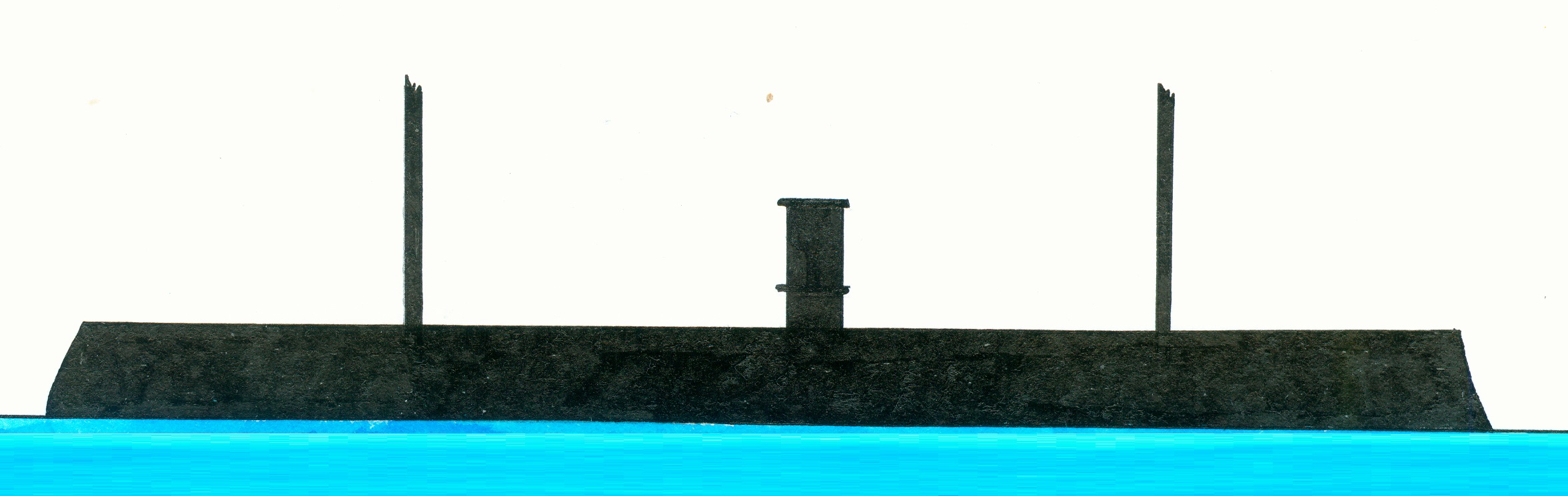
Italian cargo ship Ramb II 1936-1941 (Calitea 1941-1943), Ikutagawa Maru 1943-1945)

Ramb II. ©Warshipsresearch.blogspot.com
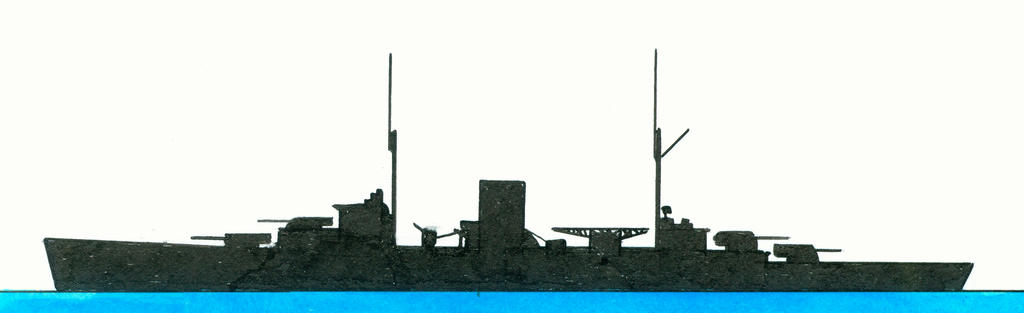
HMNZS Leander. ©Warshipsresearch.blogspot.com

Call sign ICHN. Homeport Genoa, Italy. Laid downt by Cantieri Riuniti Dell’Adriatrico, Monfalcone, Italy with yard number 1181 on 14 December 1936, launched on 7 June 1937, commissioned on 6 September 1937, requisitioned by Italian navy on 9 April 1940, converted into an auxiliary cruiser at Masawa, Italian Eritrea [since 1936 Italian East Africa], Japan did not permitted that she operated as a commerce raider against British ships in the Indian Ocean out of Japanese harbours, chartered by the Japanese navy as store ship in September 1942, scuttled by own crew in Kobe, Japan on 8 September 1943, refloated by Japanese in 1943 and as Ikutagawa Maru taken into service on 3 October 1943,commissionedas auxiliary transport on 30 November 1943, sunk in an air attack on Indochina on 12 January 1945 and stricken on 5 February 1945. Armament as auxiliary cruiser 4-12cm/14.7” guns and 2-13.2mm.0.62” anti aircraft guns. Owner Ministere dell’Africana Italiana Regio Azienda Monopolio Banane and with her sister ships active in the banana trade between Italy and Italian Somaliland [since 1936 Italian East Africa]. Just like the Ramb I converted into an auxiliary cruiser seeking refugee in Japan was the Ramb I sunk by the New Zealand light cruiser HMNZS Leander on 27 February 1941. 

Sunday, 29 December 2019

Italian troop transports underway to or returning from Eritrea according to the Dutch newspaper Algemeen Handelsblad evening edition dated 14 October 1935

An item referred to the newspaper Morning Post which reported that tidings from Port Saïd mentioned the arrival of 8 transports with totally 9,000 men on board underway to East Africa.(1) Coming from Eritrea arrived on Saturday and Sunday the Belvedère and the Sargenia with 600 wounded from the fights near Adoea and who were to be transported to the Dodecanesus.

Note
1. In 1936 became Eritrea, Ethiopia and Italian Somaliland part of the Italian province Italian East Africa or Africa Orientale Italiana. The Ethiopian Empire (also referred to as Abyssinia) was just before captured by Italy during the Second Italo-Abyssinian War between October 1935 and May 1936. Eritrea was since 1 January 1890 an Italian colony after the Italian invasion in Ethiopia in which Italy was defeated.

Sunday, 3 December 2017

Italian harbour of Assab expanded according to the Dutch magazine Marineblad dated 1937 No. 3

An item referred to the magazine Revista Marittime dated February 1937 reporting that Italy was expanding the harbour of Assab, Italian Eritrea [later Italian East Africa nowadays Eritrea] on large scale, including a jetty900 metres stretching into the sea and 700 metres parallel off the coastline. The berthing quays had a length of 2 kilometres along 6 ships at the same time could be berthed. It was reckoned that within 4 years the works were completed with as building costs 80 million lire. 

Friday, 1 December 2017

The Italian submarine service according to the Dutch magazine Marineblad dated 1938 no. 6

An item referred to the magazine Revista Marittime dated August 1938 reporting that admiral Ducci (1) in the Senate stated that the Italian submarine service numbered 105 boat but just a third was available for immediately service in times of war. The other 2/3 was under repairs or their crews needed to rest. Of all submarines were just 14 boats of the Galvant (2) and the Marcello (3) classes able to go at once from Italy via Cape of Good Hope towards Italian Somalia (a distance of 10.000 miles) without needing to bunker underway oil. Another 14 of this design were now under construction.

Notes
1. Gino Ducci (18 September 1872 Firenzen-5 January 1962 Rome), naval chief off staff 19131-1934 an member of the senate 1933-25 July 1945.
2. Not Galvant but Galvani. Part of the Brin-class long-range submarines consisting of the Brin, Galvani, Guglielmotti, Archimede and Torricelli, preceded by the Archimede-class and succeeded by the Liuzzi-class. Launched on 11 September 1938 and destroyed by the British sloop HMS Falmouth on 26 June 1940.
3. Part of the Marcello-class, consisting of the Marcello, Dandolo, Mocenigo, Nani, Veniero, Provana, Barbarigo, Emo, Morosinim Commandante Alfredo Cappellini and Comandante Faa di Bruno. Launhced on 20 November 1937, completed on 5 March 1938 and disappeared during her patrol end February 1941. 

Thursday, 30 November 2017

Italy intended founding naval base along Italian Somaliland coastline according to the Dutch magazine Marineblad dated 1938 no. 6

An item referred to the Revista Marittime dated August 1938 reporting that there were intentions to found a fortified naval base along the coast of Italian Somaliland (1), probably one of the harbours of Negro Bay namely d’Obbia, Itala or Brava.

Note
1. Italian Somaliland or Somali was since the 1880s Italian territory and in 1936 added to Italian East Africa and since 1941 controlled by British armed forces. Mogadishu was around 1935 a important naval base. 

Monday, 6 March 2017

Former Dutch steamship Gelria became Italian troop transport Gradisca according to the Dutch newspaper Soerabaijasch handelsblad dated 11 September 1935

An item reported that the crew of the Gelria (1) returned from Italy. Already underway towards Italy started the Italians on board with her conversion into a troop transport. At Genoa was the further conversion with a large number of labours in all haste completed. In the 2nd class saloon for instance were lines of 3 on top of each other ship cages made. The luxury cabins maintained for the officers. She was to depart the 12 towards East Africa.(2)

Notes
1. Built for account of the Dutch shipping company N.V. Koninklijke Hollandsche Lloyd by Alex Stephen&Sons, Linthouse in 1913. In 1934 chartered by Argentine merchants for a world tour. The next year sold to Italy and renamed Gradisca. In Italian service used as troop transport and hospital ship until she stranded in 1946 and broken up in 1950.
2. Italy was in war with Ethiopia between 3 October 1935-May 1936 ending in the Italian annexation. Ethiopia, Italian Eritrea and Italian Somaliland formed since 1936 Italian East Africa.

Tuesday, 10 January 2017

Turkish casemate ironclad Avni-Illah 1867-1912

Turkish Avni-Illah class ironclads 

Italian armoured cruiser Giuseppe Garibaldi

Building ordered in 1867, laid down by Thames Iron Works, Blackwall, London, England in 1868, launched on 21 April 1869, trials in 1869, commissioned on 1870, modernized and rearmed between 1903-1907 and sunk during the Battle of Beirut, Lebanon against the Italian armoured cruisers Guiseppe Garibaldi and Varese. (1) Of the Avni-Illah-class consisting of the Avni-Illah and the Muin-I-Zafer.

Displacement 2.362-2.380 tons and as dimensions 68,9 (between perpendiculars)-71,9 (over all) x 10,79 x 6,32 (hold) x 5,05 (fore and aft) metres. Two hexagonal casemates stinging outboard connected with armoured walls in such a manner that the blueprint shows the figure of a violin/ The result is that the guns have an optimized firing range. The 8 portholes are 1,98 metres above the water surface. Armour consists of a 12,7cm thick belt while the casemate is protected by 12,7cm thick armour.  Horsepower 400 nhp with twin screws allowing a speed of 12,5 (trials) knots. Schooner-rigged. Crew numbered 145-200 men. The original main armament consisted of 4x1-23cm/9” muzzle loading Armstrong guns. After 1907 consisted the armament of armed with 4-15cm/5.9” L/40 quick firing Krupp guns, 6-7,5cm/3” quick firing Krupp guns, 10x1-6pd guns and 2x1-3pd guns and a ram bow.

Note
1.

Note
1. Giuseppe Garibaldi-class of armoured cruisers built in Italy consisted of several ships, The Giuseppe Garibaldi which was laid down by Gio. Ansaldo&C., Genova-Sestri Ponante, Italy on 8 June 1898, launched on 29 June 1899 and completed on 1 January 1901 had a displacement of 7.350 tons, a speed of 19 knots, a armour belt of 8/3.1”-15cm/5.” thickness, a 3,8cm/1.5” thick deck, 5cm/2” thick gun shields with the gun turrets and conning tower protected by 15cm/5.9” The armament consisted of 1x1-25,4cm/10” gun, 1x2-20m3cm/8” guns, 14x1-15,2cm/6” guns, 10x1-7,6cm/3” guns, 6x1-4,7cm/1.9” guns and 4x1-45c,/17.7” torpedo tubes. 

Sunday, 10 July 2016

New regulations for non-Italian warships visiting Italian harbours according to the Dutch magazine Marineblad dated 1906-1907 no. 6

An item reported that the Italian government renewed the regulations for foreign warships visiting Italian territorial waters and harbours. Wth a maximum number of 3 ships at the same time was it allowed to visit protected harbours for maximum 8 days. Exceptions were possible after diplomatic permission. Such harbours were Savona/Vado, Genoa, Spezia, Monte Argentaro, Talamone/porto San Stefano, Gaeta, Maddalena with the nearby islands and the Sardinian coast, anchorages Messina with the anchorages at both sides of the strait, Tarente and Venice with th anchorages in the Lagoon. When entering the harbours of Genoa, Spezia, Gaeta, Maddalena, Messina, Tarente and Venice was to be saluted. Further more was to be saluted in the harbours of Naples, Ancona and Palermo and every other Italian harbour including in the colony Eritrea where at that moment an Italian warship was lying which was able to return the salute. Surveying, landing and gun practices within the gun range of the coast were forbidden, just like executions under the Italian coast.