Translate

Showing posts with label Dutch Gold Coast. Show all posts

Friday, 4 April 2025

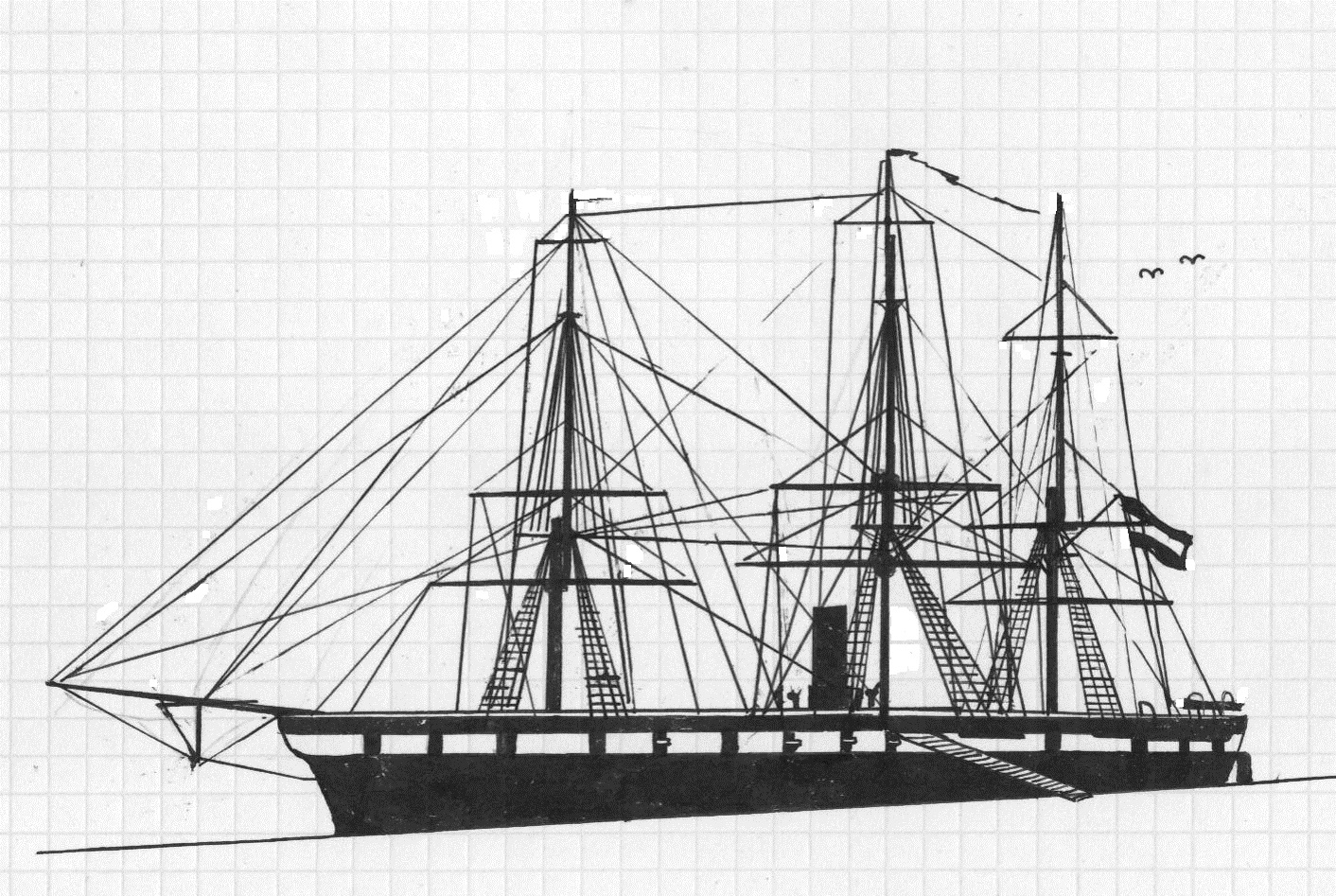
Dutch screw steamship 3rd class Zr.Ms. Het Loo 1858-1906

Call sign GQMR, wood-built, on stocks at the navy yard at Amsterdam, Netherlands 13 May 1858, launched 17 March 1859, commissioned 26 July 1859, docked at the navy yard at Hellevoetsluis 26 May-19 June 1865 &12 April-14 August 1867, 21 July-8 August 1871 and 1-3 September 1869, together with the Zr.Ms. Citadel van Antwerpen present when the Dutch colours at the Dutch Gold Coast was stricken, converted at the navy yard at Willemsoord, Netherlands into artillery training ship and commissioned at Willemsoord 16 September 1876, decommissioned and condemned for services outside the Nieuwediep, Netherlands 8 May 1889, accommodation for artillery training ship 25 September, condemned and replaced by the Zr.Ms. Atjeh 1906, decommissioned 8 November and stricken. 

Wednesday, 15 April 2020

Dutch corvette Zr.Ms. Venus arrived at Texel, Netherlands returning from the Dutch Gold Coast (Ghana) according to the Dutch newspaper Middelburgsche Courant dated 27 June 1816


An item dated Amsterdam, Netherlands the 25th reported that on the 23rd the Dutch corvette Zr.Ms. Venus (1) captain Van Schuler arrived at Texel, Netherlands. She transported governor general Daendels to the castle Del Mina, Guinea and left there in the end of March.(2) With her returned Mr. De Veer who served the last 7 years as commandant-general at Guinea.(3)

Notes
1. She returned from St. Georges Castle Elmina, Dutch Gold Coast (nowadays Ghana). ). Laid down at the navy yard at Materdam, Netherland on 2 January 1806, launched on 2 May 1807, in January 1821 added to the Colonial navy in the Dutch East Indies after being repaired while being condemned for the voyage to the Netherlands and broken up in 1823. Armed with 20 guns. Dimensions 120 (over prow) x 33 9/11 x 16 2/11 feet.
2. Herman Willem Daendels (21 October 1762 Hattem, Netherlands-2 May 1818 Elmina) governor general at the Dutch Gold Coast between 1 March 1816 and 22 April 1818.
2. Abraham de Veer, between 23 February 1810 and 1 March 1816 commandant general at the Dutch Gold coast and succeeded by governor general Herman Willem Daendels.

Thursday, 9 April 2020

Dutch governor general Daendels bound for the Dutch Gold Coast (Ghana) according to the Dutch newspaper Middelburgsche Courant dated 18 May 1816

An item dated The Hague, Netherlands the 15th referred to rumours reporting that the Dutch governor general Daendels (1) bought at Sierra Leone a brig called Goudkust with the intention to depart begin January towards Axum and St. George d’Elmina.(2)

Notes
1. Herman Willem Daendels (21 October 1762 Hattem, Netherlands-2 May 1818 Elmina) governor general at the Dutch Gold Coast between 1 March 1816 and 22 April 1818. The name of the ship he bought Goudkust can be translated as Gold Coast.
2. St. Georges Castle Elmina, Dutch Gold Coast (nowadays Ghana).

Thursday, 2 April 2020

Dutch corvette Zr.Ms. Ajax arrived at Surinam coming from the Dutch Gold Coast (Ghana) according to the Dutch newspaper Middelburgsche Courant dated 3 September 1818

An item dated Amsterdam, Netherlands 28 August reported the arrival of the Dutch corvette Zr.Ms. Ajax captain lieutenant Bolken at Surinam after a voyage of 19 days coming from St. George d’Elmina.(1)

Note
1. Department Harlingen, on stocks by P. Schuijt jr at naval yard at Harlingen, Netherlands March 1796, launched October or 18 November 1796, coppered 1798, coppered 1813, out of service 28 February 1822, part of Colonial navy 1822, keel lighter 1823, broken up 1824, dimensions 115 x 32 3/11-32 9/11 x 18, 18-20 guns, 99-140 men.

Monday, 15 May 2017

Dutch navy testing compound rifle bullets according to the Dutch magazine Marineblad dated 1886-1887 no. 4

An item reported that the Royal Netherlands Navy intended to test the so-called well known rifle bullets invented by Lorenz, engineer and owner of the Deutsche Metall Patronenfabrik Lorenz, Karlsruhe, Germany. The lead made bullets with a hard metal mantle seemed to be able to penetrate the hull of a torpedo boat on much larger distance as was possible with the soft lead bullets nowadays used by the Dutch navy. The test were executed on board of the Zr. Ms. artillery training ship Zr. Ms. Het Loo.(1)

Note
1. Screw steamship 3rd class, call sign GQMR, wood-built, on stocks at the navy yard at Amsterdam, Netherlands 13 May 1858, launched 17 March 1859, commissioned 26 July 1859, docked at the navy yard at Hellevoetsluis 26 May-19 June 1865 &12 April-14 August 1867, 21 July-8 August 1871 and 1-3 September 1869, together with the Zr.Ms. Citadel van Antwerpen present when the Dutch colours at the Dutch Gold Coast was stricken, converted at the navy yard at Willemsoord, Netherlands into artillery training ship and commissioned at Willemsoord 16 September 1876, decommissioned and condemned for services outside the Nieuwediep, Netherlands 8 May 1889, accommodation for artillery training ship 25 September, condemned and replaced by the Zr.Ms. Atjeh 1906, decommissioned 8 November and stricken, displacement 759 tons, dimensions 43 x 9,2 x 4,3 metres, coal bunker capacity 100-200 ton, horsepower 115 nhp/250ehp, speed 7-12 (maximum) miles, range (in 187) 7 days full speed, a crew numbering 86 (1877)-100 men and an armament consisting of 2 rifled 16cm guns, 1-15cm gun and 4-12cm guns. 

Wednesday, 25 May 2016

Dutch merchant ship Burgemeester Hoffman transporting troops from Netherlands and the Dutch Gold Coast towards the Dutch East Indies according to the Dutch newspaper Zierikzeesche Courant dated 28 July 1860

An item dated Harderwijk, Netherlands 23rd reported that a detachment military for the Dutch army in the Dutch East Indies would embark at Rotterdam, Netherlands on the 28th the merchant ship Burgemeester Hoffman master T.D. de Wit. At St. George d’Elmina was a detachment negro recruits to be picked up and from there to be brought transported towards Java. The 4 petty officers and corporals who were embarked at Rotterdam were temporarily detached at St. George d’Elmina where they would replace the petty officers and corporals there serving. The latter were also destined towards Java.

Wednesday, 11 May 2016

Dutch screw steamship 3rd class Zr. Ms. Het Loo undergoing repairs at Onrust, Dutch East Indies according to the Dutch newspaper Nederlandsche staatscourant dated 6 August 1864

An item referred to tidings dated 14 June 1864 dealing with the movements of the Dutch squadron in the Dutch East Indies reported that the Dutch screw steamship 3rd class Zr. Ms. Het Loo lieutenant 1st class H.D. Slegt undergoing repairs at Onrust, Dutch East Indies for her voyage back to the Netherlands.(1)

Note
1. Call sign GQMR, wood-built, on stocks at the navy yard at Amsterdam, Netherlands 13 May 1858, launched 17 March 1859, commissioned 26 July 1859, docked at the navy yard at Hellevoetsluis 26 May-19 June 1865 &12 April-14 August 1867, 21 July-8 August 1871 and 1-3 September 1869, together with the Zr.Ms. Citadel van Antwerpen present when the Dutch colours at the Dutch Gold Coast was stricken, converted at the navy yard at Willemsoord, Netherlands into artillery training ship and commissioned at Willemsoord 16 September 1876, decommissioned and condemned for services outside the Nieuwediep, Netherlands 8 May 1889, accommodation for artillery training ship 25 September, condemned and replaced by the Zr.Ms. Atjeh 1906, decommissioned 8 November and stricken, displacement 759 tons, dimensions 43 x 9,2 x 4,3 metres, coal bunker capacity 100-200 ton, horsepower 115 nhp/250ehp, speed 7-12 (maximum) miles, range (in 187) 7 days full speed, a crew numbering 86 (1877)-100 men and an armament consisting of 2 rifled 16cm guns, 1-15cm gun and 4-12cm guns.

Tuesday, 3 May 2016

Dutch screw steamship 1st class Zr.Ms. Metalen Kruis arrived in the Netherlands coming from Dutch Gold Coast according to the Dutch newspaper Middelburgsche courant dated 9 June 1868


An item reported the arrival of the Dutch screw steamship 1st class Zr. Ms. Metalen Kruis (1) captain J. Vos (2) in the afternoon of 6 June 1868 in the roads of Texel, Netherlands returning from the coast of Guinea.

Notes
1. Screw steamship 1st class also called frigate, call sign GQNT, wood-built, laid down at the navy yard at Amsterdam on 21 March 1860, launched on 29 July 1862, ex-Soerabaja renamed in 1863, commissioned on 17 September 1863, building costs ƒ 752.588,82, decommissioned and condemned at Surabaya, Dutch East Indies on 20 September 1878, dimensions 58,00 (between perpendiculars) x 12,25 x 5,50 metres, a displacement of 2.030 tons, horsepower 700 hp, speed 8,5 knots, an armament of 16 guns (8 long 30pd, 8 rifled 16cm) and a crew numbering 225 men.
2. Jan Vos (9 October 1817 Vlissingen, Netherlands-4 August 1884 Utrecht, Netherlands), retired on 1 May 1874, promoted to the rank of rear admiral in 1878

Saturday, 30 April 2016

Dutch screw steam corvette Zr.Ms. Prinses Maria arrived in the Netehrlands returning from Dutch Gold Coast according to the Dutch newspaper Nederlandsche staatscourant dated 2 April 1865

Model Rijksmuseum Amsterdam NG-MC-487. Original url

An item reported that the Dutch screw steam corvette Zr.Ms. Prinses Maria lieutenant 1st class W.K. van Gennep returning from the coast of Guinea arrived in the roads of Hellevoetsluis, Netherlands on 1 April 1865.(1)

Note
1. Former ‘kuil’ corvette Borneo, ‘kuil’corvette, on stocks at the navy yard at Rotterdam, Netherlands 30 August 1845, designed by K. Turk, disassembled and transported to the navy yard of Vlissingen, Netherlands in August 1850, renamed Prinses Amalia on 6 August 1850, laid down by P.A. Bruin 29 July 1853, launched as Princes Amelia as corvette with steam power afternoon Friday 12 October 1855, commissioned on 26 May 1856, call sign GQRL, guard ship at Surabaya, Dutch East Indies 1872-1875, condemned and sold on auction at Surabaya for ƒ 20.000 to be broken up on 9 October 1875, building costs ƒ 560.760,53½, dimensions 36,50 x 10,3 x 4,82 metres as Borneo and as Prinses Amelia 49,8 (load line between perpendiculars)-53,6 (foreside prow-aft side rudder stern) x 11 (inner hull) x 4,5(fore)-5,0 (aft) x 5,71 (depth) metres, displacement, 776 (Borneo)-1.350 (Prinses Amelia) tons, 807 tonnage (Prinse Amelia 1874), 16-19 (Prinses Amelia)-28 (Borneo) guns, crew as Prinses Amelia numbering 178 (1874)-207 men, maximum speed under steam 6-7knots and a horsepower of 150 hp. Armament as the Prinses Amelia consisted on gun deck of 12 long 30pd gun no. 2, 4-heavy 2”grenade guns no. 2 and on upper deck 1 long 30pd pivot gun no. 2 and at both sides 1 long 30pd gun no. 2. In 1869 8-long 30 pd guns, 4-20” grenade guns and 4-4pd rifled guns. A so-called water-tube boiler with 176 tubes and with a partly telescopic funnel.

Thursday, 28 April 2016

Dutch screw steamship 1st class Zr.Ms. Metalen Kruis arrived at Dutch Gold Coast according to the Dutch newspaper Middelburgsche courant dated 8 February 1868


Portrait of Jan Vos. Original source

An item reported the arrival of the Dutch screw steamship 1st class Zr. Ms. Metalen Kruis (1) captain J. Vos (2) on 26 December 1867 in the roads of St. George d’Elmina [nowadays Ghana]. Everything was well on board.

Notes
1. Screw steamship 1st class also called frigate, call sign GQNT, wood-built, laid down at the navy yard at Amsterdam on 21 March 1860, launched on 29 July 1862, ex-Soerabaja renamed in 1863, commissioned on 17 September 1863, building costs ƒ 752.588,82, decommissioned and condemned at Surabaya, Dutch East Indies on 20 September 1878, dimensions 58,00 (between perpendiculars) x 12,25 x 5,50 metres, a displacement of 2.030 tons, horsepower 700 hp, speed 8,5 knots, an armament of 16 guns (8 long 30pd, 8 rifled 16cm) and a crew numbering 225 men.
2. Jan Vos (9 October 1817 Vlissingen, Netherlands-4 August 1884 Utrecht, Netherlands), retired on 1 May 1874, promoted to the rank of rear admiral in 1878.

Wednesday, 30 September 2015

Dutch schooner brig Zr. Ms. Lansier bound for the Dutch East Indies according to the Dutch newspaper Middelburgsche Courant dated 4 November 1851

An item dated Middelburg, Netherlands 3rd reported that the Dutch schooner brig Zr. Ms. Lansier lieutenant 1st class Alvarez underway from Hellevoetsluis, Netherlands via St. George d’Elmina, Dutch Gold Coast/Ghana and Cape of Good Hope, South Africa towards Batavia, Dutch East Indies grounded on the outside of the Goodwin-Sands on 27 October at 05.30 o’clock. A Deal boat managed to salvage her and without visible damaged anchored she off Downs. On Tuesday 28th she continued her voyage.(1)

Note
1. Lansier or Lancier, schooner brig/brigantine, on stocks at the navy yard at Amsterdam, Netherlands 22 March 1842, launched on 2/3 August 1843, commissioned 10 November 1843 at Willemsoord, Netherlands, docked at the navy yard at Hellevoetsluis, Netherlands 21 May-24 December 1850, rebuilt as floating battery in Dutch East Indies, sold by John Price&Co. at 09.30 o’clock at the naval establishment at Onrust, Dutch East Indies on Tuesday 14 August 1860, dimensions 28,50 x 8,70 x 3,15, 252 tons displacement and an armament of 6 guns.

Sunday, 23 August 2015

Dutch screw steamship Zr. Ms. 3rd class Reinier Claeszen and 4th class Haarlemmermeer stationed at Riouw and Linga, Dutch East Indies according to the Dutch newspaper Nederlandsche Staatscourant dated 26 February 1863

An item reported that since the last received account the Dutch steamhips Zr. Ms. Reineir Claeszen (1) and Haarlemmermeer (2) were stationed in the waters around Riouw and Linga, Dutch East Indies. The Reinier Claeszen visited with the resident of Riouw between 19 July and 26 September 1862 several islands including Siak. Visited were successively Kampong Baleh, Moenoes and Passar-Panjang (Groot-Karimon), the roads of Singapore ending at Bangkalis. After a stay of several days at Bangkalis she departed towards Panu Sudang and from there to Langkat, Dutch East Indies arrived there on 23 August 1862. On the 31st she arrived at Pinang for coal bunkering where she was joined on 3 September 1862 by the Haarlemmermeer with the order that the Reinier Claeszen had to return towards Batavia, Dutch East Indies. The resident of Riouw went on board of the Haarlemmermeer while the Reinier Claeszen via Riouw went to Batavia arriving there on the 17th.

The Haarlemmermeer left on 8 September 1862 Pinang, Dutch East Indies went to Assahan at the east coast of Sumatra, Dutch East Indies, anchored in the roads of Malacca [Malaysia] for inquiries dealing with the trade towards Sumatra and returned via Bengkalis, Dutch East Indies towards Riouw arrived there on 26th September 1862. On 19 November 1862 departed she towards Singapore to pick up the mail brought by the mail packet of the French Messageries Impériales, went to Muntok, Dutch East Indies handing over the mail to the Dutch steamship Zr. Ms. Het Loo. The Het Loo (3) went to Batavia, with the Haarlemmermeer returning to Riouw.

Notes
1. Screw steamship 3rd class, call sign GQSN, on stocks at the shipyard of K. Smit jr. Kinderdijk, Netherlands on 4 May 1858, launched on 13 January 1859, dry docked at the navy yard at Hellevoetsluis, Netherlands 21-22-July 1859,commissioned on 2 or 16 August 1859, condemned in 1869, sold with boilers on a public auction at Surabaya, Dutch East Indies on 29 January 1870, stricken in 1870, dimensions 45,50 x 9,20 x 4,30 metres, a displacement of 759, tons, an armament of 6 guns, a crew numbering 119 men and a horsepower of 119nhp/250 ehp.
2.Screw steamship 4th class, call sign GQKD, on stocks at navy yard at Vlissingen, Netherlands 9 July 1859, launched Friday afternoon 23 March 1860, commissioned 16 August 1860, condemned and ordered 8 June 1870 no. 15 to sell hull with rigging and useless inventory, engines stored at Surabaya, Dutch East Indies, building costs ƒ 255.916,53½, dimensions 38,00-40,70 x 8,16 x 3,20 metres, 586 tons displacement, tonnage 285 tons, coal bunker capacity 50 ton or 5 days full speed, 6 guns (2 medium 30 pd guns, 4-30pd carronades), 25-75 men, 80/200 nph horsepower and maximum speed under steam 6-7 knots.
3. Screw steamship 3rd class, call sign GQMR, wood-built, on stocks at the navy yard at Amsterdam, Netherlands 13 May 1858, launched 17 March 1859, commissioned 26 July 1859, docked at the navy yard at Hellevoetsluis 26 May-19 June 1865 &12 April-14 August 1867, 21 July-8 August 1871 and 1-3 September 1869, together with the Zr.Ms. Citadel van Antwerpen present when the Dutch colours at the Dutch Gold Coast was stricken, converted at the navy yard at Willemsoord, Netherlands into artillery training ship and commissioned at Willemsoord 16 September 1876, decommissioned and condemned for services outside the Nieuwediep, Netherlands 8 May 1889, accommodation for artillery training ship 25 September, condemned and replaced by the Zr.Ms. Atjeh 1906, decommissioned 8 November and stricken, displacement 759 tons, dimensions 43 x 9,2 x 4,3 metres, coal bunker capacity 100-200 ton, horsepower 115 nhp/250ehp, speed 7-12 (maximum) miles, range (in 187) 7 days full speed, a crew numbering 86 (1877)-100 men and an armament consisting of 2 rifled 16cm guns, 1-15cm gun and 4-12cm guns.

Thursday, 20 August 2015

Prussian naval officers on board of Dutch frigate Zr. Ms. Prins van Oranje and corvette Sumatra according to the Dutch newspaper Middelburgsche Courant dated 15 April 1851

Prins van Oranje. Rijksmuseum at Amsterdam, Netherlands. Original url

Sumatra. Model NG-MC-348. Rijksmuseum Amsterdam, Netherlands.Original url

An item dated Middelburg, Netherlands 14th reported that the Dutch frigate Zr. Ms. Prins van Oranje (1) captain D. Bijl de Vroe (2) bound for the Mediterranean and the corvette Zr.Ms. Sumatra (3)captain ‘t Hooft bound for Guinea would depart on 20 April. On each ship was a Prussian officer placed to be trained in seamanship. On board of the Sumatra was also the assistant-resident for the coast of Guinea mr. Nagtglas on board.(4)

Notes
1. Dirk Bijl de Vroe (22-12-1797 Bergen op Zoom, 14-5-1879 Netherlands-Haarlem, Netehrlands) ending his career in the rank of vice admiral.
2. Former Waal, frigate 1st class, call sign GQSB, on stocks at the navy yard at Rotterdam, Netherlands by P. Glavimans Jz.August 1828, launched 16 May 1840, renamed Prins van Oranje 1844, later guard ship, sold to be broken up 1897, dimensions 54 (load line) x 14 (inner hull) x 5,8-6,3 (aft) x 7,13 (hold below upper deck) metres, 2.481-2.485 tons displacement, 60 (peace:30-30pd guns, 30-30pd carronades, 2-12pd guns))-70 (war) guns and a sail area of 2.170m2.
Rijksmuseum at Amsterdam, Netherlands
original url https://www.rijksmuseum.nl/nl/collectie/NG-MC-321
3. Sumatra also called Sumatraan, ‘kuil’corvette, on stocks at the navy yard at Rotterdam, Netherlands by C.J. Glavimans on 26 October 1843, launched on 18 May 1848, transferred to the navy yard at Hellevoetsluis, Netherlands on 28 August, there docked and coppered 9-23 October, commissioned on 1 May 1849, burned off Kema, Celebes on 16 May 1854, displacement 942 tons and as dimensions 39,5 (waterline) x 12,00 (inner hull) 12,30 x 5,00 (fore)-5,40 (aft) and a hold of 6,2 metres and an armament of 26 guns.
4. Cornelis Johannes Marius Nagtglas (16 May 1814-18 January 1897, who finally became governor of the Gold Coast (20 March 1869-8 June 1871.

Wednesday, 19 August 2015

Dutch frigate Zr.Ms. Prins van Oranje arrived at Ascension according to the Dutch newspaper Middelburgsche Courant dated 13 July 1850

Rijksmuseum at Amsterdam, Netherlands 

An item referred to a tiding of the commanding officer of the Dutch frigate Zr.Ms. Prins van Oranje reporting the arrival at Ascension on 22 May with the intention to continue his voyage immediately. Everything was well on board. In March and April were St. Cruz (Tenerife, Canary Islands), George d’Elmina Dutch Gold Coast/Dutch Guinea [nowadays Ghana] and Fernando Po visited.(1)

Note
1. Ex-Waal, frigate 1st class, call sign GQSB, on stocks at the navy yard at Rotterdam, Netherlands by P. Glavimans Jz.August 1828, launched 16 May 1840, renamed Prins van Oranje 1844, later guard ship, sold to be broken up 1897, dimensions 54 (load line) x 14 (inner hull) x 5,8-6,3 (aft) x 7,13 (hold below upper deck) metres, 2.481-2.485 tons displacement, 60 (peace:30-30pd guns, 30-30pd carronades, 2-12pd guns))-70 (war) guns and a sail area of 2.170m2.

Tuesday, 2 September 2014

Dutch warships Amphitrite and Merwede together with the Dutch merchant ship Rhoon en Pendrecht bound for Guinea according to the Dutch newspaper Goessche Courant dated Monday 23 April 1839

Model Amphitrite Rijksmuseum Amsterdam, Ntherlands

An item reported the departure by general major Verveer on last Saturday from The Hague, Netherlands towards Hellevoetsluis, Netherlands to embark there the Dutch merchant ship Rhoon en Pendrecht. This ship was to depart with the first favourable weather condition with the Dutch corvette Zr.Ms. Amphitrite (1) and the transport Zr.Ms. Merwede (2) towards St. George d’Elmina (3) and visited underway Santa Cruz, Tenerife.

Notes
1. Flush-decked corvette, on stocks at the navy yard at Vlissingen, Netherlands by C. Soetermeer 1827, launched 22 June 1830, commissioned 16 August 1830, reduced to 20-gun ‘kuil’-corvette 1837, decommissioned November-December 1851 at Curacao due to worse condition and not able to return homewards, sold to be broken up at Curacao 13 April 1852, with as dimensions 39 (between perpendiculars) x 10,5 (inner hull) x 4,10 (fore)-4,70 (aft) x 5,37 (hold below deck) metres and a displacement of <850 tons, an armament consisted of 18 short 30pd guns and 2-12pd guns after 1837 and a crew numbering 300 men (1830).
2. On stocks at the shipyard of Jan Schouten, Dordrecht, Netherlands 1832, launched 28 July 1835, commissioned 1 March 1838, docked at the navy yard at Hellevoetsluis, Netherlands 19-21 June 1839, 20-22 July 1840, 7-9 April and 13-15 December 1841, 13 July-8 August 1842, 23-29 January and 18-22 September 1845, 15-18 July 1846, for extensive repairs 27 July 1847-26 August 1848, 30 April 1 May 1850, 19 April 1852, 21 August 1854-1- August 1855, 4 August-? 1856, 28 November-9 December 1857, 4-8 January 1858, sale in the Dutch East Indies for an unknown period delayed in 1860, dimensions 33,70 x 9,1 x 3,80 metres, 8 guns.
3. Dutch Gold Coast or Guinea, nowadays Ghana.

Saturday, 30 August 2014

Dutch transport Zr.Ms. Merwede arrived in the Netherlands returning from Guinea according to the Dutch newspaper Middelburgsche Courant dated 23 October 1838

An item reported the arrival of the Dutch transport Zr.Ms. Merwede (1)lieutenant 1st class Stort on the18th in the roads of Amsterdam, Netherlands. Everything was was well on board. She participated in the expedition towards Guinea. (2)

Notes
1. On stocks at the shipyard of Jan Schouten, Dordrecht, Netherlands 1832, launched 28 July 1835, commissioned 1 March 1838, docked at the navy yard at Hellevoetsluis, Netherlands 19-21 June 1839, 20-22 July 1840, 7-9 April and 13-15 December 1841, 13 July-8 August 1842, 23-29 January and 18-22 September 1845, 15-18 July 1846, for extensive repairs 27 July 1847-26 August 1848, 30 April 1 May 1850, 19 April 1852, 21 August 1854-1- August 1855, 4 August-? 1856, 28 November-9 December 1857, 4-8 January 1858, sale in the Dutch East Indies for an unknown period delayed in 1860, dimensions 33,70 x 9,1 x 3,80 metres, 8 guns.
2. Guinea or Dutch Gold Coast is nowadays Ghana.

Dutch corvette Zr.Ms. Amphitrite arrived in the Netherlands returning from Guinea according to the Dutch newspaper Middelburgsche Courant dated 23 October 1838

Model Rijksmuseum Amsterdam, Netherlands after she was razeed

An item dated Vlissingen, Netherlands the 22nd reported that on the 17th the Dutch corvette Zr.Ms. Amphitrite (1) captain lieutenant Tengbergen arrived at Den Helder, Netherlands returning from the coast of Guinea.(2)

Notes
1. Flush-decked corvette, on stocks at the navy yard at Vlissingen, Netherlands by C. Soetermeer 1827, launched 22 June 1830, commissioned 16 August 1830, reduced to 20-gun ‘kuil’-corvette 1837, decommissioned November-December 1851 at Curacao due to worse condition and not able to return homewards, sold to be broken up at Curacao 13 April 1852, with as dimensions 39 (between perpendiculars) x 10,5 (inner hull) x 4,10 (fore)-4,70 (aft) x 5,37 (hold below deck) metres and a displacement of <850 tons, an armament consisted of 18 short 30pd guns and 2-12pd guns after 1837 and a crew numbering 300 men (1830).
2. Guinea or Dutch Gold Coast is nowadays Ghana.

Friday, 29 August 2014

Dutch warships Zr.Ms. Amphitrite, Mercuur and Merwede added to the Guinea-expedition according to the Dutch newspaper Vlissingse Courant dated 27 March 1838

An item reported that in the end of March of begin April the Dutch corvette Zr.Ms. Amphitrite (1) captain lieutenant Tengbergen, brig Zr.Ms. Mercuur (2) captain lieutenant Tuning and the transport Zr.Ms. Merwede (3) 1st lieutenant Stort were to transport the expedition commanded by general Verveer to Guinea [nowadays Guinea] to act against the ‘Hantijnsch’ chief.(4) The ships were to ve fitted out around 20th March.

Notes
1. Flush-decked corvette, on stocks at the navy yard at Vlissingen, Netherlands by C. Soetermeer 1827, launched 22 June 1830, commissioned 16 August 1830, reduced to 20-gun ‘kuil’-corvette 1837, decommissioned November-December 1851 at Curacao due to worse condition and not able to return homewards, sold to be broken up at Curacao 13 April 1852, with as dimensions 39 (between perpendiculars) x 10,5 (inner hull) x 4,10 (fore)-4,70 (aft) x 5,37 (hold below deck) metres and a displacement of <850 tons, an armament consisted of 18 short 30pd guns and 2-12pd guns after 1837 and a crew numbering 300 men (1830).
2. Mercuur or Merkuur, on stocks at the navy yard at Rotterdam, Netherlands 1830 by P. Glavimanss Jz., launched 6 April 1833, docked at the navy yard at Hellevoetsluis, Netherlands 14-19 December 1837&15-19 January 1839, 1-15 September 1849 and finally to be broken on 18 November 1853, dimensions 29,8 (load line) x 9,2 (inner hull) x 3,4 (fore)-4,5 (aft) x 4,5 (hold below maindeck) metres, 546 tons displacement and 18 guns (16-30pd carronades and 2-6pd guns).
3. On stocks at the shipyard of Jan Schouten, Dordrecht, Netherlands 1832, launched 28 July 1835, commissioned 1 March 1838, docked at the navy yard at Hellevoetsluis, Netherlands 19-21 June 1839, 20-22 July 1840, 7-9 April and 13-15 December 1841, 13 July-8 August 1842, 23-29 January and 18-22 September 1845, 15-18 July 1846, for extensive repairs 27 July 1847-26 August 1848, 30 April 1 May 1850, 19 April 1852, 21 August 1854-1- August 1855, 4 August-? 1856, 28 November-9 December 1857, 4-8 January 1858, sale in the Dutch East Indies for an unknown period delayed in 1860, dimensions 33,70 x 9,1 x 3,80 metres, 8 guns.
4. King Bonsoe of the Hanta’s or Ahanta’s. Generaal major Verveer himself died on 22 August 1838 during this expedition. Guinea or Dutch Gold Coast is nowadays Ghana.

Dutch warships Zr.Ms. Amphitrite, Pelikaan and Dordrecht added to the Guinea-expedition according to the Dutch newspaper Vlissingse Courant dated 3 March 1838

An item reported that the Dutch corvette Zr.Ms. Amphitrite (1) captain lieutenant Tengbergen, the Dutch brig Zr.Ms. Pellikaan (2) and the transport Zr.Ms. Dordrecht (3) were to support the expedition commanded by general major Verveer to the coast of Guinea.(4)

Notes
1. Flush-decked corvette, on stocks at the navy yard at Vlissingen, Netherlands by C. Soetermeer 1827, launched 22 June 1830, commissioned 16 August 1830, reduced to 20-gun ‘kuil’-corvette 1837, decommissioned November-December 1851 at Curacao due to worse condition and not able to return homewards, sold to be broken up at Curacao 13 April 1852, with as dimensions 39 (between perpendiculars) x 10,5 (inner hull) x 4,10 (fore)-4,70 (aft) x 5,37 (hold below deck) metres and a displacement of <850 tons, an armament consisted of 18 short 30pd guns and 2-12pd guns after 1837 and a crew numbering 300 men (1830).
2. Pelikaan also called Pellikaan, Department Amsterdam, building ordered 15 January 1819, on stocks at navy yard at Amsterdam, Netherlands August 1819 by P. Schuijt jr., 11 January 1820 ordered to be completed, launched 15 June 1821, coppered 1821, order 11 February 1822 to be completed in 1822, commissioned 1 March 1823, condemned 1844,sold at Paramaribo, Surinam for ƒ 1.000, 00 to be broken up 11 June 1845,displacement 191 tons, dimensions 22,6 (load line) x 7,1 (inner hull) x 2,7 (fore)-3,4 (aft) x 3,6 (below maindeck) metres and an armament of 8 guns consisting of 6-12pd carronades and 2-6pd guns.
3. On stocks at the shipyard of Jan Schouten at Dordrecht, Netherlands 1828, launched afternoon at 16.30 o’clock (planned) 29 April 1829, docked at the navy yard of Hellevoetsluis, Netherlands 1-2 April 1830& 26-12 December 1831&28 August 1832; 22-26 November 1833&7 August-1 November 1834&12-14 March 1838, 3-10 September 1838&9 November 1839-22 June 1840, 12-15 December 1841&15-19 April 1842 and 16-18 August 1843, decommissioned 15 July 1847, brought to Amsterdam, Netherlands on 22 July 1848, handed over to the Institute for sailors van de Zeil- en Roeivereniging KNZRV 1848, replaced by the former Zr.Ms. Venus in 1862was coppered, with an armament of 8 guns.
4. Dutch Gold Coast nowadays Ghana.

Sunday, 20 July 2014

Dutch ship Prinses Charlotte transported troops to the Dutch Gold Coast and Surinam according to the Dutch newspaper Leydse courant 20 November 1850

An item dated Harderwijk, Netherlands the 16th reported the intended departure of a detachment military on the 26th by ship towards Amsterdam, Netherlands and from there by train towards Rotterdam, Netherlands to embark ultimate the 27th the Dutch ship Prinses Charlotte captain L.C.E. van der Brugh. The detachment consisted of 30 African soldiers returned from service in the Dutch East Indies now to be transported to St. George d’Elmina (Dutch Gold Coast=Ghana) and 2 non-commissioned officers, 4 corporals and 69 European soldiers destined for Surinam. The detachment was commanded by 2nd lieutenant J.C. Buschman.