Translate

Showing posts with label Pescadores Islands. Show all posts

Friday, 15 May 2026

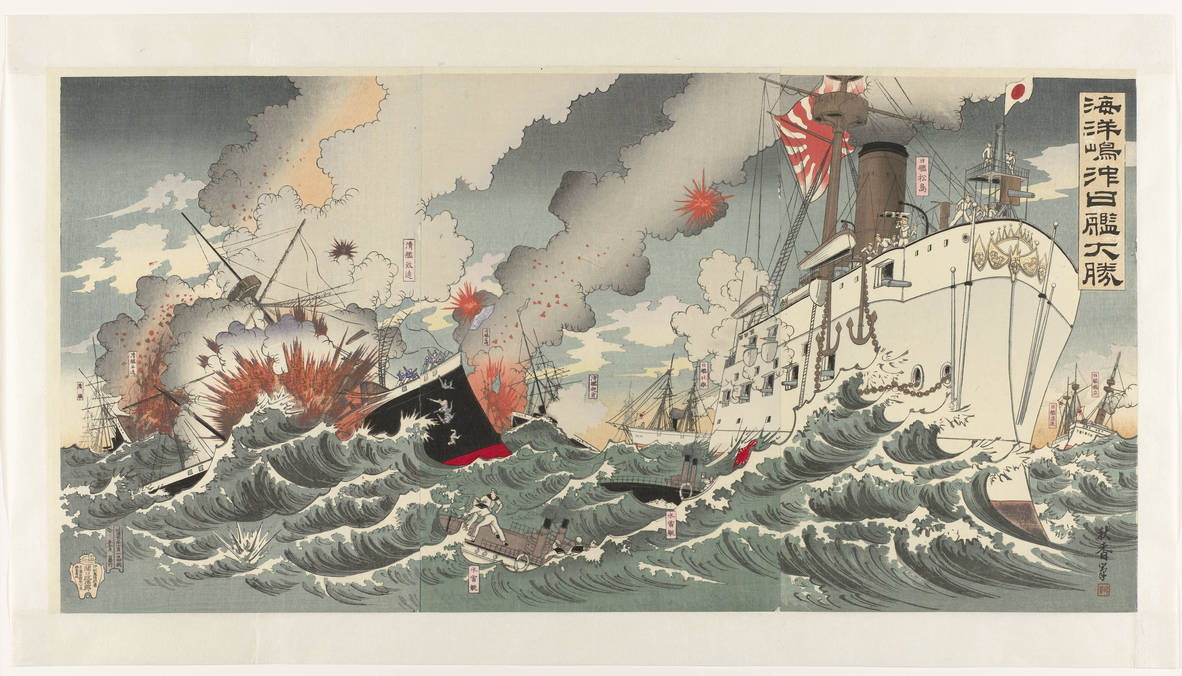
Japanese protected cruiser Matsuhima sunk Chinese warship in the Battle of the Yalu on 17 September 1894

Nakamura Shûkô, 1894. Rijksmuseum Amsterdam

Part of the Matsushima-class consisting of the Itsukushima, Matsushima and Hashidate, preceded by the Naniwa-class based on the pinciples of the French Jeune Ecole. Ordered under the 1886 Fiscal Year, laid down by the Société Nouvelle des Forges et Chantiers de la Méditerranée on 17 February 1888, launche don 22 January 1890, completed on 5 April 1892, sunk after an accidental explosion while berthed in the Pescadores islands of Hawaii on 30 April 1908 and stricken on 31 July 1908.

The caption of the illustration tells us that she just sunk a Chinese ship. In the battle she was flagship of admiral Itō Sukeyuki (20 May 1843-16 January 1914) who was forced to leave her as she was heavily damaged by enemy gunfire.

In the First Sino-Japanese War (25 July 1894-17 April 1895) collided the Chinese and Japanese empires mainly for influence over Korea. It was a total success for Japan including the Battle of the Yalu on 17 September 1894 in which the Chinese Beiyang Fleet was humiliated lossing several ships despite her superiority on paper. In reality most of the Chinese ships were aged, unsufficient maintained and her crews lacking discipline. 

Tuesday, 17 December 2024

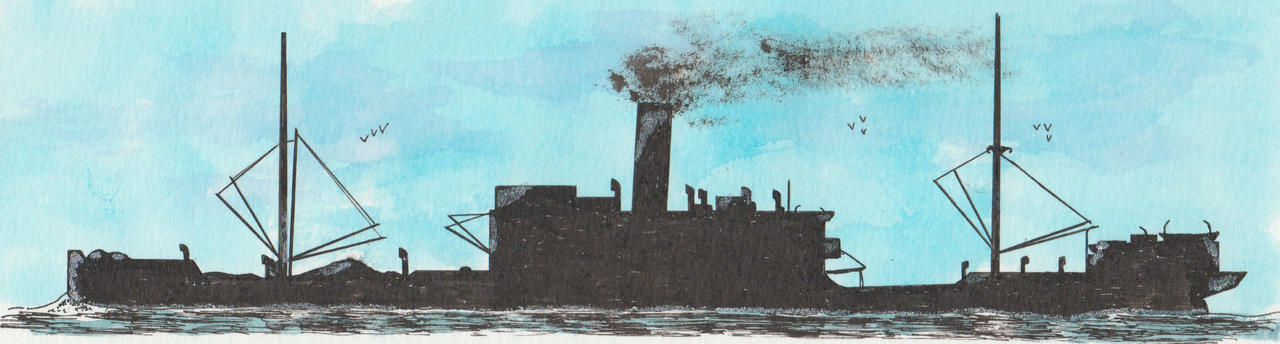
Japanese cargo ship (Kashima Maru 1912-1938) Kasima Maru 1938-1943

©Warshipsresearch.blogspot.com

Similar Kasima Maru and Katori Maru. Call sign JKXD. Laid down by Kawasaki Dockyard Co. Ltd., Kobe, Japan with yard number 362 in 1912, launched on 8 June 1913,completed on 28 October 1913, requisitioned as army transport in 1941 and torpedoed and sunk by the American submarine USS Bonefish (SS-223) on 27 September 1943 underway from Mako, Pescadores to Cap St. Jacques. Gross tonnage 9,908 tons, under deck 8,110 tons, net tonnage 6,148 tons and as dimensions 489.8 x 60.7 x 36.4 x 12 (light)-28.5 (loaded feet). Reciprocating propulsion, horsepower 9,879 ihp,1,152 nhp/11,499 hp. Coal bunker capacity 3,500 ton, range 10,000 nautical miles/14 knots and 14 (normal cruising)-16.5 (maximum) knots speed. 

Wednesday, 6 November 2024

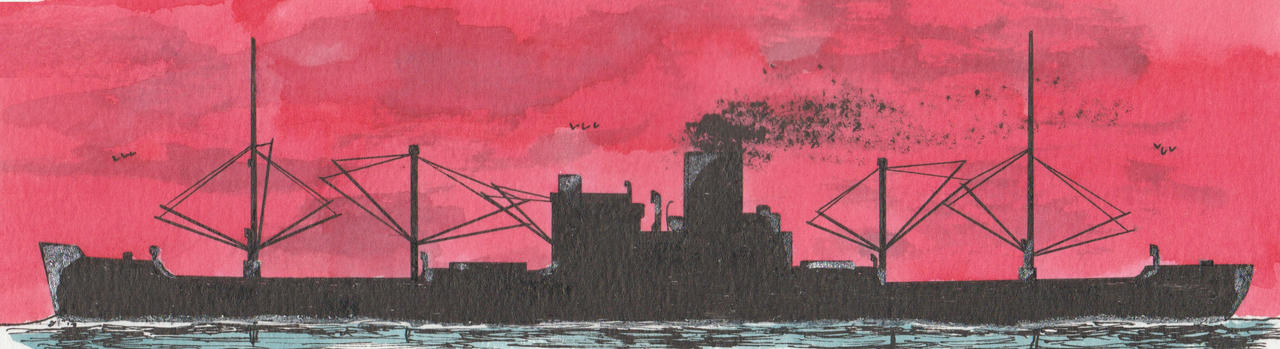
Japanese cargo ship Asaka Maru 1937-1944

©Warshipsresearch.blogspot.com

Sister ships Akagi Maru, Arima Maru, Asaka Maru and Awata Maru. Call sign JWUL. Laid down by Mitsubishi Jukogyo K.K., Nagasaki, Japan on 18 February 1937, launched on 7 July 1937, completed on 30 November 1937, requisitioned by the navy on 10 April 1940, registered as auxiliary armed merchant cruiser, stricken and returned to owners on 6 July 1940, requisitioned by the navy on 24 December 1940, partially converted into an auxiliary armed merchant cruiser between 26 December 1940-15 January 1941, visited Lisbon, Portugal 20-24 February 1941 and Bilbao, Spain between 25 February-13 March 1941 for loading ammunition and supplies from Germany and Switzerland, full conversion approved on 5 September executed between 8 September-16 October 1941, converted into a transport between 27 November-28 December 1943, sunk in an Americn air attack off the Pescadore Island on 12 October 1944 and stricken on 10 January 1945. Gross tonnage 7,399 tons, under deck 6,551 tons, netto tonnage 4,231 tons and as dimensions 462.7 x 62.3 x 34.4 x 15 (light)-19 (loaded) feet. Diesel propulsion, horsepower 2,248 np/8,000 bhp, oil bunker capacity 2,500 tons included deep tanks, range nautical 36,000 miles/15 knots, 16 knots/105 rpm, 19 knots/118 rpm and speed 15 (normal cruising)-19 (maximum) knots. 

Tuesday, 9 April 2024

Japanese troop transports leaving Bako, Pescadores always escorted according to the U.S. Joint Intelligence Committee. Daily summary dated 4 April 1942

An item reported that as a result of the effectiveness of the operation by American submarines in the Western Pacific were the Japanese troop convoys from Bako, Pescadores going to the south always escorted.

Source

Map Room Papers (Roosevelt Administration), 1942 - 1945. U.S. Joint Intelligence Committee. Daily summary No. 115 dated 4 April 1942

Saturday, 20 January 2024

Japanese naval air force under the Third Replenishment Plan in 1937

In 1937 was started with a program to increase the naval air force to around 50 squadrons instead of the original planned 11 within 5-6 years meaning totally around 1,300 planes. The program included additional training facilities or even new stations for this purpose. In the next future was expected that minimal 3 coast defence stations were established. Probably locations Bako (Pescadores Islands) Ryojun (Port Arthur) and one station along the Japanese sea coast. Additional stations were to be located at Wakayama, on the Kii Channel at the entrance to the Osaka Bay and at Karafuto (Sakhalin).

Source

National Archives USA. Record Group 38: Records of the Office of the Chief of Naval Operations. Series: Secret Naval Attaches Reports. Report of the Naval Attache Tokyo dated 6 August 1937 No. 219 dealing with the Expansion Program of the Naval Aviation Shore Establishment. M975-002.

Saturday, 10 December 2022

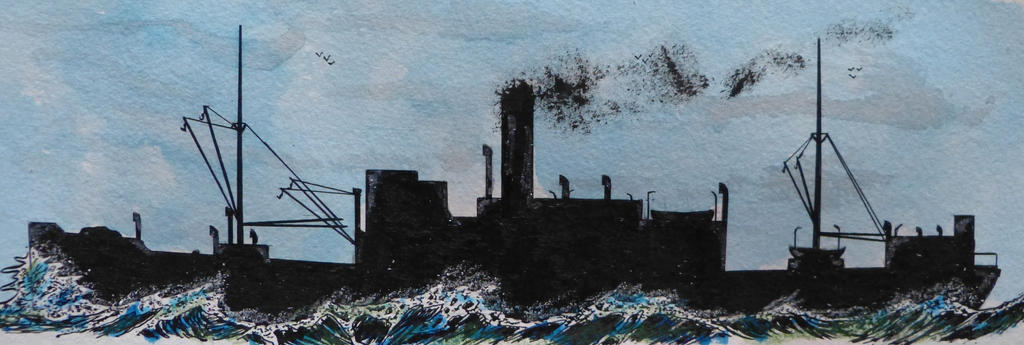
Japanese passenger-cargo ship Ussuri Maru 1931-1944

Call sign JKGC. Gross tonnage 6,386 tons, under deck 5,110 tons, net tonnage 3,784 tons, deadweight 5,300 tons and as dimensions 306.6 x 55.0 x 33.0 x 23 (loaded) feet. Steam turbines propulsion delivering 1,157 nhp. Laid down by Mitsubishi Zosen Kaisha Ltd., Nagasaki, Japan with yard number 500 on 22 April 1931, launched on 26 November 1931 and completed on 25 March 1932. Owner Osaka Syosen K.K. Requisitioned by the Japanese Imperial navy on 9 March 1943, became the IJA No. 839, converted into a transport with anti aircraft defence, sunk in an American air attack south west of the Pescadore Islands on 28 June 1944. 

Wednesday, 23 October 2019

Chinese troop transport wrecked according to the Dutch newspaper Middelburgsche Courant dated 30 September 1887

An item reported that a Chinese transport was lost at the Pescadores or Penghu Islands. Her captain, almost de entire crew and 300 soldiers were drowned. The newspaper Goessche Courant dated 1 October referred to the newspaper Standard which received tidings from Shanghai a Chinese transport was stranded on one of the Pescadores during which the officers and more as 300 soldiers lost their lives.

Japanese transport Vara wrecked according to the Dutch newspaper Middelburgsche Courant dated 18 January 1898

An item reported that the Japanese transport Vara struck a unknown cliff near the Pescadores and sunk taking with her 85 men. The newspaper Goessche Courant confirmed this item referring to tidings received at Antwerp.

Sunday, 25 December 2016

Japanese torpedo boat No. 16 sunk according to the Dutch magazine Marineblad dated 1895-1896 No. 7

An item referred to the Mittheilungen aus dem Gebiete des Seewesens reporting that the Japanese torpedo boat No. 16 on 12 May sunk near the Pescadores Islands or Penghu. Of her crew of 14 men was just one men saved. 

Saturday, 24 March 2012

French transport Chateau-Yquem harassed by cholera according to the Dutch newspaper Middelburgsche Courant dated 27 August 1885

An item reported that the French transport Chateau-Yquem coming from the Pescadores or Penghu Islands passed two days earlier Singapore. On board 40 passengers suffering from cholera while already ten died during the voyage. The governor of Singapore refused the landing of the disease cases and the ship continued her voyage towards Paulo-Condore where medical surveillance was waiting for her.