
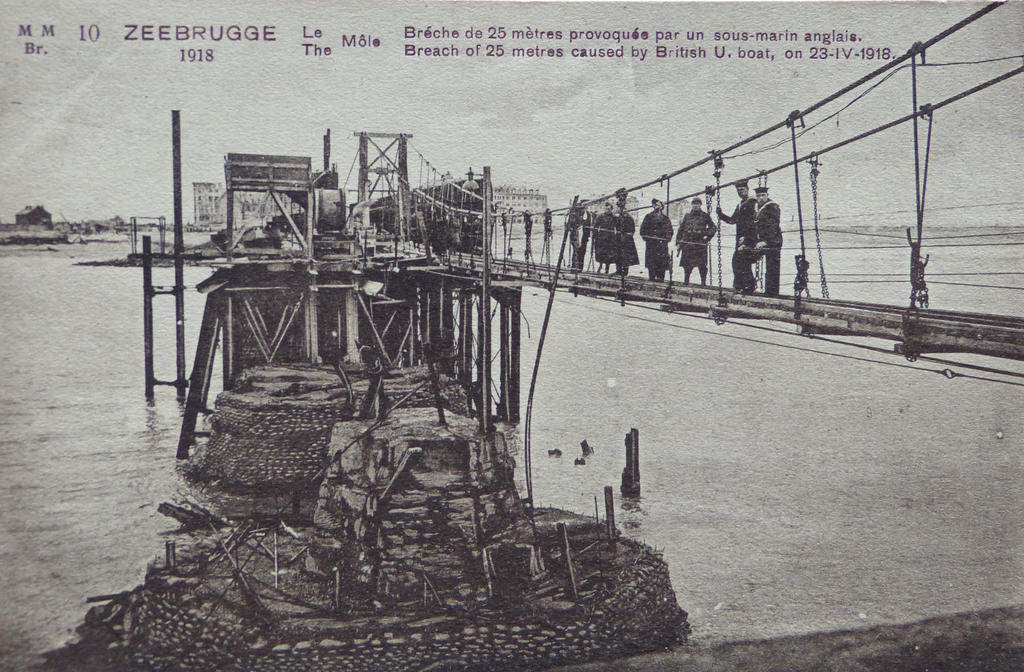
An item reported to alter the mole at Zeebrugge, Belgium drastic which was needed while one third of the pier was heavy damaged when the British submarine exploded in the attack sealing the canal to Brugge. (1) The original intention of the pier was to let the current pass freely but without deposing sand and mud in the harbour. This had been no success in fact the contrary happened probably of the muddy Scheldt water. Closing the gap would reduce the silting of the harbour in great manner according to experiments. Recently the harbour was even dredged to make it possible for the Brazilian battleship Sao Paulo (2) to enter and anchor alongside the mole despite her draught of more as 29 feet. If Zeebrugge would become an important harbour is was possible that Bruges together with the harbours of Ostend and Zeebrugge would replace Antwerp in the Belgian defensive organisation and became a defended area creating a base for the army. The future of Zeebrugge depended also on what became claim of Belgium that the Wielingen Channel was not Dutch but Belgian territory. Annual costs of dredging the harbour were estimated to be 50 million francs.
Notes
1. The attack was on 23 April 1918 causing a breach of 25 metres. Purpose of the attack was to prevent German submarines could leave the harbour. The involved submarine was the HMS C3 loaded with 5 ton explosives, laid down by Vickers, Barrow on 13 November 1905.
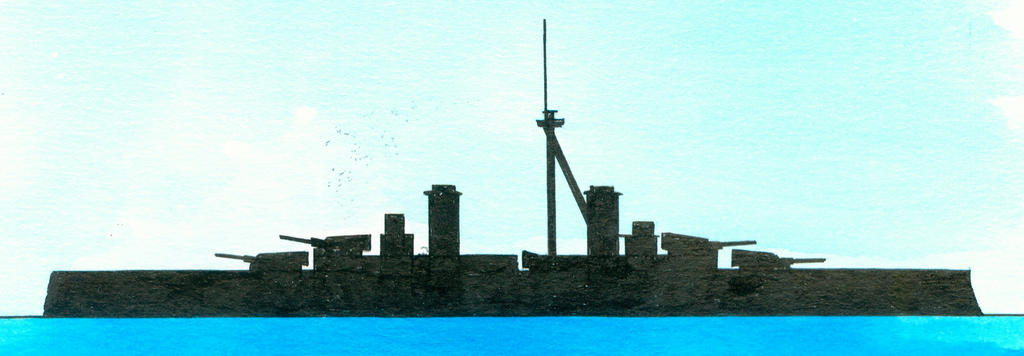
2. She transported the Belgian Albert Leopold Clemens Marie Meinrad (1875-1934), king of the Belgians between 1909-1934 as Albert I and Elisabeth Gabriele Valérie von Wittelsbach and duchess in Bavaria in 1920 towards Brazil and back. Of the Minas Geraes-class , preceded by Deodoro-class, succeeded by the Rio de Janeiro and planned Riachuelo. Laid down at Vickers, Barrow, England on 30 April 1907, launched and baptized by Mrs. Régis de Oliveira, on 19 April 1909, commissioned on 12 July 1910, refitted at New York, USA between 7 August 1918-7 January 1920, not modernized during to her worse condition in the 1930s, served as harbour defence ship during the Second World War, stricken on 2 August 1947, Training vessel until August 1951, sold to the Iron and Steel Corporation of Great Britain to be broken up and sunk when she was underway from Rio de Janeiro to the scrap yard at Greenock with her caretaker crew on board north of the Azores in early November 1951 without finding a trace of her back.
Source
The National Archives, Kew Gardens, England CAB/24/118/41


No comments:
Post a Comment