
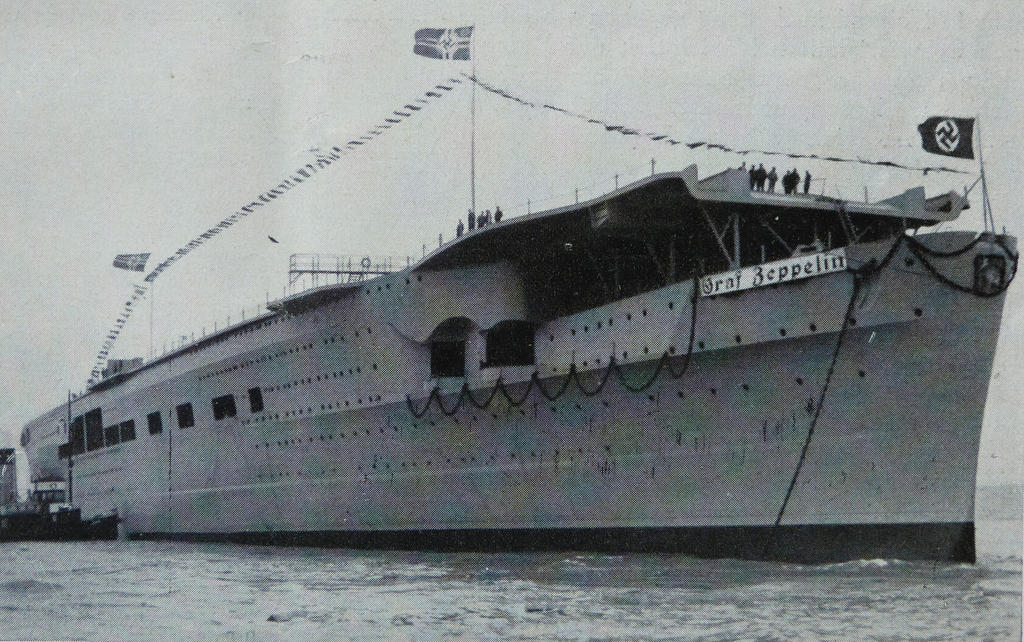
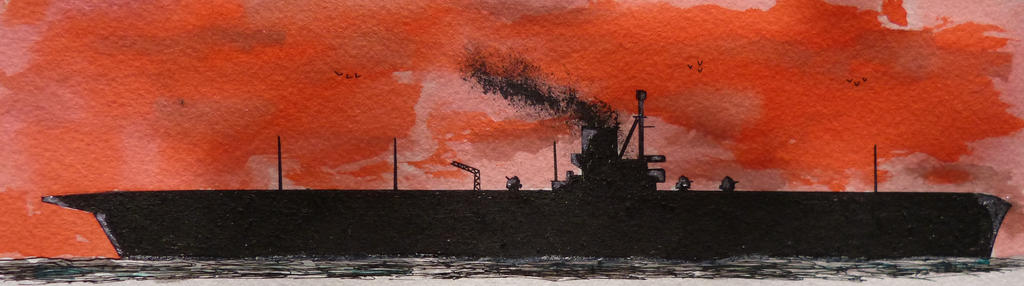
An item dated London, England 27 December reported that the British Royal Navy was concerned about the performance of the new German aircraft carriers (1) and was now waiting for more details before deciding what the effects were for the main part pof the British ships to built under the naval shipbuilding programme. The new German aircraft carrier was of the type Vorsair armed with 16-15cm and 10-10cm dual purpose guns and 22 anti aircraft revolver guns or machine guns. Despite their heavy was their maximum speed 32 knots. The newest British aircraft carriers of the Ark Royal (2) type were not so hevaily armed, much slower and less armoured. The German ships were in war conditions propbably on the high seas used for attacking the merchant shipping. Cruisers were no strong enough to stop the German ships so a battleship was needed with as result that the capital ships were scattered. The British Admiralty considered the building of new ships strongh enough to handle with the German ships but would wait until it became clear how many carriers Germany planned to be built.
Notes
1. Part of Zeppelin-class. Laid down by Deutsche Werkel, Kiel, Germany on 28 December 1935, launched on 8 December 1938, proposal dated 28 April 1940 to halt the construction accepted, towed to Gotenhaffen/Gdynia, Poland in July 1940, used as hardwood storage depot, towed to Stettin in June 1941, demolition partly succeeded on 25 April 1945, in Soviets hands, refloated in March 1946 and broken up at Leningard between 1949-1949 or sunk underway to Leningrad in September 1947. Full load displacement 34,088 tons, speed 33.8 knots, armor belt 10cm/3.9”, flight decl 4,5cm/1.8” and main deck 6cm/2.4”. Armament 16-15cm/5.9” SK C/28 guns, 12-10.5cm/4.1” SK C/33 guns, 22-3.7cm/1.5” SK C/30 guns and 28-3cm/0.79” anti aircraft guns. Able to carry 12 fighters, 12 dive bombers and 20 torpedo bombers. Grag Zepplin was the Flugzeugträger A, the second one the Flugzeugträger B which was laid down by the Germaniawerft on 30 September 1936 and broken up still on slip in 1940. Sometimes she is referred to as Peter Strasser (Brassey’s 1944) or even Deutschland. The C and D were never laid down. Jahrbuch der deutschen Kriegsmarine 1937 reports as displacement 19,250 tons, the B already laid down, construction of A was prepared.
2. Preceded by Courageous-class succeeded by Illustrious-class. Ordered under the 1934 programme, laid down by Cammell Laird on 16 September 1935, launched on 13 April 1937, commissioned on 16 December 1938 and sunk by the German submarine U-81 near Gibraltar on 14 November 1941. Displacement 22,353 (standard)-28,165 (deep load) tons, speed 30 (design)-31 (actual) knots, armor belt 11.4cm/4.5”, deck 8.9cm/3.6” over boiler rooms and magazines. Could carry 72 (design)-50/60 (actual) aircraft with her. Armament 8x2-11cm/.5 dual purpose guns, 3x4-2pdr 4cm/1.5” anti aircraft guns and 8x4-12.7mm/0.50” anti aircraft machine guns.


No comments:
Post a Comment