
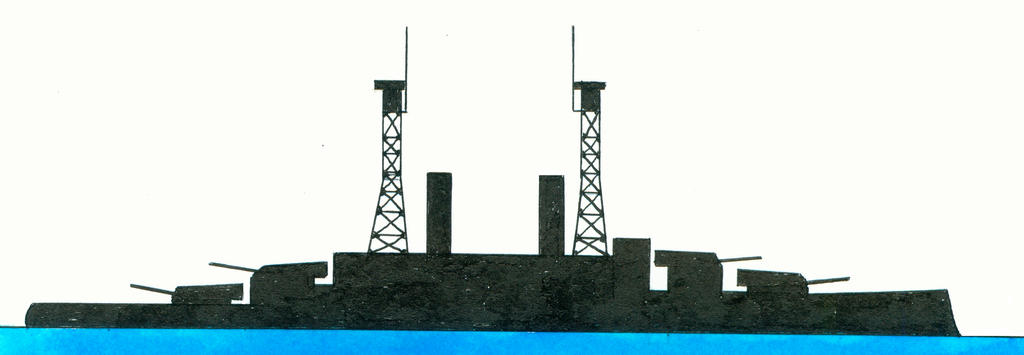
American South Carolina-class. ©Warshipsresearch.blogspot.com
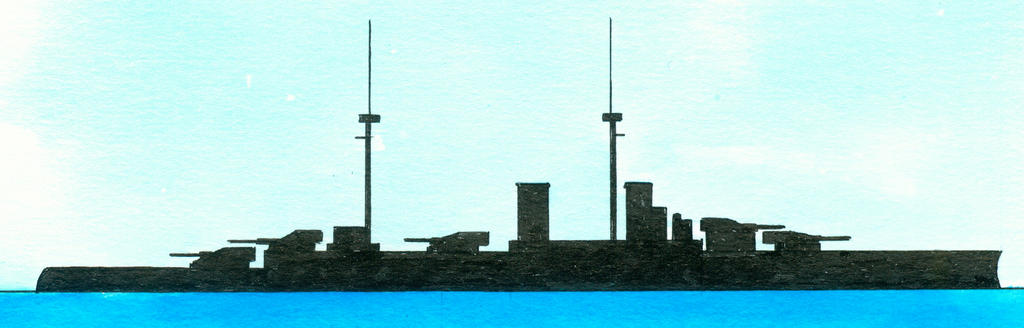
Turkish Resadiye-class. ©Warshipsresearch.blogspot.com
The Ottoman government was in 1910 interested in purchasing two battleships. American shipyards were competing with foreign shipyards among which the British were favourite. The American Embassy at Constantinople, Turkey wrote on 31 March 1910 No. 125 to the US Secretary of State that they were “closely following all developments in what appeared to be a most unfavorable situation, in order to make the most of any opportunity in the interest of American firms who nave sent representatives to this country”. (1) However, the Ottoman government seemed already for some time to be involved in direct negotiations with the British firms Vickers, Armstrong and Brown and that the building contract was an integral part of an arranegement with the new National Bank of Turkey to finance the acutal building. The Ottoman Minister for Foreign Affairs stated that was such a great need that it was impossible to consider favorably a request for a delay in the process.(2) The American Embassador made clear that his government would be disappointed in loosing a chance to improve the commercial relations between the USA and Turkey. The Americans were ready at any time to compete in case the negotiations with the British encountered difficulties and the Ottoman government choose for a competition. Those diffulties appeared miraculous a few days. The Ottomann navy rejected some important features of the British plans as undesirable. And what happene: “The plans of the American battleship Michigan were offered by the Turks to serve, with certain modifications, as the type of battleship required by this Government”. (3) Further more the political situation on the Balkan changed and the need of battleships was less urgent. At the end a Turkish battleship was built by a British shipyard but never delivered.(4)
Notes
1. The Bethehem Steel Company, William Cramo&Sons and the New York Shipbuilding Company were interested in the order. Also the German Krupp was interested.
2. Between March-24 July 1910 was the Albanian Revolt with violence ended by the Ottoman Government. The revolt pointed out the weakness of the Ottoman Empire caused by her very worse financial position.
3. Part of South Carolina-class preceded by Mississippi-class succeeded by Delaware-class, laid down by New York Shipbuilding Corporation on 17 December 1906, launched on 26 May 1908, commissioned on 4 January 1910, decommissioned on 11 February 1922, stricken on 10 November 1923 and sold to be broken up in 1924.
4. The Resadiye-class which were an improved British King George V-class battleships design ordered from Vickers, Armstrong Whitworth. The Fatih Sultan Mehmed was ordered in April 1914 but never completed. The Resadiye (ex-Mehmed Resad V) was seized when the First World War broke out and commissioned in the British Royal Navy as HMS Erin. The Ottoman Empire bought in September 1913 from Brazil the Rio de Janeiro which was renamed Sultan Osman-I Evvel which was seized by in August 1914 and commissioned in the British Royal Navy as HMS Agincourt.
Source
Record Group 64: Records of the National Archives and Records Administration Series: Records of the Department of State Relating to the Internal Affairs of Turkey. Turkey: Naval Affairs, Navy, Naval Vessels: 867.30 - 867.348. Microcopy 353 rol 42.


No comments:
Post a Comment