
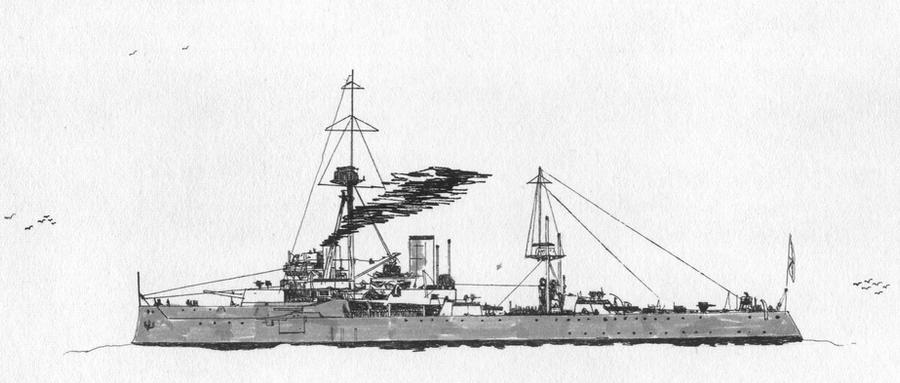
British HMS Dreadnought ©Warshipsresearch.blogspot.com
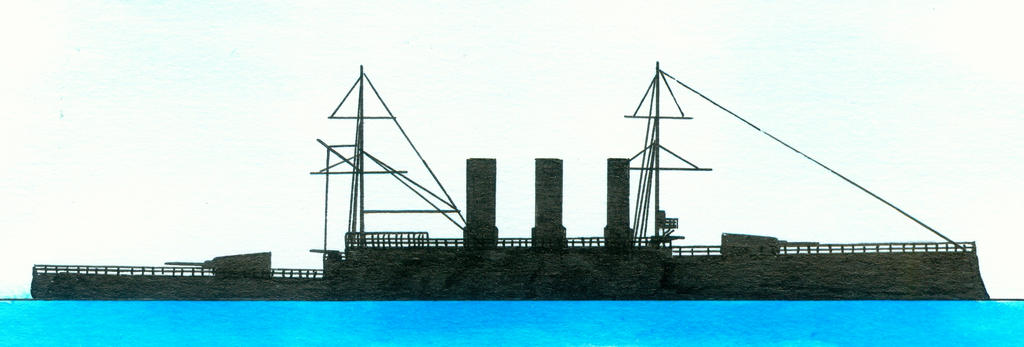
Italian Regina Elena-class©Warshipsresearch.blogspot.com
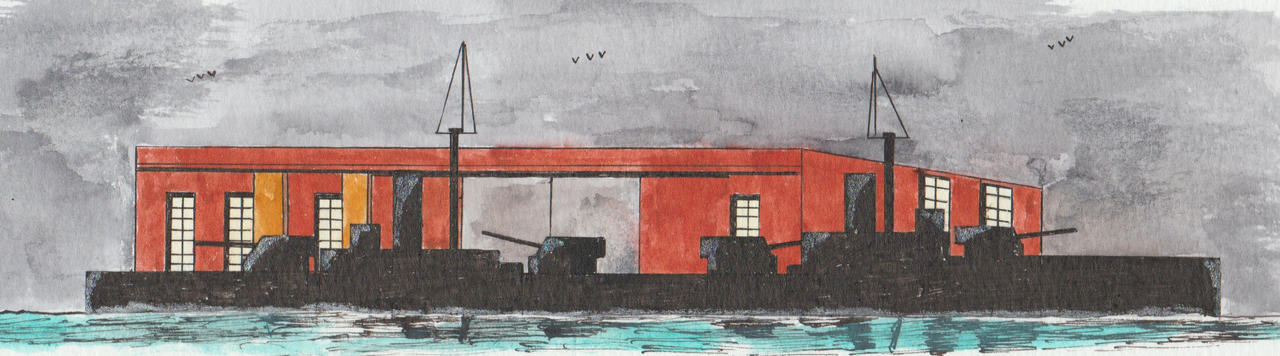
Proposal of Bernotti©Warshipsresearch.blogspot.com
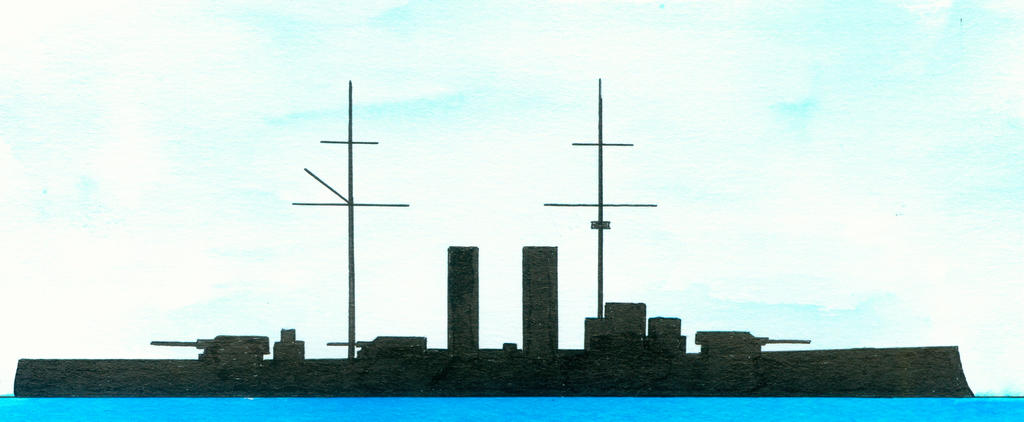
Austrian Radetzky-class©Warshipsresearch.blogspot.com
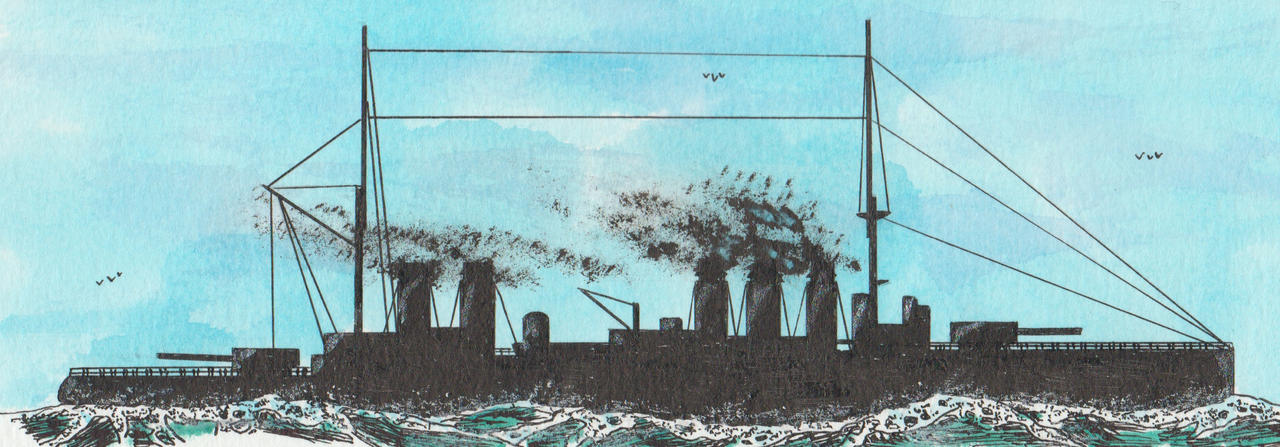
French Danton-class©Warshipsresearch.blogspot.com
Lieutenant Bernotti (1) published his vision of a battleship in the Italian magazine Rivista Marittima, supplement to No. VI, 1908, as part of a Naval Prize Essay. A translation was published in The Proceedings dated March 1909. At that moment was in England HMS Dreadnought (2) commissioned, the first steam turbine powered battleship with an uniform main battery instead of a mix of some large guns and a heavy secondary armament. The newest Italian battleships were the Regina Elena-class designed by Cuniberti, the man of the all-big gun concept qualifing his own design as obsolete.(3). The Dante Alighieri was the first built Italian dreadnought.(4) Bernotti wrote that the latest plans of battleships principally showed gins of one caliber and a high speed. The tonnage was between that of a single turreted monitor and a battleship with a large number of heavy guns. He wondered of the all-big-gun-concept the ultimate solution was regarding the lessons of the recent war between Japan and Russia (1904-1905). He choose for a battle caliber of 30,5cm mounted in four two-gun turrets (total weight 1,881 tons). He made some sketches of configurations of the positions of the gun turrets. For the secondary armament he choose for 8-15,2cm cal 500cm guns (total weight 789 tons) to which 12-7,6cm guns (total weight 57 tons) and torpedo tubes (total weight 20 tons) were to be added. A ram was not be added. The speed which had strategical importance was the one which could be maintained for a long time. This strategic speed was 3 knots below the maximum speed of 22 knots meaning that minus 3 knots would be 19 knots which was equal to the maximum speed of the French Danton-class pre dreadnoughts (19.25 knots) and a little less than that of the Austrian Radetzky-class semi-dreadnoughts(20.5 knots). Total fuel supply 1,731-1,750 ton. Armour with a thickness of 10-20cm, total weight 3,275 tons. Total weight of engines and boilers 1,952 tons. Calculated displacement 15,950 tons.
Notes
1. Bernotti (24 February 1877 Marciana Marina, Italy-19 March 1974 Rome, Italy) ended his naval career (started in 1889) in the rank of admiral (promoted 2 June 1934) in 1939 becoming a senator in the kingdom of Italy and raised to the rank of Fleet Admiral in June 1940. Expert in naval doctrine an leading theoretical theorist with the navy was also a proponent of naval aviation including aircraft carriers. His publicatuin His Fondamenti di tattica navale was translated in the English publication Fundaments of Naval tactics. In the Rivista Marittima dated July-August 1920 he published another article dealing with the future of the battleship as the lessons learned from the First World War had made clear. The ideal maximum armament was 4x3-minimum 38cm guns, a secondary armament of 15,2cm guns, 6-about 10cm anti aircraft guns, a number of machineguns and 7-12 surfaced torpedo tubus (triple or twins).
2. Ordered in 1905, laid down by HM Dockyard Portsmouth on 2 Otcober 1905, launched on 10 February 1906, commissioned on 2 December 1906, decommissioned in February 1919 and sold to be broken up on 9 May 1921. Preceded by the Lord Nelson-class and succeeded by the Bellerophon-class. Her main armament consisted of 5x2-30,5cm/12” guns to which 27x1-7,6cm/3” guns and 5-45cm/18” torpedo tubes were added.
3. The Regina Elena consisted of the 4 battleships Regina Elena, Vittorio Emanuele, Roma and Napoli, built between 1901-1908 preceded by the Regina Margehrita-class and an armament of 2-30,5cm/12” cal 40 guns and 12-20,3cm/8” cal 45 guns. In fact was this class based on a concept of a 8,000 tons warship armed with 12-8” guns dating from 1899 but which design approved. This must be the Bettolo-Cuniberti type.
4. The Dante Alighiere was designed by rear admiral Edoardo Masdea replacing the Regina Elena-class designed by by Vittorio Cuniberti succeeded by the Conte di Cavour-class. Laid down by Regio Cantiere di Castellammare di Stabia, Castellammare di Stabia, Italy on 6 June 1909, launched on 20 August 1910, completed on 15 January 1913, stricken on 1 July 1928 and broken up the same year. Main armament 4x3-30,5cm/12" guns.
Sources
https://en.wikipedia.org/wiki/Romeo_Bernotti dated 13 April 2026 11:26 o’clock
‘requisites of the battleship best adepted to the Italian Navy and consideration of its tactical employment’ in: The Proceedings of the United States Naval Institute dated March 1909 vol.35, No., Whole No. 129.
Warshipsresearch.blogspot.com


No comments:
Post a Comment