
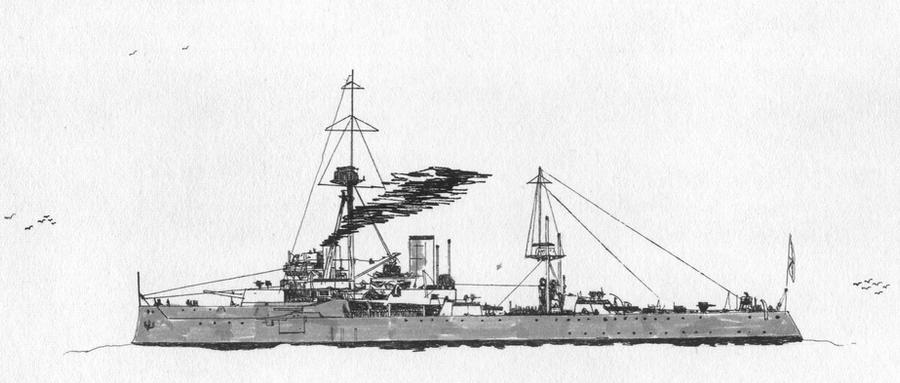
British battleship HMS Dreadnought©Warshipsresearch.blogspot.com

Russian Gangut-class dreadnoughts. ©Warshipsresearch.blogspot.com
George von Lengerke Meyer (1) informed the American president Theodore Roosevelt (2) in a memorandum dated 6 December 1906 that the Russian admiralty proposed the building of 21,000 tons displacement resembling the British battleship HMS Dreadnought.(3) Both ships were to built in Russia with a budget spread over four years. In 1906 should be 1,500,000 US dollars and in 1907 another 4,000,000 US dollars.(4) Meyer spoke a Russian admiral that although approval of the Duma [Russian parliament] was needed, the admiralty decided to start with the building. The reason was that if they waited until March the shipyards were to be closed and 20,000 labourers to ve paid off. Estimated was that average every labourer had to feed 4 persons. Paying off resulted in putting 80,000 persons on to the streets of St. Petersburg in mid-winter. The battleships would have a draught of 26 feet and an armament of 5x2-12” guns all usable in a broadside fire. The same admiral stated that the HMS Dreadnought was built within 11 monts and had a successfull trial but that “the strain of firing her broadside had been so great that her interior would either have to be rebuilt or strenghtened”. Meyer heard the next day from another “absolute reliable” source that the Admiralty wanted to have 4 dreadnoughts of which one was to be built in the United Kingdom and one in France. Each builder was to furnish a complete set of working drawings to be used for building the other two sisterships in Russia. The English Company [no name was given presumably Vickers Ltd] offered to design and built a battleship armed with 10/12-12” guns all to be fired as a broadside and she would have a speed equal to the HMS Dreadnought.
Notes
1. (24 June 1858 Boston, USA -9 March 1918 Boston), businessman, conservative politician from Massachusetts and embassador in Russia between 12 April 1905-26 January 1907. Under president Howard Taft was Von Meyer Secretary of the Navy between 6 March 1909-4 March 1913).
2. Theodore Roosevelt Jr. (27 October 1858 New York City, USA-6 January 1919 Sagamore Hill, New York, USA), president of the USA between 14 September 1901-4 March 1909.
3. Ordered in 1905, laid down by HM Dockyard Portsmouth on 2 October 1905, launched on 10 February 1906, commissioned on 2 December 1906, decommissioned in February 1919 and sold to be broken up on 9 May 1921. Preceded by the Lord Nelson-class and succeeded by the Bellerophon-class. Her main armament consisted of 5x2-30,5cm/12” guns to which 27x1-7,6cm/3” guns and 5-45cm/18” torpedo tubes were added. Speed 21 knots.
4. The Russian Empire just lost the war (8 February 1904-5 September 1905) with the Japanese Empire and in which her battlefleet was almost completely destroyed. The first Russian dreadnoughts built were of the Gangut- or Sevastopol although not earlier ordered in 1909 and actually started building in 1911 when the Duma approved the needed budget. Vickers Ltd had already in 1907 a design submitted but thw Russian Naval Ministry was forced to open an international design contest. Finally a design of the Baltic Works was chosen. The Gangut, Petropavlosk, Sevastopol and Poltava were all laid down on 16 June 1909 with the Gangut as last one commissioned on 11 January 1915.
Sources
Meyer, George von Lengerke, 1858-1918, [1906, December 6].Memorandum from George von Lengerke Meyer. Library of Congress Manuscript Division. Theodore Roosevelt Digital Library. Dickinson State University.Retrieved from https://www.theodorerooseveltcenter.org/digital-library/o54974.
Warshipsresearch.blogspot.com


No comments:
Post a Comment