
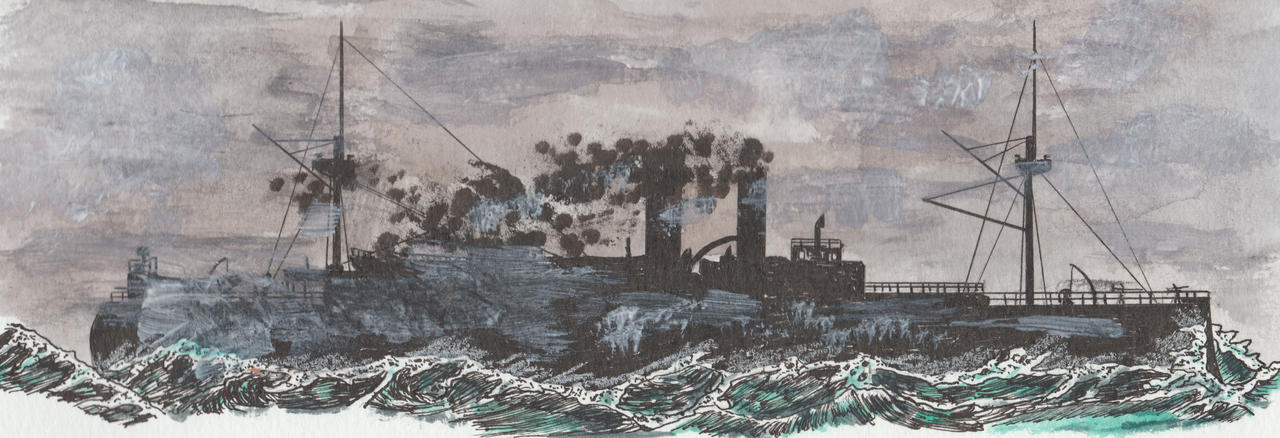
American USS Maine©Warshipsresearch.blogspot.com
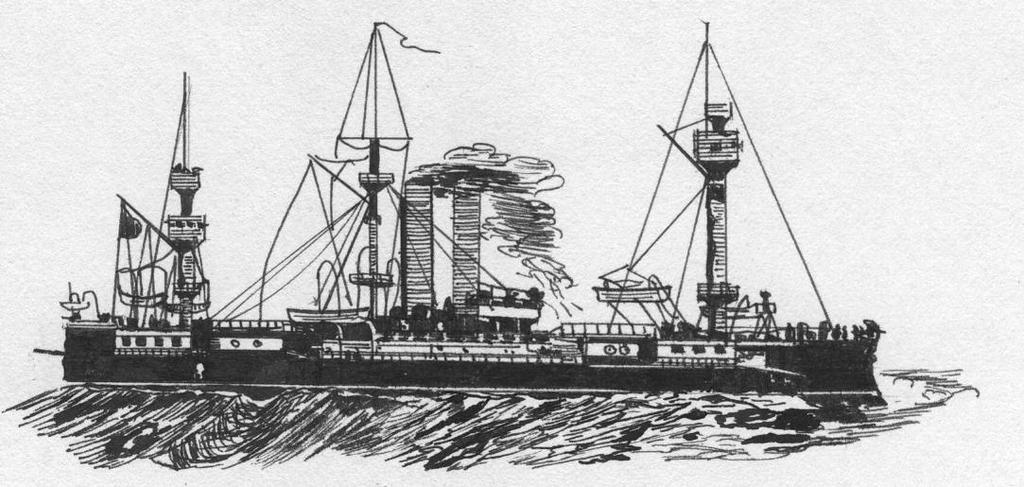
In 1886 was the building of a battleship which became the USS Texas and an armored cruiser which became the USS Maine authorized.(1) The US Navy asked for plans including from parties abroad. For the USS Maine was chosen for an American design although inspired by the Brazilian battleship Riachuelo.
The Internal Revenue Record and Customs Journal edition dated 11 April 1887 p. 144 wrote that the Secretary of Navy William C. Whitney on 6 April invited proposals for the building of 5 warships under the Act of 38 March 1887. Further more he considered the details for the Board which was responsible to examine the plans for the two 6,000 tons ships authorized under the Act of 3 August 1886. Expected was that as naval members were to be appointed captain Ramsay, commodore Goodrich and assistant naval constructor Bowles. The names of the civilian members were yet not known. In the meantime were the plans of the Bureau of Construction and Repair his favourite. Of the ten plans for new cruisers were at least six worth of close attention. According to The Nation dated Thursday 7 April 1887 were the plans opened on 1 April.
The Railroad and Engineering Journal, May edition p. 194 reported that the plans for an armored cruiser and an armored battleship were now being studied by a mixed board of naval officers and civilian constructors. The general features were published on page 211: “The armored cruiser was to have a double-bottomed, steel hull, unsheathed and divided into numerous watertight compartments, fitted with a powerful pumping apparatus, and finished with a perfect drainage and ventilation system throughout. She was to be fitted with a rambow and was to have a steel-armored deck which would run thewhole length of the ship and cover the boilers, engines and magazines. Two-thirds full sail power was required on two or three masts, each with a protected top, carrying one or more machine or rapid-fireguns. The main batterywas to havefour 10-in. guns, each weighing 26½tons, and six 6-in.guns each weighing 5 tons. The secondary battery was to be composed of four 6-pounder, four3-pounder, and two 1-pounder Hotchkiss rapid-fire guns, four 47-millimeters and four 37-millimeters Hotchkiss revolving cannon, and four Gatling guns. The vessel was to be equipped with a torpedo and searchlight outfit, and the guns were to be so arranged as to obtain for bow and stern fire the greates thorizontal and vertical command consistent with other essential conditions. The 10-in. guns were to load in at least two positions,and were to be served and handled by power and protected by at least 10 1/2 inch of steel armor, properly backged, while the 6-in. guns were to be efficiently shielded. The motive machinery was to be below the armored deck and well covered from hostile fire, and the ship was to be driven by twin screws. When fullyequipped and with all weights on board, excluding the reserve coal, she was to maintain 17 knots speed per hour over the measured mile. The coal endurance had to be large, the consump tion economical, and the distance to be covered at mod erate speed as great as practicable. The furnaces were to be arranged to work with forced draught when desired, air for combustion being furnished independently of the ventilating system. Quarters had to be provided for 270 officers and men, with provisions provisi for three months and water for one month. The ship was required to have arrangements for being steered either by power or by hand from several independent positions upon and below the deck. A sufficient number of boats to carry the crew were to be furnished, two of them being second class torpedo boats and two others steam launches or cutters, each of which was able to mount, shielded, one 3 pounder rapid-fire gun. These conditions were to be fulfilled at a maximum draught of 22 feet and on a displacement of about 6,000 tons."
The Railroad and Engineering Journal, July edition p. 311 and 315 reported that the US Navy still considered the building but did not invite yet for bids of shipyards. In the meantime reported the Board to the Secretary of the Navy what the results were of the plans sent by various parties in last April. The Board was appointed on 22 April. Some plans were not conform the requirements and were already rejected. Dealing with the plans of the Barrow Shipbuilding Company, Lieutenant W. I. Chambers (2), A. H. Grandjean and the Thames Iron Works & Shipbuilding Company was the conclusion that “The marked differences in the essential features of the designs prevent their classification in the order of merit; each exhibits features which strongly commend themselves, but the Board does not consider it advisable for the Government to build a vessel upon any one of these.”
In The Railroad and Engineering Journal, August edition p. 357-359 were the results of the examination discussed. The Board recommended not one of the submitted designs for an armored cruiser. The plans were to be carefully examined before anything could be decided. Yet it was probably the design of the Bureau of Construction of the Navy Department made a good chance to be chosen. In the end is indeed chosen for this design.
The Internal Revenue Record and Customs Journal dated 11 April commented “he one submitted by a young Naval officer, Ensign W. I. Chambers, is spoken of very highly, and he claims for the vessel proposed a capacity to steam across the Atlantic at an average speed of 17 knots. The deign of Mr. Chambers includes a novel rig, which gives great spread of fore and aft sail, admits of being quickly cleared for action and allows of tow military tops to each masts, in the lower of which are mounted four 87mm revolving canon. There are six torpedo tubes, giving an all around torpedo fire. The two which fire ahead are fixed in line with the keel under water. The gun deck battery and the berth deck compartments are protected against bursting shells by double splinter screens between the guns and by several continuous athwartship bulkheads. The design includes two armored conning towers, widely separated, so situated that a clear view all around may be obtained from each. The engines are especially deisgned for continuous working at high speed. This ship has no projecting sponsons along the side, is provided with torpedo defence nettings and will carry fourteen boats, two of which are second class torpedo boats and two steam cutters.Horsepower 10,800 hp. Rigging brig. Armament 4-10” guns, 6-6” guns, 12 quick firing guns. Armour 11”. Coal bunker capacity 580 tons. Speed 18.25 knots. Displacement 6,020 tons and as dimensions 315 (between perpendiculars) x ? x 19.9 feet.”
The The Railroad and Engineering Journal, vol. LXI (Volume 1, new series), New York, 1887. p. 211 supplied a somewhat different design: “
in which the 10-in. guns are grouped in pairs in barbette turrets on the middle line of the vessel, each pair having unobstructed arcs of fire of 280 degrees, and mounted at a height of 24½ ft.above water. There are also six 6-in. rifles, two of which are on thespar deck, and have a fire ahead, astern and abeam, through arcs of 180 degrees, the remainingfour being mounted on the gun-deck so as to fire two ahead, two astern and two abeam through arcs of 135 degrees. On the gun deck are mounted eight 6-pounder rapid-firing guns, with arcs of 140 degrees, so arranged as to be easily easily transported to fire all eight from the same broadside. At the extremities on thegun deck are four 47-millimeters revolving cannon in towers which give them nearly 18o degrees arc of fire. Above the spar deck is a spacious bridge extending from the forward conning tower to amidships, where it exte ds from side to side. At the ends of this bridge, amidships, are 3-pounder rapid-firing guns so arranged as to enable all four to be fired ahead, astern and abeam. Two Gatlings and two 1-pounder boat guns are also mounted on this bridge. The side armor is 11 inch thick and the barbette armor 10.4 inch”.
Notes
1. Ordered on 3 August 1886, laid down by New York Naval Shipyard on 17 October 1888, launched on 18 November 1890, commissioned on 17 September 1895 and sunk due to an explosion in the harbour of Havana, Cuba on 15 February 1898 and what was left of her was scuttled in the Strait of Florida on 16 March 1912.
2. For Chambers see for instance “The requirements of warships” in: Engineering. An Illustrated Weekly Journal dated 30 October 1885 p. 451 and Friday 4 December 1885 p. 543. Identical to Washington Irving Chambers (4 April 1856 Kingston, New York, USA-23 September 1934 Chillicothe, Ohio, USA), ending his career in the rank of captain?
Sources
Engineering. An Illustrated Weekly Journal. London, 1885.
Internal Revenue Record and Customs Journal. Volume XXXIII, January-December 1887.
The Nation No. 113, p. 286.
The Railroad and Engineering Journal, vol. LXI (Volume 1, new series), New York, 1887.
Hamersly, Lewis Randolph. The Records of Living Officers of the U.S. Navy and Marine Corps. Philadelphia, 1894.


No comments:
Post a Comment