
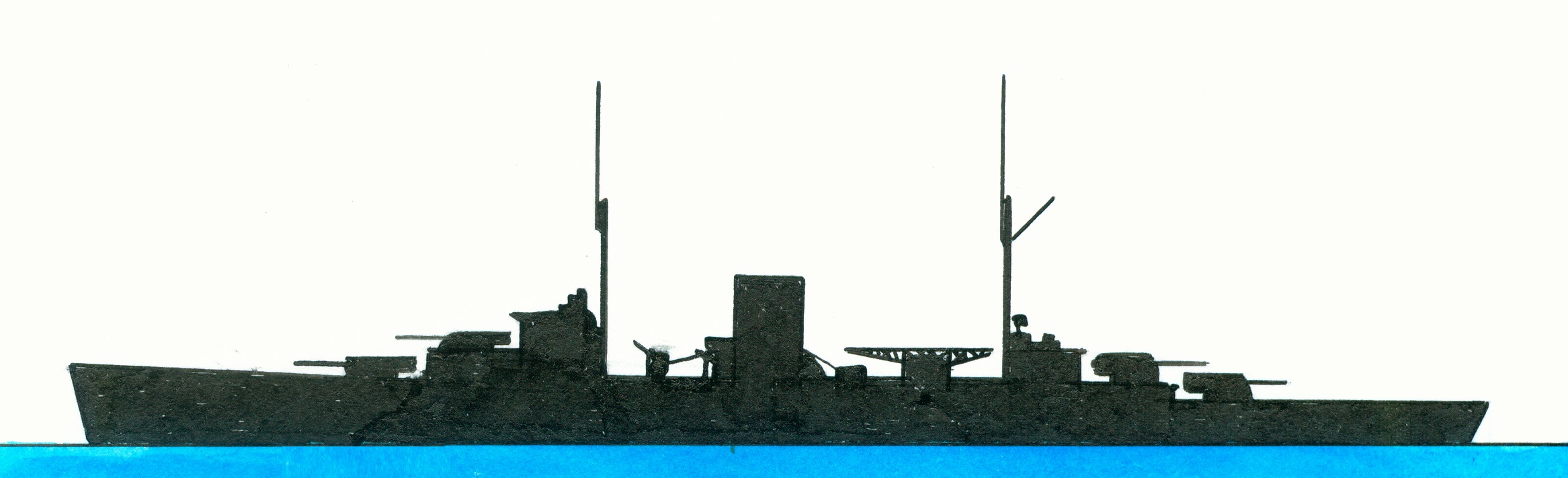
Leander-class
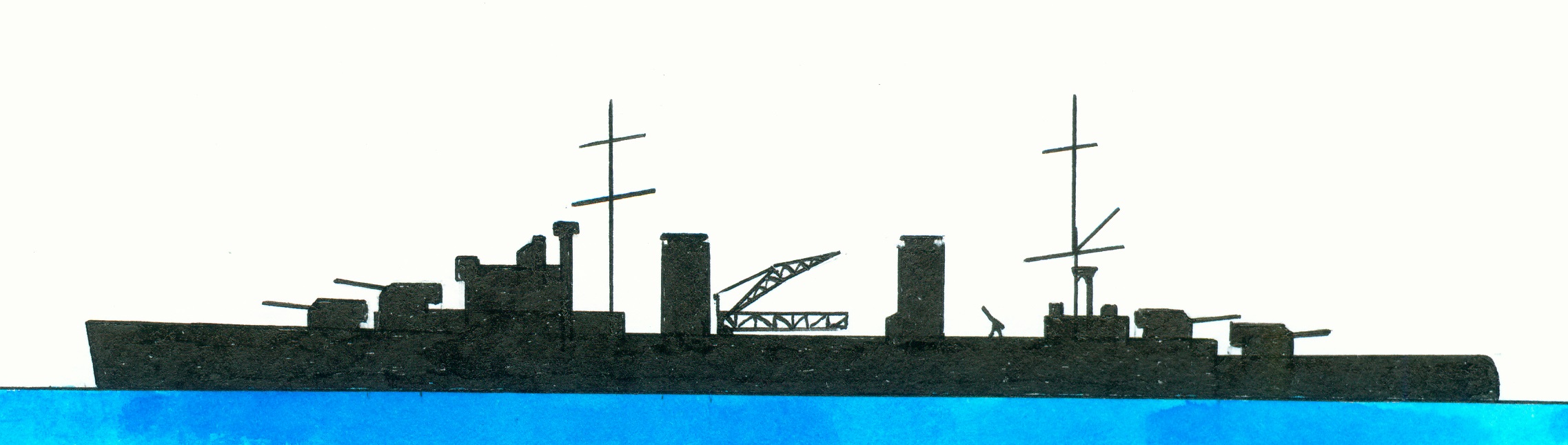
Australian HMS Hobart

Computer line drawing of the Sydney by Portsmouth Bill, UK, 2011

German auxilary cruiser Kormoran

Displacement of 6.701 (light)-7.198 (standard)-8.940 (full load) tons and as dimension s 160 (between perpendiculars)-171,40 (over all) x 17,285 x 4,65 (fore)-5,25 (aft) metres or 530-562.4 x 56.8½ x 15.3-17.3 feet. The Parsons geared turbines and 4 Admiralty 3-drum boilers supplied via 4 shafts 72.000 shp allowing a speed of 32,5 knots and with a speed of 16 knots a range of 7.000 nautical miles. Crew numbered 594 (when commissioned)-645 (when sunk) men. The armour consisted of 2,5cm/1” thick hull plating, a 7,6cm/3” thick belt over machinery spaces and a 5,1cm/2” thick belt protected the magazines and shell rooms. The armament consisted of 4x2-15cm/6” Mk XXIII guns, 4x1-10cm/4” Mk V high-angle quick firing guns, 3x4-1,3cm/0.50 Vickers Mk III machineguns, 14-7,7mm/0.303” Lewis machineguns of which 5 were removed before 1939, 2-7,7mm/0.303” Vickers machineguns removed before 1939, 4-4,7cm/1.9”/3pd Hotchkiss quick firing saluting guns removed in 1940 and 2x4-53cm/2” deck mounted Mk VII torpedo tubes. She carried one Supermarine Walrus plane with her for which she was fitted out with a revolving catapult situated amidships.
Note
1. She was launched as the passenger ship Steiermark at the Krupp-Germania Werft at Kiel, Germany 15 September 1938 for account of the Hamburg-America Line (HAPAG) for the East Asia Line. She was however requisitioned by the Kriegsmarine and commissioned 9 October 1940. By the Allies known as the Raider G while in Germany as HSK-8 (class designation) and Schiff 41 (administrative designation). With a tonnage of 19,900 tons or 8,736 GRT were her dimensions 164 x 20,2 x 8,5m. The 4x9-cylinder diesel engines supplied 14,00 hp allowing a speed of 18-19 knots. Her crew numbered 400 men. The armament consisted of 6-15cm guns, 2-37mm anti tank guns, 5-20mm anti aircraft guns, 6-53,3cm torpedo tubes 2x2 surfaced and 2x1submerged, mines, two Arado 196 sea planes and one LS-3 mine laying boat.

