
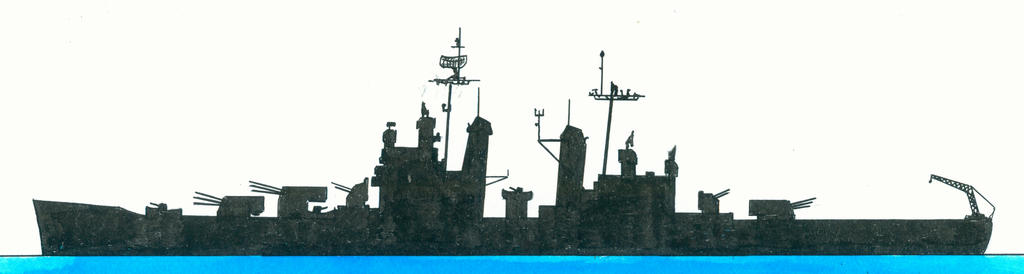

The Coast Artillery School developed for shore-based observation posts the bump-method for spotting and recognizing a ship hull down over the horizon. The method was applying to a ship from the top down and the top third of the superstructure first appearing over the horizon and this reducing to a simplified silhouette, in fact just a rough outline of the characteristic upper portions of the superstructure.
Baltimore-class with Boston and Albany subclasses preceded byUSS Wichita succeeded by Oregon City-class, all 11 planned vessels were completed: Baltimore CA-68, Boston CA-69/CAG-1, Canberra (ex-Pittsburgh) Ca-70/CAG-2, Quincy (ex-Sy. Paul) CA-71, Pittsburgh (ex-Albany) CA-72, Saint Paul (ex-Rochester) CA-73. Columbus CA-74/CG-12, Helena (ex-Des Moines) CA-75, Bremerton CA-130, Fail River CA-131, Macon CA-132, Toledo CA-133, Los Angeles CA-135 and Chicago CA-136/CG-11.
Sources
John D. Neill, “The Bump Charts” in: Coast Artillery Journal, Jan-February 1944, p. 31-33.
“Bumps. Warships are quickly recognized by new Coast Artillery Bump Silhouettes” in: U.S. Army-Navy Journal of Recognition, November 1943, No. 3., p. 21-25.
ONI. FM 30-50. Recognition pictorial manual of naval vessels, 15 September 1943.


No comments:
Post a Comment