Translate

Showing posts with label Minesweeping sloops. Show all posts

Monday, 31 August 2026

British expedition underway on the Tien-Tsin River[Peiho or Hai river] in November 1854

Illustrated London News dated 27-1-1855

The HMS Rattler (1) commanded by captain Mellers brought Sir John Bowring (2) to Peking. She was accompanied by the American steam frigate USS Powhatan (3) and steamship John Hancock with on board the American Commissioner Mr. M’Lane (4_. As auxiliaries were on the river available the American schooner USS Fenimore Cooper and the lorcha Chusan.

Notes

1. Screw steam sloop, ordered on 24 February 1842, laid down by Sheerness Dockyard in April 1842, launched on 13 April 1843, commissioned on 12 December 1844 and broken up at Woolwich between 22 July-26 November 1856. Participated with the HMS Eaglet and American USS Powhatan at the naval battle near Tai O vollage, Lamtau/Kowloon against Chinese pirates.

2. Sir John Bowring (17 October 1792 Exeter, Devon, England-23 November 1872 Clarement, Devon, England), 4th Governor of Hong Kong between 13 April 1854-9 September 1859)

3. Screw steam frigate, laid down by Norfolk Naval Shipyard, Portsmouth, Virginia, USA on 6 August 1847, launched on 14 February 1850, commissioned on 2 September 1852, decommissioned on 2 June 1886, sold on 30 July 1886 and broken up on 5 August 1887.

4. Probably Robert Milligan McLane (23 June 1815 Wilmington, Delaware, USA-16 April 1898 Paris, France), appointed as commissioner to China in 1853.

Friday, 21 August 2026

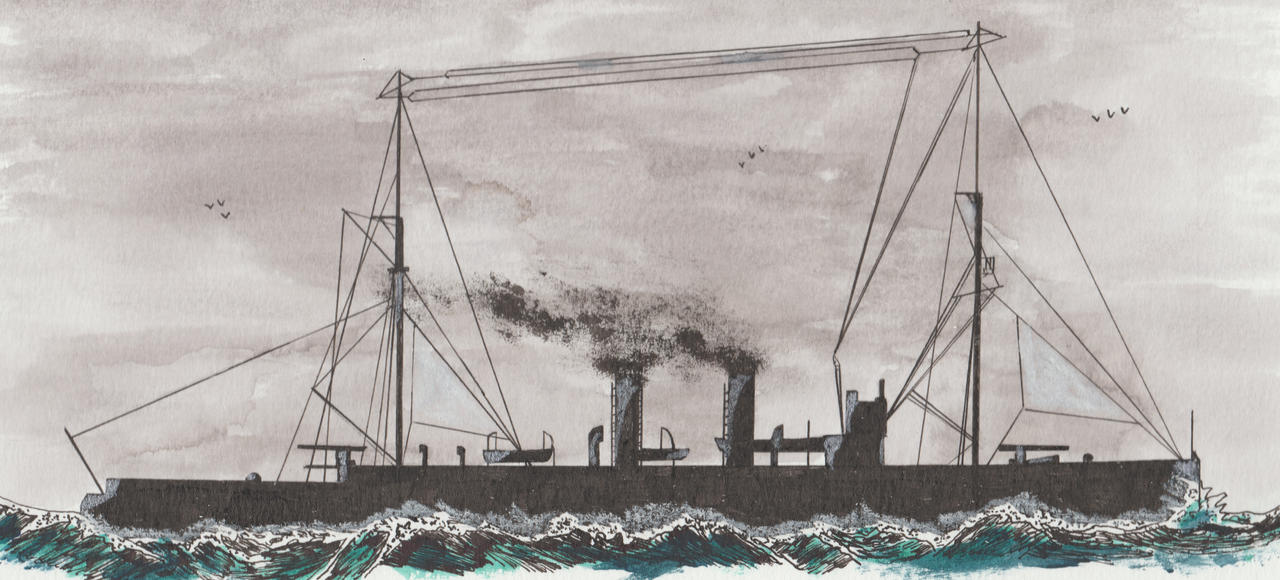
British minesweeping sloop HMS Alyssum 1915-1917

Arabis-class©Warshipsresearch.blogspot.com

Built under the Emergency War Programme of the First World War. At the end of 1914 was the design completed and in July 1915 were 36 ships in 3 batches ordered for the British Royal Navy. British shipyards built an additional 8 vessels for the French Navy. Part of Arabis-class preceded by Azalea- and Acacia classes and preceded by Aubrietia-class. The Arabis-class was just like 4 other subclasses part of the so-called Flower-class, the later also known as Cabbage-class or the Herbacous Borders. Launched by Earle’s Shipbuilding and Engineering Company, Kingston upon Hull, England on 5 November 1915 and sunk after hitting a German mine laid by the German submarine UC-66 off Gallet Head, County Cork, Ireland on 18 March 1917. 

Tuesday, 18 August 2026

British minesweeping sloop HMS Asphodel 1915-1920 and Danish HDMS Fylla 1920-1954

Arabis-class©Warshipsresearch.blogspot.com

Built under the Emergency War Programme of the First World War. At the end of 1914 was the design completed and in JUly 1915 were 36 ships in 3 batches ordered for the British Royal Navy. British shipyards built an additional 8 vessels for the French Navy. Part of Arabis-class preceded by Azalea- and Acacia classes and preceded by Aubrietia-class. The Arabis-class was just like 4 other subclasses part of the so-called Flower-class, the later also known as Cabbage-class or the Herbacous Borders. Launched by D.&W. Henderson and Company, Partick, Scotland on 21 December 1915, sold to Denmark on 16 JUne 1920, renamed HDMS Fylla, served as fishery inspection vessel on the North Atlantic and around Iceland and Greenland and stricken in 1954. 

Sunday, 16 August 2026

British minesweeping sloop HMS Amaryllis 1915-1923

Arabis-class©Warshipsresearch.blogspot.com

Built under the Emergency War Programme of the First World War. At the end of 1914 was the design completed and in July 1915 were 36 ships in 3 batches ordered for the British Royal Navy. British shipyards built an additional 8 vessels for the French Navy. Part of Arabis-class preceded by Azalea- and Acacia classes and preceded by Aubrietia-class. The Arabis-class was just like 4 other subclasses part of the so-called Flower-class, the later also known as Cabbage-class or the Herbacous Borders. Launched by Earle’s Shipbuilding and Engineering Company, Kingston upon Hull, England on 9 December 1915 and sold to be scrapped on 30 January 1923.