
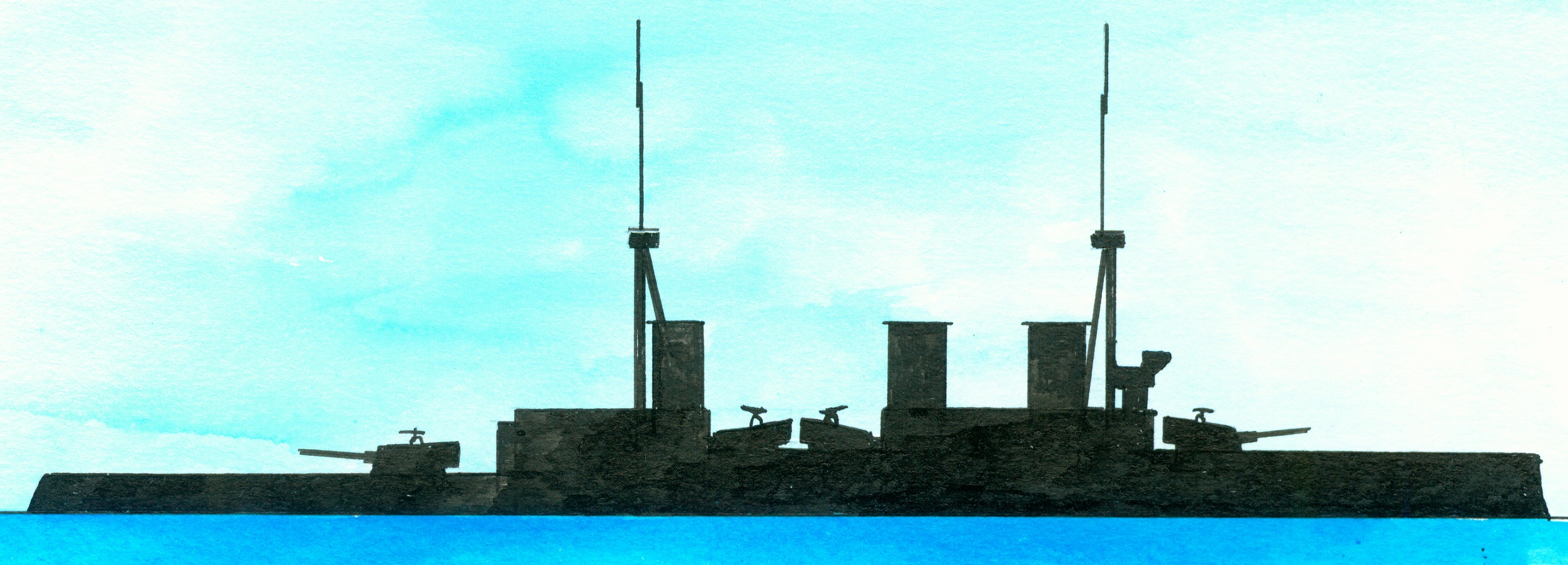
Of the Invincible-class consisting of the Invincible, Indomitable and Inflexible. Laid down at the shipyard of Armstrong, Whitworth&Co. Ltd, Tyneside, Elswick, England on 2 April 1906, launched at 3 p.m. by Lady Allendale on 13 April 1907, officially completed on 16 March 1909, commissioned on 20 March 1909 and sunk on 31 May 1916 during the Battle of Jutland when a magazine exploded after the Q turret was hit. Building costs 1.725.739 (with guns)-1.768.995 (without guns) pound sterling.
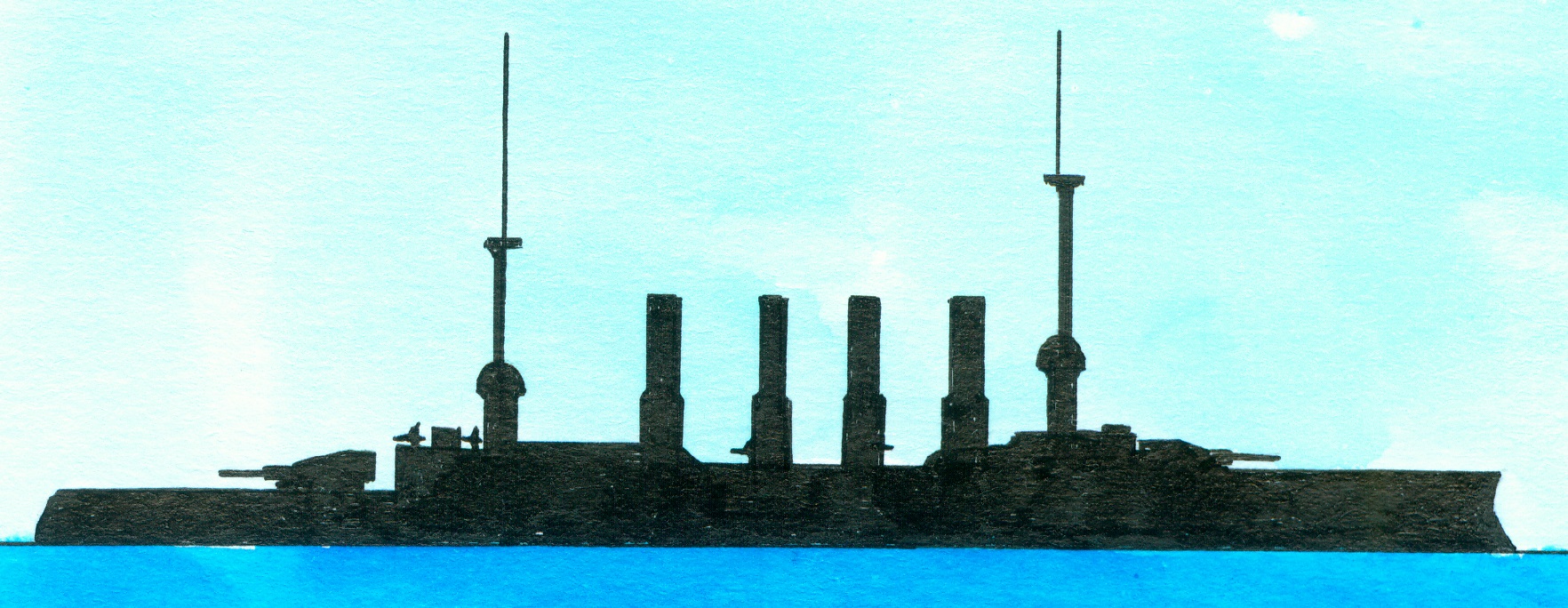
German Gneisenau-class armoured cruisers
Of the Invincible-class consisting of the Invincible, Indomitable and Inflexible. Preceded by the Minotaur-class armoured cruisers and succeeded by the Indefatigable-class. The concept for the Invincible-class battle cruisers came from the British admiral Sir John Fisher.(1) The idea was to design a ship fast enough to escape from stronger opponents like battleships and strong enough to destroy nearly all other ships while the battle cruisers were as heavily armed as most of the battleships of their time. This became clear while the Invincible and Flexible were mainly responsible for destroying the German armoured cruisers SMS Scharnhorst (2) and Gneisenau (3) in the Battle of the Falkland Islands (4) but against enemy battleships coming in problems like the Invincible lost in the Battle of Jutland.(5) Classified as armoured cruisers until an Admiralty order dated 24 November 1911 otherwise decided.
General technical specifications of this class. A displacement of 17.530 tons/17.250 long tons (loaded)-20.750 tons20.420 long tons (deep loaded) and as dimensions 172,8 (over all) x 23,9 x 9,1 (deep loaded) metres or 567 x 78.5 x 30 feet. The two paired sets of Parsons direct-drive steam turbines and 31 Yarrow water tube boilers supplied via 4 shafts 41.000 shp (design) allowing a speed of 25 (design)-26 (trials) knots and with a speed of 10 knots and maximum coal bunker capacity of 3.050 tons/3.000 long tons and 737 tons/725 long tons fuel-oil a range of 3.090 nautical miles. The crew numbered 784 men. The armour consisted of a 10,2-15,2cm-4-6” thick belt, 3,8-6,4cm/1.5-2,5” thick decks, 6,4cm/2.5” thick torpedo bulkheads with the gun turrets, barbettes and conning tower protected by respectively 17,8cm/7”, 17,8cm/7” and 15,2-25,4cm/6-10”. The armament consisted of 4x2-30,5cm/12” Mk X breech loading guns. 16x1-10,2cm/4” quick firing Mk III guns, 7 Maxim guns and 5z1-45cm/18” submerged torpedo tubes. The Inflexible and Indomitable were around 1918 also fitted out with a Sopwith Pup and a Sopwith 1½ Strutter. Their flying-off platforms fitted out with a canvas hangar were situated on top of the P and Q turrets.
Notes
1. John Arbuthnot (Jacky or Jackie) Fisher, 1st Baron Fisher (25 January 1841 Ramboda, Ceylon-10 July 1920)St. James‘s Square, London, England, an British admiral of the Fleet well known for his reform of the Royal British Navy. First Sea Lord in 1904.
2. Laid down at the shipyard of Blohm&Voss, Hamburg, Germany with yard number 175 on 3 January 1905, launched on 22 June 1906, commissioned on 24 October 1907 and sunk in a battle with the British fleet during the so-called Battle of the Falkland Islands on 8 December 1914. Of the Schanhorst-class consisting of the Scharnhorst and the Gneisenau. Preceded by the Roon-class and succeeded by the SMS Blücher. General technical specifications of this class. Displacement 11.616 tons/11.433 long tons12.804 short tons (standard)-12.985 tons/12.780 long tons/14.314 short tons (full load) with as dimensions 143.8 (waterline) 144,6 (overall) x 21,6 x 8,37 metres or 472-474.5 x 70.10 x 26.6 feet. The 3 shaft triple expansion engines and 18 water-tube boilers supplied 26.000 ihp (design) allowing a speed of 22,7 knots; during the trials 28.782 ihp and a speed of 23m5 knots. Coal bunker capacity 800 tons/880 short tons (standard)-2.000 tons/2.200 short tons (maximum). Range with a cruising speed of 12 knots was 4.800 nautical miles. Their crew numbered 840 men (included 52 officers). The armour consisted of a 15cm/5.9” thick belt, a 3,5-6cm/1.4-2.4” thick deck and with the gun turrets protected by 18c,/7.1” thick armour. The armament consisted of 2x4&4x1-21cm/8.3” L/40 quick firing guns, 6x1-15cm/5.9” L/40 quick firing guns, 18x1-8,8cm/3.5” guns and 4-45cm/18” submerged torpedo tubes (1x bow, 2 sides, 1 stern).
3. Laid down at the shipyard of AG Weser, Bremen, Germany with yard number 144 on 28 December 1904, launched on 14 June 1906, building costs more as 19 million goldmarks, commissioned on 6 March 1908 and sunk in a battle with the British fleet during the so-called Battle of the Falkland Islands on 8 December 1914.
4. On 8 December 1914.
5. Or Battle of Skagerrak 31 May-1 June 1916.

