
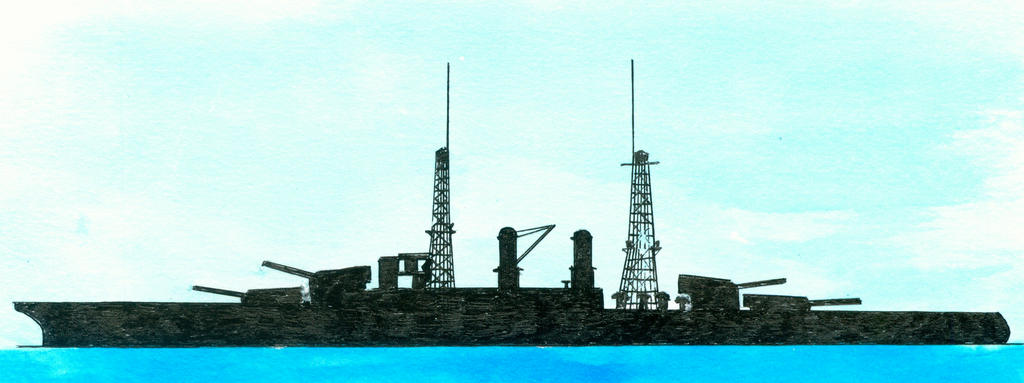
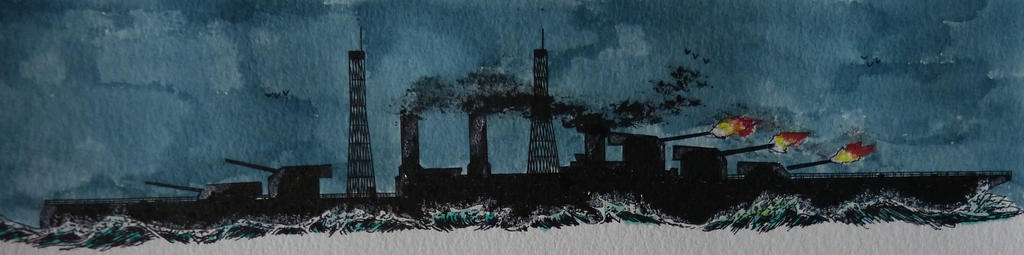

Proposal for the Colorado-class preceded by Tennessee-class succeeded by planned South Dakota-class and realized North Carolina-class. To be financed under the Fiscal Year 1917. Modified Tennessee-design, not approved and realized.
Dimensions 668 (waterline) x 97.5 (waterline) x 30.2½ feet and a displacement of 37,500 tons. Range 10,000 miles/10 knots. Horsepower at 21 knots=around 19,1-- tons with electric propulsion and 8 boiler rooms. Armament 5x2-40.6cm/16”45 cal guns, 4-21” submerged torpedo tubes, 22-12.7cm/5” 51 cal guns and 4 high powerand 4 light anti aircraft guns. Armour consisted of a main side belt with an extreme width of 17.0 feet, depth below water line 8.8½ feet and a thickness of 13.5-13.5-8 inch, barbettes with a thickness of 13” (heavy part)-4.5” (light part), turrets with a thickness of 16” (port), 10-9” (sides), 5” (top ) and 9” (rear), conning tower with a thickness of 9-16”(top), fire control tower with a thickness of 6”(light part)-16”(heavy part), uptake protection thickness 9-13.5”, total thickness of protective deck 140# and splinter deck 60#.
Weight summary normal condition:
Hull complete and hull fittings 18,339 tons
Protection 10,391 tons
Steam engineering 2,050 tons
Reserve feed 2/3 supply 207 tons
Battery 1,881 tons
Ammunition and 2/3 ordnance stores 1,536 tons
Equipment and 2/3 equipment stores 550 tons
Outfit and 2/3 stores 685 tons
Oil fuel, 2/3 full supply 1,750 tons
Margin 111 tons
Normal displacement 37,500 tons
Source
Naval History and Heritage Command US Navy Spring Styles Book No. 1 (1911-1925) S-584-099


No comments:
Post a Comment